Reading
The Chief End of Marriage
October 6, 2014
Try 3 months of unlimited access. Start your FREE TRIAL today. Cancel anytime.
START FREE TRIAL NOW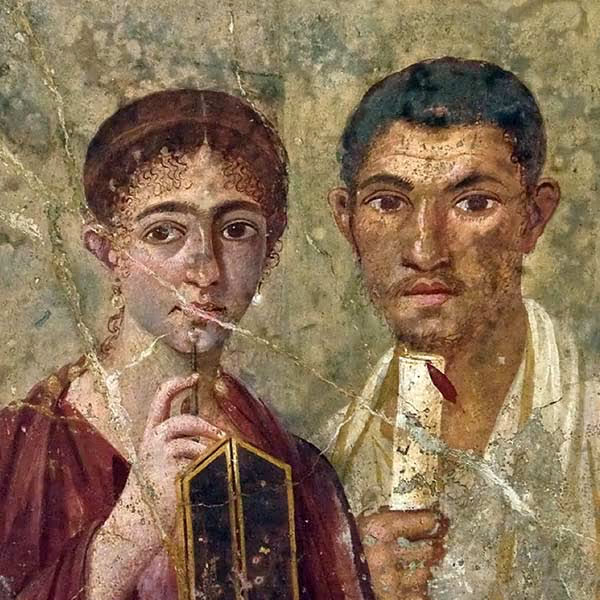
[.article__paragraph--leading]The Stoic philosopher Gaius Musonius Rufus (ca. ad 100) lived in Rome as a contemporary of Nero, who banished him from the city because of his teaching. His lecture “On the Chief End of Marriage” is a remarkable statement by a thinker who stands outside the Judeo-Christian tradition. [.article__paragraph--leading]
Husband and wife should come together for the purpose of making a life in common and of bearing children, and furthermore of regarding all things in common between them, and nothing peculiar or private to one or the other, not even their own bodies. The birth of a human being which results from such a union is to be sure something marvelous, but it is not yet enough for the relation of husband and wife, inasmuch as quite apart from marriage it could result from other sexual unions, just as in the case of animals.
But in marriage there must be above all perfect companionship and mutual love of husband and wife, both in health and in sickness and under all conditions, since it was with desire for this as well as for having children that both entered upon marriage. Where, then, this love for each other is perfect and the two share it completely, each striving to outdo the other in devotion, the marriage is ideal and worthy of envy, for such a union is beautiful.
[.smalltext]From Lecture xiiia, in Musonius Rufus, vol. 10 of Yale Classical Studies, ed. Cora E. Lutz (Yale University Press, 1947).[.smalltext]