Fiction
Stroll
War marks everybody with unique stamps; it doesn’t let anyone slip by.
August 6, 2026
Try 3 months of unlimited access. Start your FREE TRIAL today. Cancel anytime.
START FREE TRIAL NOWStroll
War marks everybody with unique stamps; it doesn’t let anyone slip by.
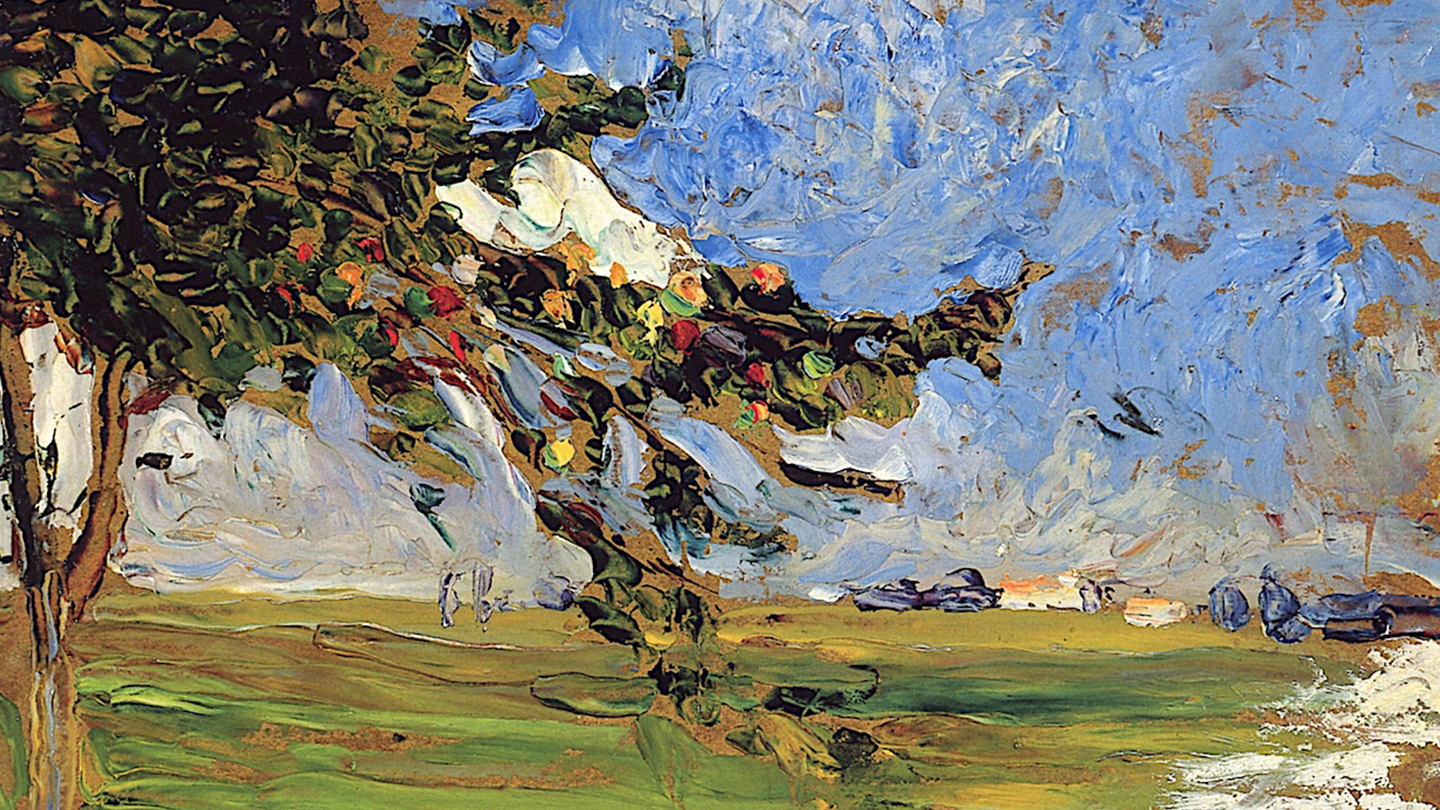
Wassily Kandinsky, Landscape with Apple Tree, 1906. [.smalltext]Wikimedia Commons (public domain).[.smalltext]
[.smalltext]A short story from To Go On Living, by Narine Abgaryan, translated by Margarit Ordukhanyan and Zara Torlone.[.smalltext]
[.article__paragraph--cap][.small-caps]Azizants Agapi[.small-caps] always went on her strolls toward evening. She walked down the sloping street paved with small pebbles until it ended, and then she turned right, toward the spring. She did not stop there – she would drink her fill on the way back.[.article__paragraph--cap]
She passed by the small shops and workshops, pausing by each one. The greengrocer was awkwardly sorting through the very perishable cilantro and watercress; the grocer was pouring raisins and nuts into paper bags. The tailor’s sewing machine was chattering, and the smell of a hot iron wafted through the air. In the shoe repair shop, an old woman in a dark headdress sat, bashfully hiding her foot clad in a plain stocking while the cobbler repaired her boots.
Nobody remained indifferent to Agapi’s visit.
“Hello, Agapi-jan,” the greengrocer greeted her.
“May Jesus Christ be your protector, Agapi-jan,” said the grocer.
“How are you feeling, Agapi-jan?” inquired the tailor.
“All will be well, Agapi-jan,” chimed in the cobbler.
The old lady shook her head and sighed. Agapi smiled and continued her journey. Past the stone houses, past the uneven fences, past the yapping yard dogs, past the empty autumnal orchards: once the quince and frost-kissed persimmon were gathered, the trees would slumber till spring.
Her journey ended at the stone bridge. She leaned against the old railing, listening to the voice of the river. These days it’s hoarse and faint, its words incomprehensible. On the left there is an old cemetery, on the right, a narrow path leading up to the bald summit of Khali-Kar. When she was a little girl, she used to climb up there every day. “Agaaapi,” her mother would call, “be careful, don’t go near the cliff.”
“I won’t,” Agapi would promise, and then she would stand right at the edge, taking in the voice of the river. It was strong and clear back then, its every word like an entire song.
“It doesn’t behoove a girl to run away from home,” her mother would scold her.
Agapi would promise that she would never again run away, but run away she did. She had the face of an angel: big translucent eyes, fluffy eyelashes, thick wavy hair.
“She will grow up to be a beauty,” said the neighbors.
“What matters most is that she grows up happy,” her mother would counter.
Agapi knew everything a seven-year-old girl should know about happiness: loving parents, delicious food, a warm bed. A younger brother and sister, a dog named Vilka. The only thing she didn’t know was why unripe apples tasted so much better than ripe ones. And why the adults forbade her to eat the apples while they were still sour, forcing her to wait until they ripened to boring sweetness. She did not like to wait, which is why she would pick the apples off the trees and climb all the way to the summit of Khali-Kar, to listen to the river.
Her family was one of those circumvented by the war: no home destroyed, no men killed in action, no women kidnapped or vanished. They held on to each other, helped their neighbors, visited the chapel: her mother would light candles and thank God. “Astvats-jan, don’t consider it too much that we’re luckier than many others.” While she prayed, Agapi and her younger sister, standing on their tiptoes, studied the icon of the Holy Mother.
“Why is she so sad?” her sister would whisper.
“Maybe someone’s upset her,” Agapi would respond.
Their mother would shush them and continued with her thanksgiving, “Astvats-jan, Astvats-jan.”
Agapi would raise her eyes to the chapel’s window, from which a narrow beam of light fell on the uneven floor. On sunny days weightless dust particles swarmed in it; on rainy days doleful shadows floated.
The war started when she was eight and calmed down when she was thirteen. The relatives were cautiously happy: it has spared us, it has spared us. Within a year, both of her aunts died from a serious blood disorder. Her mother followed, for the same reason. And one day Agapi crossed over the threshold of reality to the other side, never to return. Her younger brother and sister remained, and the decrepit dog Vilka, and her father turned grey and old overnight. Nobody talked about the war in Agapi’s family, perhaps because they knew everything about it. That it has tendency to start but never ends. That it destroys houses and takes away the men, and then, when it calms down, it inflicts incurable diseases upon the women. After having its way with the adults, it takes the young people who can’t handle their fears and pushes them over the edge of sanity. The war marks everybody with unique stamps; it doesn’t let anyone slip by.
Azizants Agapi returns from her stroll late in the evening. Passing from one streetlamp to the next, she freezes for a second in the circle of light. On moonlit nights weightless dust particles swarm there, on foggy nights doleful shadows float.
She remembers nothing and recognizes nobody. The whole meaning of her existence boils down to these everyday strolls: down the sloping street, past the shops and workshops, toward the old bridge. Standing, as she leans against the railings, and listening to the river. Drinking from the spring on the way back. And waiting for the spring, when sour unripe apples will appear once again. Agapi has finally learned why they are more delicious than the ripe ones, but she has no way to explain it to others.