The Doers
Singing Prayers of Courage
As a radio DJ in Zimbabwe, I learned the power of song to unite people in prayer, and hold to hope in troubled times.
March 1, 2022
Try 3 months of unlimited access. Start your FREE TRIAL today. Cancel anytime.
START FREE TRIAL NOW
[.article__paragraph--cap] [.small-caps] My country is a country of music. [.small-caps] In Zimbabwe, we have songs for every occasion, celebrating, mourning, fighting. But when we need it most, music is a prayer from people who need God, who sing our way back to him because he is always there, no matter how hard it is to see our way forward. The songs go up to him and his strength comes down to us.[.article__paragraph--cap]
In the very hard years of the 1990s and 2000s, I really came to know what these songs of God can mean to oppressed people: it was not safe to speak up, food was hard to come by, and money was not worth the paper it was printed on.
As a radio DJ for Zimbabwe Broadcasting Corporation, I would play gospel music and pray for all those listening in the villages or struggling to keep their households together in the cities. On national radio, you’re not allowed to say anything inflammatory or anti-government. So I thought of ways to let the Bible speak. “Do unto others as you would have done to you.” “Give justice to the weak and the fatherless.”
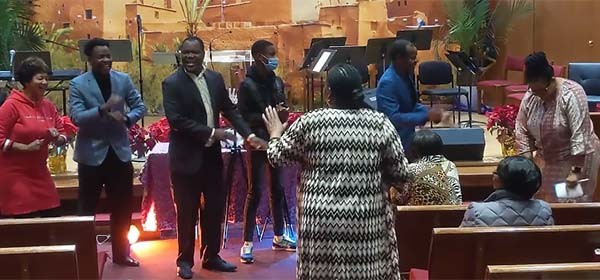
[.imgcaption] Worshipers at Zimbabwe Interdenominational Church [.imgcaption]
One day during a very bad time, I just blurted out, “If you are feeling like you cannot go on another day, and you are thinking about ending your life, do not do it. Hold on for one more day. God is there. He knows about you.”
I had wondered how many people were listening – I found out! I never got so many letters and calls in my life. They spoke about the songs, and the message of forgiveness I had shared on the three-hour broadcast.
Now my wife and I live in Harlem. We are officers in the Salvation Army, and I co-pastor a small but growing congregation – the Zimbabwe Interdenominational Church.
If you come to our services you will see that song still leads the way to prayer. When a member wants to testify, she begins to hum, then sing. The drum joins in; so does everyone else. Then we hear about a son whose cancer has come back, or a daughter who has lost touch. Or we could be rejoicing; green cards have come through – a family is reunited here in New York City. The song that is chosen tells us first.
My fellow church member Manfred Mukumba likes to say about our songs: “Shona is a strong language. When we sing Hakuna Wakaita sa Jesu , it is not enough to translate it as, ‘There is no one like Jesus’. It means, ‘I have searched everywhere. There is no comparison. Everything else may change, but he will not.’”