Interview
Saved at Sea
A rescued Vietnamese boat person has devoted her life to serving new waves of migrants.
September 30, 2026
Try 3 months of unlimited access. Start your FREE TRIAL today. Cancel anytime.
START FREE TRIAL NOWSaved at Sea
A rescued Vietnamese boat person has devoted her life to serving new waves of migrants.
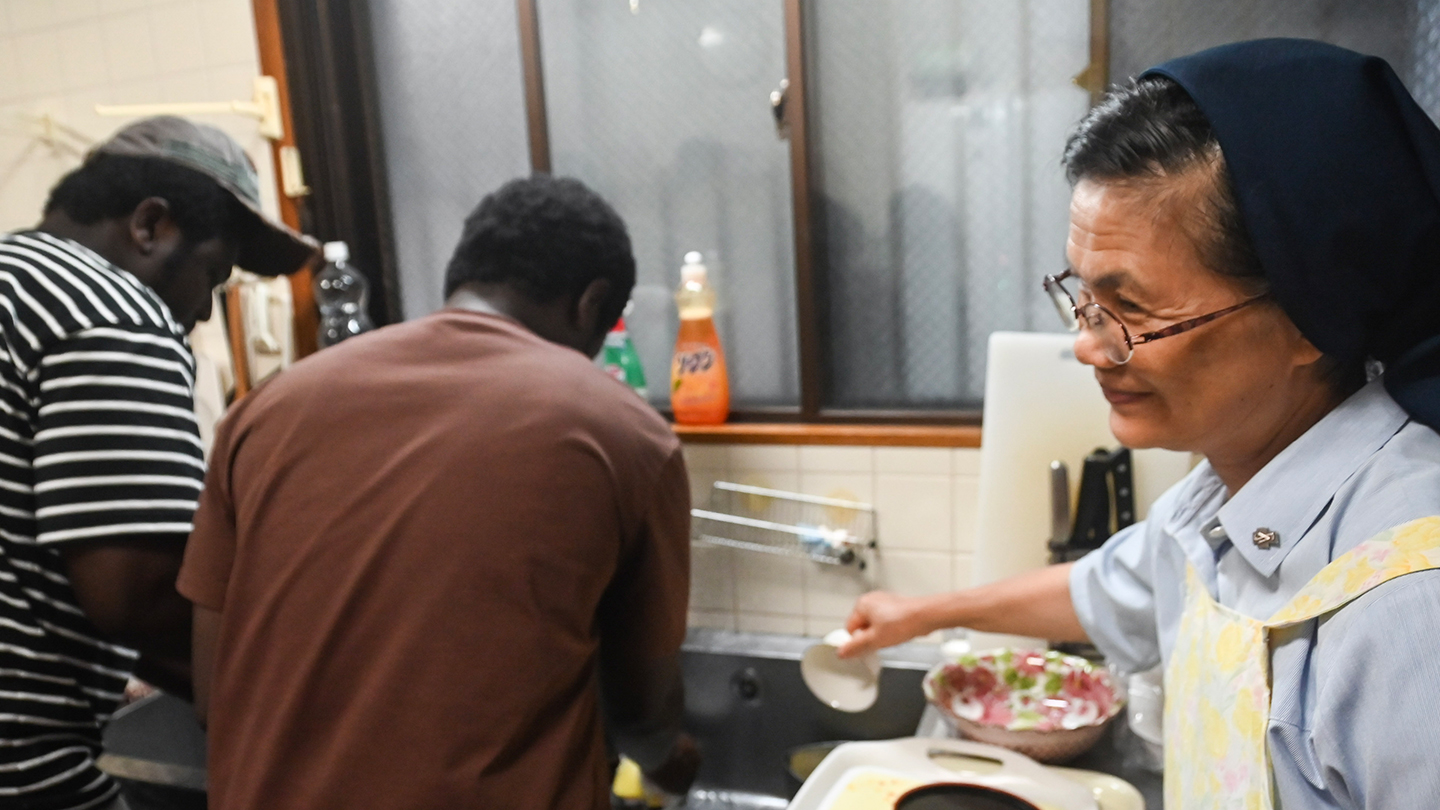
At the shelter dish sink. [.smalltext]All photographs courtesy of Tomohiro Oshima.[.smalltext]
[.smalltext]As told to Tomohiro Oshima. Photographs by Tomohiro Oshima.[.smalltext]
[.article__paragraph--cap][.small-caps]I was born[.small-caps] in 1963 in Da Lat, a town in the south of Vietnam, during the Vietnam War. My father simply loved his country and its people.[.article__paragraph--cap]
In 1968, around the Lunar New Year, the Communist army entered our town and fought the southern forces. I was only five or six, but I still remember the sound of the planes and the sound of the bombing. When the sirens sounded, everyone fled to the underground shelters – each family to a hole they had dug themselves. It was the New Year, so fortunately we had lots of food prepared.
The war ended in 1975, when I was twelve. My brother had been an aircraft mechanic, but he fell into despair after the war. He could neither continue his studies nor find work, and died of illness at a young age.
In my first year of university, my sister and I tried to escape together and hid in the southern countryside for about two months, but the attempt ultimately failed. I was made to leave school, and I despaired of my future. At my lowest, I entered a church near our home, and my heart grew calm; the despair slowly left me. After that I went to church for seven years. I wanted to be baptized, but my mother was firmly against it – we were Buddhist. So she set two conditions: I could be baptized if I married a Catholic or if I left Vietnam and lived abroad.
Because one of my sisters had married an American and gone to the United States, we were regarded with more suspicion. Even with a university degree, I was not allowed to work. It was a time when Catholics and people of Chinese descent were harshly discriminated against. My sister tried to bring the whole family over to America, but my father said he did not want to go. America abandoned us partway during the war, he said. So we did not go to America either. In the end, another sister and I decided to flee by boat. We paid two thousand dollars to go.
[.article__paragraph--cap][.small-caps]At Nha Trang,[.small-caps] 110 people boarded a small boat. We were all packed into the boat like tinned fish, seated, unable to move for five days. On the voyage, a typhoon came. The wind and rain were fierce, and there was no food. We could not move, and everyone grew weaker and weaker.[.article__paragraph--cap]
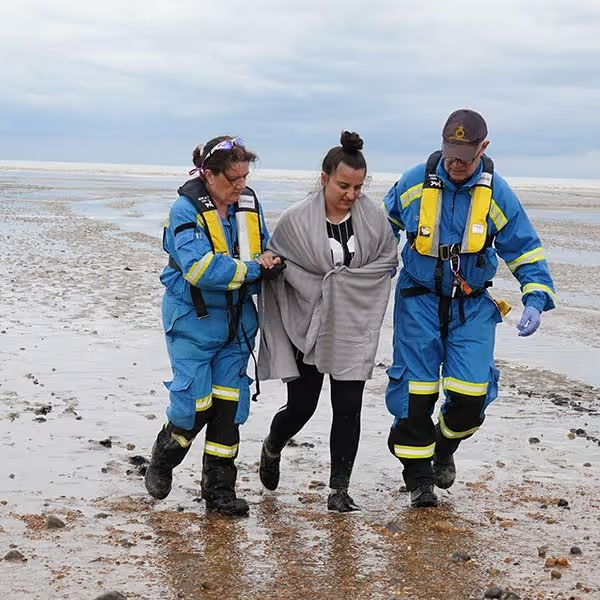
That was when I prayed harder than I ever had in my life. I had just finished university, and I had knowledge and money, yet none of it meant anything. My own power could not save a single life. “Please help us,” I prayed. And as I kept praying, before my eyes there appeared a small black dot the size of a pencil tip. It grew larger and came closer and began to take the shape of a ship. It was a Japanese cargo ship. On board our boat, a father holding his newborn baby stood near the front, crying out for help, lifting the wailing child high toward the cargo ship, and it was his voice that made them notice us. They would not have been able to see the SOS letters from their ship. Our little boat, seen from the great ship, must have seemed like a toy boat. The captain was a devout Catholic. They brought us up a rope ladder one by one. I had been sitting for five days, and after climbing up I could hardly move.
For three days we had only rice porridge. There was no way to feed 110 people, but the crew shared their own water and porridge with us, little as it was. Truly, they were fine people.
We reached Manila in the Philippines, the closest land. As we walked from the port to the refugee center, barefoot and in rags, the Filipino people who saw us handed out bread, sweets, and slippers. I wept. And I thought, if ever I have the chance, I will repay this kindness. I was baptized as a Catholic in the refugee camp in the Philippines.
And here is a strange story. That ship that rescued us, the Madonna, while on a voyage some years later from Tokyo toward Singapore, sprang a leak in its hull and began to sink. It couldn’t be repaired. But by good fortune a Korean ship was near, and its crew saved everyone – the captain and all the crew. The Madonna is now at the bottom of the sea. All its cargo sank with it. The Filipino captain felt it deeply. “Because we saved you,” he said, “this time we ourselves were saved.” If that Korean ship had not been there, they would all have gone down. And if the Japanese ship had not found us, we too would have sunk. Our group of boat people that was saved has gathered many times now, reuniting with the Filipino captain and his family. We are deeply grateful to him.
[.article__paragraph--cap][.small-caps]Ten months later,[.small-caps] I came to Japan. I was meaning to go to my sister in America, but I chose not to. I found I was happy caring for Vietnamese boat people at a place in Gunma called Akatsuki no Mura. My visa for America had already come through, but I gave it up. A little while later, I entered the Sisters of Charity.[.article__paragraph--cap]
The Vietnamese migrants bring their troubles of every kind to me. The technical trainees differ in language and custom from the Japanese, and when they do not understand, they are treated roughly. Some become injured and are sent back to Vietnam with no care at all, against their will. About eight years ago, when I was at a church in Kawaguchi, there were many instances of unexpected pregnancies. In one month, ten women came to me. For about seven of the ten, the baby’s father refused to acknowledge the child. So the young women were afraid, and those who wanted to stay would take cheap Chinese pills they’d find for sale somewhere online. Sometimes it worked. But sometimes it failed, and then their lives were in danger. There were times I was called, and I had to send them straight to the hospital by ambulance. Such cases were not just in Kawaguchi but all over the country.
In 2011, I arrived in Saitama, just at the time of the great earthquake and tsunami that caused the Fukushima nuclear disaster. Sister Taniguchi in Saitama sent us to the disaster area. A week after the quake, I went into Iwaki, in Fukushima Prefecture. Everyone was in such hardship that I spent a week there. I called on my Vietnamese friends, and we began cooking meals.
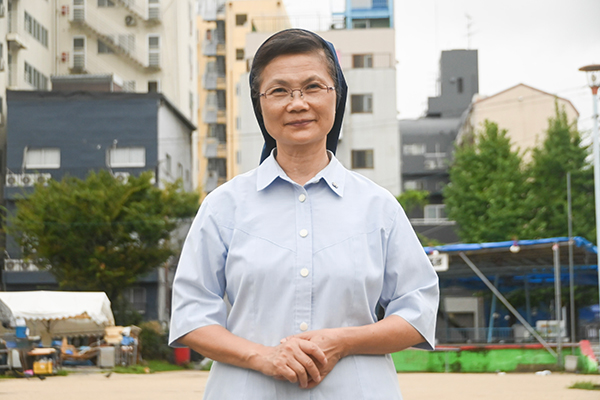
We would make Vietnamese food, sell it here and there to raise money, and use that money for the meals; meals for a thousand people at a time, or three hundred, four hundred. With Ishinomaki as our base, I went back more than ten times. Even after things settled, I went at least once a year. I kept it up until the pandemic made it impossible to go anymore.
Two years ago I came to Kamagasaki. When I first came here, there was an old chapel with a cross, and I prayed there: “Lord, all around are people suffering, people who are hungry. I want to do something. But I have nothing now – only my hands and my strength. Please help me.”
Strangely, a week later, an acquaintance in Kawaguchi sent me one hundred thousand yen. “Use it for the people in need,” he said. With that, for the first time, I made more than a hundred boxed meals at the Furusato no Ie (community center) next door. Afterward, as I always do, I posted words of thanks and photographs of the food on Facebook, and friends everywhere began sending money. First enough for 150 meals, then enough for 300 at Sankaku Park. Last month we reached 530.
Together with the sisters and with the young Vietnamese, we make thirty-five to fifty boxed meals at least once a month for people sleeping rough. When there is money, every two or three months we hold a large meal at Sankaku Park.
I try to be at the center of the need, because my one wish is to share, even a little, with those in need. When I was sinking, others reached out to me; a Japanese ship saved me. So now I want to repay the Japanese in turn – the earthquake survivors, the people sleeping rough – little by little. That I can do this at all makes me glad.