Personal History
Removal
Sunday, I heard that we are all the body of Christ. Monday, I bid on a contract to build an immigrant detention center in the Texas desert.
June 29, 2026
Try 3 months of unlimited access. Start your FREE TRIAL today. Cancel anytime.
START FREE TRIAL NOWRemoval
Sunday, I heard that we are all the body of Christ. Monday, I bid on a contract to build an immigrant detention center in the Texas desert.
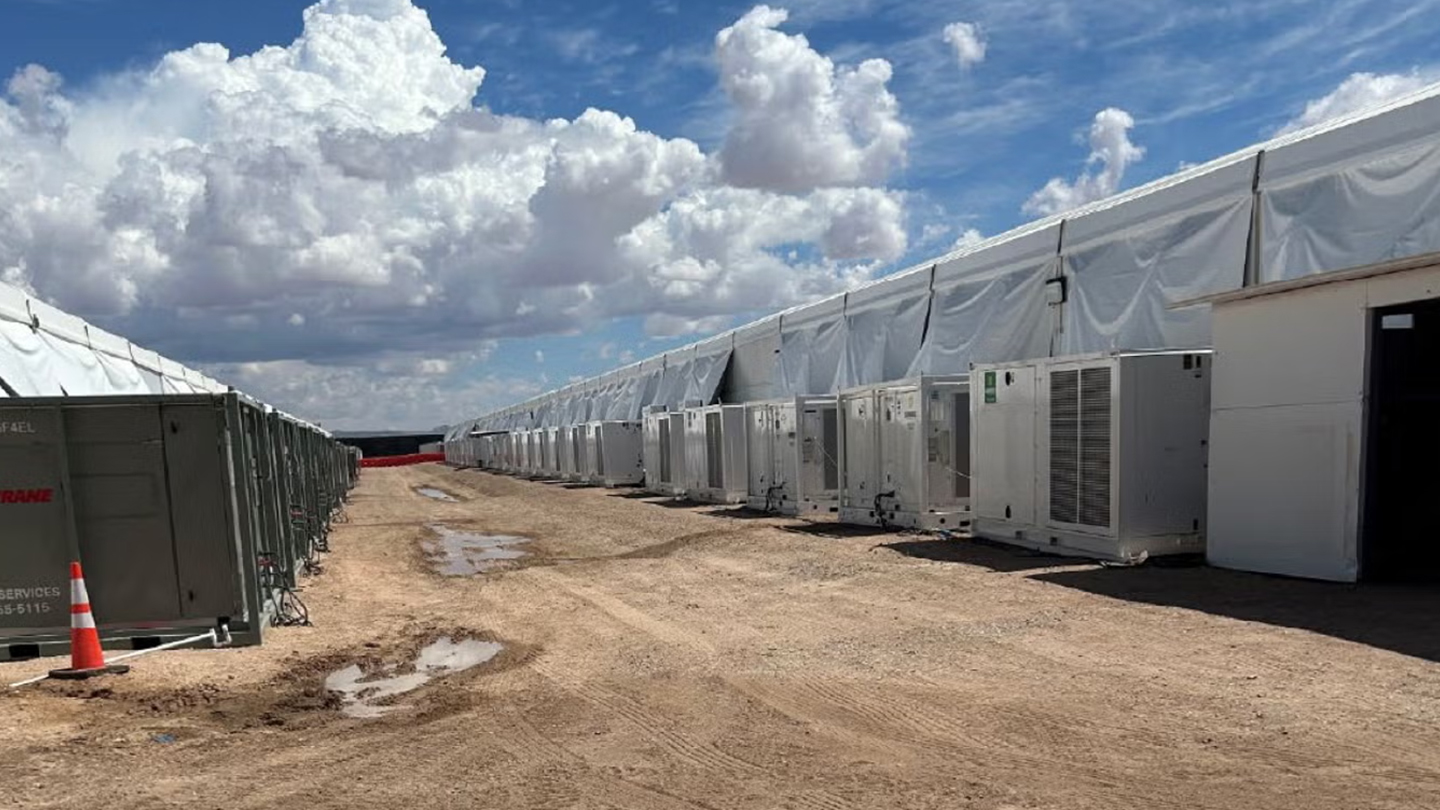
Camp East Montana, El Paso, Texas. [.smalltext]Credit: US Government Accountability Office[.smalltext]
[.article__paragraph--cap][.small-caps]On Sundays my family[.small-caps] and I stand in the same pew, number 40, which sits in the cast of sunshine from a particular arching set of windows. I arrive in a posture to bow down before, praise, and glorify my God. I say something like that the moment my knees hit the pad, a quiet, familiar sentence offered before anything else begins.[.article__paragraph--cap]
For years I have carried that promise through the Mass – particularly through the consecration and Eucharist – treating the hour as a kind of examination as much as an offering. I used to leave with the sense that I had, however imperfectly, kept faith with what I’d whispered at the kneeler, and that the coming week would be one more chance to let that interior vow take visible form: in how I spoke to strangers, how I handled interruptions, how I met need when it presented itself without warning. There was a certain steadiness in that rhythm, a feeling that my life, however crowded, aligned at least once a week with something unambiguous.
Lately, that hasn’t been happening.
While the choir sings about unity and mercy, part of my mind is still in a conference room. A phrase from the Gloria will catch against a line of boilerplate in a contract; “Lamb of God” drifts across the same mental space as a DHS form number. While the priest speaks about the dignity of every human person, my thoughts slide toward performance requirements, headcounts, “compliance environments.” Somewhere between the Creed and the Our Father, the week ahead rises up in front of me, and I remember that the company I help lead is working very hard to secure work that depends on detention, fear, and the human consequences of policy.
And then the Communion line forms.
There is nothing abstract about that moment. I step out of the pew and join the line with everyone else, all of us moving forward together, as if this were the simplest thing in the world. My hands are open. My conscience is not.
[.article__paragraph--cap][.small-caps]The room where[.small-caps] these conversations happen looks like any other: a polished conference table, government timelines projected on a screen, white mugs lined up beside legal pads as if the neatness itself could bless the work. The language is precise and sanitized because it has to be. But we are not discussing an abstraction. We are reviewing proposals tied to the detention and incarceration of thousands of human beings – men, women, children, entire families – concentrated in a single site, with two dozen more sites just like it envisioned across the country. But that is not the vocabulary of the meeting.[.article__paragraph--cap]
We don’t talk about children.
We talk about juvenile housing categories: accompanied and unaccompanied, tender age and teenage. We talk about meals being “ethnic enough.”
We don’t talk about confinement.
We talk about capacity expansion, bed-space availability and removals – words whose surfaces are strangely smooth, as if nothing sharp could live inside them.
We don’t talk about fear.
We talk about compliance and standards of care under DHS and ICE requirements, as though the careful ordering of policy could stabilize whatever lies behind the fences.
The documents are technical and orderly: contracts, performance work statements, schedules, service delivery requirements. There are performance metrics for everything: food, sanitation, medical response times, “movement control.” There are charts for throughput, escalation, incident response. There are places in the documents where human lives quietly become unit costs, and no one announces that it has happened.
My role in the room is to ensure we understand risk, interpret regulation, protect the company, and position us to perform. I know how to be calm. I know how to make complicated realities sound manageable. I am paid to be accurate – not optimistic, not pessimistic, but precise.
It was ironic, then, that the actual work had come about as a gamble.
My company, which provides emergency shelter for disaster relief, had begun pursuing these types of contracts in late 2023, anticipating the change in administrations and betting on the outcome. My earliest resistance had nothing to do with policy – it was the method. We were working through a pay-to-play consultant, an operative employed to affect the odds. These kinds of arrangements had always struck me as unseemly, the sort of thing I’d spent a career advising clients to avoid. I told myself that this ethical discomfort explained everything that followed emotionally. It was easier that way.
By mid-2025, the federal government had issued its first solicitation for a mass-incarceration facility. The request for procurement (“RFP”) arrived on Father’s Day. I remember the date because I was with my sons when I read it, and the incongruity felt less like coincidence than accusation. The scope staggered me – the scale of what was being asked, the clinical detail in which human processing was described. It is said that the devil is in the details. This was no exception.
We submitted a bid for the work, over my objections. I was personally responsible for writing the technical proposal and pricing the tender. I did it. Soldiering on, as we say – a phrase I knew from the Army, where it had meant something different, or at least I told myself it had. The work was morally conflicting in a way that I could feel in my body: a tightness in my chest during drafting sessions, a reluctance to open certain files, a low hum of dread I could not name and did not try to.
Two weeks into proposal preparation, at the end of June, we finished a review meeting. A colleague I trust – someone I have worked beside for years – pulled me aside. “Is everything OK?” One of those freighted questions that picks a scab wide open.
While I resisted the urge to unload all of this thrumming anxiety at once, the question had ripped off the scab, and demanded an answer. I told him, in confidence, that I was suffering a crisis of conscience. I asked him how he felt about placing human beings in hot tents in Southwest Texas. About locking them inside plexan and steel “pods,” like cages in any garden-variety zoo.
He shrugged. “Money is money.”
He did not mean to wound me. He was answering honestly, in the language we use when we have made our peace with something. But the words salted what was already raw, and I carried them home that night like stones in my shoes.
[.article__paragraph--cap][.small-caps]We were not awarded[.small-caps] the contract. It went to the lowest bidder – a company that had never worked with migrants, had no experience in detention, and employed three people. Three. I remember reading the award notice and feeling something I could not immediately name: relief and horror, braided together. Relief that it was not us. Horror at what “not us” would mean for the people inside those fences.[.article__paragraph--cap]
What followed arrived in headlines and incident reports. Two days into construction, a subcontractor was crushed and died. Four OSHA stop-work orders followed. The government pushed forward anyway. The facility opened – shoddy, late, unprepared. Within thirty days, the first detainee died from inadequate medical attention.
I prayed for that man. I did not know his name; I do not know it still. But I prayed for him the way you pray when language fails and all that remains is the hope that God hears what you cannot say. And somewhere in that prayer – in the silence after the asking – I felt how badly I was suffering. The search for compartmentalization, the euphemisms, the national security rationalizations I had learned as an Army officer, the conscience-management techniques we lawyers excel at – all of it was turned up to eleven, and none of it was working. The noise was coming through.
But sometimes, mid-sentence, I feel the buffer the language provides begin to thin. A number refuses to behave like a number. “Beds” becomes bodies. “Facilities” becomes confinement. “Affordable menus” becomes something more like rationing and deprivation. And I am left with the uneasy sense that the clarity and confidence I bring here may be helping construct something my faith is already trying to trouble from within.
[.article__paragraph--cap][.small-caps]At home, the tension[.small-caps] takes on a different shape. Three of my four boys will soon be in college at the same time. The language here isn’t DHS or procurement terminology; it’s tuition statements, financial aid forms, housing deposits, the careful arithmetic of a family budget stretched across years, and thinly so. Numbers appear first as emails and envelopes and then as a kind of low-pressure system over the dining room table: balances due, minimum payments, suggested loan packages. Half of my compensation comes from work won and performed. The columns in the spreadsheet do not let me forget that.[.article__paragraph--cap]
I love what my sons are becoming, each in his own way. I want to give them room to grow, to believe they can step into the world without scarcity always at their heels. That desire is real. It has a price tag, but it also has a face – four of them, in fact, moving through the house in various stages of becoming men.
We have raised them to believe certain things about dignity and justice. They care about what happens when institutions decide some lives are negotiable. They pay attention when cruelty is dressed up as necessity. They know enough of my professional life to understand that I work in complicated spaces, but every so often one of them asks a simple question that lands with unexpected weight:
“Dad, is your company really going to do that?”
Not accusatory. Just curious. Just honest. They don’t reach for the insulating vocabulary I use at work; they ask in the language ordinary people use when they mean someone might get hurt.
“Dad, you’ll recuse yourself before it gets to that, right?”
The words are offered almost casually, but they arrive like a kind of test I did not know I’d been assigned. “Recuse” is a word they learned from me, years ago, when I tried to explain integrity in legal work; hearing it now, turned back toward me, makes the room feel smaller. I hear myself answering in the careful language of adulthood – context, nuance, policy, responsibility. All of it true, none of it protective against the deeper question: What does it mean to tell your children that faith matters, that human beings matter, that conscience matters ... and then quietly benefit from a system built on detention and fear?
There are evenings when their trust feels heavier than any contract I’ve ever signed. They assume I will choose the right thing. They take it for granted that their father’s faith is not something he performs on Sundays but something that governs his life. And I find myself wondering what kind of lesson they will remember if the cost of obedience finally arrives and I decide it is more than I am willing to pay.
[.article__paragraph--cap][.small-caps]The moment when the reality[.small-caps] of the job we were pursuing could no longer hide in policy language and professional distance had come as I was reviewing a set of draft requirements for the technical proposal – nothing unusual, the kind of document I’ve handled hundreds of times. The cursor moved through familiar sections; my notes gathered in the margins in the same careful, neutral hand. It was late, I was tired, and I was trying to be methodical, letting the clauses line up and click into place.[.article__paragraph--cap]
One line item referred to “unaccompanied minors” and the associated protocols for “housing, movement, and care.” I paused, not because any of the words were new, but because, for once, they refused to stay in their category. The phrase that had always functioned as a label suddenly felt like an erasure. “Unaccompanied” no longer sounded like a status; it sounded like an ache. The words would not flatten back into terminology.
I thought of children.
Not the theoretical kind.
Not “units.”
Children.
I imagined the sound of crying in a place where crying doesn’t change anything. I pictured a child whose name is recorded in a database instead of spoken by a parent, a wristband or a file number standing in for a history. I envisioned my own children, stripped of name and identity, behind a fence, waiting for someone in a different room, speaking a different language, to decide what would happen to them next. The distance between the sentence on my screen and that imagined scene was suddenly very small.
I thought about how we train ourselves to use language that allows us to keep working, how the system depends on our capacity to keep everything technical: removals instead of expulsions, housing instead of holding, facilities instead of fences. “Removal” is a word we usually use for trash, for stains, for things that never should have been there in the first place. On the page in front of me it applied to people. And for a moment I could not do it. The buffer dissolved. The professional vocabulary didn’t hold.
I closed the document and sat there, aware that nothing had changed and yet something had. The work would continue with or without me. And I would be asked to keep offering clarity, competence, reassurance. But in that moment, the question stopped being whether these policies were politically complicated and became whether I could keep participating in something I could no longer pretend was neutral.
It was the first time I understood that my discomfort wasn’t a nuisance to manage. It was a summons.
[.article__paragraph--cap][.small-caps]And so I find myself[.small-caps] back in pew 40 again, sunlight angling across the same section of wood, my family beside me, my hands folded the same way they have always folded. The varnish on the pew is worn smooth where hands have rested for years; the kneeler thuds softly as people lower it in stages up and down the row. Nothing looks different. The priest still lifts the chalice and says the words I have heard since childhood. The choir still sings about mercy. The liturgy continues, steady and trustworthy in its rhythm, as if nothing in the world has shifted since last Sunday.[.article__paragraph--cap]
The difference now is internal. I can no longer stand here as if what happens in the rest of my life sits in a separate category. The language of the Mass has started to lean against the language of my week, and they do not fit together as they once did. Phrases I used to receive almost automatically – “for many,” “for all,” “Lord, I am not worthy” – seem to reach farther out now, into boardrooms and contracts and fenced-in spaces I have only ever seen on a screen. “The Body of Christ” brushes up against “unaccompanied minors” and “removals” in the same interior space, and the friction between them is hard to ignore. The words at the altar sound less like commentary and more like a question directed at me.
When the Communion line forms again, I feel it in my body – both the longing and the weight. My sons step out of the pew with me, one after another, joining the slow shuffle toward the front. I know what this sacrament says about belonging, about a body that is not allowed to be parceled or priced. I know what it means to hear “The Body of Christ” and to answer “Amen” after a week spent reading about beds and movement and removals. I hold out my hands, aware that grace is not permission. It is strength.
I do not yet know what obedience looks like. I do not know what this discernment will cost or what shape faithfulness will take, or whether it will mean stepping away from work that has formed so much of my life and from structures I have helped build. I only know that I cannot pretend the question isn’t real anymore. I am trying to stand here honestly before God, to let the Eucharist mean something in the places where it might hurt to let it do so.
For now, that is where I begin: not with certainty, but with conscience awakened, my hands open, and the quiet prayer that I will have the courage not to step away from the question – or from the people hidden inside the language of my work – wherever it leads.