Book Excerpt
Love Is Not Enough
If Christ had only preached love, he would never have ended up on the cross.
July 16, 2026
Try 3 months of unlimited access. Start your FREE TRIAL today. Cancel anytime.
START FREE TRIAL NOWLove Is Not Enough
If Christ had only preached love, he would never have ended up on the cross.

Heinrich Hofmann, Christ and the Young Rich Ruler, painting, 1889. [.smalltext]Wikimedia Commons (public domain).[.smalltext]
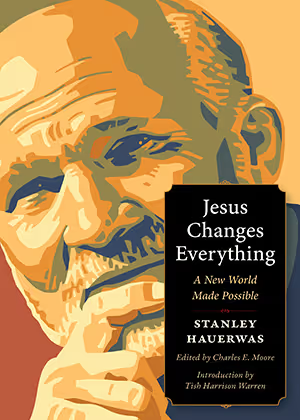
[.smalltext]From Jesus Changes Everything, this week’s featured book.[.smalltext]
We know love by this, that he laid down his life for us – and we ought to lay down our lives for the brothers and sisters.
1 John 3:16
[.article__paragraph--cap][.small-caps]Love has a prominent place[.small-caps] in Jesus’ teaching and preaching. But Jesus does not urge love as though it were an end in itself, as though it were intuitively obvious or could be embodied as a general principle or policy, for the love that he commands consists in loving others as God has loved us (1 John 4:9). The command to love cannot be separated from the one who commands and embodies it. “I give you a new commandment, that you love one another. Just as I have loved you, you also should love one another” (John 13:34). Jesus does not come to us as a preacher of love, but as the one by whom we might know the righteousness of God’s kingdom. He comes to establish the condition that makes love for one another possible in the world.[.article__paragraph--cap]
The gospel is about this man, Jesus the Christ. It is not about love or some love ethic, but a call of adherence to this man, God’s very Son, who has bound our destiny to his, who has made the story of our life his story. To make the gospel into an ethic of love is to leave it at our disposal, in which we fill in the context of love by our wishes. But Christ’s story forms us into the kind of people in whom God’s love can take shape; it transforms us so that we can become capable of love.
The great commandment, to love the Lord with all our heart, soul, mind, and strength, and our neighbor as ourselves, is followed by the story of the Good Samaritan (Luke 10:25–37). And there is good reason. The oft-cited command, “Love your neighbor as yourself” is not self-evident nor the moral upshot of that story. The story itself is the meaning of love. And that meaning both subverts and transcends our human notions of love.
If Christ was but a preacher of love, one wonders how he could have ever ended up on the cross – for who is going to object to that kind of preaching? He is nailed to a cross because his love comes as the revelation of God’s righteousness, which brings pain and change and calls us to extend the hand to those we cannot seem to love. Love is not an easy thing. Our ability to love, not just our understanding of what it means, is dependent on the hard business of following this man and on what he has done for us on the cross.
If we are to learn to love as Christ loved, we must first learn to follow him all the way to the cross. We must, as when Jesus washed Peter’s feet (John 13:1–10), be wiped clean of all lesser loves. Jesus’ way requires humility, forgiveness, discipline, and training. Otherwise, we end up trivializing love as well as our own lives, and the cross amounts to little more than a symbol of our little sacrifices that we associate with doing good to others. In reality, God’s love liberates us from what we deem our “better” selves. Christian love faces honestly the conditions under which we find it so difficult to love. To love as Christ loved we must see the world and our own lives as they are. Love cannot be blind – it is a form of seeing. The illusions we have of ourselves and of one another are exposed in our human attempts to love. That is why we are often more honest with total strangers than with those closest to us; with strangers we have nothing to lose by betraying the truth about ourselves.
There is much talk of the church being welcoming and affirming, of accepting people as they are. I don’t want God to accept me the way I am. I want God to transform me, to make me perfect. I am going to need a lot of transformation for that to happen. Our lives cannot remain the same when all our desires and loyalties are directed to the way in which Jesus loved. The gospel is not “you are accepted.” That’s not love. That message is but a way of escaping the necessity of judgment on ourselves, ensuring we will have shallow souls. I’m not content with accepting anyone just the way they are. As others have observed, about the worst advice you can give anyone is to be themselves.
Real love acknowledges the estranged condition in which we find ourselves, and our need for repentance and forgiveness. A so-called ethic of love that everyone can readily fulfill fails to address this fact. It is a cover for a kind of relativism, an ethical minimalism that rests on the inherent right to choose and assumes that since we cannot know what is ultimately good, perhaps the best thing we can do is be open and nice to others.
This kind of love is but the ethics of tolerance, an ethic of cowardly kindness and benign affirmation that rests on our own arbitrary desires and preferences. What becomes important is that we are sincere rather than right and wrong. It is no longer possible to think of people doing wrong. It is no longer possible to stray from God’s will. It is no longer possible to be evil. We can only be people who are in need and are psychologically sick or broken. There are no longer grave sins that are a result of evil intentions and wrong choices, just disordered loves.
Left with this kind of love, what are we to do, for example, with those who believe that the most loving thing is to stop reproducing for the good of the planet? Or that we should abort all babies with Down syndrome out of love for them, whom we deem unable to live worthy lives? On what basis are we to determine who gets life-saving procedures? Should we employ criteria of social worth to select who lives and who dies, or should we simply leave it to chance? Can love alone decide?
These issues make clear the insufficiency of always trying to do the most loving thing. We are not the most loving people. Besides, the most loving thing can quickly become an ideology of our own self-interest, our own happiness, our own unwillingness to suffer, and our own unwillingness to submit ourselves to the will of God. The task of following Jesus is to face reality as it is; we will fail to do this if we assume that love can come without discipline and suffering. We will fail to do this if we are under the illusion that human flourishing can occur without suffering. It is the worst kind of immorality, the worst kind of unkindness, to rob others of their right to suffer in order to relieve our nagging fear that perhaps we also should be prepared to suffer.
Love is not the saving of others from suffering, but the willingness to continue to love them in their suffering, and patiently hold the pain and guilt that such love cannot help but bring. If we are willing to do that, we might begin to understand why it is that Christ didn’t come bringing a message of love but brought himself to die and be raised, that the world and we might live free from the fear of reality.