Book Excerpt
Love Divine and Love Human
Sexual love represents only a small part of the love of God.
February 12, 2015
Try 3 months of unlimited access. Start your FREE TRIAL today. Cancel anytime.
START FREE TRIAL NOWLove Divine and Love Human
Sexual love represents only a small part of the love of God.
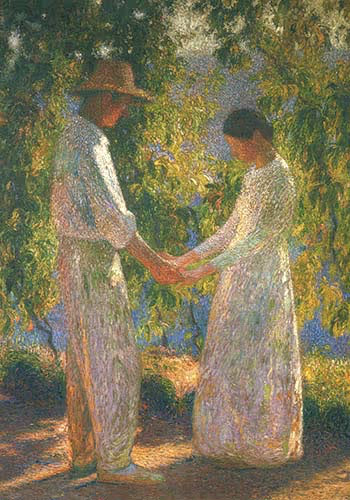
[.smalltext]From Eberhard Arnold: Selected Writings, this week’s featured book.[.smalltext]
[.article__paragraph--leading]In this essay from 1921, Arnold maintains that sexual love represents only a small part of the overpowering love of God. As such, Eros is not inherently suspect, but ought to be celebrated – as long as it remains subordinated to Agape. This bold assertion is consistent with Arnold’s view that nature itself should be redeemed for God– and that the idea of being redeemed “from” our earthly nature is simply not Christian.[.article__paragraph--leading]
[.article__paragraph--cap][.small-caps]In his A Christmas Carol,[.small-caps] Dickens portrays a rich old merchant in whom all but the last spark of love has died. His life has been ruined because he has given himself over completely to earning money. Nothing but coldness comes from him; he is a man without a heart. This is so tangible that no child or beggar on the street dares ask him for the time of day or approach him for help.[.article__paragraph--cap]
In deathly loneliness he lives a purely commercial existence, devoid of human relationships. He has sacrificed even the love of his youth to the idol of money. Any pure hope he might once have had has been consumed in his quest for recognition and success; every noble feeling has been extinguished in his craving for financial gain. A man of established fortune, he is a soulless being. His life is so completely turned away from human community that his death is merely the confirmation of a long-established condition. Only if the spirit of his youth once more awakens will his lonely coldness and emptiness give way to God’s warmth.
No one can live without love. Those without love are aging and dying; in truth, they are already dead. Where love sickens and degenerates, the innermost life is poisoned. Those who allow love’s ardent urge and longing to go unused suffer the loss of their most precious possession. Deep down, all of us worry about love. Every person feels that love is his destiny. Yet there are many who, in anxious moments, fear the love-life; to these people, love appears as a fire so hot it must be avoided. Others, no more fireproof, come too close to the blazing fire and are burned. They allow themselves to be destroyed in a smoldering fire. Their outward persons deteriorate because they let their inner beings go to ruin.
For most people, love is a labyrinth in which every step seems a blunder. They have not discovered the secret of how to guide the living stream into the right channel. They feel that all love must end in God, just as all rivers flow into the ocean. They realize that much water trickles away or evaporates instead of finding its destination. They want nothing but the fulfillment of their own being and God’s being, and yet they lack the vision to separate the pure, original force of love from its weakened forms.
Our language has only one word for the many different degrees of love – including all its sick and deviant forms. This simplicity of expression hides the mystery of love, and does not distinguish the relationships of body and soul that are healthy from those that are sick. The Greeks, on the other hand, differentiated between Eros, which includes but is not limited to possessive desire; and Agape, which is divine love, God’s all-embracing love that gives itself to all.
People frequently ask how these spheres of love are related. Some are inclined to deny any essential difference between possessive love and personal affection, while others try to separate “holy” love from any contact with Eros. Still others insist that since there can be no radiance of love without erotic energies, divine love does not exist at all.
Only those who have distanced themselves from God can judge in this way. Those who have been overwhelmed by God know that all forms of love, no matter how impure or distorted, are simply reflections of his unending and outpouring love. They are sure that God’s holy love alone is what is essential in the love-life, and they know that the only important question regarding love is whether it remains in touch with this center of life, or whether it strays from it.
Scientists have pointed out that the areas in the brain responsible for religious experience and for the experience of love are adjacent. Herein lies a deep symbolism that points to the ultimate truth: “God is love; he who abides in love abides in God, and God abides in him.” Even the most degenerate and besmirched feelings of love have something from God hidden in them! Sadly, such feelings consume what is of God within them, to the extent that a person drowning in the flesh no longer has any eye for God at all.
Those who squander the energies of their love in the intoxication of the senses deprive the neighboring centers of the brain of their vital power. They exhaust and ruin their feeling for the life of God. They become dull to the noblest impulses that come from the heart of God. Their vision is clouded, and they grope in the dark. But God sees with pure eyes. God floods us with Agape, the divine love that is devoid of lust or possessiveness.
Most people equate Eros with lust, which in its worst form continually exchanges one possession for another. But the erotic life can be ruled by Agape. How often this actually happens is another question.
In this visible world of time and space, we are unable to relate to one another without experiencing the attractions and repulsions of soul and body. This is the sphere of emotionally stimulated love, manifested in the holding of hands, the meeting of eyes, the striding together arm in arm. This is fellowship in word and song, in hiking and sport; it is friendship in joy and sorrow, in faith and in hope; this is the community of humankind without which we could not live.
We rejoice about these powers of Eros that cannot be mistaken for sultry eroticism. For Eros does not represent mere lust, but communal experiences of the soul that belong to a relatively pure atmosphere. Yet the purest air of love is still the breath of the Spirit that goes out from Jesus; Socrates and Plato could only sense this.
The essence and basis of all life and community is Agape, the love that comes from God and leads to God. Agape is the love that never ends and knows no bounds. It is the revelation of the transcendent in the immanent – the revelation of the spiritual in the material, the cosmic in the earthly.
The love between two people or between the members of a community can be fulfilled only in God’s inexhaustible and everlasting eternity. Only in God can love flow freely through our lives; only in him can we radiate a love free from the possessive desire of Eros. Only in him can the intoxication of the senses be replaced by the ecstasy of the divine Spirit, which is so often mistaken for asceticism. Eros has submitted to the rulership of Agape. The all- embracing Spirit has replaced the isolated, possessive will. Nietzsche himself recognized that all love leads to the eternal and the endless: “All desire seeks eternity – deep, profound eternity!” Goethe, too, recognized the power of Eros: Faust at first exults in the physical, but ultimately finds fulfillment in building and preserving the community of humankind.
Our love-life determines our fate in the most serious sense of the word. Either Eros hurls us down into the hellish abyss of demonic self-destruction, or it lifts us up to the pure heights of God. This depends on the inner nature of our love-life, on the nature of the spiritual powers with which we align ourselves. At times we may be unaware whether we have joined with the powers of darkness or with the light of God, but this will become obvious by what effect our love has. One who goes to the harlot becomes flesh and spirit with her. One who enters into the union of two before God and in God experiences rich blessings.
God compares his covenant with his people and the unity of Christ with his church to the union of betrothal and marriage. Christ is the single object of the devotion of his church; he kindles in her all the powers of love and of the Spirit. In the same way, true marriage awakens and unfolds all the powers of manhood and womanhood. This will – to create something beyond the self – should awaken all our energies for the will of God.
But even if the way of marriage is barred by bitter experience or inverted inclination, we can still find happiness through God’s love. We must not estrange ourselves from life and love in bitterness, nor stifle the best in ourselves by turning to possessive desires. Rather, we must accept that higher calling in which all powers of love are kindled and revived by the generous, sunny love of God. Then none of love’s energy will be wasted or left unused; no power of life suppressed. But we must rise up out of the smoke and fog so that our vision becomes free and our hearts wide; we must open our lungs to the pure air. Here, love comes into its own, love that wants nothing for itself but is fulfilled in lavish giving.
It is true that there is a certain asceticism in the life- affirming love of God, an asceticism that rejects possessive desire. But those who are liberated from the sexual in this way belong to the happiest of people. They are able to love more abundantly than others because their entire time and strength are free, because Agape, God’s love, dominates their relationships to others.
Many people who struggle against degeneration and defilement end up embracing a purely negative asceticism. But Jesus did not want this. He had no distrust of life; he joyfully affirmed all those forces of life that are illumined, penetrated, and ruled by God’s love. He held marriage and its inviolability in high esteem, and honored it by discerning its desecration in the impure thought and the covetous look. He established brotherly love as the sign of his church, and in his own life he embraced all people without anxiety or compromise. He loved the rich young man and yet challenged him to give away all that he had, and he welcomed those who sought redemption from their sick sensuality when he allowed women of ill repute to kiss his feet and anoint his hair. Even on the cross, he gave his mother a son, and his friend a mother.
Jesus transcended the Eros-life completely. He did not stifle emotional relationships, but rather revealed the love of God free from fleshly desire. And God’s love is eternal and imperishable. Greed and vanity, possession and property perish before it, as do the highest gifts of language, knowledge, and prophecy. “He who lives in love lives in God, and God in him.” Love begets love. He loved first who himself is love; only through him are we able to love. The warmth that comes from God’s heart cannot be produced in any laboratory, by any decree, or by any organization. No friendly effort or zealous benevolence can imitate it. Whoever has felt its unique life-power radiating from the aged or from the wheelchair of a crippled person knows that it is independent of the physical freshness of youth. It is life itself. It is a primary force, an original power of the deepest source.
This Agape knows no bounds of space and time. It is the strength of unconquerable perseverance. It is stead- fast faithfulness, and it is equal to every task. It clothes the energy of our love in inexpressible purity, and never injures the modesty or sensitivity of the soul. It is free from inflated arrogance, from pretense, and from presumption for its own advantage. It is real and genuine, and has nothing to do with passing effervescence or superficial enthusiasm.
Agape seeks and demands nothing for itself because it lives completely in the object of its love. It knows nothing of rights, and instead finds happiness in giving. It is never harsh, never excited, never provoked to bitterness. It sees both the essential and the potential in everything, and does not take into account what might still be evil. Yet it has nothing to do with injustice. It sees through every- thing that still delays the holy calling of a soul. It wards off all that threatens to obstruct a person’s destiny. And it can do this because it is one with God, because it hopes and believes in the final fulfillment of humanity.
No founder of a religion, no philosopher or moralist has lived this love as Jesus did – Jesus, who entered the life of the physical and the emotional. And the love of Jesus is forever and is boundless, or it is nothing. It gives and forgives everything, and includes enemies as well as friends. It is not limited by possession or property. It is unconditional and absolute, and is never frustrated by outward circumstances. By it, his followers will be known to the world. In it, we no longer look to be loved but seek to love others.