Review
I Am Not a Number
The wild quest for freedom in the classic TV series The Prisoner.
October 27, 2026
Try 3 months of unlimited access. Start your FREE TRIAL today. Cancel anytime.
START FREE TRIAL NOWI Am Not a Number
The wild quest for freedom in the classic TV series The Prisoner.
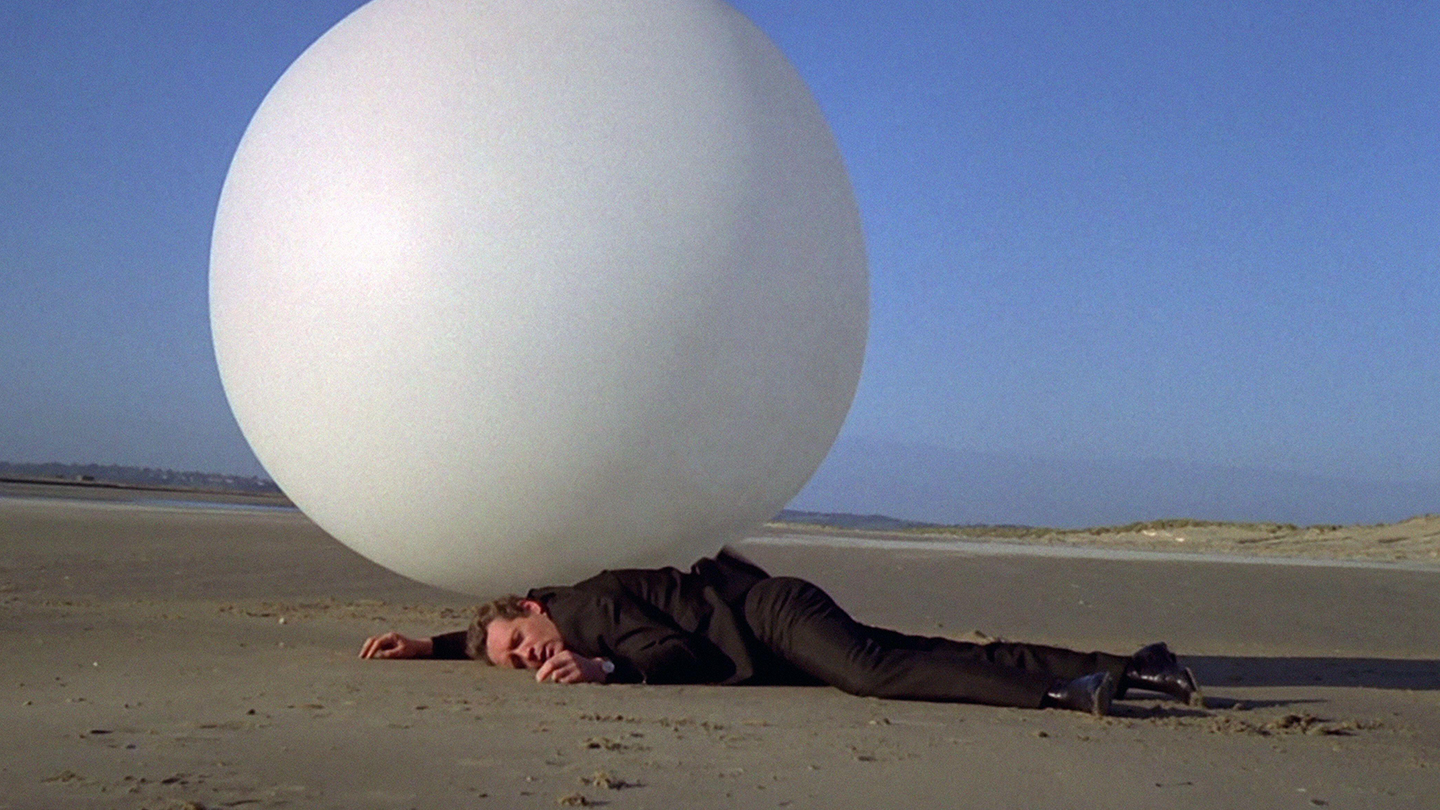
Patrick McGoohan in Season 1, Episode 1 of The Prisoner, 1967. [.smalltext]Photograph by TCD/Prod.DB / Alamy Stock.[.smalltext]
[.smalltext]Editor’s Note: Spoilers ahead.[.smalltext]
[.article__paragraph--cap][.small-caps]A man – some viewers[.small-caps] will recognize him as the spy from ITV’s Danger Man (Secret Agent in the United States), but he is, in a far more essential sense, just The Prisoner – drives the coolest car you’ve ever seen through the heart of London. His face, when we see it, is grave, determined, maybe just a little maddened. He walks through a dark passage – at some point the car must have gotten parked, but we have no time for trivia – while his footsteps dominate the soundtrack. He bursts through a pair of doors, hands a letter to a dimly functional-looking man, strikes a table, expostulates, leaves. In a series of quick cuts, we see a file drawer marked “resigned,” then a typewriter X-ing its way through the man’s picture, and finally a machine dropping the X-ed out man into that file drawer, all while our hero (he’s already our hero) drives home.[.article__paragraph--cap]
The place he drives to is not, seemingly, the rural fastness he drove in from – even as he resigns from his secret agency, our hero keeps secrets from us. As he parks, we see another, infinitely less cool car (a hearse, actually) following at a distance. He enters an apartment, tosses things into a suitcase. Outside, a man in an ominously tall hat approaches his door. Back in the apartment, a gas of some sort pours through the keyhole. Our hero passes out. He wakes in a copy of his own living room, in a village whose name no one will tell him, bounded by mountains and an ocean.
Everyone agrees that The Prisoner (1967), the unclassifiable British television show that Criterion recently added to its streaming collection, is an allegory. But of what? If you watched it in 1967, unaware that you’re enjoying a soon-to-be cult classic, a singularity in its medium, you’d probably place it as a spy show. Or perhaps you’d view it as spy-fi, that subgenre of the spy thriller defined mostly by the fact that the spy’s gadgets are all absolutely sick and the film stock has the colors of a childhood dream. Your first guess, either way, would be that the show is saying something about the Cold War, probably something drearily obvious like Both of the sides are bad or But one of the sides is worse, so…. This impression is briefly reinforced when our hero is summoned to a place called the Green Dome to talk to someone called Number Two. The Green Dome turns out to be the dopest villain’s lair in the history of television. Number Two turns out to be another dimly functional-looking man who tells our hero that “we” want “information,” which “we” will get “by hook or by crook,” starting with the reasons for his resignation. Right. The Russkies got him.
But it turns out we aren’t really watching a spy thriller, let alone spy-fi in the Avengers mold. (I have, as it happens, the greatest admiration for spy-fi in the Avengers mold, but that’s not what The Prisoner is.) First of all, in a spy story the hero may not crack and tell, but the narrative, at some point, needs to. We read Tinker, Tailor, Soldier, Spy for many reasons, but one of them is that we need to know who the KGB’s mole in the Circus is. We want information, and by hook or by crook, we’ll get it. The Prisoner scorns this need of ours. We never find out who is doing what on whose behalf. We never even really find out what side The Prisoner himself is on. The civilized contempt with which he resists his jailers is mirrored in the show’s fine contempt for our need of closure, a quality that makes The Prisoner far more like Twin Peaks than any spy show.
The show also follows the logic of nightmare rather than the logic of plot. When our hero makes his first escape attempt, he is not, say, sapped by a blackjack-wielding thug but chased down by a giant bubble that suffocates him half to death. An old friend turns up in a hospital bed, then is said to have committed suicide. Number Two is replaced midway through the episode by another man. The dead former colleague’s wife involves our hero in a second escape attempt, which fails. It turns out the dead former colleague is still alive and In On It. That’s the first episode, and it’s as straightforward as the show ever gets. The show will proceed in this manner: Our hero, who the various Number Twos all refer to as Number Six (but we would never allow this slur to pass our lips), is subjected each episode to various nested plots-within-plots that are so wild and extravagant – not to mention (if any spy agency were actually to do them) expensive – that they quickly exceed not only the logic and budget of any real-world agency but even any coherent single purpose whatever. In a general way all the plots seem aimed at “breaking” him, but for the sake of what? If they can go to all that trouble, they can probably get at whatever he knows in a cheaper way.
[.article__paragraph--cap][.small-caps]On the other hand,[.small-caps] it is true that spy agencies, when not kept on a tight budgetary leash, will do incredibly strange things just for their own sake. I’m not sure anybody writing The Prisoner would have known this at the time, but the CIA was, for example, dosing elephants with LSD more or less concurrently with the show’s run. People who want control over other minds will certainly go to lengths, and their experiments will sometimes appear whimsical, even occultic. All the way back in 1967, when the CIA’s would-be truth serum was just beginning its long second career as a thing teenagers take to make Iron Butterfly listenable, The Prisoner is already recognizably a work of psychedelia, just as the 1966–68 Batman TV show was already camp even as the ink was still drying on Susan Sontag’s famous notes. Culture moved fast in those years. Perhaps The Prisoner – with its surreal visuals, its postmodern Village in which Victorian, Edwardian, and Swinging London aesthetic and architectural motifs coexist without conflict – is simply a trip.[.article__paragraph--cap]
But that reading doesn’t fully work either. If The Prisoner is a trip, The Prisoner is defined by his refusal to go. The wildness of the plots comes to stand in for just how stubborn our hero is in refusing to relax and enjoy the phantasmagoria. So then we have the reading of the show as a relatively apolitical fantasia on more general – not to say ill-formulated, vague, incoherent – fears of the disappearance of the individual in mass society, whether capitalist or communist.
The personal views of creator and star Patrick McGoohan, a small-c conservative Catholic, lend some color to this reading, as does the show’s most famous soundbite (besides “I am not a number! I am a free man!”): “I will not be pushed, filed, stamped, indexed, briefed, debriefed, or numbered. My life is my own.” It’s a fantastic speech in context, with its rat-a-tat percussion. Shorn of that context, as it often is, it just sounds like an open-ended hatred of bureaucracy as such, separated from the things the bureaucracy is or isn’t doing. I actually like bureaucracy just fine when it keeps the milk I buy at the store from poisoning me. I only don’t like it when, say, it moves large numbers of people to the North Lake private prison three hours or so from my house. I prefer bureaucracy, on the whole, to being ruled by a charismatic leader, and to living in hunter-gathering bands. I’m not sure there are alternatives to it.
McGoohan was, by some accounts, something of a charismatic leader himself. Fellow actors speak of him in hushed admiration or enduring anger. He ran off the show’s co-creator, George Markstein, with his refusal to clarify little details like “Who actually are the bad guys” and “What’s going on?” (On the other hand, Markstein thought the show an allegory about the welfare state, so maybe that’s a good thing. See what I mean about open-ended hatred of bureaucracy?) Watch the show enough times, and you begin to feel like The Prisoner’s relationship to the island and its government has a codependent quality. Like one of those guys who joins the military so he’ll have an authority to hate, maybe the Prisoner needs a Number Two to triumph over in order to feel alive, and maybe he needs some contented fellow-villagers to feel superior to. A frequent type-scene on the show involves one of the various Numbers Two commenting on their failure to break his mind: They’re always calling him “a tough nut to crack.” McGoohan himself once described the character as “the one rebel they can’t break.” That’s not a sober description of a maturely conceived fictional character. It’s what us boys want you to write on our report cards.
So then you start to ask questions about what was happening five minutes before the show began: wasn’t this man literally a spy? What is this integrity, this nub of personhood, that he refuses to let the Village take away from him? Didn’t he already sign it away to MI6 a decade ago or more? Hey, has he spent any time in Latin America recently, by the way? Does he have a lot of Miami Cuban friends? Has he ever heard of the P2 Lodge? Where was he on November 22?
He says he won’t be pushed. But has he maybe done a bit of pushing in his time? Sometimes the great individualists – the Sun Ras, the Captain Beefhearts – are also petty tyrants. In their obsession with being consistently who they are – as though men made themselves – they leave little room for anyone else.
[.article__paragraph--cap][.small-caps]Reading the show[.small-caps] as an allegory about a man hanging on to his integrity under “bureaucratic modernity” is one of the most popular fan pastimes. It’s also a mistake. It makes this precious, influential, unrepeatable show just a little insipid. Let’s see if we can push the show a little further, make it yield another layer of meaning.[.article__paragraph--cap]
The final clue, for me, comes in the show’s wild two-part finale, “Once Upon a Time/Fall Out.” There are people who have been mad at this pair of episodes since 1968, just as there are probably people who still send death threats to Hideaki Anno for the beautifully strange ending of Neon Genesis Evangelion’s single. Such people suffer from self-imposed misery. It’s “Fall Out” especially, that makes the show feel contemporary and matches the intelligence and imagination of the very best shows of television’s first thirty years or so – shows like Twilight Zone, Doctor Who, the original Star Trek, Sapphire and Steel, Children of the Stones, the teleplays of Nigel Kneale. It answers no questions, provides no closure, yet ends the show as decisively as the last rhyme in a sonnet.
Many things happen in this carnival of narrative, but here’s the most important, certainly the most coherent: We finally meet Number One. It’s The Prisoner himself. He’s the one who has set all these demented tests for his own integrity, who has tricked himself into revealing to himself the sort of stuff he’s made of. In this moment, the show rebels against its own sometimes simplistic tough-guy individualism. It hands in its resignation from itself. The show ends, fittingly, with The Prisoner back in that car, taking that same drive to headquarters with which the show began.
McGoohan read the finale a little pessimistically, although with a fine, Roman Catholic sense of our universal solidarity in sin. He told an interviewer in 1977, “Now this overriding, evil force is at its most powerful within ourselves and we have constantly to fight it.” He also said that “each man is a prisoner unto himself.” On this reading, The Prisoner is doomed to repeat the cycle of his imprisonment many times in a kind of purgatory.
But if this show has taught me anything, it’s that no mere mortal, not even Patrick McGoohan, is my boss, and a purgatorial-return reading of the ending of The Prisoner dishonors the wild creativity that the show exemplifies throughout its seventeen episodes. Wherever he is at the end of “Fall Out,” we know The Prisoner has indeed fallen out – he’s not on that island anymore. He’s continuing to form a self, but no longer in a self-imposed cut-off from other people. Whether to hand in another resignation letter, or for some other purpose we never get to see, he’s driving toward the city, the place where it’s hardest to pretend that we make ourselves in splendid isolation, that what we are comes only from deep within. Individualism, however tractable or stubborn, is a great gift. But it is at its greatest when it makes us a self among others, not above them.