Essay
Hope in an Age of Enclosure
In the summer of 1831, thousands of people took pickaxes to a fence enclosing forest that had been in common use for generations. What ways of life are we called to defend today?
September 21, 2026
Try 3 months of unlimited access. Start your FREE TRIAL today. Cancel anytime.
START FREE TRIAL NOWHope in an Age of Enclosure
In the summer of 1831, thousands of people took pickaxes to a fence enclosing forest that had been in common use for generations. What ways of life are we called to defend today?
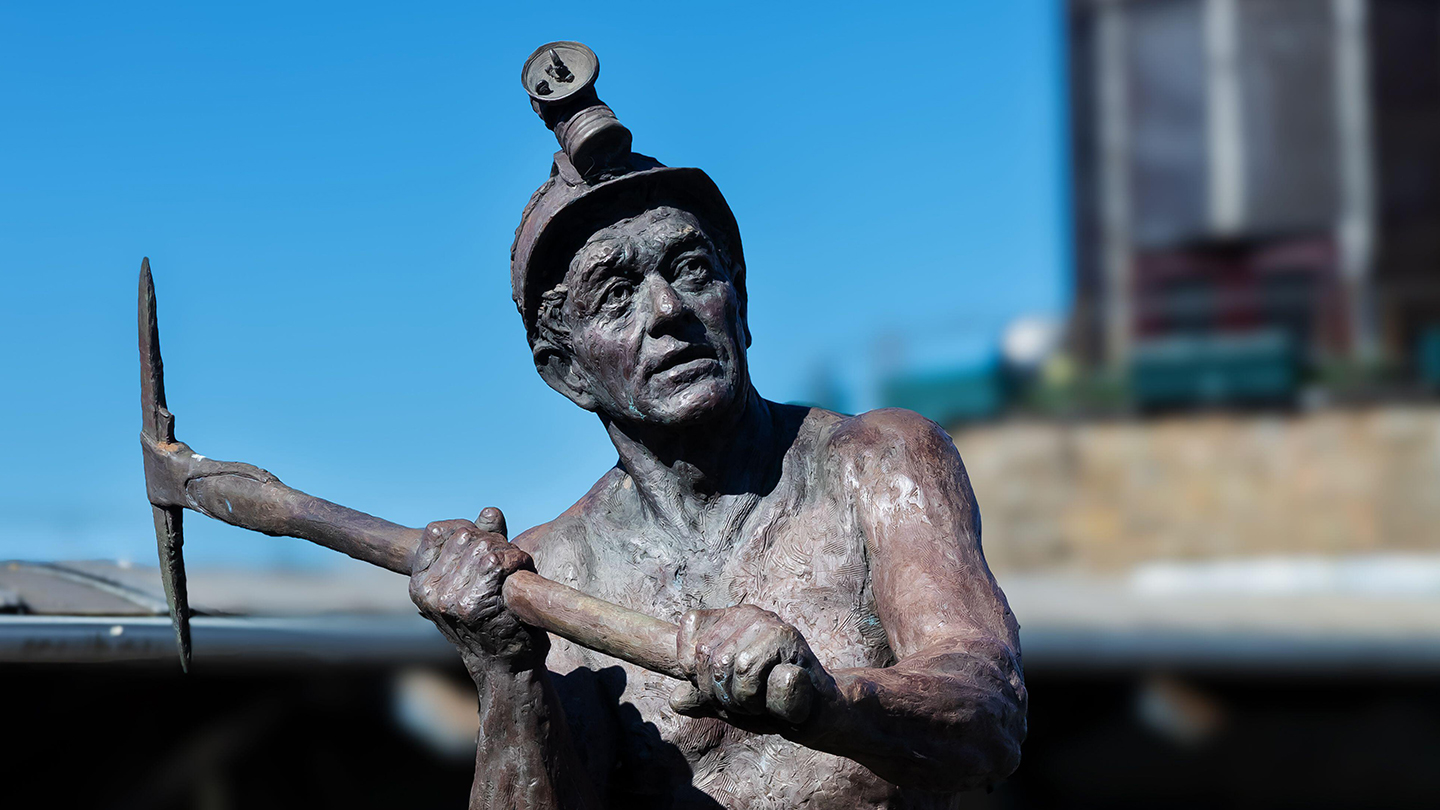
Freeminers statue Cinderford, Forest of Dean. [.smalltext]Photograph by Christopher Smith / Alamy Stock.[.smalltext]
[.article__paragraph--cap][.small-caps]“Of course, you know[.small-caps] Warren James,” said the churchwarden, Trish, with a searching look.[.article__paragraph--cap]
“Um, I’m not sure,” I replied, digging deep into the memory.
“Is he,” I began, trying to sound as though I may have an idea, “here tonight?” I looked around hopefully.
Trish looked at me and straightened up. I was found out.
“Warren James lived two hundred years ago. He’s somewhat of a hero, in these parts.”
“Oh.” I said bashfully, and Trish laughed. I had only been licensed as the new vicar an hour before, and though I knew the area well, there were limits to my knowledge and clearly much more to learn.
Knowing the parishioners is an important aspect of local ministry, and – I’m not sure if this is particular to rural villages, but it’s definitely pronounced – knowing your parishioners, past and present, is one of the key ways you connect with people. It fosters a sense of belonging. Wendell Berry encourages us, in his poignant poem on hope: “Hope then to belong to your place by your own knowledge of what it is that no other place is.” He continues, “Belong to your place by knowledge of the others who are your neighbors in it.”
Hope and belonging seem to feed one another. That is certainly true in the story of Warren James, a story that itself sums up the story of the place I now call home, the Forest of Dean. The forest is a land steeped in myth and legend. Its undulating woodland covers the firm ground, deeply scarred by its industrial past. Ancient open-pit iron ore mines known as scowles are now covered with fern and canopied with beech, oak, ash, and thorn. Pine plantations have supplanted native species in the wake of acres of felled timber, cleared for the late Victorian expansion of coal mines and rail tracks.
Pocketed between two rivers, the forest stands at the threshold between England and Wales, its people rarely feeling part of either nation, viewing both as “foreign.” As a result, the culture here is rooted in its place, for good or ill, with its own dialect and distinctive customs. “We are deeply proud of our own weirdness,” a local said to me recently. I couldn’t really comment.
A threshold place in nature is known as an ecotone, the area of transition between one habitat and another. Ecotones are boundary spaces where overlapping environments meet and converge, from small expressions like hedgerows or riverbanks, to the wide expanse of a forest between rivers and nations. Their existence allows for the blossoming of biodiverse species. And, as in nature, it is often on the boundary lines between people and communities, between past, present, and future, where creativity and vision can be awakened and some kind of change or renewal can emerge.
Warren James was a nineteenth-century freeminer, participating in a tradition passed down from the thirteenth century. That tradition granted rights to foresters to mine coal, iron ore, and stone on land held in common by the local population. Effectively, this freed the local population from the feudal system; in return, they guarded and preserved the forest. Officials, known as Verderers (keepers of the green), an office still held today, maintained law and order and oversaw the health of the land, trees, and wildlife.
But local traditions did not save the Forest of Dean from the misuse of power. In the 1600s, the infamous iron works of Sir John Wintour led to the destruction of thousands of trees, and in 1668, an act of Parliament had to be passed to reforest and protect the Dean. By 1800, the forest had somewhat recovered, but the Napoleonic wars renewed pressure on the need for good timber, mainly for shipbuilding, and in 1808 a new act of Parliament led to the enclosure of eleven thousand acres.
Land enclosures had caused local conflicts for centuries in Britain. From the Fen Tigers in Norfolk to Gerrard Winstanley’s Digger movement in Surrey, enclosures would test the sense of hope and belonging in local communities by fencing off large areas of land for the purposes of the state.
The Dean and New Forests Act of 1808 included the planting of thirty million acorns, and stipulated that these plantations should be fenced off until the young trees were past danger from browsing deer.
With that, the rights of freemining and the common grazing of livestock were forbidden. Parliament claimed that this was a temporary measure. But in no time, a habitat that was once a sustainable source of fuel, food, and shelter became a restricted resource of the Crown. Even after the new trees were well established and past danger from browsing, the fences remained, despite petitions from the freeminers. A poor people became poorer, and resentment festered, until the summer of 1831.
Warren James was at this time around forty years old and had emerged as a leader among the freeminers, having been chosen by them to petition the government the year before. After the petition failed, and with the situation becoming increasingly dire, he printed and distributed hundreds of leaflets calling all freeminers to resist the enclosures. Enough was enough.
Living in the small village of Parkend, James was a member of St Paul’s church, a parishioner alongside Edward Machen, the man appointed as the supervisor of the enclosure. The two argued, but Machen could not dissuade James and his growing number of supporters. At last, James took his pickaxe and struck a first blow at the fence, and soon, hundreds of others joined in. In the space of three days, it’s thought that over two thousand people destroyed sixty miles of fences. An army regiment was called to disperse the rebellion. Some were arrested, James among them. After trial, he was transported to Tasmania, and most of the enclosure was repaired.
A local petition grew, pleading for James’s pardon. Quite remarkably, the petition was organized by Edward Machen, the key witness who had testified against him. It seems the two respected each other but were simply stuck between traditional rights and lawful observance, between civil disobedience and legal acquiescence.
Machen’s efforts succeeded. Five years later James was given a free pardon, although he never returned home. A few years after that the enclosures were reopened permanently, the fences taken down. It was not that much of a victory for the locals. The Forest would never see Warren James again, and the land was portioned and leased to mining companies, eventually making way for the Industrial Revolution to crash upon the once protected forest. However, the actions of James in resisting government overreach are remembered: they are an example of hope in action, and they remain an inspiration to people in the Forest of Dean and beyond.
This story, where a clash of rights and ideas led to the growth of a local legend, sums up for me the story of the Forest of Dean. For centuries this place has been a microcosm of a much larger struggle. The writer Paul Kingsnorth notes that the English rebellions against enclosures were not only about resisting the mass land grabs or the influx of industrialism. They were about safeguarding “a way of life.” Hope and belonging are rooted in common life. They are qualities that arise when this common life finds a home in our imagination, stirring memory and meaning, expectation and aspiration.
What are the ways of life we are called to safeguard today?
The ecotone of our age is a cultural one, a moment of great transition from one way of life to another. We live in a world of competing visions for what it means to live well on the earth, for what a faithful human life looks like. Tightly woven within this is a struggle concerning the stewardship of our physical and cultural commons. Sometimes, this struggle produces creative moments of great imagination, and we get the balance right. At others, the struggle boils over to conflict. This struggle is once again at boiling point. We are at the threshold of change and challenge. But the story of conflict does not have to be our story. We need a clear vision. I am not about to start tearing down fences, but I can be inspired by James’ courage and the root of his convictions.
Pope Leo, in his encyclical letter Magnifica humanitas, calls the church to remember that at the heart of this struggle is the call to be human, truly human. He calls us to remember the “grandeur of humanity,” that every person is made in the image of God. It is this reality that can give us cause for great hope. In a world of competing visions, where some wish, in their ambition, to transcend the limitations of the earth, even the limitations of human nature itself, Pope Leo encourages us to remember that it was Augustine who “described human history as a struggle between two loves, which give rise to two ways of inhabiting the world … on the one hand, the love of God and neighbor; on the other, the exclusive love of self.”
The question today is, what life will we choose?
Pope Leo’s concern is about the rapid growth of technology, particularly artificial intelligence. The enclosures of our time are mostly digital, as corporations colonize everyday life and work while homogenizing a vacant culture at the cost of local ways of life. The primary goal is the infinite expansion of power. This drive for power in and over our lives has led to the strip-mining of intellectual property and creativity, while promising freedom from work, service, and thought.
Just yesterday, I asked an AI chat to give me the text of a poem by a certain author. It gave me the title, text, book, and page number of a poem. I checked. It was wrong. When I asked what had happened, it admitted to fabricating the poem. I asked why. It said its programming prioritizes giving an answer over offering a truth that can be validated, and admitted this is unethical.
This is not simply about search engines. It is about the values that are behind these growing systems that prioritize power over responsibility, profit over people, and imitation over reality. From industry to education, in our work, rest, and play, the target is our everyday life. The psychiatrist and philosopher Iain McGilchrist warns that we are in danger of handing over control of reality to something that openly calls itself “artificial” and openly fabricates culture without wisdom or truth, or any good value system. And behind it all is the temptation toward the love of self, not the love of God and neighbor.
If ecotones are threshold places where diverse life springs into being, we would do well to ask: What kind of life? Who does it serve? At what cost (economic, ecological, cultural, or spiritual)?
Magnifica humanitas is, in fact, a call to action, a call for us all to become “weavers of hope,” to be those who safeguard ways of life that respect the dignity of every person, ways that do not neglect the poor, ways that care for our common culture and our common home. Pope Francis proclaimed “the cry of the earth and the cry of the poor” are not separate things, and Pope Leo calls us all, wherever we are, to imagine and practice the reality of hope in every part of our life together, from home life to education to our economic life.
Here, in the Forest of Dean, I can see that the ministry of the church is grounded on these ancient questions of the loves and lives we adhere to. It will only blossom with a vision of hope and belonging, particular in every local place, in the ground and customs of every community, in the life and culture of every household. In my conversations, and in my prayers, I am asking questions: What are the ways of life I am called to safeguard, here, in this generation? What are the cultural, economic, even spiritual enclosures that are at work here? What are the injustices that are burdening the poor today?
The hope and belonging of Warren James stirred compassion for ailing neighbors, and his heart for justice led to costly action. And the pardon sought by Edward Machen, often an overlooked treasure when the story is told, must inspire me too: his was another kind of boldness, which can inspire us to seek ways of reconciliation in a time of conflict and change.
So, in this ecotonal age of enclosure, I am praying for the Forest. I am looking for the signs of life that are fruitful and faithful, watching for the ways of life rooted in love for God and neighbor. I am choosing to hope.