Essay
From Battle Hymn to Pacifist Proclamation
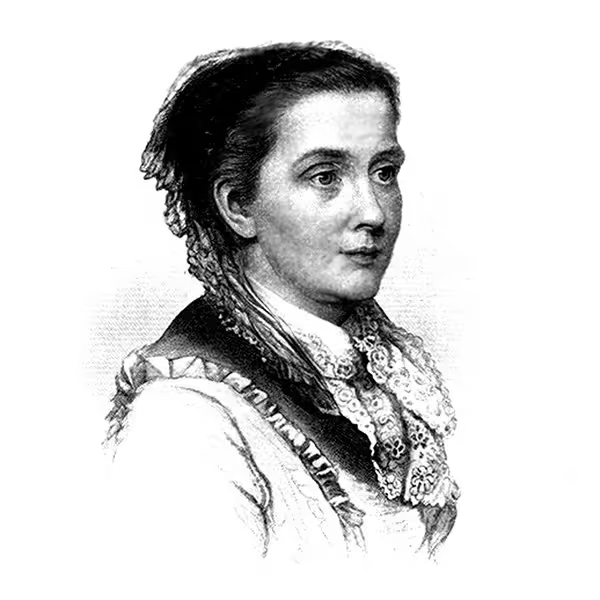
Julia Ward Howe, who penned the Civil War anthem “Battle Hymn of the Republic,” spent her later years working for peace.
August 17, 2026
Try 3 months of unlimited access. Start your FREE TRIAL today. Cancel anytime.
START FREE TRIAL NOWFrom Battle Hymn to Pacifist Proclamation
Julia Ward Howe, who penned the Civil War anthem “Battle Hymn of the Republic,” spent her later years working for peace.
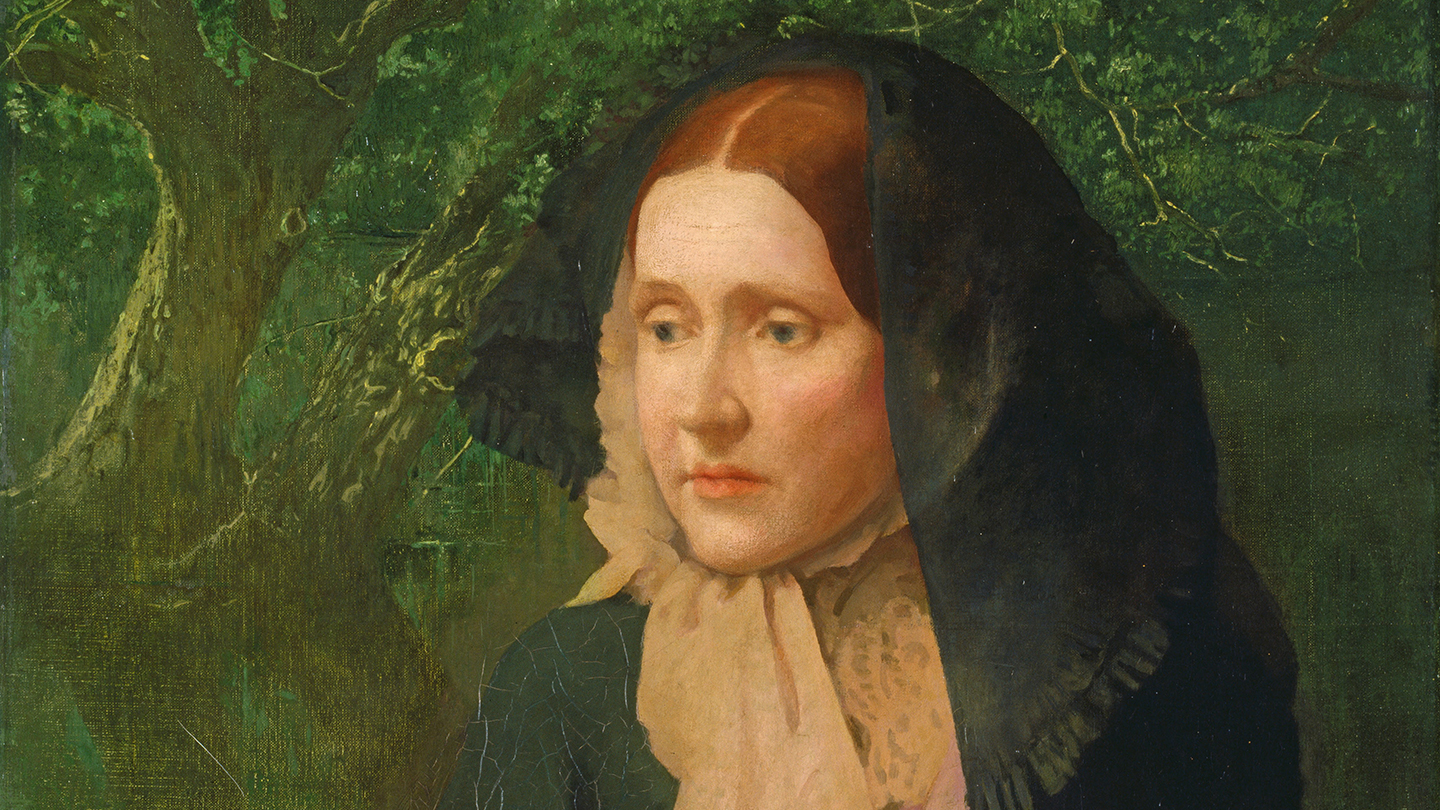
John Elliott, Julia Ward Howe, oil on canvas, 1925. [.smalltext]Wikimedia Commons (public domain).[.smalltext]
[.article__paragraph--cap][.small-caps]Julia Ward Howe woke up[.small-caps] one November morning in 1861 in a room at Willard’s Hotel in Washington with a poem in her head that would make her famous for the rest of her ninety-one years. She then spent most of those years trying, quietly at first and then not so quietly, to take back what the poem encouraged.[.article__paragraph--cap]
She did not think of it that way at the time, of course. Howe could not have known, sitting up in the gray light, scratching those verses onto whatever paper she could find, groping for a stub of pencil so as not to wake the baby sleeping beside her, that she was setting down words that would be sung at funerals, football games, and presidential memorials for a hundred and sixty years and more, or that the same woman who imagined glory arriving with a sword in its hand would spend the latter half of her life trying to talk the world out of picking up that sword.
To understand what changed in her, you have to start further back, with a childhood that gave her, in equal measure, both the material for the hymn and the seeds of everything that would later contradict it. She was born in 1819 in New York City, the fourth of seven children of Samuel Ward, a Wall Street banker and a strict Calvinist of the old school. Her mother, also named Julia, was a poet and died when young Julia was only five. The house she grew up in was wealthy and watched over, and, by her own later account, more than a little joyless, her father’s severe faith setting the temperature for the whole household. It is not hard to hear, in the sweeping apocalyptic confidence of the hymn, an echo of that Calvinism, the certainty that history has a judge, that the judge is on the move, and that when he arrives, he arrives with fire. She had been raised to expect that sort of God. What is harder to see at first is that she had also spent her whole life quietly arguing with him.
In her twenties, she left her father’s Episcopalian church for Unitarianism, a move that in her day was not a mere shrug of preference but something closer to a change of citizenship, trading the God of eternal damnation for a God who, whatever else he was, was not interested in burning most of the human race alive forever. It was the difference between a universe governed by wrath and one governed by mercy. She spent the rest of her life trying to hold those two inheritances together: the fire she had been given as a child and the grace she had gone looking for as a young woman. The hymn, when it came, was those two rivers meeting for one incandescent moment before they went back to running in their separate channels.
In 1843, she married Samuel Gridley Howe, a man eighteen years her senior, already something of a legend for his exploits fighting alongside the Greeks in their war of independence and for founding the Perkins Institution for the Blind, where he had taught a young Laura Bridgman to read by touch years before anyone had heard of Helen Keller.
It was not a happy marriage. Samuel Gridley Howe was a reformer in public and something considerably less generous in private. He disapproved of his wife’s writing, tried more than once to keep her from publishing, and expected her to be content managing a household of six children while he pursued his own causes. By most accounts, his deepest emotional loyalty lay not with her but with Charles Sumner, the abolitionist senator who remained his closest confidant for decades. She bore their children, one of whom did not survive childhood, and poured into poems what she could not into her marriage.
[.article__paragraph--cap][.small-caps]A woman who has[.small-caps] already learned, in her own home, what it costs to have her voice managed and her ambitions second-guessed by someone who believes he is acting for the good of the household will recognize the same patterns when she encounters them again on a larger scale, dressed up as national policy rather than domestic instruction. The suffrage movement she would join a few decades later was not, for her, an abstract commitment to an idea. It grew directly from the specific, personal, daily experience of being a capable adult whose capability was repeatedly treated as an annoyance by her husband.[.article__paragraph--cap]
She found her true intellectual and spiritual family not at home but in the circle of Boston reformers and abolitionists the Howes moved among, especially in Theodore Parker, the radical Unitarian minister whose sermons dismantled, piece by piece, the idea that Christianity required its adherents to accept slavery, war, and the subordination of women as part of the natural order of things. Parker became one of her closest friends, and through him and through abolitionists like William Lloyd Garrison, Wendell Phillips, and Maria Weston Chapman, Howe arrived, by the years just before the war, at a firm commitment to the immediate and total abolition of slavery. It would be pleasant to report that this commitment made her entirely clear-sighted about matters of race, but it did not; her travel writings about Cuba from this period carry the casual racial condescension common among white reformers of her class and generation, a reminder that the saints, when you get close enough to read their diaries, turn out to have been human, with all the unevenness that word implies.
It was Howe’s abolitionist conviction that put her in a carriage outside Washington on November 18, 1861, returning from a review of Union troops at Bailey’s Crossroads that had been cut short by a skirmish with the enemy. The road was choked with marching regiments, and to pass the time her party, which included her minister, James Freeman Clarke, fell to singing the war songs of the day, among them the one about John Brown’s body lying a-moldering in the ground. The soldiers along the road took up the chorus and called out their approval. Clarke turned to her and asked why she did not write better words for so stirring a tune. She answered that she had often wished to, but the words had not yet come. That night, back at Willard’s Hotel, she went to sleep and, as she put it afterward, woke in the gray of the morning twilight with the lines of the poem already beginning to knit together in her mind.
What she wrote was not, whatever else could be said about it, a poem of equivocation. It announced, in full Calvinist confidence, that the glory of the Lord’s coming had already been seen, that judgment was trampling out something terrible and necessary in the vineyard, and that a fiery gospel was being written with the very tools of war. It took the apocalyptic imagery of her childhood faith and moved it into the specific historical moment of the war she was living through, because she believed, with her whole considerable intellect and heart, that the war then being fought was a holy one, a war to end slavery, and that a holy cause justifies, sanctifies, even glorifies, the violence required to win it.
This belief was understandable for a woman who had devoted years to the abolition cause and had watched young men in blue march off, perhaps to die, to end something as monstrous as slavery.
The Battle Hymn of the Republic was published in February 1862, and it did what stirring hymns do: it gave Union soldiers a way to imagine their deaths as meaningful, it gave the North a way to see its cause as sacred, and it gave Julia Ward Howe, for the first time, fame large enough that her husband could no longer simply forbid her from speaking in public.
And then the war dragged on. The Civil War, which Howe had helped sanctify with a hymn, did not remain a brief, clean, righteous affair. By any measure, it became the deadliest conflict in American history, with six hundred thousand dead by the time it finally staggered to its end, along with many wounded and many destroyed families. Howe did not experience this only through newspaper reports. She had watched hospitals fill with the wounded and dying. She had, in that same decade, lost one of her six children, not to a bullet but to the ordinary mortality that stalked every nineteenth-century household, a loss that made clear to her the inestimable value and the fragility of the young lives everyone kept sending off to war with stirring hymns.
By the time the war ended, her relationship to the imagery she had written about so confidently had begun to shift, though it took another external shock to bring it fully into the open. That shock arrived in the summer of 1870, when the Franco-Prussian War broke out in Europe. Two more Christian nations were exhausting themselves in mutual slaughter. Watching from a comfortable distance for once, rather than from inside the thing, she found herself unable to believe that the questions being settled could justify the human toll. She had seen this before, and knew how it ended. This time, she did not write a hymn urging anyone on. She wrote something closer to a refusal.
Why did the fire that burned so confidently in 1861 give way, by 1870, to a demand that the world lay down its weapons? It was not one thing but several converging factors, each making the others harder to ignore. It was arithmetic, first of all: the brute, unglamorous arithmetic of six hundred thousand graves, which has a way of outlasting even the most sincere theology of a righteous cause. It is one thing to believe a war is holy while watching troops muster with drums and flags, and another to go on believing it after four years of hospitals, widows, and body counts. It was also the Franco-Prussian War itself, which showed her the same machinery running again on a different continent over different grievances, and made it impossible for her to keep treating the Civil War’s violence as a singular, sanctified exception rather than as merely one instance of a pattern that could repeat indefinitely. If war were fought only for the abolition of slavery, a person might have gone on believing in it. War fought over the jealousies of European monarchs made the whole apparatus of glory and the “gospel-in-steel” look considerably less like providence.
The Battle Hymn of the Republic marks a moment when God’s wrath and God’s grace briefly merged in Howe’s thinking, when wrath itself seemed to be doing grace’s work, burning away slavery as Parker’s sermons had burned away the pieties that propped it up. But the longer the war went on, the harder it became to distinguish wrath’s cleansing fire from its plain appetite for destruction. Howe’s later politics amounted to a decision, made slowly and never announced as a single dramatic break, to stop trusting the fire and to insist instead that human beings, especially the women who bore and raised the sons being burned in it, had an obligation to intervene, preferably before the fire was lit.
Running beneath all of that, giving it a shape it might otherwise not have found, was the women’s movement she formally joined around 1868, which gave her, for the first time in her adult life, both a public voice independent of her husband and a community of women who were actively rethinking what women’s moral authority in public life might look like. It is not an accident that her turn toward pacifism and her turn toward suffrage happened in the same years, because both grew out of the same conviction she had been forming since childhood: that the people asked to bear a thing, whether a marriage or a war, ought to have a say in whether it happens at all. Wives had been expected to bear their husbands’ decisions without complaint. Mothers had been expected to bear their sons’ deaths without complaint. Howe had spent decades practicing, inside her own house, the discipline of no longer staying quiet about what she was expected to bear, and by 1870, she was ready to extend that discipline to the largest and most lethal decision any society makes.
That refusal took the form of her Appeal to Womanhood Throughout the World, later remembered as the Mother’s Day Proclamation, though it has almost nothing in common with the flowers-and-brunch holiday that eventually borrowed its name. Howe opened her appeal by noting, “We women of one country will be too tender of those of another country to allow our sons to be trained to injure theirs.” Once again, two great nations, in full view of the Christian world, had exhausted their strength in mutual slaughter, and grave questions of justice between nations had again been handed over to “the ruinous arbitration of weapons.” Howe called on “all women who have hearts, whether your baptism be that of water or of tears” to rise up and refuse, from now on, to let their sons be trained to injure other women’s sons or to let their husbands come home to them smelling of bloodshed: “Say firmly: ‘We will not have great questions decided by irrelevant agencies, our husbands shall not come to us, reeking with carnage, for caresses and applause.’” These words must have sounded strange coming from the woman who famously once summoned the terrible swift sword: “From the bosom of the devastated earth a voice goes up with our own. It says, ‘Disarm, disarm! The sword is not the balance of justice.’”
Howe hoped the appeal would lead to an actual international council of women, meeting periodically to work toward the peaceful settlement of the world’s quarrels before they could turn into wars. She proposed a Mothers’ Day for Peace, observed every June, as a standing occasion for that work. It never caught on the way she intended. History is full of these smaller, truer visions that get outrun by louder, more commercially convenient versions, and Howe’s peace proclamation is a textbook case: forgotten by most of the country, revived occasionally by peace movements during the world wars and in Vietnam, but never as famous, even now, as the hymn she had written nine years earlier.
None of this required her to disown the hymn, and there is no clear record of her ever trying to do so. She continued to allow it to be sung, and was introduced as its author, for the rest of her long public career. It would be a mistake to call this hypocrisy. It is closer to the ordinary condition of anyone who has lived long enough to have meant something with her whole heart at twenty and then meant something different, just as fully, at fifty. We are not required to be right the first time to be worth listening to the second time. We are only required to have kept paying attention in between, which Howe, whatever her blind spots, plainly did. The same unevenness that let her write condescendingly about Cubans never entirely left her, even in her later years of advocacy. It is worth resisting the temptation to smooth her into a saint. She remained, to the end, a woman capable of both remarkable moral courage and the ordinary blindness of her privileged class.
She spent her later decades as an editor of the Woman’s Journal, as a founder and later president of the Association for the Advancement of Women, as one of the founders of the General Federation of Women’s Clubs, as a biographer of Margaret Fuller, and, at seventy-four, as one of the speakers at the World’s Parliament of Religions in Chicago. She died in 1910, having outlived the husband who had tried to silence her for nearly four decades and, by the strange accounting that only becomes visible in hindsight, having done more lasting good in her second, quieter, more patient vocation than in the blaze of the first.
A person can say something at twenty or forty that she believes with her whole soul, something that can do real good and real harm at the same time, and then spend the rest of her life slowly, honestly, sometimes painfully, learning what else needed to be said. That is not usually how conversion stories are told. We prefer a single blinding light, a road-to-Damascus moment, a clean break between the person you were and the person you became. Howe’s story, like most real ones, was not that simple. It took her from believing in war to fighting even harder for peace. What changed her, slowly, over time, was seeing more than her famous hymn had room for. She was, whatever else can be said of her, a person who could not ignore what the world had shown her to be true.
That, in the end, may be the only kind of conversion most of us ever experience: not a lightning bolt but decades of paying close attention to the true cost of the “glory” that “The Battle Hymn of the Republic” celebrates. And so the woman once famous for loosing the fateful lightning of the terrible swift sword spent her last public words urging the mothers of the world to lay that sword down.