Essay
Edith Stein on Empathy
What was the philosophical puzzle that consumed Edith Stein?
November 13, 2026
Try 3 months of unlimited access. Start your FREE TRIAL today. Cancel anytime.
START FREE TRIAL NOWEdith Stein on Empathy
What was the philosophical puzzle that consumed Edith Stein?
[.article__paragraph--cap][.small-caps]Imagine you are standing[.small-caps] in a park in the early evening, with a few bright flashes of sunlight cast across the grass. You are standing next to a friend. As your eyes return from the grass to your friend, his body has disappeared, leaving in its place only a faint outline of a human body. Inspecting this, you walk to the spot that would have been behind your friend and discover that what is left is a transparent lens. You see the park again. Only, this time it looks different. Through the human window you see butterflies flying close to the ground and the patches of sunlight on the grass that look pure white when you focus on them. The whole park looks different. It is in fact the same park, but it looks entirely new. What you see is the world through your friend’s perspective. This, according to the twentieth-century phenomenologist Edith Stein, is empathy.[.article__paragraph--cap]
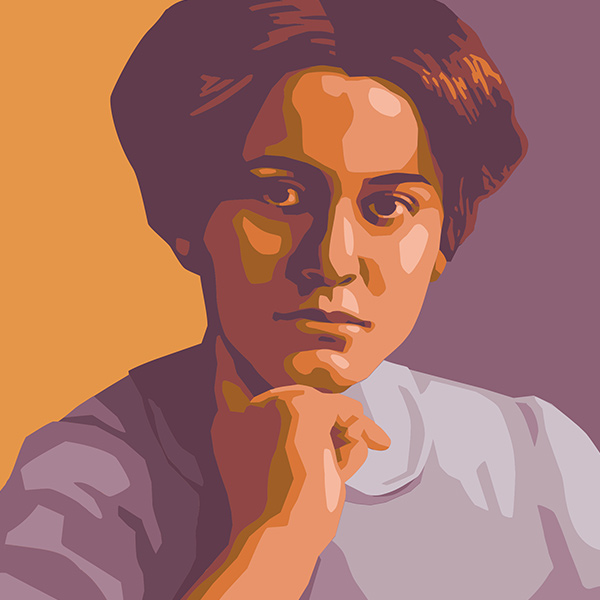
These questions were for Stein, as they are for us all, existential. Born on Yom Kippur to a Jewish family in Breslau, Germany, in 1891, she lost her childhood faith when she was fourteen: “I consciously decided,” she would later say, “of my own volition, to give up praying.” Philosophical questions compelled her; above all, this question of other minds. She began studying with the phenomenologist Edmund Husserl in 1913 at the University of Göttingen. Later, she would convert to Catholicism and continue her scholarly work, fusing phenomenology, Thomism (from her study Potency and Act), and faith in her magnum opus Finite and Eternal Being.
It is not always the case that a philosopher’s work and life are intricately intertwined, but for Stein, they would be. As Alasdair MacIntyre wrote of her: “[…] she deliberately and intentionally brought her philosophical thinking to bear on the practices of her everyday life and drew upon the experiences afforded by those practices in formulating philosophical problems and arriving at philosophical conclusions.” Further: “[…] much that is crucial to her life outside philosophy can only be adequately understood in the light of her philosophical development.” The beginning of this life of truth-seeking, this philosophical development, would be her dissertation, On the Problem of Empathy, published in 1917.
What was the puzzle that so consumed her? To most of us, empathy is the ability to understand others’ feelings. It is often contrasted with sympathy, and it has gained traction as a mainstream concept in recent times, in part due to the influence of the popular writer Brené Brown. To the psychologist, empathy is either a cognitive mechanism or part of a “theory of mind” – it is something we use to interpret the behavior of others. To the philosopher, empathy is a contested term. The current mainstream paradigm for understanding empathy is imagination: you empathize with someone when you imagine what things would be like were you in their shoes. Since this act of imagination requires adopting another person’s perspective temporarily, it is referred to as “imaginative perspective-taking.” This view of empathy, arguably, has its roots in Adam Smith’s “sympathy.” It has had recent defenders as well. This way of thinking about empathy has become so influential that it is likely to be the go-to popular definition that most people will reach for if they’re trying to explain the concept.
But philosophy is not a popularity contest: that a view is common does not make it true. And this view is one that Edith Stein was beginning to wrestle with in 1913, in her drafts of what would become her dissertation, in her conversations with Husserl, in Göttingen, in a world that was about to end. For Stein, the stakes could not be higher. What turns on her view of empathy is the existence of everyone in the world.
There is a long-standing problem in philosophy called “the problem of other minds.” Its most radical version is known as solipsism: the idea that I alone exist, that others, though they seem to be creatures like me, either are mere automata or are phantasms, with no interiority, no minds. Few would voluntarily call themselves solipsists, since it describes what is, in another register, a kind of narcissistic disposition – something we view as negative, anti-social, and so on. Thus, to be a solipsist is a kind of last resort: it is something reason forces you to be when you cannot solve the problem of how you know that other people exist.
The problem of how one knows that anyone else exists turns out to be a very hard one indeed. Immediate responses to the problem of other minds might involve laughter and protest. “Of course I know you exist, you’re right here!” someone might say. Fair enough. But that is not the philosophical problem. The philosophical problem of other minds is the problem of how you know other people exist. To have a belief that someone exists is not enough to know it. The belief must be true, and it must be justified: in other words, you must know how you know it. When people respond, “You’re right here,” we might charitably take them to be saying that they know other people exist by perception. You see a body, and the body seems to suggest the existence of an embodied mind. Call this the easy view. It turns out that this easy answer has many problems associated with it. Here’s one: minds, most people assume, cannot be perceived with the senses. You can see an apple; you can’t see a belief. You can see a table; you can’t see a desire. And so on. So, if the problem is to explain how you know that other minds (not bodies) exist, sense perception is a dead end.
Let’s try another move: we might say that we can see people doing things with their bodies that match the mental states we experience in ourselves. In other words: “Of course she exists! When she cries, I can see she’s sad; that’s an internal state, which means that there is someone there: she is a person!” But wait: emotional expressions do not always match the mental states of the person whose expressions they are. Consider the fake smiles we all must flash at parties to convey warmth to strangers and acquaintances. Surely there is not genuine joy behind every smile. Since mental states and expressions can come apart in this way, a traditional philosophical problem can be raised here: the problem of skepticism. Because we cannot know for sure what a person is thinking or feeling behind their expressive behavior, we cannot really know what is going on with another person. We cannot, in fact, know that anything is going on at all.
So goes the problem of other minds. If one cannot show how she knows that other minds exist, she is forced into solipsism. The only person I am certain exists is me. These are the stakes for understanding empathy. According to the current paradigm, empathy is imagination: we imagine what another person is feeling. But imagination is not constrained by what is true. I can imagine riding a unicorn, even though unicorns do not exist. So, if imagination is how we understand empathy – that is, if we think empathizing another person’s emotion is imagining how they feel – then empathy cannot show that other minds exist. The “others” could be figments of my imagination!
This brings us back to Edith Stein’s empathy. For Stein, empathy is “a kind of act of perceiving sui generis.” In other words, empathy is perception, not imagination. But empathy is a special kind of perception, not the kind appealed to in the easy view. Empathy is, specifically, a kind of perception of persons, and involves a perceptual perspective-taking, in which one sees some aspect of the world through another person’s perspective. When we see the world as other people do, we can be sure of the existence of other minds because new ways of looking are afforded to us which we would not have if not for their existence. We know there is another, because we see, at least in part, through his eyes. This is a leap, a brilliant escape from the trap of solipsism using the method of Husserl’s phenomenology. It glimmered before her, not yet worked out: just a promise.
And then, of course, came the war. She put her doctoral studies on hold, did a nursing course, and ended up at age twenty-five in a field hospital in Austria, tending to wounded and typhus-stricken soldiers, wreckage of the front lines. “My life,” she wrote then, “was no longer my own.” In her autobiography, Edith Stein described how she disobeyed her mother to serve as a Red Cross nurse. Edith had lost her father when she was about two years old and had been raised – alongside her seven siblings who made it past infancy – by her mother, and so it was to her mother that Edith looked for permission to take this step. Her mother attempted to dissuade her by saying that the soldiers would probably give her lice. “Naturally that was a scourge I dreaded,” she wrote, “but if the people in the trenches all had to suffer from it why should I be better off than they?” “You will not go with my permission,” said Auguste Stein. “Then I must go without your permission,” replied Edith. About the end of her service, she wrote: “The month of August 1915, spent on this ward, was probably the hardest of all my nursing service. The difficulty was of an entirely different nature than the one I had experienced when working in Barracks Six.” And yet still: “Now I was caring for people, doing what I liked to do.”
In 1916 she returned to her dissertation on empathy, taking a position as a research assistant to Husserl, whom she followed to the University of Freiburg. Part of her view of empathy would end up involving an analogy with memory: just as we can enter into our past selves, see the world the way we used to see it, we can enter into other selves, and see the world the way others now see it. Consider episodic memory. Here’s one of my own: I remember being six years old on Christmas morning and seeing a giant box wrapped in shiny, dark blue wrapping paper, with a big white bow. When I remember this, I do not look on at my six-year-old self (though I could). I see, in my mind’s eye, the big blue box as if it’s in front of me now. I feel the excitement of having the box and the anticipation of not yet knowing what’s inside – it would turn out to be a wooden chair, with each leg painted in a different primary color, for my tiny work desk. Obviously, this big blue box and this tiny chair, if I had them now, would do me no good. And now my feeling is quite different: gratitude toward my mother for her care in selecting and carefully wrapping a gift for me when I was young. Yet I can still inhabit my six-year-old perspective: the excitement, the anticipation. So it is with actual others in the present. I watch a friend watch her child take his first steps. The significance of this for me could not be anything like the significance of this for her. Still, I empathize: I see her son through her eyes, and in this special seeing, this empathizing, her mind is present to me.
It was Husserl who first posited the idea that empathy might be a solution to solipsism, but it was Stein who worked the position out fully. Husserl, as a phenomenologist, focused on understanding the world as it presents itself to us: as it gives itself to us. How do other minds, other persons, give themselves to us? In part, through cultural artifacts: writing, art, traditions: all the things that bear the imprints of those other minds. Stein suggests that there is the possibility of empathizing with a person’s spirit through their works, for instance, by reading what they have written. The final chapter of her dissertation, entitled “Empathy as the Understanding of Spiritual Persons,” discusses the role of empathy in doing just that.
“As it pursues the formative process of spiritual products,” she writes, “we find the spirit itself to be at work. More exactly, a spiritual subject empathically seizes another and brings its operation to givenness to itself.” (On the Problem of Empathy, 93.) Previous attempts to overcome the problem of solipsism, she claims, foundered on a misguided approach: philosophers had sought to know about people, as one would know about an object of scientific research. But history and culture are not natural sciences. We can know about someone by listing out his actions; but we can know that person by reading his words. “The most exact statement of all that Friedrich the Great did from the day of his birth up to his last breath,” she writes:
does not give us a glimmer of the mind which, transforming, reached into the history of Europe; while the comprehending glance may seize upon this in a chance remark in a short letter. The mere ordering of facts makes a meaningful occurrence into a blind occurrence causally ruled. It neglects the world of the mind that is no less real or knowable than the natural world. Because man belongs to both realms, the history of mankind must take both into consideration. (On the Problem of Empathy, 126)
Empathy, in other words, far from being simply my understanding or imagination of others’ feelings, involves the ability to “empathically seize” another person’s work to understand it, and thereby to know her. I don’t, in doing this, dissolve into the other person. Indeed, their very foreignness to me – the fact that their motivations and patterns of desire and thought, their selves, are other than myself – allows me to know that I am truly encountering another than myself. When we spend time with philosophers – or any writers, really – reading them, discussing their works repeatedly, we come to inhabit their thought-worlds. We see through their eyes. This is one way that other minds, other people, give themselves to us. This kind of reading is familiar to many scholars; Stein identifies it as the heart of humanistic scholarly activity. But it is not only a question of professional scholarship: it is the work of the amateur, the lover, as well. It is what happens whenever we truly involve ourselves in reading another person’s spirit through encountering their cultural work. This reading is only possible, she claims, through empathy.
Given this, it is hard not to connect Stein’s conversion to Catholicism to her reading the autobiography of Saint Teresa of Ávila, through whom she would come to see the world anew. In summer of 1921, when visiting her fellow pupil Hedwig Conrad-Martius, Stein picked up a copy of Saint Teresa of Ávila’s The Book of My Life; she read it all night long. “When I had finished the book, I said to myself: this is the truth.” Saint Teresa of Ávila, along with Saint John of the Cross, were the founders of the Discalced Carmelites to which Stein would later belong. One of the other works influential on Stein would be The Interior Castle, in which Saint Teresa writes that “we consider our soul to be like a castle made entirely out of a diamond or of very clear crystal, in which there are many rooms, just as in heaven there are many dwelling places.” The book describes the transformation, or more aptly metamorphosis, which occurs when our desires turn toward God: “Truly, I tell you that the soul doesn’t recognize itself. Look at the difference there is between an ugly worm and a little white butterfly; that’s what the difference is here.” Following Saint Teresa’s influence, Stein was baptized on January 1, 1922.
This work would be on Stein’s mind until the end of her life. She would write, later, that “people keep their inmost region hidden. It has been said that the soul is really at home here. But – as odd as this may sound – she is as a rule not at home.” Prior to her conversion, Stein’s dissertation on empathy was already concerned with the various “depths” of the individual person. After her encounter with Saint Teresa, the meaning of this depth, this interiority, took on a new significance: not only do we not know our depths, but we do not act from them. “There are very few souls who live in their inmost self and out of their inmost region; and still fewer who constantly live from and out of their deepest interior.” “According to their nature – that is, their fallen nature – these persons keep themselves in the outer rooms of the castle which is their soul.” It takes a kind of transformation, in which one turns toward God, for one’s interiority to be a place from which she can act and make herself known to others: “It is necessary that God call and draw them insistently so as to move them to ‘enter into themselves.’”
Early in 1941, when the fourth centenary of the birth (1542) of Saint John of the Cross was approaching, Stein was tasked with preparing a study of his work and life, which we know today as The Science of the Cross. This book would be her last. Stein wrote that on Saint John’s deathbed, “God had granted three petitions for his consolation: not to die a superior; to die in a place where he was unknown; and that, after having suffered much.” In the same work, Stein ends with a description of the death of Saint John of the Cross: “In this dying is there not some of the divine freedom with which Jesus Christ bowed his head on the cross? And just as on that first Good Friday, signs and wonders proclaimed that it was truly the Son of God who had died on the cross.
On August 2, 1942, SS men arrived to arrest Edith Stein and her sister Rosa. In the Translator’s Note to the Saint John text, it is noted that Stein wrote to her prioress from the transfer camp that: “So far, I have been able to pray gloriously.” It was probably on August 9 that she and those with her were gassed. For over a year before her untimely death she had studied the way of the cross.
My experience of this intellectual empathy has been, for quite some time, focused on Stein herself. It is her thought-world I have sought to inhabit, her existence as a person which has overcome my potential solipsistic loneliness. Here’s what that is like:
Imagine you are standing in the realm of Ideas, with a few bright flashes of sunlight cast across them. Just ahead is the Idea of Empathy. You are standing next to a friend. As your eyes return from the Ideas to your friend, her body has disappeared, leaving in its place only a faint outline of a human body. Inspecting this, you walk to the spot that would have been behind your friend, Edith, and discover that what is left is a transparent lens. You see the Ideas again. Only, this time they look different. Through the human window you see many things you had not seen before: the soul as a castle, a butterfly. The whole realm looks different. It is in fact the same realm of Ideas, but it looks entirely new. What you see is the world through your friend’s perspective. This, according to Edith Stein, is empathy.
A few years before her death, on June 9, 1939, Stein had written: “Even now I accept the death that God has prepared for me in complete submission and with joy as being his most holy will for me. I ask the Lord to accept my life and my death … so that the Lord will be accepted by his people and that his kingdom may come in glory, for the salvation of Germany and the peace of the world.” As Pope John Paul II put it, Edith Stein, later (as of October 11, 1998) Saint Teresa Benedicta of the Cross, was “a daughter of Israel” “who as a Catholic during Nazi persecution, remained faithful to the crucified Lord Jesus Christ and, as a Jew, to her people in loving faithfulness.”