Essay
Are Moving Statues Spiritual Junk Food?
What drove thousands of Irish Catholics to visit a shrine in hopes of seeing a statue move?
August 15, 2026
Try 3 months of unlimited access. Start your FREE TRIAL today. Cancel anytime.
START FREE TRIAL NOWAre Moving Statues Spiritual Junk Food?
What drove thousands of Irish Catholics to visit a shrine in hopes of seeing a statue move?
[.smalltext]Photograph by Liam White / Alamy Stock.[.smalltext]
[.smalltext]Last year we published an issue devoted to “The Supernatural,” which explored miracles, angels, and other spiritual phenomena. This essay covers a phenomenon unique to Catholic Christianity: religious statues which, mysteriously, seem to move on their own. It also covers a theological debate that is relevant to all Christians: What is the balance between popular piety and theology? When should theologians critique the stranger forms of popular piety – and when should they yield to them?[.smalltext]
[.article__paragraph--cap][.small-caps]When we heard[.small-caps] that the statue of Mary in the local girls’ school had moved, and that people were going to see if it would happen again, we decided to join them. The summer of 1985 was a dreary and wet one, even by Irish standards, and this seemed as good a way as any for a bunch of ten-year-olds on the outskirts of Dublin to spend a rare dry Saturday. Several of the small crowd of adults there ahead of us may have had a similar thought – with an unemployment rate of 17 percent, mid-1980s Ireland wasn’t short of people with time on their hands.[.article__paragraph--cap]
Squint though we might through the school’s glass door, the statue showed no sign of budging, so it wasn’t long before the crowd began to splinter, some drifting home, some standing by the gate chatting over cigarettes, and some making their way around the side of the building. The latter group seemed to know what they were doing, so we followed them into one of the school’s prefabs, slinking in and sitting down in the back rows of a packed room. It wasn’t long before the room was abuzz with the sound of prayer; it wasn’t much longer before we were bored again and slipped out. With barely anybody left by the school entrance, there didn’t seem much point in giving the statue another chance, so instead we set off towards the far more reliable thrills of the woods and fields along the river Liffey, there to sit and tell ghost stories next to the ivy-covered ruins of the parish’s medieval church.
To this day, I have never heard anyone from the parish even mention this episode. Ireland’s statues had been busy that year, and a two-day wonder like ours hardly seemed worth talking about.
It all started that February in the village of Asdee, County Kerry, ancestral home of the notorious outlaws Frank and Jesse James. Young girls, visiting the local church one lunchtime, said they had seen two statues moving. Before long, three-dozen children were saying the same thing, with several adults claiming that they too had seen movement. Some weeks later similar developments were reported in the village of Ballydesmond, about an hour’s drive away. The national media covered the stories, but it wasn’t long before interest faded.
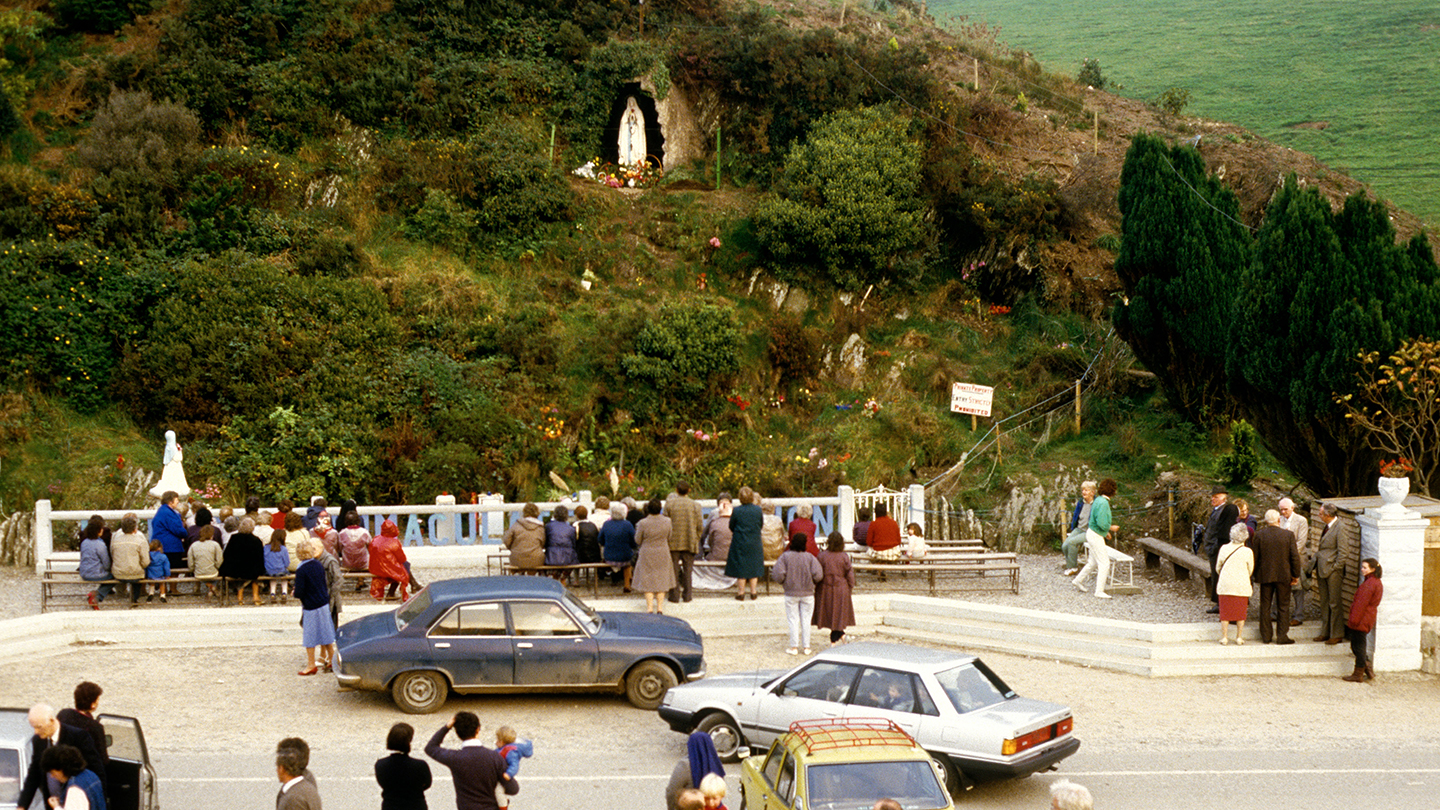
Everything changed that July, just a week after everyone had been glued to their television screens watching the Live Aid concerts in London and Philadelphia. Two women claimed to see the statue of Mary move at a hillside grotto outside the Cork village of Ballinspittle, and within days crowds of thousands were gathering daily to watch and pray around the statue. Huge numbers reported one kind of movement or other on the part of the statue, many saying they’d seen the face of Christ superimposed over the image of his mother. By early August one national newspaper was estimating that over 100,000 people had visited the shrine in the hope of seeing the statue move, the Irish police reckoning that 15,000 people had visited on 15 August alone.
By then the phenomenon had spread further again. In Inchigeela, another Cork village, two young girls reported that Mary had spoken to them at a grotto, first saying “Peace,” and then, “Bring more children to pray, tell the families to get together to pray the Rosary.” God, she had told them, was deeply sad. Mid-August saw reports of apparitions at shrines in Courtmacsherry and Melleray, the latter entailing biblical visions and warnings of satanic conquests. In early September a group of teenage girls in Carns, County Sligo, reported seeing a vision of Mary in a field, and over subsequent weeks, with hundreds and even thousands of people gathering nightly to pray there, further apparitions were reported. All told, apparitions of one sort or another were reported at over thirty locations around Ireland, though both claims and media interest tailed off as the year wore on.
Through it all, Church authorities remained cautious, if not outright dubious. Bishop Joseph Cassidy, then official spokesperson for the Irish Catholic hierarchy, expressed concern that the claims and gatherings risked harming people and bringing religion into disrepute. “I think there’s a danger that religion itself – genuine religion – would be ridiculed,” he told RTÉ, the Irish national broadcaster. “I think there is a danger that good prayerful people, and there are many good prayerful people out there, would have their expectations unduly aroused,” he continued. “And I think there’s a danger, thirdly that vulnerable people – fragile people, you know, people who are particularly susceptible to suggestion – might be emotionally or psychologically disturbed.” Furthermore, he said, there was a real risk of turning Mary “into a marionette.” Her function, he said, was not to move herself, but to move us.
Cork’s Bishop Michael Murphy initially praised the faith of the crowds gathering in Ballinspittle while refusing to endorse the apparition reports – given the rarity of direct supernatural intervention in life, he said, common sense demanded that claims of such should be approached with prudence and caution. A year later he was blunter still, issuing a statement that the sheer number of alleged apparitions was a strong pointer to their incredible character. “God does not display his power in such ways,” he wrote, continuing, “To portray Our Lady as giving an endless stream of messages, some of which border on the absurd, is another indication of unreliability.”
Others were less delicate in their skepticism; the various apparitions were widely mocked across the media, laughed at by the public at large, and fretted over by business figures and government officials who sought foreign investment and worried the country was becoming a laughing stock.
It is, of course, easy to exaggerate the scale of interest in the phenomenon. Perhaps 10,000 people were visiting Ballinspittle every day, but estimates of more than 100,000 people in total by early August, with many more over the course of the summer, don’t allow for double-counting and the likelihood that many pilgrims were repeat visitors. It’s worth keeping in mind too that at this point almost 95 percent of the Republic of Ireland’s population was Catholic, with more than half a million more Catholics in Northern Ireland, the overwhelming majority of these being weekly Mass-goers; even if 500,000 people had visited apparition sites that summer, for every Irish Catholic who had done so, seven had stayed away.
And yet, the numbers were still impressive, easily the biggest Christian gatherings Ireland had seen since roughly half the country’s population had turned out for the visit of Pope John Paul II six years earlier. The gatherings themselves had the distinct appearance of the kind of popular outdoor devotions that had been omnipresent in Ireland just two or three decades earlier, with large groups deep in prayer and recitation.
Of those who visited Ballinspittle, according to applied psychology researchers from University College Cork, fully 70 percent believed they had witnessed supernatural actions. What they had actually experienced, the researchers concluded, were optical illusions, tricks of the light caused by staring too long and too intensely at the statue in the evening light, with the ring of twinkling electric lights encircling the statue’s head not helping.
So what had driven so many Irish Catholics to believe something so unlikely was happening?
For all that the papal visit had drawn unimaginably huge crowds, and Mass attendance in general was still incredibly high in the 1980s – my own parish would have typically had six or seven packed Masses every weekend, some with people not merely filling the pews but lining the aisles – there was no shortage of signs that the health of Irish Catholicism should not be taken for granted. Research suggested that levels of religious belief were lower than levels of religious practice, while numbers of active clergy had begun to dip by the 1960s and were dropping again in the 1980s. Crowded churches concealed the fact of rising absenteeism among younger Catholics, and there was a distinct sense that to a large degree religious identity was merely a matter of convention.
Changes in how the faith was formally taught did nothing to help the situation, and may have made things worse. Many parents were confused about how to share their own religious beliefs – or even what those beliefs were, with a 1980 document from the Irish bishops expressing concern that many such parents were “going through adult lives with ideas about religion more suitable for primary schoolboys and schoolgirls than for modern adults”
During the 1970s, older “dogmatic” approaches focused on learning and explaining the definitions in the Catechism were briefly replaced by attempts at more “kerygmatic” methods focused on the stories of the Bible and the person of Jesus, only for these to be abandoned in favor of methods which prioritized students’ own rather limited life experience. It was assumed, as Derek Scally notes in his book The Best Catholics in the World (2021), that the children were being supported in their faith lives in their homes and parishes. This assumption could hardly have been more wrong, as the “social catechumenate,” upon which national attempts at deploying new models of catechesis had been based, was dying by the 1980s.
Dying, but not quite dead.
It wasn’t just that the disintegrations that had marked Church life across Germany, France, Britain, the United States, and so many other countries had not yet ravaged Irish Catholicism – though this would come in due course, like a boot hitting a rotten door. Rather, it was that even in the 1980s, Irish imaginations did not seem to have been secularized or disenchanted to the same degree as others in the West. It remained common belief that miracles were in fact possible, that God could and did speak to people in words and images they could understand, and that he did so surprisingly often.
The Pope’s visit in 1979 had been a powerful reminder of this, centered as it was on his pilgrimage to Ireland’s national shrine at Knock, County Mayo. One summer evening a century earlier fifteen villagers had testified to witnessing a glowing tableau outside the village’s parish church: a sacrificial lamb standing on an altar, with the Virgin Mary and Saints Joseph and John the Evangelist standing by it. It was as though the veil between Earth and Heaven had been drawn aside, and the Knock villagers had been blessed with a glimpse of the divine liturgy.
The Knock apparition on August 21, 1879, followed by claims of further apparitions even across the Irish Sea in Wales, had not happened in a vacuum. Rather, there was a deep sense in popular Irish Catholicism that the boundaries between the natural and supernatural worlds could be gossamer-thin, and that there were places where this could be the case to cursed or blessed effect. The most obvious of these “thin places” as they’re sometimes called nowadays, were the tens of thousands of “fairy forts” that dot the Irish countryside, and the 3,000 or so holy wells that had been places of pilgrimage and implicit resistance against religious persecution.
It’s easy to sneer at such popular religion, with its superstitions, traditions, and lore, but anybody who takes the time to trawl through the thousands upon thousands of reports the Irish Folklore Commission gathered from schoolchildren across Ireland in the 1930s will find such scorn misplaced. Rather, this kind of piety, steeped in stories of Jesus and the saints, made for a deeply Christian culture, of a sort which – as Pope Francis wrote in his programmatic Evangelii Gaudium: The Joy of the Gospel – bore witness to the faith it had received, by translating God’s gift into its own life and enriching it with new and eloquent expressions.
In hindsight, it seems that the “Moving Statues” epidemic of 1985 was not merely enabled by a popular willingness to believe that the very landscape was sacred and that God would act miraculously there, but by a desperate need for hope. It’s striking that the crowds who gathered at the grottos were lay people, with priests keeping their distance and bishops looking askance on the whole affair.
If there was a feverish quality to the events of that summer, it should be remembered that the early 1980s had been a profoundly anxious time for Irish Catholics.
Along with a succession of national elections and a viciously fought national debate over abortion, the decade was marked by a series of grotesque and unsettling stories, beginning with the hijacking of an Irish airplane by an erstwhile monk who demanded to be told the third secret of Fatima. The deaths through starvation of ten IRA members while on hunger strike in Northern Ireland’s notorious Maze Prison soon followed. Subsequent years would see national headlines dominated by stories about the discovery of a wanted murderer in an apartment owned by the State’s attorney general, the kidnapping of a champion racehorse, the death of a teenage girl after giving birth at a Marian grotto, and the killing of hundreds of people by Sikh terrorists who exploded a bomb in an Air India flight off the coast of County Cork.
Small wonder, then, in such distressing times, that some Irish imaginations had been caught through the early 1980s by reports of a succession of Marian apparitions at the Yugoslavian village of Medjugorje. The reports began in June 1981 and drew Irish pilgrims in sizeable numbers. Among these would be one of the girls who would in turn claim to have seen visions at Carns, County Sligo. Clearly offering at least a kind of genetic precursor to the Irish phenomena, the Medjugorje apparitions supposedly continue to this day, though Pope Francis in 2013 echoed the Irish bishops of 1985 when he pointed out that the Mother of God is “not a postmistress, who sends messages every day.”
Perhaps so, but the obvious question stands, and it’s the same question that the Irish “moving statues” phenomenon invites. Why do people believe such things, especially in the face of skepticism on the part of Church leaders? Part of the answer, it seems, is that they need to, or, more precisely, that they need to believe in something. As Christians, we need spiritual nourishment for a mature faith capable of thinking prayerfully and praying thoughtfully. It is a damning comment on the evangelical, pastoral, and moral failures of modern Christianity that too often deprived of solid food from hands we can trust, we turn to moving statues to fill the spiritual needs we continue to feel.