Book Excerpt
A Christian Response to Fascism
How a pacifist Christian community responded to the 1933 mandatory referendum endorsing Adolf Hitler.
November 12, 2026
Try 3 months of unlimited access. Start your FREE TRIAL today. Cancel anytime.
START FREE TRIAL NOWA Christian Response to Fascism
How a pacifist Christian community responded to the 1933 mandatory referendum endorsing Adolf Hitler.
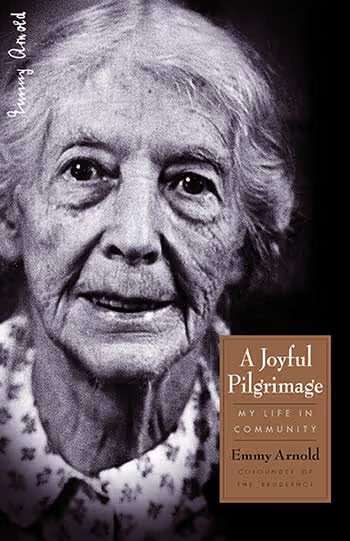
[.article__paragraph--leading]It was natural that as the only founder of the Bruderhof still alive after World War II, Emmy Arnold would one day be asked to tell her story. She was already in her seventies when she began the project, but the details she recounted were as alive for her as if they had happened the day before. The original handwritten German manuscript for what became the book A Joyful Pilgrimage evolved from the author’s notes, some made as early as the 1930s. The following excerpt is taken from the chapter “Conflict with Hitler’s State.”[.article__paragraph--leading]
[.article__paragraph--cap][.small-caps]By the summer[.small-caps] of 1932, the spirit of Nazism was thriving among many in Germany: “It can’t go on like this! It is time to put national interest above self-interest! We need a strong leader!” All this sounded fine, but those who saw deeper realized – on account of Hitler’s own ominous pronouncements – how dangerous a leader he might be. And yet, was the steadily growing power of the Bolsheviks any better? We could only hope that both threats, National Socialism and Bolshevism, would pass.[.article__paragraph--cap]
It was through a phone call from our son Heinrich, who was studying at an agricultural school in Fulda, that we first heard the news: Hitler had been appointed Chancellor of the German Reich, and had already taken office. The news came as a surprise to almost everyone, but to those who had a presentiment of what lay ahead, it was an especially great shock.
When new decrees and legislative changes were posted each day, we knew we could expect nothing good. Gleichschaltung (the Nazi policy of forced conformity, or “equalization”) and the persecution of the Jews were among the first things we heard about. Schools, monasteries, and communities were closed down because they did not want to be “equalized.” Germans were expected to greet each other with the salute, “Heil Hitler,” and most people complied, assuming that there was no other way. What a pitiful sight it was to see an old lady like our Grandmother Arnold salute someone in this manner! Yet we could understand why people were afraid to say what they really thought about such matters. Anyone who did was labeled a “traitor to the people and enemy of the fatherland.”
Every problem, every evil, was blamed on the Jews. At the entrances to many villages, signs were put up saying, “No admittance for dogs and Jews.” Soon Germans were no longer allowed to buy in Jewish shops. In some places, for example in Kassel, an area was enclosed with barbed-wire fencing, and anyone caught buying at a Jewish business was denounced and locked inside. Suddenly, the new “science” of race determined everything, and anyone who claimed “Nordic” or “Germanic” ancestry had to prove his “Aryan” bloodline. “Mixed” marriages between Gentiles and Jews were forbidden, and those that already existed were annulled, which caused untold suffering. Many Jews tried to emigrate to other countries, but it was far from simple – indeed, often impossible – to obtain the necessary papers.
Soon columns of Storm Troopers, Black Shirts, and Hitler Youth were parading through even the smallest towns and villages. Their marching songs, especially Die Fahne hoch! (Raise high the flag!), were sung everywhere with great enthusiasm. Such aggressive groups came marching through our Rhön Bruderhof too, but they soon realized that we were not willing to participate in their activities. In many a members’ meeting we discussed the question: to what extent should we give an opposing witness? We wanted to act openly at all times. We would not be “equalized,” that is, accept all the new decrees, and we could not say “Heil Hitler,” since we did not believe that Heil (salvation) came from him! Naturally this often got us into trouble on the street or in the shops. But how could we cooperate? It was no question to us what spirit Hitler served, and we refused to have anything to do with it.
Already in the first months of 1933 we heard about the closing of schools, particularly progressive ones; about dissidents being deported to concentration camps; about the State’s growing opposition to the churches, Catholic as well as Protestant. Before long, free speech was effectively forbidden on all fronts, and every bit of public information had to pass by the censor. Conditions were ripe for disaster. No one knew what was really happening, and the press was no help. Now and then we might see a cryptic notice like, “Another Dangerous Communist Nest Discovered!” but beyond that we knew little.
What were we to do? We all felt the same: we must continue to live for the witness entrusted to us and to speak out. “It will depend on who holds out the longest,” Eberhard said. And so we continued to build. In the spring and summer of 1933 we again had many guests, including some who wanted to stay. Our discussions with them, in particular those concerning National Socialism, were intense, and at times it felt as though every word counted. This was especially true toward the end of the year, when the political climate grew even more repressive. We were not surprised that several who had earlier asked to become members left us, as things grew more dangerous; Eberhard half-jokingly called them our “summer novices.” One who did stay was Günther Homann, who worked in our library and archives with great dedication, year after year, until his death.
At Easter 1933 we baptized eighteen new members, most of whom had come the previous year and made clear their intentions to go the way of the cross with us, come what may. Among them were Hans and Margrit Meier, Peter and Anni Mathis, Edith Boecker (later Arnold), Susi Gravenhorst (later Fros), Gertrud Loeffler (later Arnold), and two of our children, Hans-Hermann and Monika. Coming as they did in such a critical time, the baptisms of these new brothers and sisters gave us fresh courage and strength for the way we all had chosen.
In June, despite objections from her parents, we went ahead with the wedding of Marianne Hilbert, a teacher in our school, and Kurt Zimmermann. Tensions with the families of people who came to join us were not unusual, of course, but as Nazism took over the country, the battle lines were drawn more clearly, even among relatives. It had to be all or nothing.
Earlier, after Edith Boecker had joined us, she had been pressured by her parents to come home to Hamburg, at least to say good-bye. Once she arrived, they attempted to talk her out of returning to our community, and when this did not work, they took her travel money and locked her in a second-story bedroom. In the end, Edith escaped: she made a rope with her sheets, let herself down from the window, and made her way back to the Rhön Bruderhof.
Relations with local government authorities were not much better, and Eberhard visited them frequently to clarify our position – namely, that discipleship of Christ, as we understood it, could not be compromised with the demands of National Socialism.
In October, in an effort to lend legitimacy to his government, Hitler ordered a nationwide plebiscite. On October 27 Eberhard went to the authorities in Fulda to explain our attitude to the upcoming plebiscite. An official there told him, “If you don’t vote ‘yes,’ Dr. Arnold, there is only one thing left: concentration camp.” Eberhard returned home by taxi. As usual, he walked the last stretch, taking a shortcut over the brow of the hill; this time, however, he slipped on the rain-wet grass, fell, and broke his left leg. Luckily Alfred had gone out to meet him with a lantern, but he was unable to help him to his feet. Running back to the house, he fetched Moni, who came back with him, took one look at the leg, and diagnosed a compound fracture. They had to carry him home on a stretcher.
Eberhard was in great pain, and it was clear the leg had to be operated on as soon as possible, so the next day we drove him back to Fulda, where he underwent surgery. Once back home he was confined to his bed for several weeks.
The plebiscite, which took place on November 12, was not a free election in any sense, but a closely watched show of force. Every person of voting age was compelled to go to the polls, and the authorities made a point of informing us of this. What should we do? After much soul-searching, we decided to go. Rather than refuse to participate – rather than simply say “no” to government, like anarchists – we would use the occasion as an opportunity to witness to our beliefs in a positive way.
Eberhard formulated a short statement declaring that insofar as government was instituted by God, we respected it, but added that our mission was a different one: our task was to live according to the way of Christ, as a corrective to the rest of the world. After discussing this statement in a members’ meeting and agreeing to use it, each of us copied it on a piece of gummed paper. Then we went down to Veitsteinbach, the village in whose district we belonged, stuck our statements to our voting slips, and returned home. How surprised we were the next day, when the newspaper reported Hitler’s politics had been affirmed at the ballots with a unanimous “yes”!
Four days later, on November 16, our Bruderhof was the target of a surprise raid by the SS, SA, and Gestapo (secret police). About 140 men surrounded the Bruderhof, and no one was permitted to leave his or her room or place of work. Uniformed men stood at every door, and others pushed their way into apartments and searched every room. Books and letters seemed to be of special interest to our visitors, and even personal letters of engaged and married couples were read and ridiculed. Documents from abroad – for example letters from Hardy, who was studying in England under the sponsorship of a Quaker friend – received extra attention.
The secret police searched longest, of course, in our archives, our library, and Eberhard’s study, where they expected to find writings and records that proved our “hostility to the state.” While the men pushed their way in and out of our rooms, overturning this, and opening that, Eberhard lay on the sofa with his newly operated leg. They probably would have liked to take him away then and there, and throw him in a concentration camp. But what could they do with this sick man? Late that evening a big car drove off loaded with books, writings, and records. What would happen next?