AI Editing Is Botox
What do we lose when we smooth out the natural wrinkles in our faces and our writing?
April 24, 2026
Try 3 months of unlimited access. Start your FREE TRIAL today. Cancel anytime.
START FREE TRIAL NOWAI Editing Is Botox
What do we lose when we smooth out the natural wrinkles in our faces and our writing?
[.article__paragraph--cap][.small-caps]The Cotinus coggygria, otherwise known[.small-caps] as the smoke bush, has become one of my favorite drought-tolerant plants. (I live in California, so it feels right to have one). I’ve spent the better part of my adult life navigating drought conditions and striving to find beautiful plants that thrive despite the lack of rain. I admire the smoke bush for its tenacity, but mostly I’m obsessed with its incredible beauty.[.article__paragraph--cap]
The smoke bush can present in several different colors, ranging from yellow to orange to shades of red and pink. I’m especially fond of those possessing a deep plum-colored leaf, boasting big, pink plumes. Though referred to as a bush, these plants more closely resemble a tree and can grow up to twelve feet tall. When the late afternoon sun hits the pink and purple wisps, I can’t look away.
The most arresting part of a smoke bush, though, is that when the flowers are spent – usually in the late summer – they produce these long feathery hairs that cover the plant in what looks like a purple haze. These hazy wisps give the tree a smoky effect, and thus, its name.
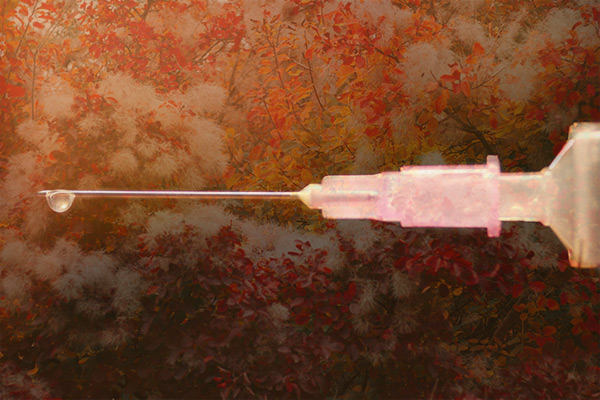
[.imgcaption][.smalltext]Photographs by Raghavendra Konkathi and Oleksii Rozanov / Unsplash.[.smalltext][.imgcaption]
[.article__paragraph--cap][.small-caps]Last summer I taught[.small-caps] an undergraduate advanced composition course with an emphasis on food writing. I was tired of my usual syllabus, so I’d designed this new iteration to breathe a bit more life into my teaching. We needed to have fun.[.article__paragraph--cap]
In most ways, this course was the delightful break I’d hoped it would be. I enjoyed vignettes about boba, restaurant reviews about sushi and smash burgers, and annotated recipes for roast chicken and risotto. However, as an accelerated summer course, students were tasked with completing a semester’s worth of work in just five weeks. A few of them lagged behind in the readings or skipped a class session, but they were (mostly) engaged and produced beautifully original pieces. So, I was surprised when, about midway through the term, a student turned in an essay that had been heavily modified by AI.
I could tell immediately.
When I asked him about it, the student replied that his draft was hard to wrangle. He couldn’t get the flow right. He didn’t like some of his transitions. So ChatGPT smoothed it out. Made it cleaner. Made it better.
It wasn’t better.
It read like it was written by a stranger, rather than the charming student who’d endeared himself to me with his unique interests, opinions, and tone.
I explained to him that I didn’t want a perfect essay; I wanted his essay, whatever that looked like.
[.article__paragraph--cap][.small-caps]I want to believe I can still identify my students’ voices,[.small-caps] even after all the AI updates. I want to believe the humanity still breaks through on the page. When I say “your tone, associations, and insights are unique and can’t be replicated” to my students, I want it to be true. But I’m increasingly worried that it’s not.[.article__paragraph--cap]
It seems we’re supposed to be grateful or excited that AI tools are advancing so quickly, but I can’t figure out why. For starters, no one is providing an affordable version of the robot I want: Rosie from The Jetsons. I don’t need a bot to write my emails; I need it to fold my laundry. Still, the prevailing message from OpenAI, Apple Intelligence, and other bot peddlers (can I call them that?), is that AI takes what is human and smooths it out, perfects it: emails, text messages, research papers, math equations, calendar entries, photos, emojis, sketches, design projects.
The communication around these updates repeatedly invokes ideals of both productivity and improvement. But to what end? Implied within all these developments, tools, and products is the message that, in fact, the bots will save us, optimize us, make us shinier and more appealing.
They call it human, but better. But is it? If AI is doing humanity better than we are, then what are we doing?
[.article__paragraph--cap][.small-caps]Exploring the natural world[.small-caps] has proven to be an effective coping mechanism for me amid what I think might be a tech-based existential crisis. I keep returning to the smoke bush. Most research about the smoke bush uses this phrase: When the flowers are spent. I’ve pondered this phrase for a good long while.[.article__paragraph--cap]
It means the flowers have withered and melted after blooming, a process called senescence. Senescence refers to deterioration from age. I turned forty this year, and perhaps because of this, I’m acutely aware of the many ways I’m experiencing my own senescence. While I’m reflecting on the ways I’m spent, I also have the joy of experiencing the deterioration of my preconceived ideas of excellence: my understanding of the world, my perception of myself, my perception of how others think about me. I’m discovering myself in a new way.
It’s during senescence that the smoke bush reveals its billowing plumes.
[.article__paragraph--cap][.small-caps]Early on in my summer composition class,[.small-caps] the student who ultimately relied on AI for editorial help on his paper had told me that he liked to hike. He’d grown up outside Yosemite National Park, and he planned to spend much of the remaining summer outside exploring. In a conversation with him about his essay, I reminded him how hard it is to hike. What it feels like to get dirty and dusty and need to stop to catch your breath or worry you might not make it to the top. I asked him if he thought taking a four-wheeler to the top of the trail would be the same. He said that taking a four-wheeler is nothing like hiking.[.article__paragraph--cap]
I asked why not: You’re still getting to the top.
He countered that getting to the top was not the point.
“Oh,” he said. Oh.
“This is a hiking class,” I said.
But now that I’ve spent more time with the idea, I think I may be more accurate in saying that all of life is a hiking class.
[.article__paragraph--cap][.small-caps]In her book, Syllabus,[.small-caps] artist Lynda Barry reflects on what it looks like when adult students learn to draw, or, rather, to draw again for the first time. They’re unable to produce what presents as polished, mature work. They feel self-conscious. Embarrassed by their juvenile productions. Barry writes, “But what if the way kids draw – that kind of line that we call ‘childish’ – what if that is what a line looks like when someone is having an experience by hand? A live wire! There is an aliveness in the drawing that can’t be faked. . . . Real aliveness of line is hard to come by.”[.article__paragraph--cap]
Real aliveness is neither smooth nor polished.
Real aliveness is a crooked line that represents so much more.
Real aliveness shows the journey.
Damn AI. Now I have to talk about Botox.
I didn’t really want to discuss Botox for a lot of reasons. For starters, it’s boring. I’m a middle-aged woman living in Santa Barbara; I’m in conversations about wrinkle removal more often than I would prefer. And I’ve done it. Twice. Wait. Three times. I’ve spent more than one thousand dollars to temporarily remove lines from my face. Lines that are not causing anyone any problems. Lines that 1) I earned by being wildly expressive and an easy laugh and 2) are not a medical concern.
I have just a few close friends who haven’t done it – because of financial constraints or autoimmune conditions. These friends routinely lament that in ten years they’re all going to look ancient. A legitimate concern. I’m saving money now, sure, but the price I’ll pay is that when I go out in public with my girlfriends, people are going to think I’m their mother. Of course, I suppose that’s only a negative if we think that looking old is bad. But . . . well . . .
The lure of perfection is ever-present, and now it’s more attainable than ever. But quick-fix perfection isn’t actually perfection; it’s a filter on reality.
That’s what all of this – the Botox, the AI edits – really is: a filter. If, as a society, we continue defining our humanity by visible perfection, if we redefine what it means to be alive – if we say that our living should be shiny and smoothed out, no live wires on the page or on our face – if we all stop hiking and just take the four-wheeler to the top – those of us still on the dirty path are not just left behind, we look like failures.
But even if we successfully erase the existence of our way of life from our bodies or our work, our humanity still lives inside of us, and what of that? Can that be perfected? Can that be filtered?
[.article__paragraph--cap][.small-caps]Most of us, of course,[.small-caps] have no interest in walking around wearing our flaws for the world to see. Right now, the prevailing messages seem to be that those natural human processes of living, working, creating, and aging aren’t good enough. They’re too hard. But what about effort? What about striving?[.article__paragraph--cap]
My children will often refer to kids at school as “try-hards.” This is an insult, unfortunately. They say things like, “Oh, that guy is so annoying. He always raises his hand in Spanish class. Such a try-hard.” These days I spend a lot of time trying to convince my kids that trying hard is, as the kids say, a flex.
I’m trying to convince everyone that trying hard is a flex, and the evidence of our effort is magnificent.
We have little control over any part of this human experience and that lack of control can be terrifying. Everything we do has the possibility of failure. It’s vulnerable, painful, and hard.
I think that’s why all this filtering and fakery is appealing. If we smooth out the rough edges of our existence, on the page or on our face, if everything is clean, polished, and beautifully presented, then our frailty is harder to grasp, and the illusion of security and control is within reach.
If everything looks perfect, perhaps we can forget that it’s all in the process of decaying.
But it is.
And we’re missing it.
What could we feel or be or enjoy or relish if we embraced our aliveness, which actually means embracing our eventual death? Our decay? Our senescence?
What happens to us when we habitually commit to erasing the chaotic humanity of our fragile selves?
[.article__paragraph--cap][.small-caps]Smoke bushes, of course,[.small-caps] have no choice in their own deterioration. Leaves can’t rage against the dying of the light, and I’m so glad. I’m deeply grateful the smoke bush can’t hang on to its foliage and insist that the supple purple color of its youth never fade. It can’t boast the perfection of the smooth, clean lines of its leaves. If it did, we would lose the stunning billowing hairs for which the tree is named.[.article__paragraph--cap]
Leaves need to change and wither in order to make space for the flaming, vibrant beauty that only comes from falling apart.