



Subtotal: $
Checkout

The World Still Being Spoken
Sci-fi novels like Isaac Asimov’s Foundation series and Frank Herbert’s Dune series hold echoes of a much older, and better, story.
By Jon Nichols
January 26, 2026
Human beings cannot live without a story. We need to believe that the events of our lives fit somewhere. We are desperate to know that the threads of joy and sorrow are being woven toward meaning. For most of history, that confidence was called providence. In this view, the world is a story still being told, and its Author is good.
Modern life keeps this structure but removes the storyteller. We speak of systems instead of purpose, of forces instead of will. What once was narrated as grace or judgment is now rendered as data. The old question – What is God doing? – has been replaced by another: What is happening? Yet both questions imply a need for meaning. We want to know that history is not random, and that someone, somewhere, is keeping the plot.
When that assurance fades, we begin to write for ourselves. We invent theories and technologies to hold the fragments together. We forecast, manage, and optimize, hoping that prediction can stand in for promise. The result is not peace but pressure, the feeling that the story depends on us and must never be allowed to fail.
Art, more honest than philosophy, keeps returning to this tension. In its myths and epics, the human heart confesses what the modern mind denies. Our stories of the future are never only about machines or empires; they are parables about providence lost and sought again. They ask, in a hundred disguises, the same old question: If the Author is gone, who writes the story now?
Every age has tried to see the future. Ours tried to calculate it. We built models for weather and markets, mapped the spread of diseases and ideas, and began to believe that if we gathered enough data, history itself might yield its pattern. It was the old dream of providence rewritten as science, and it found its most elegant form in the imagination of Isaac Asimov.
In his Foundation novels, Asimov turned providence into mathematics. His prophet is not a mystic but a statistician who believes that by measuring humanity at scale – every desire, every fear, every war – he can map the shape of history itself. He calls this new discipline “psychohistory,” and through it claims to foresee the fall of empire and to design its redemption, a plan that will preserve civilization through centuries of darkness.
It is, in a strange way, a sacred story retold without its God. Asimov keeps the moral architecture of scripture, the fall and the promise of renewal, but removes the presence of the divine and drains it of the transcendent. God is gone, yet providence remains, running on probability. The future is not prayed for but calculated. His mathematician becomes a kind of secular messiah, saving humanity through foresight rather than faith. It is not mockery but mimicry. Asimov meant to be humane, to preserve order without superstition. Yet what he built was a world managed from above, where mercy is inefficiency and freedom a statistical error.
A generation later, Frank Herbert’s Dune novels answered Asimov as though in protest. Where Asimov saw salvation in prediction, Herbert saw the curse that follows. His desert planet is haunted by visions of the future so vivid they destroy the possibility of choice. Paul Atreides, his reluctant messiah, becomes the prisoner of his own foresight. Time folds back on itself as every vision makes more certain the future he dreads. Herbert’s universe is mystical where Asimov’s is mechanical, but the logic is the same. Knowledge, stretched toward omniscience, erases responsibility. The prophet becomes another kind of machine, and humanity’s only hope is to flee beyond the reach of his sight.
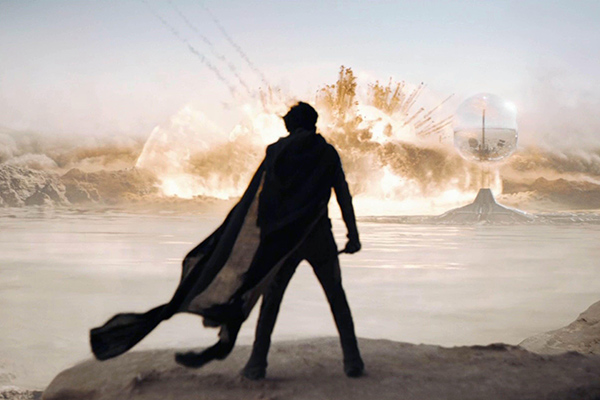
Photograph by Collection Christophel / Alamy Stock.
If Asimov built a human providence, Herbert pronounced its judgment. He saw that the attempt to play God ends in tyranny. Yet his protest remains trapped in the same circle. His world is the vision of a weary prophet who exposes the false gospel of technocratic faith but cannot imagine the true one.
Between them stands the modern condition. We build systems to manage the unpredictable and then curse them for stealing our freedom. We long for meaning but distrust authority. We drift between Asimov’s control and Herbert’s chaos. Their argument is still ours, the quarrel between a false providence and a world that no longer believes in any.
This is why their stories matter. The technologies that once looked like parables have become our daily liturgy. Algorithms track our choices and feed them back to us as fate. The news speaks in forecasts and the markets in prophecy. We read our own lives as data trends and call it truth. When that fails, we retreat into Herbert’s desert, into vision and identity and revolt, believing that meaning can be recovered only by tearing the system apart. We are the children of both empires, ruled by the math we built and haunted by the future we imagine.
These two myths are versions of the same inheritance. They are memories of providence without its revelation. Both reach for what has already been spoken, trying to rebuild in imagination what was once given in fire and cloud. The story they echo begins in Exodus.
Everything the modern world calls knowledge begins in measurement. But the first knowledge in Exodus begins in hearing. Before laws are given or seas divide, a voice says, “I have seen the misery of my people, and I have heard their cry.” It is a sentence without statistics. It is a sentence that shatters the silence of Egypt. Egypt’s strength depends on keeping the cries unheard. The God of Moses begins by listening.
That single act divides the world. Egypt represents everything that believes order must be absolute. It is the same confidence that built Asimov’s empire of data and Herbert’s empire of destiny. That egocentric conviction that the world can run itself if only the variables are managed. Into that closed world, God intrudes, not with a better plan but with presence.
What follows is the long undoing of necessity. Pharaoh’s heart hardens because control always resists grace. Each plague exposes a different idol of order until nothing remains but the question Pharaoh first asked: “Who is the Lord?” And for the first time, the future is not a calculation or a curse. It is a promise.
This is the story Asimov echoed without knowing it and Herbert rebelled against without escape. The mathematician kept the architecture of providence but lost its compassion. The prophet kept its awe but lost its hope. Both imagined worlds closed around their own genius. Exodus opens the world again through the living God who both commands and listens.
That pattern carries forward. The prophets keep its memory. The cross brings it to completion. In Christ, the Author enters His own story and ends every tyranny of self-made meaning. He is the Word that speaks creation anew and calls the lost world home.
We don’t live in Pharaoh’s Egypt or Asimov’s empire, yet their logic survives. The pattern remains. Empire keeps rebuilding itself in new forms, but the story of Exodus still speaks. The Author has not withdrawn. Every act of listening, every mercy shown, is a small defiance of Pharaoh’s logic. To live by faith in such a world is to believe that the sea can still part, that creation is still being spoken, and that the story is not over.
Yet even after the waters close, the question returns. Every generation feels again the same ache to know where the story is going and whether anyone is guiding it. We invent systems to secure the answer or prophets to imagine it, but both end in the same silence. The map is too small for the terrain.
What remains is the older, better story. A world enslaved to its own order is broken open by a God who listens. A people walk through the impossible and discover that time is not a cage but a path. History moves again because mercy moves.
That story still holds. It holds when the machines predict future economic outcomes, when our choices feel rehearsed, when hope seems like self-deception. It holds because the Author has not abandoned His book. To live by that story is not to escape the world but to inhabit it differently. It is to believe that love, not data, will have the final word. It is to stand, as Israel once did, between walls of water and trust that they will not collapse before the promise is complete.
Perhaps we do not need new myths at all. Perhaps it is enough to remember that the world is neither random nor ruled by us, but held, still held, by the One who hears.

You have ${x} free ${w} remaining.
This is your last free article this month.
We hope you've enjoyed your free articles.
This article is reserved for subscribers.
Already a subscriber? Sign in
Try 3 months of unlimited access. Start your FREE TRIAL today. Cancel anytime.
matt
Beautiful food for thought. Thanks