In the Footsteps of Saint Francis
A vibrant Franciscan community in the Ardennes attracts young people thirsty for faith.
March 7, 2026
Try 3 months of unlimited access. Start your FREE TRIAL today. Cancel anytime.
START FREE TRIAL NOW
[.article__paragraph--cap][.small-caps]When someone invited us for Mass,[.small-caps] during a holiday in the Ardennes, we didn’t expect too much. We come here for nature; the rivers and forests are vibrant and alive, less so the social life of the area. Many pubs and restaurants are closed, so are also most of the churches, remnants of a lively Catholic past.[.article__paragraph--cap]
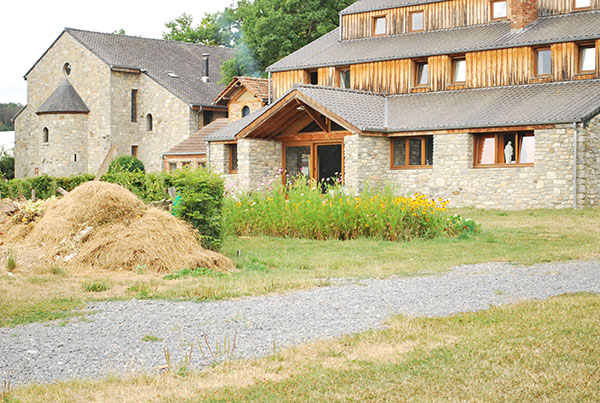
But when we arrive at the forested domain of Tiberiade, a new monastic community, just outside the village of Lavaux-Ste-Anne and walk between high trees and wooden buildings, we hear polyphonic singing coming from a big white festival tent at the edge of the field. Inside, a priest leads a service, clothed in a blue habit like some of his fellow brothers in the front. On the woodchip floor we see a few sisters playing instruments including a guitar and a traditional Senegalese kora. It’s a regular Eucharist, but it all feels very friendly, playful almost. Children crawl between the benches. The muddy bare feet of one sister shows she has already been in the vegetable garden. At the back of the tent sits a farmer, his dog on his lap. This appears to be the home church for many Catholics in the region, and sometimes even for the Belgian king, when he is in this region for a holiday, whispers a lady next to us. The small king comes here to pray to the Great King.
Tiberiade is a community, in the spirituality of Saint Francis. Prayer and manual labor are the fundamentals of life here. Their mission is to point people to Christ and to love the church. People can come to join one of the daily prayers or to spend a longer time here; anything from a day, a weekend retreat, or a camp to a gap year (a “sabbatical year”). But that’s dangerous, says Gustave, a thirty-year-old Belgian with Rwandan roots. When his year was finished, he felt so happy that, after finishing university, he decided he wanted to go back forever. “I missed the simplicity, the fraternity, but also the relationship to creation.” He’s taken temporary vows, since in the monastic tradition you have to think about it for at least six years before you can join for life. “But I wish to stay here for the rest of my life,” Gustave says. “That may be strange for someone coming from such a lively student life in Brussels. But maybe I’m a bit strange,” he laughs.
[.imgcaption][.smalltext]All photographs courtesy of Fraternité de Tibériade.[.smalltext][.imgcaption]
The lingua franca here is French, but to get some background information in Dutch, I turn to the Flemish brother Emmanuel. He takes me to a small room, where he sits next to a candle and an icon. It is the first room ever built here and it has no door, so we have to step through the window. “The community was founded by Brother Marc, a native from this village. He felt a calling to start in community on his family’s land. Not really big, maybe twelve people – that was his wildest dream. He went to the regional bishop, who approved, if he would find some fellow monastics and chose a monastic rule to adhere to. Marc chose a Franciscan rule, pledged the vow of chastity, poverty, and obedience, and waited. He wanted to pray and work, read the Bible and till the soil, and by doing so point people to the church and to Jesus. Many came, but nobody really wanted to stay.”
After a couple of years, Marc was visited by a carpenter who helped him build a roof. He was so impressed that he decided to stay and take the vows. His name was Joseph. Next came a fourteen-year-old boy who attended a youth activity and told Marc he would like to stay. “Come back when you reach adulthood,” Marc said. The boy did. Currently this man is responsible for the farmwork and the care for thirty cows, thirty sheep, six pigs, and three donkeys.
“Around thirty-one years ago I joined this small band of brothers,” says Emmanuel. “When I arrived here by train, I thought that this was my last trip ever. I didn’t know that I would spend many years in a growing community, doing missionary work in Belgian university towns or field trips in Asia to support persecuted churches.” Today Tiberiade has a second community for sisters in a village nearby, and there is another branch in Lithuania. “Next to Belgian, French, Italian, and people from the Baltics, we also have African and Asian brothers.”
In Emmanuel’s youth, church was mainly a cultural thing. “I had not yet met the living Christ. During a visit here I discovered for the first time that God is someone you can talk to, who can make you happy. In a special night of worship, I experienced something very intimate. I felt that Jesus called me, and invited to join, for life. I felt respect for my freedom. I studied law and had a girlfriend at that time. I felt that I was allowed to say no and that He would bless me anyway. But I chose to leave everything behind.”
It took three years to think everything through, and to finish his education. “I wanted to see it ripen; after all, it was so small here, it could have become a cult. But what touched me here was the authenticity. You don’t need subtitles here, you can see with your eyes that the spiritual life is the way to peace in our heart and between people. I could have been a lawyer, married, rich, and independent. Now I am celibate, poor, and obedient instead. But I am happy.”
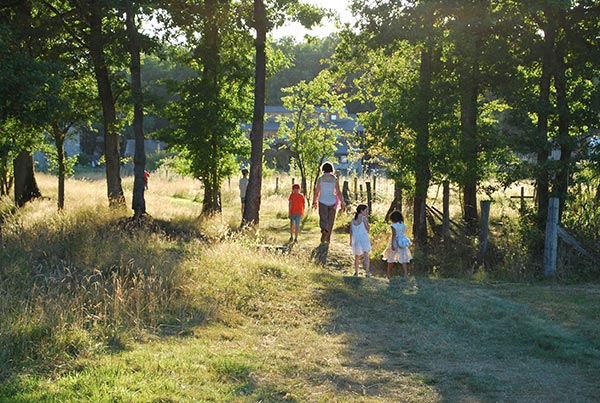
[.article__paragraph--cap][.small-caps]When we arrive in Pondrôme,[.small-caps] a village a few miles away, we meet the sisters of Tiberiade, around a dozen older and younger women living together. Sister Benedicte is feeding the goats and harvesting leeks for dinner.[.article__paragraph--cap]
There are not many guests today, so Benedicte has time to tell me about life here. “I joined in 2005, when I was twenty-six years old. In the beginning I lived with two other sisters in Lavaux, but after a few years we started this branch here. On Sundays, and during some activities, we join the men.”
Benedicte wears a veil and a golden ring. “Entering this life is like a marriage. And my veil, I don’t wear it out of masochism, but to be a sign of something else, Someone else. Is it hard to keep such a vow for life? Well, sometimes, but it’s not easy in a regular marriage either. Sometimes it’s a battle, if you are tired of work and you have irritations, or if you pray and you don’t feel anything. But it’s also a source of joy. I see here in our daily life that God is our King, that he loves everyone without end. If you start to discover this, everything changes. You start to see the beauty in everything around you.”
In the kitchen a few guests are preparing the meal when Sister Eva Marie comes in. She is Lithuanian, like a few other women here. “I met the brothers from Tiberiade in the ecumenical community of Taizé in France. During a youth camp, I discovered how beautiful it was here, living a religious life, in nature, with its simplicity, its hospitality, its mission. It took me some years to decide to join. I was an only child, so my parents were shocked. They didn’t really believe, but they had to let go of all their dreams of grandchildren. Now they have peace with my life.”
Prayer forms the fundamental structure of the days here. At 5.30 p.m., everyone heads towards the chapel. The sisters are joined by believers from the region. One of the brothers, who is an ordained priest, leads the Eucharist. One sister plays the kora to accompany the singing. Beauty is important; the walls are built with oak and natural stone, one of the walls has a replica Christ’s open tomb.
“It’s wonderful,” says Rania, a Flemish student who is spending a week here. “For the silence, without a smartphone. Maybe people associate nuns with sour sisters, but it is completely the opposite: they are full of fire and freedom; they radiate with joy.”
In a country that is still rapidly becoming secularized, Tiberiade provides many old and young people with a chance to revive their faith. And many people find their way to this place. Tiberiade opens its doors to everyone, believers and nonbelievers alike. I meet a Buddhist who is taking a retreat here to prepare for a hermit’s life in a cave in the Canary Isles. “Very often people come who know nothing about Christianity.” Emmanuel tells me. “In the past the culture was more aggressive, but now many are curious. I invite them to come and sit. Just sit and watch.”
So whenever I get the chance to be in southern Belgium, I come and sit. I sit and watch, listen to the prayers, try to understand the francophone liturgy, and appreciate the beautiful craftwork. I look at the friendship between the brothers and sisters, or listen to Sister Agnes playing the harp while through the open door I hear a robin joining in. There is a joy and earnestness here that seems to touch those of us who visit. It’s like a small piece of eternity, and I thank God for this place that invites everyone to get a small foretaste of it.