Kitty and Me
Over twenty years, a teen mentorship grew into something more: two women showing up for each other, learning how to love, to lose, and to stay.
January 21, 2026
Try 3 months of unlimited access. Start your FREE TRIAL today. Cancel anytime.
START FREE TRIAL NOW
[.article__paragraph--cap] [.small-caps] It was February 2005, [.small-caps] one of those bone-deep cold days when the wind slices through your coat. I was on a Brooklyn street corner waiting – again – for my “little sister,” Kitty. We had been paired for about a year through a mentorship program that encouraged twice-monthly meetups, but ours rarely stayed on schedule. Kitty – short for Katia – was fourteen: curious, introspective, perceptive. But her home life was chaotic, and she was hard to pin down.[.article__paragraph--cap]
When she finally appeared from beneath the elevated subway tracks, relief washed over me, until I saw what she was wearing: a thin shirt and no coat. In twenty-degree weather.
“Why aren’t you wearing a coat?”
“My mom said she’s gonna buy me a peacoat when she gets paid,” Kitty said proudly, as if that promised future coat was already keeping her warm.
Being a Florida transplant, I wasn’t entirely sure what a peacoat was, but I knew this was puffer-coat weather. “C’mon,” I said, nudging her into a discount shop. We sifted through racks together until landing on the cheapest, warmest jacket that would get her through the winter.
Tugging at the sleeves like a reluctant snowman, Kitty frowned at her reflection. “Miss Christina, don’t waste your money. My ma’s gonna buy me that peacoat.”
“Okay,” I said gently. “But until she does, wear this one. Otherwise, you’ll get sick.”
The money probably was wasted, because I never saw that coat on her again. But I never saw her in a peacoat either.
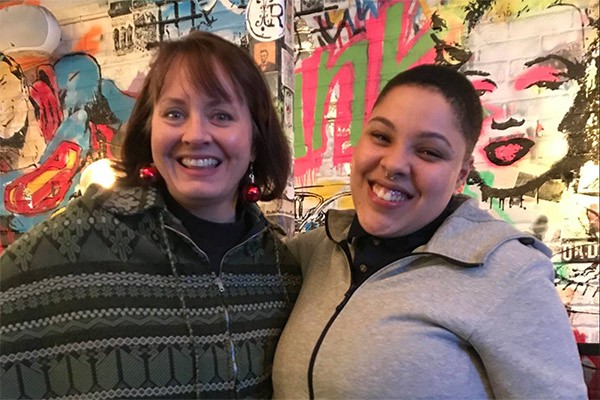
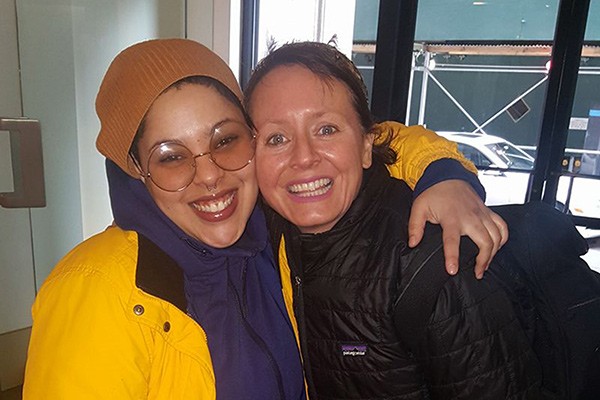
[.imgcaption] [.smalltext] Photographs courtesy of Christina Ray Stanton. [.smalltext] [.imgcaption]
When I reminded Kitty of that day recently over hot fudge sundaes, she shrugged – no memory of it at all. And why would she? It was twenty years ago. She’s thirty-four now, I’m fifty-six, and we’ve collected a lifetime of moments since then.
Somewhere along the way, that mentorship turned into something else: two women showing up for each other, through the years, learning side by side what it means to love, to lose, and to stay.
I could never have predicted this when I signed up through New York Cares , the city’s largest volunteer network. I’d been drawn to the idea of mentorship, of showing up for someone the way I wished someone had shown up for me.
It was impulsive. I was a typical New Yorker – overscheduled and harried – but a twice-a-month outing sounded manageable. I figured, well, I’m already going to galleries and grabbing brunch. Why not bring someone along?
Our first meeting was awkward. We sat together in a park, trying to break the ice. She was five feet tall, with huge eyes and cheeks, the smoothest skin, and a bright, easy smile. English was her favorite subject in school – mine was too – and her favorite food was pizza. I thought, “this might actually work!”
But scheduling our meet-ups was more challenging than I had imagined. The museums I loved were nowhere near her neighborhood, where she had a lot of demands on her attention. Her weekdays were packed – school, babysitting younger siblings, cooking, cleaning – and weekends meant visiting her father in jail. He was serving a ten-year sentence for reasons I never asked about.
The plans I once imagined for us fell away, causing me to reassess. I learned that it was less important to her where we went than that we were together. Which came to make sense to me too.
So we started at the McDonald’s near her school. It wasn’t the Guggenheim, but it became our spot for two years. We would sit and chat – she would share her life in a fast stream of updates, and I grew fascinated by her mind and her spirit. I found myself caring more about her each time we met.
Slowly, we made our way into the borough where I lived, Manhattan. At the Top of the Rock observatory, her eyes widened as the city sprawled beneath us. Though Kitty had grown up in this city, even she seemed a little daunted and disoriented by its scale.
Yet, she knew her own neighborhood like the back of her hand. As she spoke of the people and street corners that shaped her, I began to see a New York I hadn’t fully known – a world that gently nudged me past the edges of my quiet Florida Panhandle upbringing. As a newcomer, I realized, I was learning to find my footing in this enormous city too.
Despite the difference in our ages and backgrounds, we were both learning what it meant to belong.
She introduced me to her favorite rap artists, and I shared the music I was obsessed with at the time. After a trip to France, I came back hooked on a track by the French rapper Kamini called “Marly-Gomont,” and I played it for her. She froze.
“Wait … a Black guy speaking French?”
We both laughed. Not at the question, but at how weird and unexpected the song felt in that moment. Even in a city as global as ours, both of our worlds had their blind spots. For her, it was imagining Black life outside the context she grew up with; for me, it was realizing how narrow my own assumptions were. The tune ended up sparking one of our longest conversations about identity, place, and feeling “othered,” which, ironically, is the actual point of “Marly-Gomont.”
Union Square became our hangout and Max Brenner – “chocolate by the bald guy” – replaced McDonald’s as our new ritual. Who needed an art gallery when art, in the form of elaborate ice cream concoctions, was right in front of us?
At her first Broadway show, Xanadu , Kitty’s eyes lit up like the stage lights. At her quinceañera, I felt the same awe I had seen on her face at Xanadu . Marveling at her radiance in a billowy gown, I felt something shift in me. Kitty was no longer just “my mentee.” Something deeper had taken root.
We were becoming friends.
Kitty was always candid about her worries for her family, her love of school, and the way she felt invisible next to her siblings. I tried, in my own way, to share the comfort and guidance I had found in my Christian faith, hoping she might be inspired to lean on God as a source of strength and identity.
But still, I felt inadequate. I wasn’t a psychologist or a social worker or a parent – I was a licensed New York City tour guide, and, in an earlier chapter of my life, an actress on the stage. Yet I found I could relate deeply when she spoke about her absent father and her struggles with her mom.
I had grown up in a house that had everything except connection. My mother, lost in her own world, rarely looked into mine except to comment about my weight, my skin, the chips I shouldn’t eat. We never talked about what I loved or feared, never shared the quiet language that helps a mother and daughter truly see each other. Advice, comfort, and curiosity were not part of our rhythm.
I felt closer to my father, but he was almost never home. He hid in his work the way I hid in school activities, both of us quietly escaping the same hollow air. He died when I was twenty-two, and that snapped the last thread to my childhood. Untethered, I packed my life into one suitcase and left for New York, chasing something I couldn’t name. Maybe it was fame. Maybe it was freedom. Maybe it was the hope that, in a city of millions, I would find people who would like me for me.
I was still chasing that unidentified dream eleven years later when I signed up for the mentorship program. Maybe if I could offer an adolescent the support I had longed for during my childhood, I could heal a younger version of myself in the process.
When Kitty graduated high school, I felt proud. She enrolled in college, landed a job at Williams-Sonoma, and began reconnecting with her dad after his release. She seemed to be both launching and finding her footing at the same time.
Then, abruptly, it all fell apart.
She moved out of her family apartment, quit her job, went off social media, stopped answering calls. Five years of silence followed. I would sometimes see “Kitty mirages” in subway trains or in Union Square crowds, but it was never her. I would poke my head routinely into Max Brenner, hoping against hope that she might be sitting at our usual table, missing me. But she never was. I prayed for her safety, trusting that God would hold her when I couldn’t.
Then, one day, a text: Let’s meet. My heart leapt. I told her to pick the time and the place, and we settled on the base of the Brooklyn Bridge. I arrived an hour early, pacing, my nerves fraying, too restless to wait. And then, there she was, alive and whole. I felt the weight of the years melt away as we hugged. She was twenty-six and, finally, beside me again. For a long moment, I didn’t know whether to cry or laugh; I whispered a prayer of thanks.
Over diner fries and coffee, Kitty talked about needing space. Feeling unprotected and adrift, she’d been couch-hopping, trying to figure out who she was. Years of abuse and criticism had left her questioning her worth. Her dad had once promised he’d take care of her when he got out of prison – then, when he was released, he stepped back, saying, “Well, you’re already raised,” as if she were a finished product. So she pulled away, learning to rebuild herself on her own terms.
She cried with the quiet relief of someone who had endured what might have destroyed her. Turning twenty-six, she said, felt like stepping out of a burning room, having carried herself through the heat, fully aware of the strength it had taken to get there.
I felt proud of her, truly proud of the person she had become. I also felt the ache of knowing there were moments when I could have been more present, more helpful. But that didn’t diminish what she had achieved; if anything, it made me admire her resilience even more.
The reconnection launched a new relationship, this time as two adult women walking side by side. Which is where we are today.
I recently asked Kitty what our time together during the mentorship program had meant to her. She smiled, recalling our trip to a Greek restaurant and how it sparked her love of Greek food. She also mentioned the subway, laughing as she remembered learning how to navigate it through our jaunts, giving her the ability to move through the city like a New Yorker. Then she paused, as if weighing something heavier.
“But mostly,” she said, “you listened. You saw me. You put God in my world … but you never forced him on me.”
The simplicity of her words caught me off guard. I felt my throat tighten, that quiet ache that comes when love and grace arrive unannounced. Then she grinned, wiping away the sentiment with a laugh.
“You’re my girl,” she said, adding an expletive for punctuation, which is her way of keeping things real.
Through Kitty, I learned what it means to step out of endless doing into the raw, messy, beautiful reality of simply being present.
I wish I could say that Kitty and I each made peace with our mothers, but we didn’t. We are still learning how to live with that kind of loss: how to carry it, how to let it shape us without defining us. Kitty is still looking for love, for security, for peace. I still search for those things too. Therapy has helped us both, and so does our creative work – her music, my writing – each of us learning, in our own way, to turn pain into purpose.
I used to carry a quiet guilt. First, because I wished I could have done more for her when she was struggling, and later, because she didn’t embrace my faith. I had hoped she might find comfort and strength in it the way I have. Instead, she recently told me that my “Jewish faith” had really moved her. I laughed and said, “Close enough,” a little wistful that I hadn’t known the right words to share it.
Then I realized that choosing to stay in each other’s lives is its own kind of faith. The quiet kind that doesn’t convert or conform, it just endures.
And maybe love is like that too: not always the coat we imagined, but the one that keeps us warm.