A Season of Unveiling
Discussing new ways to observe Lent and a book of Lenten and Easter devotions that you shouldn’t miss.
March 3, 2026
Try 3 months of unlimited access. Start your FREE TRIAL today. Cancel anytime.
START FREE TRIAL NOW
[You can listen to this episode of Another Life on Apple, Spotify, Amazon Music, or wherever you get your podcasts.]
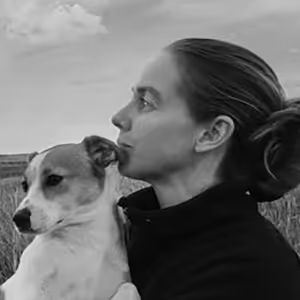
Joy Marie Clarkson: Welcome to Another Life, a podcast of Plough Magazine. Well, hello everyone, and welcome back to the podcast. I’m recording this on Ash Wednesday, which is the very first day of Lent, which is a season leading up to Easter that Christians across the world have observed and prepared for in various ways throughout most of Christian history. And today I’m so excited to welcome someone to the show who has been a long-time online friend. I find her writing and her pictures especially beautiful and encouraging. And I’m really delighted to welcome to the show Norann Voll. It’s wonderful to have you today.
Norann Voll: Thank you so much, Joy. It’s a pleasure to be here. It really is a long-time wish to talk with you.
Joy Marie Clarkson: Yes, when I started the podcast and pitched what I wanted for, I had in my mind that at some point I wanted to talk to Norann. So, all that to say, I’m very glad to have you on today.
Now, I always begin by asking people where they are physically in the world, because usually when we have these conversations, it’s with people dotted all over many continents. I will start with me. I am in my little East London flat. It is a sunny day, finally. We’ve had something like three straight weeks (with the exception of two days) of rain. So, we’re already all feeling very Lenten – very penitent – due to the weather. But it is a beautiful sunny day. And after this call, I will dash off to our university chapel service for Ash Wednesday. Where does this find you and at what hour?
Norann Voll: I’m sorry to be keeping you inside on such a beautiful day. It’s a pre-dawn morning here in upstate New York. So, it’s pitch dark. I’m looking forward to the sun rising in about an hour and a half. And I am sitting in my little apartment in the Mount Academy High School Residential Life Building, which is a story.
Joy Marie Clarkson: So, to give everyone a little bit of background, Norann is a member of the Bruderhof. So, I want to hear a little bit about the Mount Academy because that’s one thing. But also, why don’t you tell people where you have been for the last twenty-five years? Because if I’d done this with you a year ago, I don’t think I would have found you in New York.
Norann Voll: No, you would not have. So, I was raised in upstate New York, but my home for the last twenty-five years has been regional Australia, about eight hours drive north of Sydney. My husband, Chris, and I moved there in 2002, and we raised our three sons there. But since we’ve become empty nesters as of last year, the Mount Academy, which is the Bruderhof’s four-year high school, has been asking us to join their residential life team, because both of us love working with teenagers. I’ve been in the classroom for years. And we moved here last August to join the team here for this academic year. So, we went from a boy-only household to a dorm full of young ladies. And it’s been such a wonderful experience. We get to work with a dynamic team of staff and with students from all over the world. So even though it’s been a year of transition, it’s been one filled with wonder and deep fulfillment, I have to say. It has been amazing.
Joy Marie Clarkson: That’s wonderful to hear. How are you finding – and perhaps this will come up later as well – the transition from seasons? Because of course, if you were in Australia right now, you would be beginning fall. It would be beginning to turn towards winter.
Norann Voll: It’s very different, but this is where I grew up. So, it feels very familiar in many ways. The Australian Lenten and Easter experience is very unusual, because it is actually the end of summer; it’s harvest time. Can I just launch into that experience? Because it definitely has affected how I view Lent. In Australia right now, there’s fields of ripened sunflowers, there’s vineyards hanging with vintage, there’s wayside chicory blossoms. And then a very special, unique thing happens: the eucalyptus trees that dominate our woodland start shedding their bark in sheets. So, you have the sunflowers and grapes yielding the oil and wine, the chicories improving the soil nutrients, and then the shedding bark renews the tree’s health. So, in all the woods as you’re driving along, you’re seeing all the bark just peeling off, revealing a new color of bark underneath. And ecologically speaking, the reason that the tree is letting go of the bark is to rid itself of lichens, fungi, and parasites. So – of course, me finding nature metaphors everywhere – I feel that it is a very Lenten symbol, a Lenten metaphor of the process of repentance, sacrifice, prayer, and actually how that revitalizes our souls. It’s a time of holy harvest. And I love those metaphors. It took me a long time to find them, believe me, but they’re there.
Joy Marie Clarkson: That’s really wonderful to hear, because one of the questions I was going to ask you, which you have begun answering already, is that so much of the imagery of Easter and Lent is about new life and about springtime. And I will just say from my experience, because I also live somewhere different than where I was brought up... I was mostly brought up in Colorado. And Colorado has deep winters with deep snow. While I think technically Florida is the sunshine state, Colorado is the second sunshine state. So, it usually has three hundred days of sunshine a year. And often you’ll get these big snows in February and March, but they’ll melt off within a few days. And so, moving to the United Kingdom, I actually found winter much more difficult here than in Colorado, even though there was more snow in Colorado, because rather than getting tons of snow, you begin to understand why C. S. Lewis wrote that it was “always winter, but never Christmas” in the Chronicles of Narnia as the symbol of the curse, because that’s what it feels like here for months and months. From the end of November to sometimes all the way up until April, it’s just gray and drizzly. And there’s a romance to that, but you can get seasonal depression.
So, for me, that really brought a new depth to Lent. I always think of Lent as beginning around Valentine’s Day, somewhere in that region. It’s the forty days before Easter, which is also symbolic of the forty days that Jesus spends in the wilderness. And so, for me, it always starts in that place in the winter in the United Kingdom where you’re just tired. It’s no longer the beauty of Christmas, and you have lost the novelty of the New Year. And you begin in this weary darkness, and the days literally get brighter as you get closer to Easter. And then when you land at Easter, you have springtime coming, and things blooming, and blossoming, and beginning to grow. So, it’s this somatic, natural experience of what feels like death to resurrection that I find helpful even just in surviving the winter here. And so, I was curious about your experience of that with the flipped seasons.
But that’s really cool about the bark coming off, because on Ash Wednesday in many traditions, you literally go and get across the ashes on your head, and you’re told, “From dust you come; to dust you will return.” And it’s a reminder of our mortality, that our life is only so long, that we have to repent. And it’s a memento mori – remember you must die. But of course, now that I think of it, now that you said that, there’s so much memento mori, there’s so much of that repentance metaphor in autumn as well.
Norann Voll: There really is. But it’s harder to notice, I have to say.
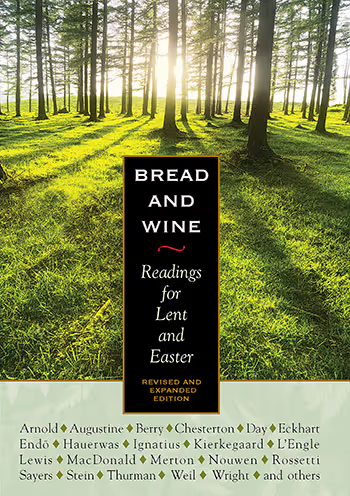
Joy Marie Clarkson: I was going to ask you this. You’re part of the Bruderhof community, which is the Christian community that started Plough and is the reason that I’m on this podcast. And so, I was curious about different Christians’ experiences of Easter and Lent. And part of this also is that I want to speak a little bit about the book, Bread and Wine, which we’ll talk about later. But it is a wonderful resource that is published by Plough that leads up to Easter with readings every day from different authors that help readers to spiritually prepare. So that was the motivation to talk about this. But I wanted to hear… I didn’t grow up in a tradition that celebrated Lent very much. It was something I vaguely knew about. But now I worship more in an England church, and so there’s quite a specific experience of that. So, I thought it would be nice to share what your experience of Lent is, what is your church community’s experience of the time leading up to Easter, and I can tell you a little bit about mine.
Norann Voll: Thank you. Well, each Bruderhof community will celebrate Lent a little uniquely due to the location and the culture. As I just told you, in Australia, we’ve rewritten our entire Easter hymn singing because so many of the hymns are about chicks and new life. But I think the unifying Lenten traditions would be singing Easter hymns already during Lent; reading and studying scripture – often we’ll divide into small groups just so we can do a deep dive; learning poetry – especially the children and youth learn a lot of Easter poetry; and often for the primary school students, producing original theater. And that usually has a musical component, often an original one. I remember in my year seven and year eight, we wrote an entirely new Easter cantata. Many of the songs have now made their way into our Easter traditions, and we sing them thirty years later. And as far as special foods, I think the traditions that span all continents definitely are the homemade hot cross buns for Palm Sunday.
Joy Marie Clarkson: That’s really wonderful to hear. So, if I could share a little about mine. I always try to make it to an Ash Wednesday service if I can, which is where you read all the penitential bits of the Old Testament where it says to repent. I’m trying to remember the readings from the Prophet Joel. And then it’s focusing on preparing your heart and repenting before coming to Easter. And then you’re marked with ashes, which are usually from the Palm Sunday crosses from the year before in most Anglican churches. I feel very bad about this, but I have a collection of Palm Sunday crosses because I never remember to bring them to church to be burned for Ash Wednesday services. So, on Palm Sunday, which is the Sunday before Easter, you’ll often be given these little palm fronds that are wrapped into lovely little cross that you use to celebrate Jesus being prepared to go to Jerusalem with the palms. And then it’s really cool because then the next year those are burned, and you’re marked with ashes to remember that from dust you come, and to dust you will return. So, I always like to do that, although I always feel somewhat ambivalent about whether to leave the ashes on my forehead or not, because on the one hand, it’s cool because people can ask you about it, and you can say, “Oh, it’s from church.” But then the reading also says that “when you pray, don’t let anyone know you’re praying; and when you sacrifice.…” The reading is about inner holiness, not outer. So sometimes I take it off. And especially because I think more than people saying, “Why do you have ashes on your forehead?” They usually say, “Just so you know, you have something on your forehead.”
Norann Voll: Have you been today yet?
Joy Marie Clarkson: I have not been today yet. My normal church service had theirs at 7:30 a.m., and I’m not as noble as you. I could not get up and out of bed and to my church at 7.30 a.m. So, I’m going instead to the service that’s held … I work also at King’s College London, and so they have a service for all the students around lunchtime. And I’ve done that for the last years, and it’s really wonderful. It’s really exciting. London is a very multicultural, multi-religious place, and it’s also a very secular place. So, it’s not somewhere you would necessarily expect there to be a really full student chapel service. But I’m always amazed that it’s always packed. And it’s really exciting to see. And I wonder, are students coming here because they’re already Christians? Is it something that they are just curious about, and they want to experience? And so, I find doing it at the university exciting.
But that kicks off Lent. And then in my church, there’s often special Bible studies to get deeper in scripture. Some people fast something or spend special time praying or wanting to give to a cause. And then another thing in my church – which is typical, I think, of a lot of the older liturgical traditions – is you can’t say Hallelujah during Lent, you can’t get married during Lent, and you can’t get baptized during Lent. All of those things you save for Easter, which may seem kind of extreme, but it is the season of repentance. And then it’s really exciting because you come to Easter and dozens of baptisms and weddings start happening. And it’s just this joyous experience. It’s this restraint that leads to delight. And that’s expressed in the fact that in the normal liturgy, “Hallelujah” is taken out, and you don’t say that until you get to Easter, and then either during the Easter vigil or on Easter morning – either the Saturday at midnight service or the Sunday morning of Easter – the priest finally says, “He is risen!” And you say, “He is risen indeed! Hallelujah!” And it’s just this wonderful, joyous moment of “we’ve made it, and now we’re at this gift of Christ not only giving himself on the cross but rising again.” And you feel it in your body and with everyone else, and it’s exciting, and it’s wonderful. So those are some of the things that my church does.
Norann Voll: Many of our communities have a tradition of Easter sunrise with a fire. And that’s when we all greet one another with the “He is risen! He is risen indeed! Hallelujah!” So, it’s lovely to hear about your traditions. That’s amazing. I love the restraint. And I was going say that unlike anywhere else, Australia has taught me to sit with the discomfort of Easter. Just in the same way that you’re talking about the grayness, that lingering cold, the lingering dark, in which we look for signs of new life and resurrection, Easter in Australia has taught me the same thing, too. It’s a softening of the seeds and a new gentleness and then the glory of Christ being risen and celebrating that.
Joy Marie Clarkson: That’s so special. Also, I love that you all do a bonfire as well, because that’s actually one of the oldest traditions, I think, in Christianity that’s shared by a lot of traditions: the imagery of fire. For some reason, that’s very common. So often there will be a bonfire as well. What is it burning? I can’t remember what the fire is burning, but you burn something on Easter Vigil also. So, there’s a big bonfire. I’ve been to several where you almost get a little frightened because they’re a little out of control. It’s exciting. But it’s a part of the exuberant joy. You need this release after a long season of waiting.
Norann Voll: My sons have lit some pretty legendary ones.
Joy Marie Clarkson: So, I want to talk a bit about Bread and Wine. So, I said earlier that in my growing up, we were in a more non-denominational world. And so there weren’t a lot of ways to prepare for Easter. It was something you could do, but something you didn’t necessarily do because you didn’t want to. It didn’t want to be something you did out of works, right? It was something that you did more seriously. But the one thing that my family did do for Advent and Lent – I think we did it for Lent as well – was that we actually read the Plough books we had. Watch for the Light is the Advent. And then the Lent and Easter – and now Lent and Easter and all the way up to Pentecost – collection is Bread and Wine. And my dad would read to us. He would sit us all down and read out loud whatever daily passage it was. And that was a really special part actually of my childhood, especially Watch for the Light and then later with Bread and Wine. And we have a new edition that’s just come out that goes all the way up to Pentecost. But you were telling me that your husband was involved with the first edition. Is that right?
Norann Voll: Yes, my husband Chris worked for Plough for many years. He still does on and off on occasion. He’s a great writer and a wonderful poet. And he helped assemble the first collection. And I actually believe that he came up with the title Bread and Wine. And I remember we would have been, newlyweds or just a little bit into our marriage by that point, but he would bring home selections and poems and say, “Should we include this? What do you think about that?” So, we are really excited about this new edition because it’s certainly become part of our Lenten tradition to read it. And we’re looking forward: we’re just so excited about the new edition. So excited.
Joy Marie Clarkson: It’s really beautiful. There has been a lot of hard work that’s been put into it. It has most of the old readings. A few that have been replaced or redone. But it’s also exciting because they brought in new contemporary authors and it’s even richer than it was before. And one of the things I love too is it exposes you to such a broad range of authors from many different Christian traditions. Everyone from C. S. Lewis to… I don’t want try to name all of them. I will not name the right ones. But we have Eric Varden, who’s the bishop of Trondheim in Norway who’s only in this edition. And I think he’s just such a wonderful thinker and writer. And so, it’s so exciting to have this new edition with some new authors or some new old authors gathered in.
Norann Voll: And I love how they shortened some of the passages so that it can fit better into your normal devotional routines. I think that’s seems really helpful.
Joy Marie Clarkson: Yes, it’s very doable for a morning’s reading. And I think especially if you’re in a busy season of life, if you have little kids, if you’re working a lot, to be able to have something that is just small and nourishing and accessible is really helpful. So, you’ve mentioned both helping to discern which readings should go into the original edition and also the general practice of Lent and Easter in your community. I was curious if you have any favorite authors or poems or hymns for this time of year.
Norann Voll: I love to read Bread and Wine every year, and I’m starting my new edition today. I’m getting my copy today. I’ve looked at the soft copy, but I’m actually going hold the book this afternoon. I’m so excited. But another devotional by Plough, The Crucified is My Love by Johann Ernst von Holst, is a wonderful read. But I love to revisit my favorite mystics: Julian of Norwich, Hildegard of Bingen, Meister Eckhart.
The poetry I return to every year – Jane Kenyon, Christina Rossetti, and then my favorite is The Everlasting Mercy by John Masefield. And I’ve taught it for many years to advanced students, but it’s something that Chris and I read together, read aloud, and just savor even the last few stanzas every year.
Joy Marie Clarkson: Yes, I love many of those. Also, I didn’t know Jane Kenyon until encountering her through Plough books, but she has quite a powerful writer. One of the things I anticipate and get excited about in Lent is all the Easter hymns. And one of my favorites is “Now the Green Blade Riseth.” I’m just going to read some of the lyrics from that. And it does go again to that imagery of spring. So, it says:
[.blockquote]Now the green blade riseth from the buried grain.
Wheat that in dark earth many days has lain.
Love lives again that with the dead has been.
Love has come again like wheat that springeth green.[.blockquote]
And it goes on several verses, and it ends with this verse:
[.blockquote]When our hearts are wintry grieving or in pain,
Jesus’s touch can call us back to life again.
Fields of our hearts that dead and bare have been.
Love has come again like wheat that springeth green.[.blockquote]
And I’ve always just loved that. It’s to a traditional tune. And I’ve always found it very haunting and almost playful. But I love that imagery of almost the inevitability of resurrection – that every year, it seems unlikely that spring will come again, and every year it happens. And this is this powerful cosmological imagery of the way that Christ’s resurrection will bring us back to life. So that’s one of my favorite hymns I look forward to singing at Easter time.
Norann Voll: It’s one of my favorites too, and Chris and I have actually done a recording of it that we set to Australian imagery a couple of years ago. I’ll send you the link when we’re done with the podcast. But it’s just one of my favorites. It’s a family favorite as well. So, thank you for sharing that.
Joy Marie Clarkson: I love that. And I love to know that you set it to… because I was going to say that it is very strongly this northern hemisphere imagery. So, it’s so cool that you set it to Australian imagery.
One other question I wanted to ask you was thinking about showing hospitality in this season. I think of you from far away as someone who is very good at and enjoys hospitality. I have to be careful when I look at your Instagram because there’s a one in three chance that it will be something very delicious that you have just baked or made or a salad. And especially when you’re in Australia, all these just incredibly lush vegetables. So, I think not only in your love of cooking, but also just in your general attitude, you’re someone who shows great hospitality. And I imagine that you’re in a whole different mode of hospitality now that you’re overseeing the boarders.
Norann Voll: Yes, I am. Yes.
Joy Marie Clarkson: So yes, how can we show hospitality in this season?
Norann Voll: Well, I just always feel – and it’s a growing sense as each year passes – that in every way possible, opening not just our homes, but also our hearts during Lent is really important to whoever crosses our paths. And I often find that the people I meet during Lent, either in person or online or through mutual friends often have a profound impact during the rest of the year. I don’t know why. That’s how it is. And right now, I’m in the most amazing season of as far as food goes internationally, because I have two Africans and a Japanese student, two Australians and a parcel of Americans in my dorm house. So, we are having Ramadan foods from Lagos, which include very hot, spicy peppers with eggs buried in the sauce there. And then special dumplings to celebrate the Lunar New Year from Japan. And the Australians are just having a bit of a pavlova time, even though pavlova is usually a Christmas dish, they are just feeling like pavlova and making pavlova. And then the Americans are going for this sort of sweetbreads, the kneaded sweetbreads. So, my house is a revolving feast. So, what I love about this Lent is that, quite honestly, every single one of my usual traditions is being upended. And it’s been a year of holy interruption, and I’m really learning to welcome that. So, I would probably be saying something completely different a year ago, and probably be saying something different a year hence, but may it always be that way that we are open to the newness that Christ wants to bring in our life daily through other people.
Joy Marie Clarkson: I love that. And as you mentioned, this is an unusual year because the beginning of Ramadan, lunar new year and Mardi Gras, Lent, all happened around the same day. And so, in London, it’s been just totally wild. There were tons of fireworks two nights ago. And I was like, “Are we getting these because the beginning of Ramadan, or are we getting it for Lunar New Year, or is it a Mardi Gras parade?” It could be any of them. But I think there’s also something wonderful about the season and that it reminds you how much food can be a way of both welcoming people and also sharing a part of who we are. The other time I remember this happening – where there was an overlap with numerous things – was when I was living in an international dorm during my masters. And I think there was one year when Ash Wednesday overlapped with Passover, and one of the students who lived in the dorm who was an observant Jew and was going around giving people… what’s the leaven the bread without leavening? Matzah. He was giving people matzah and saying, “Eat the bread to remember the tears of my people.” And he was very funny and he was being playful and lighthearted. But it was interesting because it was a way to invite people into the story that shapes his own faith. And he was always very curious about what the Christians were doing. And he felt that the Catholics did it better than the Protestants. But there is this specialness about the way that food is something that can both welcome people into the story that we’re telling, and it can also be a way to exclude people, right? If people can’t eat something or whatever… so, something I like to think about is how am I showing hospitality and also telling the story of what I believe in by the things that I bake or cook or by welcoming people in. And I also like how in some traditions, there is the idea that a part of preparing for Easter is showing a special love to the stranger and the lonely. That’s actually a part of preparing for Easter. And so that’s something I’m thinking about in this season is how to show hospitality and show it through food.
Norann Voll: I think I’m noticing it even more at the dorm, because it is an international dorm, that those seasons are definitely tied to food traditions and home. And I think the intense homesickness, the longing for our loved ones, is really increased during these times. And it’s so important to find the stranger in your midst wherever you find yourself and welcome them in and make them feel at home through the table. It’s just such a unifying force in our lives wherever we are. And I’ve seen that. I’ve always known it to be true. And I’ve seen it around my home table but seeing it at a dorm table – or we have a beautiful kitchen bench where fifteen students can sit around and see that the laughter, the conversation, the connection is just amazing when you’ve have a bowl of dumplings and some chopsticks.…
Joy Marie Clarkson: That is very true. I did both Shrove Tuesday and Lunar New Year yesterday. We went to Chinatown and had a lovely dim sum lunch. So, I feasted greatly. Although a lot of British people got mad at me for calling American pancakes “pancakes” because apparently, they don’t think they’re pancakes. But I persisted my American ways. I like a crepe, but I like a good fluffy American pancake as well.
Well, there are so many more things that we could talk about and say. I’m going to ask you my final question, but are there any final encouragements or thoughts you would give people as they’re heading into the season leading up to Easter before I ask you my final Another Life question?
Norann Voll: Well, my girls, my students asked me yesterday, what could they give up for Lent? And we talked about all the traditional things that people like to give up: chocolate or social media, whatever it is. And I said, “Why don’t you give up things like gossip or negativity or turning the conversation to yourself or putting other people down.” And later in the day, one of the girls came back to me and she said, “I just love that idea of giving up gossip and negativity, but I don’t think I can give up both. I can only give up one.” And I said, “Listen, if you give up one, you’re actually giving up both. Because to take a moment where you want to think something or say something negative about somebody, turn that into a positive. If you have been given the gift of speech and connection, whenever you have the opportunity to put somebody else down, actually bless that person with your words or if you’re not speaking with your thoughts.” So that was something that I’ve been thinking about since yesterday – that we really use this time because we never know how many days we have to be present to one another and to love one another. And we’re thinking: “Easter’s coming” or “I am going to do this in summer” or “How do I prepare for the Advent season later this year.” We don’t know how many days we have, and let’s use each one each day to bless, to love, and to show grace and kindness.
Joy Marie Clarkson: I love that so much. And I think something else I would add to that is that even if you find yourself struggling with giving something like that up, there’s something about having the intention to give up negativity or something like that, that you find yourself falling into regularly. That even if what it mostly produces in you is every time you have that temptation, you speak to God about it and pray and say, “I’m doing it again.” There’s a real gift in that because it leads you back to talking to God more, if you’re putting it in a very basic sense. And that’s something that I found helpful. Even if you’re not particularly successful with what you’re trying to give up, every time you have the temptation to get near it, to open your heart to God, that is a way of bringing us closer to God, even in our own failure. And it reminds us that Lent is not about God’s favor or being perfectly prepared because that is a work that God does in us not just through our own effort. But that’s something that I found helpful.
Norann Voll: And it is a time to be more attuned to the work that God is trying to do in us and not put ourselves under pressure, but rest in this time of listening and meditation and community around these things. I always ask, “God, what are you going to do next? Show me. Show me in the season.”
Joy Marie Clarkson: I have a terrible confession, which is that I actually often get a little bit nervous around Lent because I found that – it is perhaps a little bit superstitious – but I have generally found it to be quite a spiritually potent time. “Lord save us from the time of trial.” But I have often found it to be a season of apocalypse in the true sense of the word, which is an unveiling of what is happening in our lives and what is happening between other people. So, I always get a little bit nervous around it. But I also try to trust, to put it into God’s hands and ask him what he’s doing in my life.
And I guess one other thing that has been helpful is something you said – that it’s also about community, and it’s about what God is doing in our community and how we celebrate this with community. And that can help us also be faithful in Lent, because it’s not just on our own effort and this isolated thing with being with others. And the final thing I was going to say is about adding something rather than taking something away as well; not just trying to fast something, but trying to be more attentive, trying to read Bread and Wine every day, trying to do one thing that brings you closer to God. Something that is a bit like a nutrition. The new fad is “Don’t restrict yourself; add vegetables; add nutrients.” And I think about that spiritually in Lent. It’s not about restriction; it’s about coming closer to God and adding things. Well, this has been so delightful to talk to you, Norann. I could go on for many hours. But alas, I must live within the constraints of the podcast format.
So, I will conclude with a question that I ask all of our guests, which is: What is one thing, and it could be a person, a practice, a poem, anything – it doesn’t have to start with P. Those all happen to be P’s, but it doesn’t have to. What is one thing that helps you remember that another life is possible?
Norann Voll: Being attentive to springtime is something that just helps me realize that God can do anything, newness is possible, new beginning are always there and just around the corner and that we serve a God who is always busy, very busy, writing new chapters. And I’m so excited right now too. We’re sixty days past the winter solstice. And there’s already this new scent that’s rising from the woods. The owls are mating, the skunks are in their mating season, our bald eagle pair are sitting on their nest. And being attentive to springtime is just a reminder that we serve a God, and we live in a world where all things can be made new.
Joy Marie Clarkson: I love that. Thank you so much. And thank you for joining us, and thank you everyone for listening. I hope that you will pick up a copy of Bread and Wine. It really is a very nourishing and deep resource for this season. But thank you, especially, Norann, for joining me, and I wish you a very beautiful Lent and Easter when it comes.
Norann Voll: Same to you, Joy. It’s been a pleasure speaking to you today and every best blessing for this Lenten season.