Unwelcome Pruning
Lenten lessons from a crop of grapes ruined by Australian wildfires.
February 21, 2026
Try 3 months of unlimited access. Start your FREE TRIAL today. Cancel anytime.
START FREE TRIAL NOW
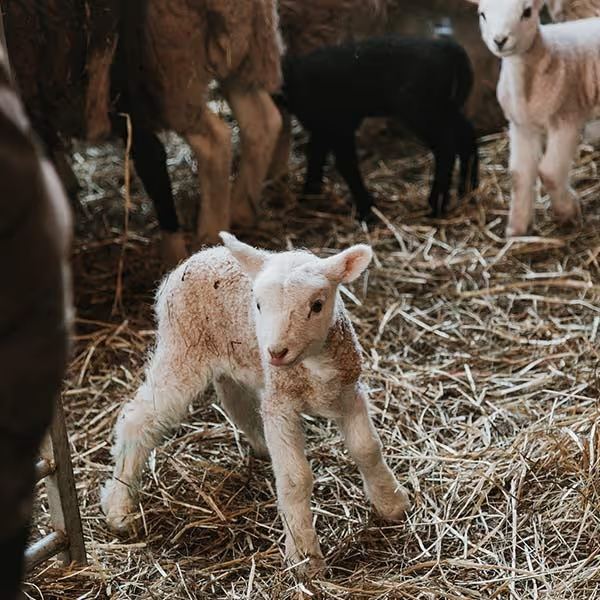
[.article__paragraph--cap] [.small-caps] Each year of my childhood [.small-caps] during March and April, I watched for signs in the upstate New York countryside that indicated the nearness of Easter: the first snowdrops or aconites, the bright green tips of skunk cabbage, or new lambs.[.article__paragraph--cap]
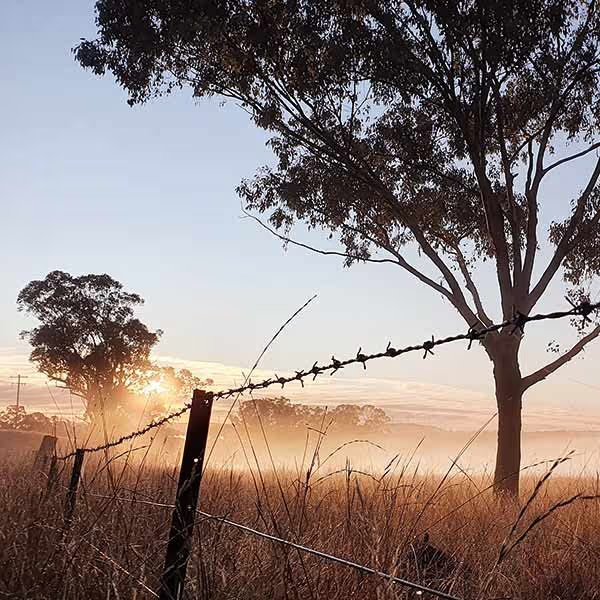
In the years after moving to the Southern Hemisphere, I think I missed these signs altogether. But after over two decades here, I’ve learned that the seasonal changes in regional New South Wales are more subtle. Here, Easter comes not with spring but fall. And Easter’s harbingers are certainly present. In fact, the natural metaphors seem to strengthen the sense of dying to self in order to obtain a more abundant harvest.
As newly arrived Americans-Down-Under, my husband, Chris, and I did our best to put down roots in our adopted homeland. But when Easter came around, I couldn’t help longing for familiar “new life” symbols. Symbols that seemed to me joyous and relatable: hatching chicks, fresh green grass, and cherry blossoms.
In this land of “upside down” seasons, as Easter neared and summer turned to autumn, the more difficult issues of death and dying and slowness slouched over the landscape. That’s when I found myself aching for home and springtime.
Our local First Nations people regard this time of seasonal shifts as the end of the “sun time” and the beginning of the “frost time.” But rather than just being a forty-day wilderness of sorts, the line between March and April is demarcated by the “fruit time,” or time of harvest. When we consider how the apostle Paul refers to Jesus as the “first fruits of them who have fallen asleep” (1 Cor. 15:20–23) and use the weeks before Easter to cultivate our hearts and minds, Lent has the potential to become a fruitful season.
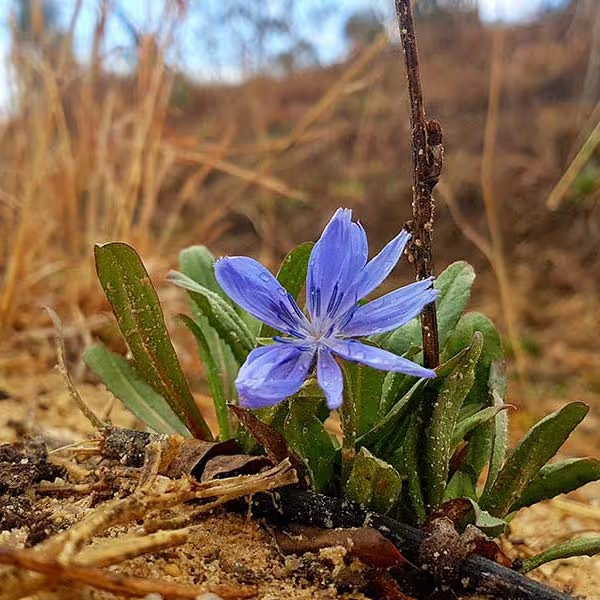
During Lent, wide fields of ripened sunflowers, vineyards of vintage, and wayside chicory blossoms surround us. The eucalyptus trees that dominate our woodlands shed dead bark in sheets. The sunflowers and grapes yield oil and wine, the chicory improves soil nutrients, and the shedding bark renews the trees’ health. Along with the bark, the letting-go process enables the tree to rid itself of lichens, fungi, and parasites.
In a similar way, the Lenten process of repentance, sacrifice, prayer, and pilgrimage strengthens and revitalizes our souls; it’s a time of holy harvest.
It reminds me of how my farmer father taught me to stay closely attuned to the seasons – sowing, waiting, growth, birth, death – and to embrace the miraculous amid the painful, the wonder alongside the wild.
Unlike anywhere else, Australia has taught me to sit with the discomfort of Easter.
Years ago, a nearby organic winery called us because they needed help for an early morning grape harvest. It was just before Lent. The sugars were right, the rains and frosts were staying away, and the trucks were lined up to haul the grapes from the hills to the city for immediate pressing. But the vineyard’s manager didn’t have enough workers to help with the harvest.
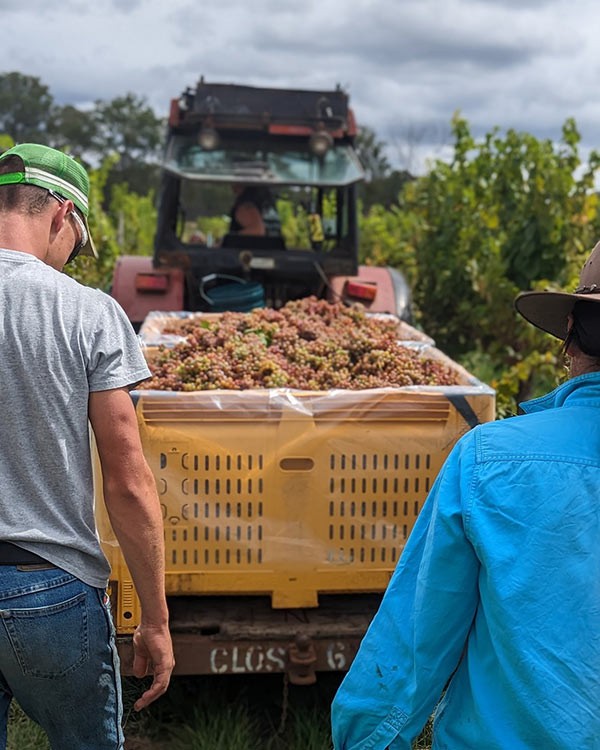
We drove through magnificent eucalyptus forests rugged with rounded rock sculptures to arrive predawn. There were a dozen other workers from the area, none of whom we knew. Our first invitation was to pick the sauvignon blanc grapes on the “Hill of Dreams,” the hillock where the owner had planted the very first vines. We began the work – snipping the bunches of grapes with tiny sharp scissors, loading buckets, and tipping them into wooden crates on the back of a small tractor.
[.imgcaption] [.smalltext] Photograph courtesy of Norann Voll. [.smalltext] [.imgcaption]
The sun rose, curious native bees arrived to investigate, and we moved on from the “Hill of Dreams” to other vines, other grapes. We finished in the heat of noon, our hands sticky with sugar, and a slight ache in our backs as we sat on cooler chests around the homestead porch and enjoyed sandwiches and cold beer with the other workers while the laden trucks pulled away through the forest to be crushed in a town some three hours away.
Picking grapes before Easter became a yearly tradition. We always came to the vineyard early, not knowing anyone else who was there, working hard with our hands as we learned names and stories, and then feasting together afterward as the trucks drove away.
Until the year of the fire.
It was a bumper year for the vineyard – a long drought had favored the rare Nebbiolo and Gewürztraminer grape varieties which thrive in granite soil. No mold or rot had threatened the perfect bunches, and the spring used for irrigating had not run dry.
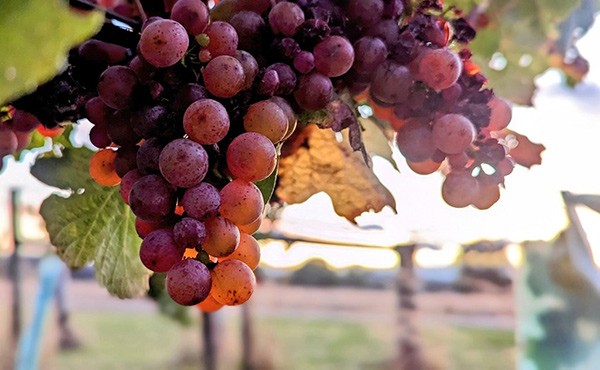
But one night, fires that had plagued the dense plateau around the vineyard ignited the neighboring pine forest. The team struggled all night alongside the local firefighters to keep off the flames, but embers were parachuted from the forest, and fell on the vineyard, burning many vines and damaging most of the grapes with smoke. That year we helped with a different kind of harvest. The charred vines were laden with fruit, and even though they were destroyed, the grapes needed to be removed from the vines.
We volunteered our time to cut the seemingly perfect, ash-tinted grape clusters – and let them fall to the ground. The scorched branches and bunches were cut off as well, until, in some cases, there was only one stubborn piece of vine clinging to life.
I had always wondered about Jesus’ words that “every branch that bears fruit he prunes, that it may bear more fruit” (John 15:2). Now I better understood. In order to heal, there had to be hurt. Row after row, over several days, we worked. Nothing could be saved. But still, we ended each day with feasting, reminiscing about earlier harvests, the fire, and the future. Sometimes, to lift our spirits, we sang. When we washed our hands at the homestead spigot each evening, the ash remained on our fingertips.
[.imgcaption] [.smalltext] Photograph courtesy of Norann Voll. [.smalltext] [.imgcaption]
That “harvest” helped me realize I had been relying on old ways of seeing, because, in the lead-up to the joy of Easter Day, Lent is a time of “not yet,” of uncomfortable waiting, of fallow fruitfulness, of unwelcome pruning. It’s a time to gather and let go, to refocus and renew, to hope and to heal – in equal measure and with as much courage as that requires. So often, it’s the kind of waiting when we get to watch our earthly plans destruct as eternal plans take shape.
As T. S. Eliot writes in “Little Gidding”:
[.blockquote] The dove descending breaks the air
With flame of incandescent terror
Of which the tongues declare
The one discharge from sin and error.
The only hope, or else despair
Lies in the choice of pyre or pyre–
To be redeemed from fire by fire. [.blockquote]
[.blockquote] Who then devised the torment? Love.
Love is the unfamiliar Name
Behind the hands that wove
The intolerable shirt of flame
Which human power cannot remove.
We only live, only suspire
Consumed by either fire or fire. [.blockquote]
Just as the fruit of the land must be harvested and pressed and shared, we must allow our hearts to be processed, renewed, and repurposed. But more than allow it, we must use this time of Lent to desire it. It’s not easy.
And sometimes, it requires the duality of fire – both the ruination and the redemption. I can be that perfect bunch of ash-covered grapes that needs to be cut and still be part of the harvest. I can be those over-reaching, smoke-ruined vines with glossy leaves that need to fall under the harvester’s shears and yet contribute to a future harvest.
[.article__paragraph--cap] [.small-caps] That fire was six years ago. [.small-caps] In the years since, the vines have been replanted and the trellises rebuilt. This year they told us it’s been the most abundant harvest since the fires.[.article__paragraph--cap]
Let’s allow this time between sun and frost to be one of fruit.