Pets in Heaven
Aquinas may be dead right, but anyone who offers systematic theology to someone who has just lost a pet needs to learn a thing or two about love.
March 4, 2026
Try 3 months of unlimited access. Start your FREE TRIAL today. Cancel anytime.
START FREE TRIAL NOW
[.article__paragraph--cap] [.small-caps] We had to put Rupert to sleep [.small-caps] about 6:45 on a Saturday morning. He’d had a seizure about 6:00 the night before and when I got home was his usual self. But he had another about 10:30, which may have been the most frightening thing I’ve ever seen, and we took him to the pet ER. Our second daughter Hannah came with me.[.article__paragraph--cap]
I assumed that he’d get seizure medicine the way people do. By the time we got to the ER, he was OK again. I called our eldest child, Sarah, whose dog he was, to tell her. She was then working for Caritas in Bangladesh.
I thought the vet would tell us he needed treatment, and that he was old and this might happen again, but he was OK for now. I knew from her first words that he was dying and listened to her long, careful, kind explanation, waiting for the death sentence.
While he was waiting to be seen, she said, he’d had another seizure. Three seizures in eight hours was a sign that he was dying, probably of a brain tumor or stroke, she said. He wasn’t going to live long, and with each seizure he’d get worse, and he might start seizing and not stop till his brain burned out and he died. I had to call Sarah again. She decided to let him go.
[.imgcaption] [.smalltext] Photograph courtesy of David Mills. [.smalltext] [.imgcaption]
At about 5:00 a.m., they put Hannah and me in the room designed for families losing a dog or cat. We gave him a steak and egg muffin I’d gotten from a twenty-four-hour gas station nearby, and packages of beef jerky from the vending machine in the lobby. Sarah said to give him chocolate, which he loved and could not hurt him now. We got M&Ms from the vending machine. I called Sarah on video so she could see and talk to him – not that dogs understand phones. If you want to feel your heart ripped out, listen to your daughter saying goodbye to her dog.
We finally pressed the white button on the wall to call the vet to put Rupert to sleep. He already had a catheter in his leg and she gave him a sedative first. He sat between Hannah and me and slowly sank to the floor and went to sleep.
“I’m putting in the lethal drug now,” the vet said, and started pressing the plunger. We looked at Rupert, while stroking his head and back. “It’s done,” she said and took her stethoscope from around her neck, leaned over, and held it to Rupert’s chest for a few seconds and then looked up and told us he was gone. As she left the room, she said, not looking at us, “I’m sorry for your loss.”
Rupert was Sarah’s dog, but he’d been our dog too. We kept him for her when she went to Africa on six-week assignments and then permanently when she took a long-term assignment in South Sudan.
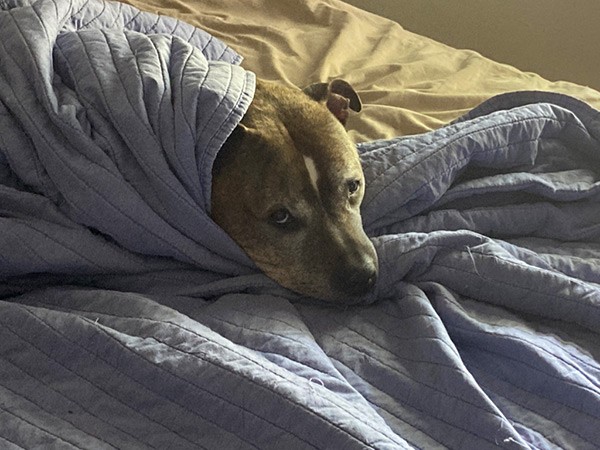
He was an emaciated, mangy pit-mix when she got him from the Yonkers Animal Shelter ten years ago, and he couldn’t bark but only rasp. The people at the shelter said he’d been found starving in the city park, and that he couldn’t bark because drug dealers wanted silent guard dogs and burned out the dogs’ vocal cords.
I tried to suggest other dogs when I saw how she felt about him. He then leaned against her leg, a gesture that always melted her heart.
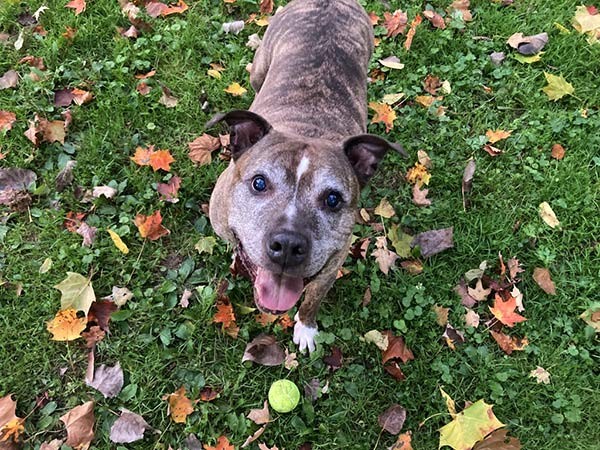
He grew into a blocky eighty-five-pound dog, with a big, flat head, small ears, a thin tail, a lovely brindle coat, and a beautiful happy-face. Sarah worked hard to heal him. He became a sweet dog, good with people and other dogs, and absorbed with his family. He had “food issues” and did not like being left alone. He learned to bark.
After we buried Rupert, I glanced at Facebook to see if anyone had sent me a message, and the post at the top of my page was a theologian’s explanation of why we will not see our pets in heaven. He gave the usual “animals don’t have rational souls so they can’t have immortal souls” argument, its logical steps reminiscent of a recipe in a cookbook.
But this writer thought he had good news for those who’d lost their pet. In the New Heaven and the New Earth, there will be animals! Dogs! Cats! As if this matters to someone who’s lost a dog or cat they loved. So you’ll have dogs, but not the dogs you loved. Big whoop. It was heartlessness dressed up as good news.
Theologians, especially the systematic ones, often argue as if they were snapping Legos together to make a jet plane from a kit to match the picture on the box. It will look like a jet plane, but not really like a jet plane, yet they treat it as if it were real. They don’t see the limits of building with Legos and that there are other ways to put the Legos together. The satisfying feeling of proving a point beyond reasonable doubt makes us quick to be right and unable to see that we might have missed something.
I appreciate intellectual systems. I enjoy reading Saint Thomas Aquinas and feeling his ideas click into place, everything in the right spot, until he gets to what seems like the inevitable answer. I appreciate how illuminating his systematic understanding can be. But I can’t help wondering if sometimes even he would have gotten to a different answer had he started with different assumptions, or had different experiences, or better understood others’ feelings. I’m sure that’s true of lesser theologians.
So with the theologian on Facebook. His good news wasn’t really good news, and I’m not sure why he thought it was. I suspect he just enjoyed too much the power given by being able to think through a system to an apparently undoubtable conclusion. The painful, confusing world becomes easier to deal with that way.
I’m almost sure he did not think deeply enough about love. He apparently did not himself know the love that can pass between a person and a pet and wasn’t wise enough to know he didn’t. His good news was that a loving God will supply you with simulacra. No one who’s loved an animal – no one who’s loved any being – wants a substitute. If the theologian knew this, he might have questioned his conclusion and not proclaimed as good news something that was not good news.
When you love creatures, you love particular creatures, creatures you know, with whom you have a history, creatures you love not as generic representatives of their type, but as individuals. Not just a dog, even a perfect dog, but Rupert, or our first dog Ben, or my dog, the great Moby .
[.imgcaption] [.smalltext] Photograph courtesy of David Mills. [.smalltext] [.imgcaption]
I’d written about this in an article I wrote ten years ago about Ben’s death. We hope for heaven, and for those things that will, as far as we can tell now, make heaven more heavenly. Love demands the particular things that have been loved. We hope for that look of recognition in our dogs’ faces as they see us again, and all the ecstatic yelps, wagging tails, and licking faces that follow.
The theologian wrote as if heaven narrowed and focused our love, when I think it perfects and expands it. Theologians sometimes write as if in heaven the vision of God will obliterate all other visions. They seem afraid that a lesser love will usurp the greatest love. I think it much more likely that enjoying the vision of God, we will find ourselves able to love others even more completely. We’re told it’s a vision enjoyed in community, where “with the Virgin Mary, the angels, and all the blessed,” as the Catechism of the Catholic Church puts it, “the blessed continue joyfully to fulfill God’s will in relation to other men and to all creation.”
Theologians! There is more love in heaven and earth than can be contained in your systems. God can supply rational souls, if rational souls are needed. He will supply everything we need, and it is reasonable to hope that that will include the creatures we have loved.
“I know he’s just a dog, but it’s bitter,” I ended a message telling some close friends, who’d been in our home and knew Rupert. A priest kindly responded, “I’m not sure there’s such a thing as ‘just a dog.’”
I should have said, “not human.” I couldn’t pray the In Paradiso for a dog, as I prayed it for my sister in the hospice when she died. But as Hannah said, as we were digging Rupert’s grave and found we’d disturbed the grave of one of the many rabbits and guinea pigs buried around our yard, “Guinea pigs are pets, dogs are family.” And as my friend the priest said, God “created dogs as sacraments of his extravagant love for us.”
The same priest sent me Pope Francis’s lines from Laudato si’ : “Jesus says: ‘I make all things new.’ Eternal life will be a shared experience of awe, in which each creature, resplendently transfigured, will take its rightful place and have something to give those poor men and women who will have been liberated once and for all.” Francis said, “each creature,” not “each human being.” It’s a vision, a glorious vision, that the systematic theologian’s system kept him from seeing.
I hope that Rupert will be one of those creatures, thinking of what he meant to our daughter and to the rest of us; of the way he always looked at me, head tilted to the side, as if I were a great mystery he had to decipher; of the way he liked to sleep with at least half his eighty-five pounds resting on you; of his friendliness to visitors and his attempts to climb into their laps; of the way he would chase balls until you both were dead with exhaustion and he’d still want to play; of the way he played with our papillon, one-tenth his size, by rolling on his back; of his vain attempts, huffing and puffing, to catch the deer he’d chased out of the yard; of his intense loyalty, his constant affection, and his place in our lives, now empty, a place that cannot be filled by another, a place we hope he will fill again, resplendently transfigured.