Cultivating Joy
Author and podcaster Kate Bowler talks to Plough about her latest book, Joyful, Anyway: Finding Delight in Impossible Times.
May 2, 2026
Try 3 months of unlimited access. Start your FREE TRIAL today. Cancel anytime.
START FREE TRIAL NOWCultivating Joy
Author and podcaster Kate Bowler talks to Plough about her latest book, Joyful, Anyway: Finding Delight in Impossible Times.
[.article__paragraph--cap][.small-caps]Joy is both an academic interest[.small-caps] and a deeply personal project for Kate Bowler. As a professor of history at Duke University, she has spent years researching the Prosperity Gospel and the American self-help industry – both of which she considers to be ideologies that sell the idea of happiness and well-being as a reward for perfect faith or enough determination to optimize your life. Since surviving stage IV cancer in her mid-thirties, Bowler has made it her life’s work to “tell the truth about our shared humanness,” a truth in which sadness and joy coexist. Her podcast, Everything Happens, deals with the strangeness of a world turned upside down by grief, and the surprising range of emotions that the aftermath of a tragedy contains: the way your senses can feel tuned right up, and the way laughter can break through pain in unexpected ways.[.article__paragraph--cap]
In her new book, Joyful, Anyway: Finding Delight in Impossible Times, Bowler describes how accepting and grieving the reality of our situation is an essential step toward making space for joy. She examines what she calls “the ache,” an insatiable hunger for more life and goodness that seems to be an innate characteristic of the human heart. She suggests that rather than being a design flaw, the ache is actually a prerequisite in the search for God’s presence.
Christian thinkers from Saint Augustine to C. S. Lewis have pointed to this hunger as an essential part of faith, a sign that there is a God-shaped hole in our hearts that nothing else can truly satisfy. Without being honest about the ache, we can’t orient ourselves toward God. As Bowler recently put it in her newsletter, prayer is a way of “casting a plummet into the depths … an honest sounding of distance between us and God,” the ache being “the pulley itself – the tug on the line, the evidence that we are still attached.”
Being aware of the reality of our suffering is important, but it isn’t an end point, Bowler tells me when we speak by Zoom. “Our culture’s response [to the ache] is typically to tell us to ‘be present’; it’s a neo-Buddhist framework for a kind of ‘awakeness’ that I do think is a precondition for joy. ... [However,] it treats awareness as if it’s a solution in itself, when in fact it’s not.” When we come to see joy as a counterbalance to suffering, and the ache as a clue that in fact we were made for more permanent joy, we can start to move toward a more integrated understanding of what we were made for, and of where these experiences are leading us.
If despair is a severance, a lie that tells us that the world is lost and joy is not possible ever again, joy is a restoration of wholeness that allows room for honesty about pain and sadness, along with the integration of the full spectrum of human experience. Joy allows us to see reality more clearly, including (and especially) our hunger for God.

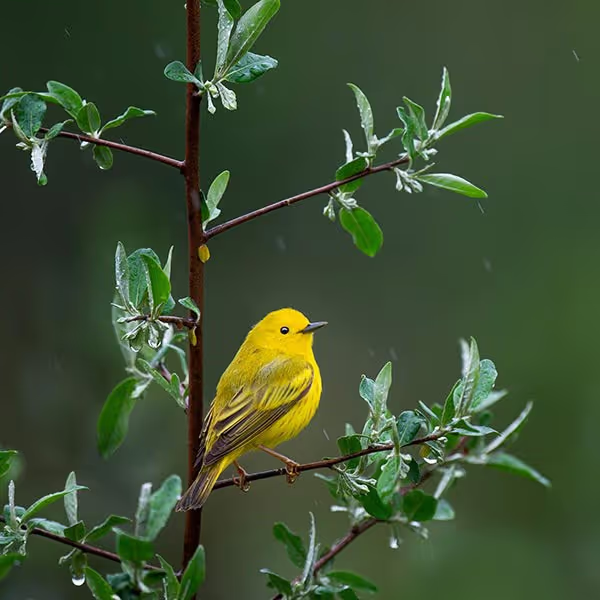
[.imgcaption][.smalltext]Photograph by Rikku Sama / Unsplash.[.smalltext][.imgcaption]
In Joyful, Anyway, Bowler calls joy the “cousin” of happiness, but makes a vital distinction between the two. As Christians, we’re called to experience profound joy in this lifetime as a foretaste of eternity, but we are not promised happiness. “Happiness is in many ways a story about our circumstances, our genetic happenstance – even the word happiness comes from the word ‘hap,’ as in happenstance, just meaning the stuff that happens to you,” Bowler tells me.
[.blockquote]So, a happy person is typically somebody who has been able to accumulate all kinds of small moments of luck and then stack them all together and have a wonderful mood. Happiness, we experience neurologically as a sense of ease, that things are going our way. It’s a very relaxed, pleasant, lovely thing and sometimes we can feel it in a whole season of our life, which is delightful.[.blockquote]
[.blockquote]Joy is not like that at all. Neurologically, joy hits our reward systems and gives us dopamine, yes, but it also engages our stress systems, which really helped me to understand why you can experience joy right in the midst of an unresolved, sometimes even catastrophic experience. You can’t be happy and sad at the same time, but you can be joyful and sad at the same time, which I really think is a neat trick. Joy enlivens us, it’s a big, bright feeling. If happiness feels very relaxed, joy feels like it expands our lung capacity. It allows us to breathe in our reality and say that, even in the midst of whatever pain we’re going through, this world is somehow still good.[.blockquote]
So why does joy make us cry? “I think it’s because we’re hovering around our deepest longings, our deepest loves,” Bowler says. “If we think about the ache as the awareness of our incompleteness, and of the hunger for eternity in our souls, and we think about joy as temporary wholeness, both are describing the shape of our loves. It is our loves that break our hearts; it is the knowledge that every beautiful thing is temporary. Our mortality is this strange player in all of this; it’s always tapping us on the shoulder and reminding us that everything is a glimpse of an eternity that we long for.” The ache is a constant companion to joy, Bowler says, because joy in this life is beautiful but temporary.
Bowler believes that our emotions can point us toward a deeper reality about who we are and who God is:
[.blockquote]Just listening to stories of how joy steals into people’s grief, I feel such awe every time. It’s one of the only things to me that feels like proof that we are loved, and that we’re actually promised not just that we’re supposed to survive our lives but that we’re somehow supposed to love our lives.[.blockquote]
What do we get wrong about God when we go to the extremes of, on the one hand, believing that faith will protect us from harm and suffering or, on the other hand, believing that this life is nothing but pain and suffering and all our reward will be in heaven?
“I think honestly this project started for me because I didn’t recognize any definition of joy,” Bowler tells me. As she started researching joy, she says that two things really started to stand out to her.
[.blockquote]One is Easter joy, a moment where we answer Samwise Gamgee’s question of “Is everything sad going to come untrue?” And at Easter we say yes, and we celebrate the eternity that is to come. But also I think God gives us joy now so that we can live this Easter joy in a time when the kingdom has not come, and things are still really pretty shitty. And so I think that joy feels like a Pentecost gift: something to keep us going. And studying Pentecostals for such a long time, [I learned that] joy was part of their vocabulary that helped me to realize we’re meant to delight [in life], and not just to endure [it].[.blockquote]
The other key thing that stood out to Bowler as she began to research joy was the idea of abundance, and understanding the nature of life as a gift. Her father is a historian of Christmas, and this taught her something essential about joy:
[.blockquote]My dad used to say that the thing about Christmas – and God – is that it has to be more than enough; we need the feasting, the celebration, and the excess in order to know something about God’s character and about why we’re made. I think that’s why joy is a response to this idea that we just need to survive, suffering is all we get, and we need to live with less and make do until we die. I think that we have examples in the Christian calendar every year that tell us that laughing until you cry, and reveling in the absurdity of wanting more, unlocks something in us and tells something about us and about God’s character.[.blockquote]
One of the most difficult questions about joy is how much agency we have. If we’re avoiding the Prosperity Gospel framework that sees material success and happiness as rewards for faithfulness and instead understand that there’s no formula we can follow to “achieve” joy, then how do we walk the line between acceptance of our situation and gently opening ourselves up to receive joy as a grace? Can we do anything to allow ourselves to be, to borrow C. S. Lewis’s phrase, “surprised by joy” more often?
When I share that, after my father’s terminal cancer diagnosis, I was surprised by how often people would ask pointed questions about his lifestyle, as if to try to find out what he did wrong in order to get cancer, Bowler recognizes the phenomenon instantly. “In an American self-help framework, we’re drowning in ‘everything is possible-ism,’ which is a Prosperity Gospel or wellness optimization story. ... People who think this way always assume that any tragedy is actually a failure of character, and so they will ferret through our lives, they will become accountants of our pain, in order to figure out what we did wrong.”
On the other end of the spectrum, there is “nothing is possible-ism,” which is essentially a path of nihilism and despair where we feel we have absolutely no agency at all. Bowler argues that we have to keep looking for the reality that lies in between these two extremes: “We refute despair by lighting that place inside of us [that is capable] of small meaningful action. I think there are some preconditions to joy; we have to open our aperture for reality, we have to clear out as much resentment as possible. Bitterness and ‘of course that would happen’ thinking are calcified negative expectations that make it very hard to be surprised by joy.”
The best way to cultivate joy, Bowler says, is to “lean into small ways of accepting love as an assignment” every day, like the elderly driver called Charlie whom she describes meeting in Joyful, Anyway. “Charlie felt that his homework from God was to be tasked with love” in the seemingly mundane daily interactions he had with people. Bowler adds:
[.blockquote]I do think there is a really interesting alchemy between saying yes to the person in front of you and then being surprised by the magic that comes with that. This is also something I’m learning in the improv classes that I’m taking; joy is highly contagious and it’s something we can give each other through inspiring, small actions. Finding that place of limited agency for joy is challenging, but there’s a lot we can do to prepare the way, and then we have to say yes and lean forward into love.[.blockquote]
That’s the thing about joy: it’s a gift that cannot be earned, a mercy that takes us by surprise every time, and, like all gifts, it requires our readiness to say yes to God.