Essay
What Is the Bible For?
The Bible is more than a repository of divine truths, or instructions on how to find favor with God, or a medicine cabinet filled with spiritual pain relievers.
May 22, 2026
Try 3 months of unlimited access. Start your FREE TRIAL today. Cancel anytime.
START FREE TRIAL NOWWhat Is the Bible For?
The Bible is more than a repository of divine truths, or instructions on how to find favor with God, or a medicine cabinet filled with spiritual pain relievers.
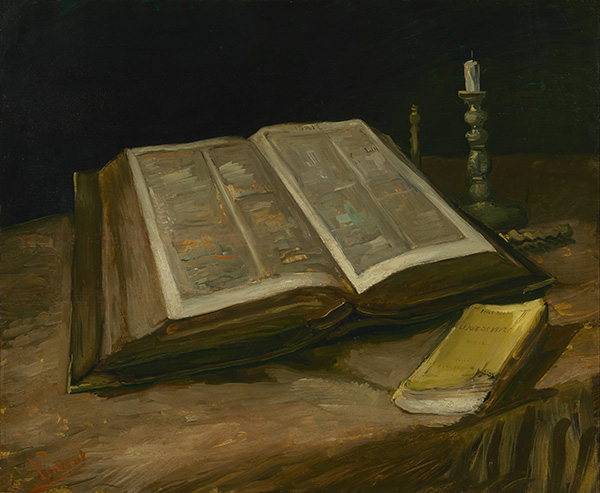
Vincent van Gogh, Still life with Bible, oil on canvas, 1885. [.smalltext]Wikimedia Commons (public domain).[.smalltext]
[.article__paragraph--cap][.small-caps]People often ask me[.small-caps] which Bible translation I read. Whenever they do, I feel my guard going up. Why are they asking? People use the Bible in so many ways. Some treat it as a grab bag for encouraging quotes about God’s blessings. Others use it as a cudgel to smash today’s idols with correct doctrine. Some are so obsessed with comparing translations and contextualizing and historicizing the text that they never get around to obeying what it says. I’ve been guilty of all of the above. [.article__paragraph--cap]
The Bible does indeed sound warnings regarding our rebellious ways. The Psalms do provide comfort, God’s promises do instill hope, memorizing scripture and meditating upon it can refresh the soul, and learning “to correctly handle the word of truth,” as Paul instructs Timothy, is important in guarding the faith (1 Tim. 2:15). And yet the Bible is more than just a repository of divine truths, or a religious instruction book on how to find favor with God, or a medicine cabinet filled with spiritual pain relievers to help our souls find some rest.
[.article__paragraph--cap][.small-caps]What is the Bible for?[.small-caps] This is the question my hermeneutics professor asked on the first day of class. Dr. Donald Burdick oversaw the original NIV translation of the New Testament. He was exacting and concise but also fluid; scholarly but extremely humble. “Translating the Bible isn’t easy,” he told us. “But there is something even more difficult – allowing the Bible to translate our lives. Our problem lies not in a lack of understanding but lack of heart. In the end, it’s not how much you go through the Bible that counts. It’s how much the Bible goes through you.”[.article__paragraph--cap]
It is natural and good to turn to the Bible for help. We obviously “see through a glass dimly” (1 Cor. 13:12) and need God’s word to guide our feet and light our way. Apart from divine revelation, we remain in the dark on many fronts. Yet the gift of God’s word lies not just in the insights it gives, but in the fact that when God speaks something happens. His word is “living and active, sharper than any double-edged sword,” the writer of Hebrews says. “Everything is uncovered and laid bare, before the eyes of him to who we must give account” (Heb. 4:12–13). The Bible, therefore, is less a divine textbook to be pored over and more like a window through which we look, and through which light comes in. We see and feel and ponder our lives and our world in a different light. Our lives are reconfigured.
This is why it’s not enough to just read or study the Bible. Something more is at stake. God himself wants to address us, and we must stand at attention. “Who can stand fast” before the word of God, asks Dietrich Bonhoeffer.
[.blockquote]Only the one whose final standard is not his reason, his principles, his conscience, his freedom, or his virtue, but who is ready to sacrifice all this when he is called to obedient and responsible action in faith and in exclusive allegiance to God. The responsible individual tries to make his whole life an answer to the question and call of God. Where are those responsible people?[.footnote-link]1[.footnote-link][.blockquote]
This is a haunting question. As French social philosopher Jacques Ellul reminds us, standing fast means “heeding God’s questions and risking ourselves in the answers that we have to give.”[.footnote-link]2[.footnote-link] “Brace yourself like a man,” God challenges Job. “I will question you, and you shall answer me!” (Job 38:3; 40:7).
In reading scripture, we must not only seek to understand it but be prepared to answer God with our lives. For when God speaks, his word always elicits a response. Worship and God’s word are not separate domains. God’s word echoes so loudly that it cannot be confined to a moment in time or to our own interpretation. It seeks to resound through the entirety of our lives through our acts of obedience. While on the road to Emmaus, after his resurrection, Jesus spoke to his closest followers from the scriptures. Amazed, they asked each other, “Were not our hearts burning within us while he talked with us on the road and opened the Scriptures to us?” (Luke 24:32). Do we want the scriptures to be opened up for us in this way? Are we prepared for our hearts to burn? Will we let the living Word of God conquer what is not yet God’s and rewrite our lives?
Or do we want to remain in control? To possess God’s word but not be possessed by it – translating it, codifying it, taming it, hearing it spoken in lofty tones so that our religious lives can feel secure and remain intact? Søren Kierkegaard admits:
[.blockquote]I cunningly shove in, one layer after another, interpretation and scholarly research (much in the way a boy puts a napkin or more under his pants when he is going to get a licking), I shove all this between the Word and myself and then give this interpreting and scholarliness the name of earnestness and zeal for truth, and then allow this preoccupation to swell to such prolixity that I never come to receive the impression of God’s Word, never come to look at myself in the mirror.[.footnote-link]3[.footnote-link][.blockquote]
Pilate is a case in point. He questions Jesus, “What is truth?” But in his arrogance, not his ignorance, the very question he asked revealed where Pilate really stood. He stood in judgment on the one who is the truth. Pilate suffered from what A. W. Tozer calls the veil drawn in our hearts, “the veil of our fleshly fallen nature living on, unjudged within us, uncrucified and unrepudiated.” This is the veil of the self that we never honestly acknowledge and never fully place at the foot of the cross. It is woven of the fine threads of what Tozer calls “hyphenated sins” – self-righteousness, self-pity, self-confidence, self-sufficiency, self-admiration, self-concern, self-interest, and others like them. These things “are not something we do, they are something we are.”[.footnote-link]4[.footnote-link]
[.article__paragraph--cap][.small-caps]Years ago, I was driving along[.small-caps] the Front Range east of Denver. Beating the clock to get to a lecture I was giving on Genesis, God’s question to Adam and Eve started beating down on me. “Where are you? Charles, where are you?” At that moment, suspended between the foothills of the Rockies and the great expanse of Colorado’s sky, rushing somewhere but also going nowhere and everywhere, I was laid bare. God was speaking to me. I had managed to construct a Christian life in which I was at the center – rushing from one person and event to another, all in order to do God’s business. My ideas of doing great things for God were so loud they drowned God’s voice out.[.article__paragraph--cap]
This is why we need the Bible. Not the letters printed on its pages, but the living Word that pulsates through it, confronting and transforming us. “Whom shall I send? And who will go for us?’” God asks Isaiah. “Here am I. Send me!” (Isa. 6:8). “Who do you say that I am?” Jesus asks Peter (Matt 16:15). And to the rest of his disciples, he asks: “Will you also turn away from me?” (John 6:67) and, “Can you drink this cup?” (Mark 10:38).
When we open our Bibles, we must be prepared for something to happen. And when it does, J. Heinrich Arnold writes, “the Bible suddenly becomes a flaming book. Every letter is like fire. Christ comes into the heart as fire and hot coals – it can be compared to tasting salt, it is so real.”[.footnote-link]5[.footnote-link] God’s word radiates such power it retranslates our lives; it relocates us and re-narrates who we are, putting us on a different footing, on a different path, in a different direction, empowered by a different spirit, inspired by a different script.
[.article__paragraph--cap][.small-caps]God’s word cannot remain[.small-caps] on the pages of holy writ, at least not for those who bank their lives on it. Knowing God is to encounter the truth. As Kierkegaard puts it: “The truth, if it is there, is a being, a life. Therefore it says, ‘This is eternal life, to know the only true God and the one whom he sent’ (John 17:3), the truth. That is, only then do I in truth know the truth, when it becomes a life in me.”[.footnote-link]6[.footnote-link] Historian and social philosopher Eugene Rosenstock-Huessy concurs. “The power who puts questions into our mouth and makes us answer them, is our God…. Of course, our God is not a school examiner. Man never gives his real answer in words; he gives himself.”[.footnote-link]7[.footnote-link][.article__paragraph--cap]
Jim Edgar gave himself. Jim was a youth worker, an unassuming, small fellow with eclectic interests such as bird-watching, old-fashion sports cars, and black and white reruns. Jim would hang out after school and chat with me and my teammates after football practice. He loved teenagers and spent a lot of his time with us – inviting us over to his house to eat pizza, listen to music, discuss life. He also took us on outings. On one of them, he noticed I was struggling and quietly handed me a scripture passage typed out on a notecard. “No temptation has seized you except what is common to man. And God is faithful; he will not let you be tempted beyond what you can bear. But when you are tempted, he will also provide a way out so that you can stand up under it” (1 Cor. 10:13). That passage not only gave me courage, but made God present and his word alive.
Richard was an avid outdoorsman, a good student, and my seminary roommate. In our class on the Gospel of John, we had to submit an exegetical paper on John 13:1–17, where Jesus washes his disciple’s feet. Why did Jesus take off his outer garments? What did washing feet involve in the ancient world? What was the master-servant relationship like? Was Jesus just washing feet or was he teaching his disciples a deeper lesson? Did he wash Judas’s feet? It was a meaningful assignment. But more striking was what happened later. Richard began to slip away from our campus apartment late at night. I assumed he was at the library. But as I found out later, he was downstairs washing the day’s dishes for a couple with two small children who weren’t managing life well. And me? I knew John 13:1–17 inside and out but had forgotten the punchline: “I have set you an example,” Jesus told his disciples, “that you should do as I have done for you.”
As far as we know, Jesus never wrote a thing, with the exception of writing something in the sand once (John 8:6). It was Jesus’ life that ultimately spoke; he gave himself, not just a teaching. In so doing, he wrote his life, through the Spirit, on those who would later sacrifice themselves to follow him. Our lives show whether our reading of the Bible is worthwhile or not. Timothy, the apostle Paul’s protégé, understood this well. Despite knowing the scriptures from childhood on, it was through Paul’s life – a living Bible so to speak, whom Timothy emulated – that he grasped the power of the gospel (2 Tim. 3:10–11). God’s word is a power because it writes itself on the personalities of those who follow him. This is why we are inspired by the likes of Mother Teresa, William and Catherine Booth, Dorothy Day, and Oscar Romero.
A living church is a Bible-believing church. But aren’t we meant to let God’s word flow through our lives, not just personally but together? “Let the word of Christ dwell in you [plural] richly as you teach and admonish one another with all wisdom” (Col. 3:16). What stands out in so many of Paul’s letters is the communal embodiment of God’s word. “Carry one another’s burdens,” Paul writes. But how, unless the burden is known and we are willing to carry it? “Bear with each other” is relevant only if we are close enough to get on each other’s nerves. “Forgive one another” means we are in each other’s lives enough to hurt and let one another down. To “serve one another” is laudable, but how can we meaningfully do this if we don’t know each other’s daily needs?
The early churches were not just places people went to hear the scripture read once a week for personal uplift. They didn’t just study God’s word. God’s word came to them by the Holy Spirit with such power and conviction and to such an extent that the Lord’s message rang out through them. They had become such an example of the gospel’s power that nothing more needed to be said (1 Thess. 1:6–10). They were, as Paul puts it, a living letter from Christ, “written not with ink but with the Spirit of the living God, not on tablets of stone but on tablets of human hearts” (2 Cor. 3: 1–3). Can this be said of our churches today?
[.article__paragraph--cap][.small-caps]Once when Sadhu Sundar Singh[.small-caps] was in the Himalayas, he was sitting on the bank of a river. He recounts the following: “I drew out of the water a beautiful, hard, round stone and smashed it. The inside was quite dry. The stone had been lying a long time in the water, but the water had not penetrated the stone.”[.footnote-link]8[.footnote-link] What might this say to us, we who are immersed in a river of Bible translations? What good is the Bible if God’s word doesn’t penetrate and saturate us?[.article__paragraph--cap]
This incident makes me think of a different metaphor, where Jesus speaks of a sower whose seeds falls on different kinds of ground (Luke 8:4–15). Which seed produces a good crop? The seed that falls on good soil. That soil, Jesus says, is those who have “a noble and good heart, who hear the word, understands it, retain it, and by persevering produce a crop.”
“What use is it to contemplate the Source,” Eberhard Arnold asks, “if we do not drink from it? What use is the Word if we know it only by rote and the all-too-familiar letter stays outside us? The roots of a living tree absorb the water and keep it. Out of the depths, the water brings life to every fiber. The living Word has the same effect as living water: its life wells up and flows into every branch.” How does this happen? Only through the Holy Spirit. Then the Word “is written in the living flesh of [the believer’s] heart by the living finger of God.” [.footnote-link]9[.footnote-link]
The last thing I recall Dr. Burdick saying to us eager seminarians was this: “What good is a holy book if there doesn’t exist a holy people?” I have often pondered this, and still do. Quoting Eberhard Arnold again, “The light of the Bible is able to shine out only when our hearts are also kindled, and God alone can kindle the light.”[.footnote-link]10[.footnote-link] Or, in Abraham Joshua Heschel’s words, only if we are gripped by the holy.
[.blockquote]When we turn to the Bible with an empty spirit, moved by intellectual vanity, striving to show our superiority to the text; or as barren souls who go sightseeing to the words of the prophets, we discover the shells but miss the core. It is easier to enjoy beauty than to sense the holy. To be able to encounter the spirit within the words, we must crave for an affinity with the pathos of God. To sense the presence of God in the Bible, we must learn to be present to God in the Bible.[.footnote-link]11[.footnote-link][.blockquote]
Yes, to be present to God! Surely this is what it means to be a holy people: to have a craving for God’s word and for God himself, to hear him speak and hear his voice and then respond from the heart, to translate God’s holy word into deeds befitting that word, to live out God’s question with the answer of our lives. That is what the Bible is for.