We Are the Alternative to War
Christian nonviolence is not a foreign policy. It’s how we live as worshippers of the crucified Messiah.
December 13, 2025
Try 3 months of unlimited access. Start your FREE TRIAL today. Cancel anytime.
START FREE TRIAL NOW
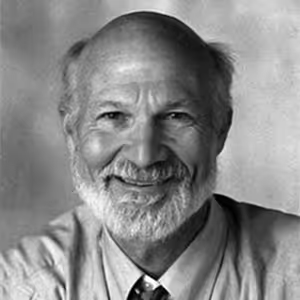
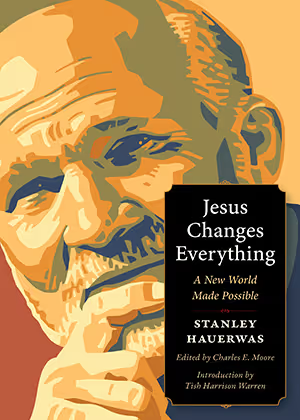
Stanley Hauerwas speaks with Plough ’s Charles E. Moore about nonviolence as a Christian practice.
Charles Moore: How are we to articulate a coherent pacifist perspective that takes the complexities of international conflict seriously?
Stanley Hauerwas: I often say, as a Christian committed to nonviolence, that I don’t have a foreign policy because I’m not a state. The very assumption that I have to know how to find a solution to the war in Ukraine is already a set of presumptions that misdescribe what it means to be nonviolent.
What is so important for thinking through all this is that nonviolence is not an end in itself. We are nonviolent because we are worshippers of the crucified Messiah. That crucifixion is God’s salvific work in the world to make possible lives that are not possessed by violence.
Part of the problem is the very way of presenting what the ethic of nonviolence is. We usually think that there’s pacifism, and then there’s the crusade presumption that you can go to war when the end is completely good. And between nonviolence and the crusade, there’s the just war tradition. And that determines our imagination for how to think about war. But the problem with that is it makes those three alternatives look like they are separate from any determinative convictions about God and God’s embodiment in Jesus Christ. So, first, we need to be a people that witnesses to the God who gives us an alternative to war, and that alternative is us.
I’m trying to resist the abstraction, the character of nonviolence taken as an end in itself. There has to be a body of people who are an alternative to violence, and therefore the first thing that Christians cannot do is kill other Christians. One of the problems with the witness that we have made for two thousand years is the willingness of a Christian to kill another Christian; that’s suicide. So, there must be an alternative body of people that have learned how to live nonviolently. And learning to live nonviolently is a difficult business because Christians are fallen humans just like non-Christians. But we are also an alternative to the politics of the world because we are committed to being truthful with one another.
If Christians aren’t to kill Christians, does that allow us to kill non-Christians?
No, it’s training to learn how to be with those that would kill us – but we cannot kill.
Christians have a higher allegiance here than to nation states. And yet it seems like nation states do what nation states do. How do we live faithfully in the midst of such a world where nation states and what they do or fail to do have such dramatic and horrendous effects?
We produce people like Dorothy Day . That’s how you go about providing an alternative to the nation state. In the book that I’ve written, War and the American Difference , I tried to show how the war-making character of the modern nation state is a sacrificial system that commands a loyalty that is, from a Christian perspective, idolatrous. And that is something that the church has to say in America in particular.
I was just looking through that book, trying to remind myself what I think about these matters. And I found a quote from Carolyn Marvin and David W. Ingle’s book Blood Sacrifice and the Nation :
[.blockquote] In the era of Western ascendancy, the triumph of Christianity clearly meant the triumph of the states of Christianity, among them, the most powerful of modern states, the United States. Though religions have survived and flourished in persecution and powerlessness, supplicants nevertheless take manifestations of power as blessed evidence of the truth of faith. Still, in the religiously plural society of the United States, sectarian faith is optional for its citizens, as everyone knows. Americans have often bled, sacrificed, and died for their country. This fact is important clue to its religious power. Though denominations are permitted to exist in the United States, they are not permitted to kill, for their beliefs are not officially true. What is really true in any society is what is worth killing for and what citizens may be compelled to sacrifice their lives for. [.blockquote]
That gives you a sense that the very existence of people committed to nonviolence is a threat in the modern nation state, because war is such a morally powerful institution.
In your book, War and the American Difference , you argue that war is the glue that gives Americans a common story. Now, however, the same could be said for many nations. Is there something unique about America, or is the whole world order glued together by war, by the perpetuation of one conflict or another?
The Treaty of Westphalia institutionalized the modern nation state, which is determined by boundaries that you can draw, by lines on a map. Nation states have an inherent commitment to defend themselves from other nation states. The very system of international relations is a system that’s based on war.
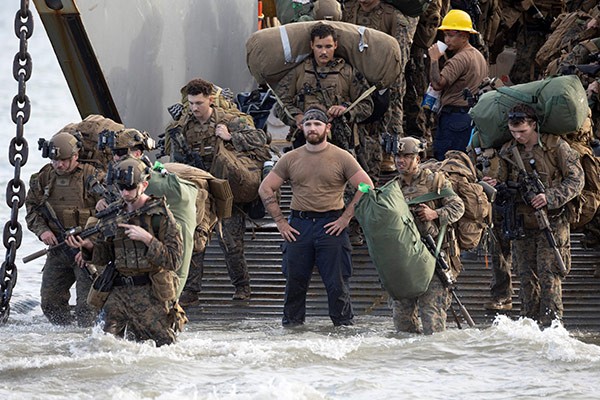
[.imgcaption] U.S. Marines disembark from a U.S. Navy Landing Craft Utility (LCU) during amphibious operations in Arroyo, Puerto Rico, December 9, 2025. [.smalltext] REUTERS/Ricardo Arduengo. Used by permission. [.smalltext] [.imgcaption]
What about the just war theory? Many Christians still see that as a viable way of thinking about and responding to war. Is the just war theory a morally incoherent system?
It’s better than the alternative: unjust war.
First of all, you have to ask, what kind of people would think you need to justify war? That’s a step in the right direction. The just war theory is actually very rigorous. You can only go to war for a limited political purpose. That’s very important. You have to be able to tell the enemy on what grounds you are going to war. That way they will know under what conditions they should surrender. The war must be declared publicly so that it is clear what you think you are fighting for. And then when you go to war, you must observe noncombatant immunity. This allows you to distinguish war from murder. You kill the combatant on the other side because they are trying to kill you. It’s not murder; it is war. These are very stringent demands.
The difficulty with these criteria for just war is they are so determinative that they never are fulfilled. People get the notion that four out of five isn’t bad. “This war is close enough to just war, we’ll call it just, even though we may not be able to observe noncombatant immunity.”
If a war is not just, what is it? Take the two world wars. Why don’t we call them World Slaughter I and World Slaughter II. They were not just wars, even though Americans tend to think they were since we more or less won them. Just war is much more demanding than that. If they were not just wars, then what are they? That is a question that we haven’t heard asked.
Isn’t the slaughtering just as bad today? How do we speak out now?
In Gaza, the Israeli commitment to “never again,” which is certainly understandable, legitimates this kind of slaughter, which is deeply disturbing. And Christians simply have to say what we think is true about what’s happening in Gaza.
The Ukraine war is, of course, drawing all tensions between the Crimea and Russia that have been there for centuries. The Orthodox will have some real soul-searching to do when this is all over. Orthodoxy is, in many ways, so much more attractive than what we have in the West. But they’ve had difficulty being independent of social orders. You get Russian Orthodox, Ukrainian Orthodox, Greek Orthodoxy, so on. The identification of orthodoxy with nationalistic culture is one of the issues that they will have to question themselves about.
It’s not too different from American Christianity and our identification with the state. It’s the Constantinian compromise or synthesis: but the state always wins out. We won’t die or even kill for Christianity, but we’ll die and kill for the state.
Where do you start making a difference? We start where the Bruderhof starts, namely, our need to live like your founder, Eberhard Arnold, did. You’ve got to start somewhere.
But surely Eberhard Arnold, like Dorothy Day, Martin Luther King Jr., and Bonhoeffer, is exceptional. Can the church live like them – collectively, corporately, communally – or is that just too idealistic? You mentioned speaking truthfully. How do we speak truthfully to one another so that more Dorothy Days would typify the church?
The answer is, I don’t know. There’s an example that I use. Paula and I were members of Aldersgate United Methodist Church for quite a number of years. One of the ladies in the congregation was a quilter. During Laity Sunday once, she got up and said, “Well, I’m a quilter, and I know that’s silly, but I belong to a quilting society. During Vietnam, we decided to have a witness against war. And we surrounded the Pentagon with quilts that we had quilted. We stood there for a day.”
As you’ve pointed out many times in your writings, as American Christians we’re implicated in war and the policies of our country in some profound ways. We’re feeding the very system that generates war by our politics and economics and so forth. How do we avoid that?
By having people that raise the question. I don’t know any other way. And that it is a people, not just individuals. The church needs to be the moral equivalent to war.
We are baptized into the body of Christ, and therefore we have faced death and found repentance. And that commits us to be a people who are to care for one another in life and in death. We cannot kill one another.
One of the central texts of the Anabaptists is Matthew 18, where Jesus says you should confront someone who you believe has sinned against you or the church. I call attention to that text often because it helps remind us that nonviolence oftentimes requires conflictual interaction between people. We are committed to exposing our wrongs in a way that calls for reconciliation. I always say, “Dear God, you can take my loves, but don’t take my hates, because if you take my hates, how will I know who I am?”
What that confrontation is meant to do is to bring out something that would normally result in violence. We’re not just talking about taking life, but we’re talking about relationships that can oftentimes appear nonviolent, but hatred is at bottom of them. A lot of violence is irrepressible because it has been under the surface for a long time.
Going back to just war: What would a just war Pentagon look like? What would a just war foreign policy of the United States look like? We’ve gotten so used to simply thinking we need a military that is able to control the world to make us feel safe.
As Christians, we need ask about the assumption that we are always ready to go to war. The very readiness is an invitation to go into war.
No one would make an ethical argument for slavery these days, but they would make an ethical argument for war. Is it possible to argue for the end of war apart from the cross?
I suppose people could just assume that life is better than death, and therefore since war is death, we should try to do what we can to avoid imposing deaths on other people. The problem is it’s not a persuasive argument for most people, because their presumption is that war is a security that we desperately need, and without which life is too dangerous.
When Martin Luther King Jr. came out and gave that extraordinary sermon in Riverside Church against the Vietnam War , his staff were apoplectic at him. They said, “We’re about civil rights not about any war.” King said, “Before I was a civil rights leader, I was a Southern Baptist pastor. That means I’m against war.” That was an extraordinary commitment to a Christological understanding of nonviolence.
And the eschatological presumptions: an account of nonviolence is going to involve an explanation of what it means to be claimed by God, to be a people set apart.
You wrote recently : “Silence is not neutrality. It is consent. Let us be clear, we do not consent.” Now it’s one thing to state that on paper. Are there other ways to state that?
Protest events are certainly part of it. These are issues for the long haul, and you’ve got to be ready to wait it out and do the work of nonviolence.
I don’t like the language of “nonviolence” because it’s simply not violence. I don’t like “pacifism” either because it sounds so passive. “Nonviolent resistance” is better.
For those of us committed to nonviolence, we must be the most political of animals, because if you can’t kill your enemy, you’ve got to put up with them somehow. And so politics is at the very heart of nonviolence.
What Martin Luther King Jr. understood well is that what made him possible was the good faith of the people in Montgomery who had lingered in a racist world without killing. Those people who were so oppressive that they made Martin Luther King possible. He did not construe the other in terms of an enemy. He was trying to save them.
Besides being the alternative, being a different politic, giving our allegiance to a different order, to God’s kingdom, do you have any advice for us in this hour to put our convictions that we have in the cross and the nonviolent way of Christ into practice, more concretely?
Prayer. I think fervent prayer is really at the heart of giving us a way to go on when it’s not clear how going on is going to make a difference. Learning to pray. The Book of Common Prayer certainly has us pray for people who are in offices that are connected with violent outcomes. And we need to pray that they will be saved from that.
Your question presumes you need to find some way to “make a difference.” Of course, that’s true, but we need to remember that the difference has been made in Christ. And it’s our task to manifest that difference in the world through worship and charity toward our enemies.
There are a lot of challenges. How do we not just talk past each other or against each other or stay in our silos? How do we get together to have an honest discussion with some humility, but at the same time really address each other? Isn’t that what Matthew 18 is about?
Yes. The answer is we have to be very patient. Patience is part of the very inner workings of nonviolence. Patience makes nonviolence possible. But patience means you also have to be committed to justice in a way that refuses to let the violence that has become habit go unquestioned.
I wish I could represent something that is something that we can do. But what we can do is make one human contact after another human contact. And we can help one another discover what it means to worship a crucified Messiah and what it means to be people who recognize that the Resurrection made it possible for us to be in the world without violence.