




Subtotal: $
Checkout

Aurel Kolnai, Philosopher of Hatred
A Jewish refugee, Kolnai wrote perceptively about the nature of hate and its antidote. His ideas merit our attention today.
By Nathan Beacom
March 11, 2026
Jesus not Caesar! Such was the rallying cry of Tomas Masaryk, the founding father of Czechoslovakia. For Masaryk, this phrase meant that ultimate loyalty was owed, by the Christian, to Christ, and not to any political dynasty or figure. Initially, this expressed an objection to the Hungarian authorities who had long subjugated Czechs and Slovaks, but in time, it came to apply to all political leaders who claimed Caesar-like authority. Loyalty to Christ as the true king, Masaryk thought, was a safeguard against deifying particular leaders or parties, forestalling totalitarian temptations.
Aurel Kolnai (1900–1973) was a philosopher who came of age in Hungary during the First World War. An ethnic Jew, he fled from Hungary around the age of twenty to escape local anti-Semitic violence. In Vienna he had a brief membership in the atheistic circle of Sigmund Freud, before leaving both Freud and atheism in favor of Catholicism. By this time, still in his twenties, Kolnai had already witnessed the Bolshevik revolution and the depredations of communism, and now a new threat was arising in Austria and Germany: National Socialism. For Kolnai, Masaryk’s motto had the ring of truth.
Kolnai managed to see through the competing radicalisms that were colonizing Europe in his day. Inured to communism from the start, he was now dismayed at the rise of fascism. Inspired by his young Christian faith, he kept his head in the midst of the fray. It was easy, at that time, to fall to one side or another, depending on which side disgusted one more. If one feared communism – perhaps having heard of the mass graves of innocents in Poland – it was tempting to grab on to fascism, which promised to stand against the Red tide. If, however, one feared the fascist strongmen, perhaps communism would appeal as the means of keeping them at bay. Kolnai refused to embrace one evil to combat another. There would be no Caesar for him, whether his name was “Adolf” or “Josef.”
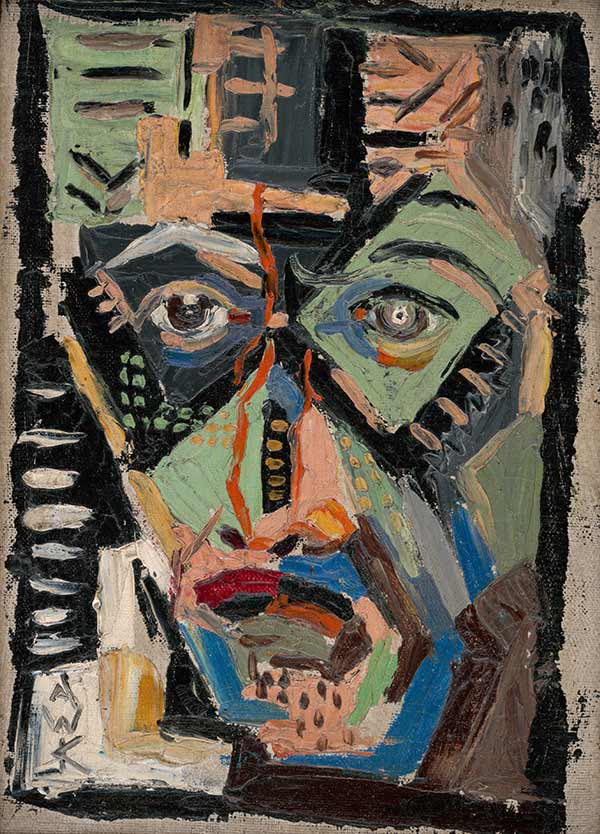
Arnold Peter Weisz-Kubínčan, Man’s Face, oil on canvas, 1921. Wikimedia Commons.
In times of political tension and intense factionalism, Christians, like anyone else, can lose their way. C. S. Lewis put the problem well: “The devil always sends errors into the world in pairs – pairs of opposites. And he always encourages us to spend a lot of time thinking which is the worse. You see why, of course? He relies on your extra dislike of the one error to draw you gradually into the opposite one.”
Aurel Kolnai, who did indeed refuse both evils, wrote perceptively in these years about the nature of hatred and its antidote. His example and his ideas still merit our attention today.
Philosopher of Hatred
Aurel Kolnai became a philosopher of hatred by necessity. By his own description, he was a sensitive child, particularly attentive to the value of common and ordinary things. But this was the 1920s and urgent issues were at hand. For Kolnai, philosophy was always in dialogue with what was really happening in the world of history. Kolnai, with his affection for the given and the ordinary, rebelled against fascism as much as he did against communism. In it, he saw an ideology that was opposed to human reason and to human dignity. He was one of the earliest intellectual critics of this new philosophy, arguing that it was an assault on all that was good in “the West.”
Unfortunately, Kolnai found himself somewhat lonely in his opposition to radicalism. Many Christians had been wooed by fascism all over Europe, including in Nazi Germany. Even those who opposed the Nazis, like the philosopher Dietrich von Hildebrand, nonetheless supported other forms of fascism.
Kolnai was prompted by the surrounding events to become a philosopher of negative emotions. Max Scheler, one of Kolnai’s philosophical heroes, had focused his work on love. In this period, though, Kolnai felt that he had to focus on hate. This was not, of course, from morbid fascination, but out of an encounter with a real, effective, and violent hate that was growing all around him.
Kolnai noticed something curious about political hatred. Contrary, perhaps, to our expectations, it does not need to involve any actual, pressing threat to our own person or interests. “I can perfectly well hate people who have never really crossed my path,” he wrote, “who have never stood in the way of a central personal project of mine, but who seem to me to embody a repulsive form of life and whom I, at all events, have felt – however peripherally, without any threat to my person – to possess power.” This repulsion is characterized by its “centrality” and “depth.” In political hatred, it is the very existence of persons whose form of life I consider repulsive and a perception of their influence in society that I despise.
In this context, we can better understand the Jew-hatred of the 1930s. It did not need to be the case that an average German was in actual fact threatened by Jews, or, indeed, really affected by Jews at all. All that was needed was the perception that Jewish people led a form of life that was “powerful” and “repulsive.” The image of the Jew which was common at the time was of a person who had no loyalty to the nation; he merely leeched the nation’s wealth for his own gain and for the gain of his fellow Jews. What is more, he was seen as the source of “degraded” forms of art like jazz and modernist painting. It is not enough, in the context of hatred, that events, behaviors, or actions are stopped. It would not have been enough if, say, certain financial reforms had been implemented to benefit the German worker. It was not the Jew’s actions that needed to be destroyed, but the essence that lay beneath those actions: the Jew himself.
But this is by no means only operative in the realm of anti-Semitism. It is common in many forms of politics. Such hatred led the Soviets to “liquidate” small landholders. The object of hatred may be a Jew, but he may also be a liberal, a conservative, a Christian, a Muslim, or any other thing. All that is needed is the sense of “power” and “repulsiveness.” This sense of repulsion attaches not so much to behavior or even character as to an idea of the nature of the one hated. If I merely dislike a man’s behavior or character, I may still love him and wish him to change. If I hate him, then I hate something that I perceive to characterize his very essence. Because of this, I want him, somehow, gone.
This drive to annihilate, Kolnai says, does not necessarily mean murder. A person might think they are free from hatred if they do not desire the literal destruction of the enemy. Kolnai, however, notes that I may merely desire some other form of destruction: the loss of his social status, his humiliation, his banishment from membership in the community.
In Kolnai’s day, there was a prominent Nazi philosopher named Carl Schmitt, who conceived of politics fundamentally in terms of enmity. For Schmitt, all political life depended on a well-defined enemy. One can never have friendship without having a defined foe. Kolnai rejected this idea. While enmity is a reality of political life, “it is, rather, both wise and possible deliberately to cultivate and expand the loving attitude, whilst the attitude of hate is confined, loaded with restraints and overshadowed by the commandment of love. ‘Friend’ and ‘foe’ are not related like reciprocal values in mathematics; human beings are, rather, free to assign more of their personal commitment to the positive side.”
Hatred, Kolnai writes, is “always personal and impersonal.” What he means is that when we hate in a political context we do not merely hate a person or an idea, we hate both together. The hated one becomes identified with the ideas that we hate. The Jew is identified with greed and conniving. The foreigner is identified with whatever negative attributes we ascribe to his culture. It is characteristic of hatred that it identifies “what I don’t like” with “what is evil.” To hate, I must give to my dislikes a moral language and must lay moral blame on the one hated. Even if I do not know an individual member of the hated class, I must make assumptions about his moral responsibility for those “forms of life” which I find repulsive and threatening. Because the “forms of life” and the person are, for the hater, identical, it is the person who must be destroyed.
The Christian Response
For Kolnai, though, there is a Christian cure to the sickness of hatred. The Christian must see every human person, at least potentially, as a member of the communion of saints and as an object of love. This breaks down every possible boundary of class, race, distance, and even way of life. It means that I must separate my stance toward the person from my stance toward his characteristics and behavior. The latter, I may hate, in the sense that I want to drive them out, but only if that hatred is based upon a love of what is actually good for the person. The Christian humanizes the world by making the fundamental stance toward persons one of unconditional love. Kolani calls this “solidarity for man as such.” Put simply, the Christian must love his enemies.
This is why, for Kolnai, fascism is a “heathen” ideology. It is unchristian because it maintains a place for hatred of persons. So, too, does communism. In most ideologies, somewhere room is made for hatred of the person. Christianity cannot live in tandem with any ideology that leaves such space.
This may seem obvious, but there are many secret ways in which the Christian may fall into hatred while continuing to think of himself as a follower of Jesus Christ. He may class a certain group of people as enemies of Christ, or of his gospel, or of his church. Surely it is OK to hate these people whose anti-Christian form of life repels us. A Christian may also assure himself that, in certain cases, love actually requires the destruction of the other. I must destroy him because he is an insult to righteousness, to God, and to the faith. Kolnai refers to this as “diabolisation.” I make my own enemy into the devil, and give myself permission, therefore, to hate him. If he is the devil, surely he falls outside the circle of love.
It may indeed be necessary to oppose a person or group who threatens human life and dignity, but hatred is different. It is not focused on the prevention of actual, existing threats, but on the destruction of the enemy at large. It obsesses over detailing the evils of the enemy, and yet is careless about the actual details regarding who is responsible for the supposed evils and careless about any sense of proportion.
To combat these hidden avenues of hatred, the Christian needs to remember that even the combat of evil is not the hatred of persons, but the hatred of evil acts. Persons must always be loved. Their potential for reform must always be remembered. No one on earth can be counted out. If we treat this principle as inviolable, we will be safe from going down the path of some certain hatred that to us seems, in the instance, fully justified. To hedge and limit this principle of “the solidarity of man as such” is to set foot on the path of hell.
For Kolnai, there is, it seems, an element of changing the way we look and see. We may accept as a principle that we should hate the sin and love the sinner, but what does that mean, and how could we put it into practice?
To change the way we see others, we have to look through a certain lens, namely, the lens of “personality,” and the “unity of mankind.” Personality refers to the basic essence of the other, who, like me, is a rational, free being. Apart from any other conditions of worth or lovability, this remains true of all persons. As such, persons are worthy, unconditionally, of a certain reverence. That second idea is not as vague as it sounds. For Kolnai, this unity is manifest simply by the fact that no life can be totally disentangled from the story of the human race throughout the world. “There are no two men (or two human groups) who have really had absolutely nothing to do with one another or could not have come into a closer relationship.” My life is part and parcel of the shared and interpenetrating life of all the men and women on the earth. If nothing else, we are unified by sharing the same nature; I am related to you unconditionally as person to person.
Perceiving these truths – the nature of personhood and the unity of humankind – our vision can change too. The sight of dignity now rests, not on the behavior, race, class, or party of the other, but on this universal fellowship, “the solidarity of man as such.”
Did Kolnai Fail?
Kolnai spent the years leading up to the Second World War writing essays and books against the growing fascist threat. But for all his passionate writing, Austria did, as we know, fall into Nazism, and we are well aware of the awful events that followed. For Kolnai’s part, he escaped westward and continued to write, now in English, against the Nazi terror.
Kolnai didn’t stop the Nazis. Other critics, such as Dietrich Bonhoeffer and Edith Stein, were executed. Does this mean they failed?
A few years ago, Terrence Malick made a beautiful film called A Hidden Life, about an Austrian farmer named Franz Jägerstätter, who was killed for refusing to collaborate with the Nazis. Jägerstätter’s principled stand, from one standpoint, had even less impact than Kolnai’s. But Malick’s film makes the case that any act of goodness is not lost. Any act of love keeps alive whatever good remains on earth.
What might this mean, specifically, for a writer and thinker like Kolnai? The success of worthy thinking and writing does not consist in immediate and universal efficacy in the world. It can be discovered in each and every instance in which it helps to illumine a single mind toward truth and goodness. This is obviously a different view of the role of the philosopher than is held in much of the academy. But just as acts of caring, however small, reverberate through the course of the human story, so truths told and wisdom shared reverberate through human souls, hopefully, giving birth to good acts. From this viewpoint, Kolnai did not entirely fail. Yes, he failed to inspire the forces that might have stopped Nazism earlier. The good results of his work, however, will mostly never be seen.
This is the paradoxical witness of the Christian, especially, whose weakness ends up besting the powers of the world. The Nazis would fall. They would be held accountable and brought to justice, and thousands of unremembered names played their own little role in not letting the light of love go out.
In our own historical contexts, we must be vigilant against hatred, not just in others but within ourselves. That surging feeling of repulsion can creep up within us when political tensions are high, but as Kolnai noted, we have the deliberate power to decide whether that voice will dominate us or whether it will be overshadowed by the voice of love. As a Christian, Kolnai pursued this road with hope.

You have ${x} free ${w} remaining.
This is your last free article this month.
We hope you've enjoyed your free articles.
This article is reserved for subscribers.
Already a subscriber? Sign in
Try 3 months of unlimited access. Start your FREE TRIAL today. Cancel anytime.
Dóra
Thank you - just to add that Kolnai was not from a Slovak, but from a Hungarian family. What is today's Slovakia used to be part of Hungary before 1919.
Timothy Westergren
Thank you for rescuing Aurel Kolnai from obscurity. I did not know his writings. His reflections on hate from the crucible of European fascism are vital for those of us who witness from apparent weakness in the face of American Neo-fascism today. Hate is legitimised, even by and for Christians. We must resist this at all costs. It is the spirit of the anti-Christ. I will share this post.