Against Decluttering
Influencers would have us declutter our lives. Maybe they have our relationship with our possessions all wrong.
April 29, 2026
Try 3 months of unlimited access. Start your FREE TRIAL today. Cancel anytime.
START FREE TRIAL NOWAgainst Decluttering
Influencers would have us declutter our lives. Maybe they have our relationship with our possessions all wrong.
[.article__paragraph--cap][.small-caps]I’m surprised that people[.small-caps] are surprised when I say that I’m not neat. Something about me must suggest that I’m spruce. It’s not that I eat food in my room. I clean up after myself. I just have stuff, maybe more than the average person, but I don’t think that much. I’m hygienic. But even after a spring cleaning frenzy, the clutter reaccumulates quickly, my drawers once again overflowing, my desk rendered unusable until I throw out more stuff. This task always feels like a grave violation of the contract between myself and my stuff, like separating goats from sheep, chaff from wheat, when all of it feels precious and urgent in some idiosyncratic way.[.article__paragraph--cap]
My parents are also untidy. For most of my childhood, our barn was littered with broken lawn mower parts and we seemed to always have at least two cars that didn’t start. For a time, we burnt our trash. The inside of our house was similar: toys everywhere, seasonal decorations that rotated a little slower than the seasons, Christmas trees that stayed up until Valentine’s Day. We lived far from town and far from the eyes of anyone who would care.
My parents’ untidiness used to bother them, but it doesn’t so much anymore. They’ve accepted that clutter is a part of their marriage. When we moved from our home on a backroad to the biggest nearby town, we took our hillbilly habits with us. This new house was smaller and my mom couldn’t bear to part with the furniture she’d recently inherited from her mother, nor all she and my dad received as wedding gifts. A section of the kitchen counter beside the sink became devoted to expired blood pressure medication. Another counter is the holding cell for a box of tools and bolts that my dad says will eventually make their way to the garage out back. Last time I visited, I relocated some vitamins to a cabinet and got an earful when my parents couldn’t find them on the windowsill above the microwave. You haven’t lived here for a while, my dad said, so don’t go around trying to make it unusable for us. True, fair, and aggravating! When I return to my apartment from trips home, I’m seized by a frenzied resolution that I might inherit my fashion taste and stubbornness and probably one day heart disease from my parents, but I refuse to inherit these tendencies too. I harden my heart until I separate polyester from cotton, uncomfortable from comfortable, chaff from wheat.
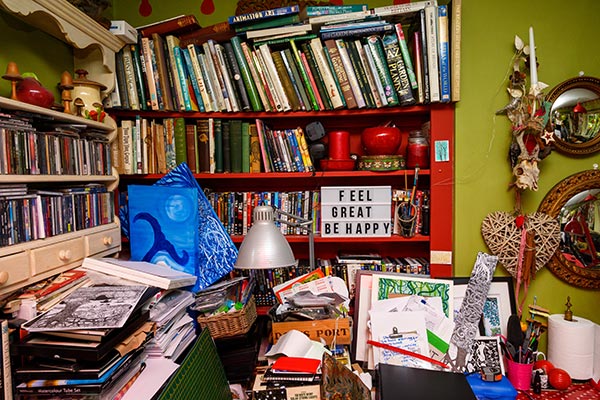
[.imgcaption][.smalltext]Photograph by Clynt Garnham / Alamy Stock.[.smalltext][.imgcaption]
Some Catholic and Orthodox writers, like Flannery O’Connor and Alexander Schmemann, think of things – water and candles, for example – as sacramental in nature, always pointing to something else more metaphysically rooted and permanent than material reality. Water, even a river as filthy as the Ohio, can always fulfill its telos by baptizing an unbeliever, washing the mud of original sin away. Candles best find their purpose lit before an altar in prayer to an almighty God. And so on.
Stuff always points us beyond the here and now. Not just religious objects, but personal belongings too. My stuff is never just stuff. All of it is sentimental. Photos correspond to friends who might tragically and abruptly drop dead. Notebooks to past knowledge. Mail to a future call from the IRS. Knickknacks to places I’ve been. Books to my wish that I’d be a smarter, better person. Clothes to either a more innocent or glamorous version of myself. And most of it gestures toward my parents, who always buy too much for Christmas, even when my brother and I tell them they don’t have to, because despite all the ways I fail as a daughter, they love me more than I can bear to imagine. And stuff is how they show it. Their love has never been conditioned on anything. It’s difficult to believe mine is unconditional when I decide they’ve given me too much.
[.article__paragraph--cap][.small-caps]When the pandemic started,[.small-caps] I and millions of other college students left our belongings in dorms over spring break, not expecting to be separated from them longer than a week or two. My college boxed my possessions and sent them to be stored at a warehouse while dorms were disinfected. When I returned in August, I was directed to drive an hour north to retrieve my belongings. When I got to the warehouse, I was given one box containing a fraction of my stuff. I held it together on the drive back and fell into hysterics when I walked through my door. Almost all of my shoes: gone. My jewelry, including a necklace from my late grandmother and my dad’s high school class ring: gone. Half my clothing: gone. I wept for hours. For weeks, whenever I thought about my lost things, my eyes welled up with tears. I was ashamed that it wounded me so much. Eventually, most of my stuff, including the jewelry, was found, and I was reimbursed for what was missing. With this recovery, a sheepish peace settled over me. It was the first time I thought of myself as a materialistic person.[.article__paragraph--cap]
Truth is, my clutter problem could be solved by stricter cleaning and organizing habits. I’m skeptical, though, that a new routine would change the way I feel about my stuff – like a careful guardian when I have it, a tyrannical god damning treasures to an infernal secondhand shop when I decide I have too much. This relationship seems more worrisome; clutter a mere byproduct of attachments about which I haven’t yet decided how I feel, and maybe never will.
But it’s one that I should figure out; there’s biblical precedent for its importance. Three of the four Gospels record an encounter Jesus has with a rich young ruler, who though he has kept all the commandments, wonders what he lacks in seeking the inheritance of eternal life. The author of Mark writes that “Jesus, looking at him, loved him, and said to him, ‘You lack one thing: go, sell all that you have and give to the poor, and you will have treasure in heaven.’” The rich young ruler lacks, Jesus is careful to point out, precisely because he has. He cannot have that which he hopes for because he possesses. Does having things make a sinner? Perhaps his belongings only circuitously point him back to his wealth. They could also remind him of the man he is and how he got to this moment of meeting the Son of God, Who just wants to talk about how much stuff he owns. Either way, his possessions point him away from heaven. Things – having them, liking them – are antithetical to salvation. So the Lord asks us to part with them. Elsewhere He asks us to hate our fathers and mothers and wives and children and brothers and sisters. He separates sinners from saints as easily as telling a goat from a sheep. Still, we are told that His yoke is easy and His burden light.
Marie Kondo, the organizing consultant and influencer, wrote in her 2010 book The Life-Changing Magic of Tidying Up that decluttering was a task most people only need to undertake once. In Kondo’s schema, dubbed the KonMari method, almost everything must go, even treasured belongings. The ratio changes: there’s less wheat and more chaff. After one’s wardrobe and living space are pared down to the bare essentials, everything left finds its most natural place, and no clutter ever collects again.[.footnote-link]1[.footnote-link] A room becomes as it always should have been. Kondo says that in the process of decluttering, clients might identify clutter elsewhere in life. It’s not unheard of for uncluttered clients to discover profound unhappiness in their marriages and seek divorce, to quit jobs and pursue dream careers, to lose forty pounds. The thrilling potential of such a realization has always dissuaded me from trying. Would I remember something tragically bleak that occurred in early childhood? Shave my head and get a sleeve of inappropriate tattoos? Drop out of grad school? Would I cut loved ones out of my life and tell new friends that my only regret was not doing it sooner? I’ve never been much of an optimist, and the lurking possibilities, some more plausible than others, scare me.
I’m decluttering now for no reason other than that I have too much stuff again, but I’m fearful that at the end, I’ll find that I’ve gotten rid of everything, including whatever scrap of unconditioned love I had, if I had any to begin with. In my current decluttering, I’m avoiding the KonMari method. I’m picking one item out at a time and setting it aside for a clothing exchange party some friends are hosting next month. This makes tidying up less monumental, but perhaps more painful because the job of singling out a least-loved item, and by extension, a least-loved attachment, comes every day. In this method, my stuff never requires me to consider whether the arc of my life is one that I want to keep on, but it still forces me to continually evaluate whether the relative meaningless of an object outweighs the gift of love that binds me to it.
In September I threw away some old notes on Kierkegaard and the Pentateuch and the politics of memorials. A few weeks ago at a party I discovered a hole in a velvet minidress I bought my junior year of college. Gone. And yet, I need to get some things, too: a black blazer, low heels for job interviews. And always more books. My mom texted me the other day that JC Penney’s corduroy pants are on sale in black, brown, gray, tan, teal, pecan, rose, olive, navy, and burgundy, and would I want some for Christmas? It’s hard to not feel like the question is a proxy for another one: Can I show you how much I love you? And I wonder whether God has as hard of a time saying no to me when I pray as I do when I tell my mom that I don’t need more corduroy, because I really don’t; I barely wear the corduroy I have. I wonder if He evaluates me the way I evaluate my stuff, separating the precious from the fungible, the good from the broken, the chaff from the wheat. I wonder if He is deciding whether His love for me outweighs the vacuity of my life, if there is enough space in His room for me.