What the Prophets Knew About Meals
The ancient wisdom of five religious traditions anticipated the gross inequities of modern economics – and offers a way out.
February 23, 2026
Try 3 months of unlimited access. Start your FREE TRIAL today. Cancel anytime.
START FREE TRIAL NOW
[.article__subhead] THE SACRED AND THE STATISTICAL [.article__subhead]
There is a pattern that appears in sacred texts. Jesus miraculously feeds five thousand with five loaves and two fish (Matt. 14:13–21). The Buddha miraculously feeds five hundred monks cakes and milk mixed with ghee, honey, and jaggery (Jataka 78).
As an economist, I study inequality through mathematics, not mysticism. My tool is the Time-Based Need Index (TBNI) – a formula that measures how many hours of labor a person must exchange for basic survival. By this measure, I can prove that:
The same food, the same molecules of lentils and bread, transfers wealth in opposite directions depending on whose mouth it enters.
When I first calculated these numbers, I thought I had discovered something new – a mathematical proof of extraction, a quantification of what we dimly sense but cannot name.
Then I read the prophets. They knew. Not the equations, not the TBNI calculations, not the M-coefficients. But they knew the pattern. They knew that food is never just food, that meals reveal the soul of a civilization, that the way we eat together – or fail to – determines whether we survive or collapse. Ancient wisdom and modern mathematics point to the same truth.
[.article__subhead] WHAT JESUS KNEW ABOUT SCARCITY [.article__subhead]
[.blockquote] Jesus went up on a mountainside and sat down with his disciples. A great crowd of people followed him because they saw the signs he had performed. ... Philip answered him, “It would take more than half a year’s wages to buy enough bread for each one to have a bite!” ...Then Jesus took the loaves, gave thanks, and distributed to those who were seated as much as they wanted. (John 6:1–14) [.blockquote]
Every theologian focuses on the miracle – how five loaves became five thousand portions. But look at what Jesus doesn’t do: He doesn’t create a marketplace.
Think about it. He has five thousand hungry people. He has limited food. The “rational” solution (by modern economic logic) would be:
This is precisely how our world operates. When there’s scarcity, we create markets. When there’s hunger, we create prices. We call this efficiency.
Jesus calls it an abomination. He doesn’t ration. He doesn’t charge. He doesn’t create tiers (first-class bread vs. economy bread). He distributes “as much as they wanted” – which violates every principle of scarcity economics. And here’s what the Gospel records: There were leftovers. Twelve baskets of fragments.
The Mathematical Parallel
In my research, I discovered something economists call “artificial scarcity.” Food isn’t actually scarce – we produce enough calories to feed 10 billion people (global population: 8 billion). Yet according to the 2024 report of the Food and Agriculture Organization of the United Nations (FAO), 673 million people are hungry. Why? Because we’ve inserted a price mechanism between production and consumption. Food exists, but it’s locked behind purchasing power. Here’s the calculation:
Jesus understood what economists refuse to admit: Scarcity is a choice, not a condition. The five loaves multiplied through distribution without extraction. When you remove the price barrier, when you stop hoarding for profit, there’s enough. The twelve baskets of leftovers aren’t just surplus. They’re proof – proof that abundance appears when sharing replaces selling.
What This Means for TBNI
The modern food system creates artificial scarcity through TBNI stratification. A Stage 12 person, with a TBNI of less than 1 second, can buy anything and waste freely, while a Stage 1 person, whose TBNI is more than 12 hours, cannot afford basic nutrition. The gap between them isn’t natural; it’s constructed. We’ve created a system where some people’s leftovers exceed other people’s entire food budget.
Jesus’ meal distribution erases TBNI. Everyone eats “as much as they wanted,” regardless of their labor-exchange capacity. This isn’t charity. It’s not even compassion. It’s structural redesign: What if food existed outside the labor-for-calories exchange? A modern equivalent is the concept of Universal Basic Food Security – not food stamps (which maintain the market) but direct distribution outside pricing mechanisms.
[.article__subhead] WHAT THE BUDDHA KNEW ABOUT CONSUMPTION [.article__subhead]
[.blockquote] There is no fire like passion, no grip like hatred, no net like delusion, no river like craving. ( The Dhammapada , Verse 251) [.blockquote]
The Buddha spent years analyzing tanha , or “craving,” the source of suffering. But he also established a practical economic system: the bhikku (monk) carries a bowl and accepts whatever is offered. No money. No transaction. No calculation of “deserving.”
The key principle is that the monk doesn’t earn food through labor, and that the giver doesn’t purchase merit through payment. Both are liberated from the market transaction. This seems mystical until you calculate the mathematics of monastic economics:
The monk exists outside the TBNI system entirely. Not at the top (like billionaires with TBNI approaching zero), but outside – in a different economic dimension where the labor-for-food exchange doesn’t exist.
But here’s what’s crucial: This only works if the community participates. The monk’s bowl remains empty unless the householder fills it. The system requires reciprocal non-transaction – I give without expecting return; you receive without owing debt. This is the opposite of market logic, where every transaction creates obligation (debt) or extraction (profit).
What the Buddha Knew
The suffering ( dukkha ) of modern food systems isn’t hunger itself – it’s the calculation.
The middle-class person calculating: “Can I afford ₹100 for lunch or should I pack a ₹30 lunch?”
The poor person calculating: “If I eat today, I can’t send money home.”
The rich person is not calculating at all, which is its own form of unconsciousness.
The Buddha’s solution: Exit the calculation entirely. The monk with the bowl isn’t “cheap” or “lazy.” He’s free – free from the anxiety that defines modern economic life.
A Modern Parallel
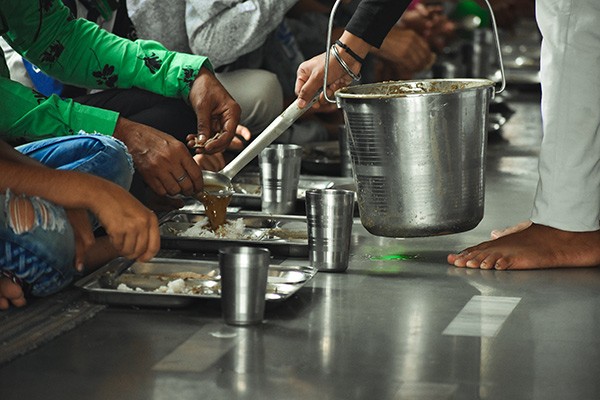
I calculated the economics of communal kitchens ( langars ) at Sikh temples:
This is a ₹7.3 billion/year operation running entirely outside market economics. The breakthrough: when you remove price, you remove TBNI stratification. The billionaire and the beggar eat the same dahl, sitting on the same floor, served by the same volunteer. For those twenty minutes, inequality doesn’t exist – not because wealth was redistributed, but because the meal exists in a non-market space.
What if 30 percent of our meals came from community kitchens outside market pricing? Not soup kitchens for “the poor” (which maintain status hierarchy), but temples, churches, and mosques where everyone eats together, regardless of wealth? The Buddha knew this would work 2,500 years ago. We’ve somehow convinced ourselves it’s “impractical.”
[.imgcaption] [.smalltext] Photograph by by Singh_Ramana / Adobe Stock. [.smalltext] [.imgcaption]
[.article__subhead] WHAT MOSES KNEW ABOUT JUBILEE [.article__subhead]
[.blockquote] Consecrate the fiftieth year and proclaim liberty throughout the land to all its inhabitants. It shall be a jubilee for you; each of you is to return to your family property and to your own clan. (Lev. 25:10) [.blockquote]
The Jubilee law is the most radical economic policy ever written into scripture. Every fifty years, all debts are cancelled, all land is returned to original families, all slaves are freed, and all agricultural production is halted. Economists read this and think: “Impossible. This would collapse the economy.” But that’s the point.
The Mathematics of Jubilee
What Moses understood is that inequality compounds exponentially. Here’s my calculation:
Two people start with ₹100,000 each. Person A has the Midas touch; his wealth increases 15 percent per transaction. Person B is bad at business or short on luck; his wealth decreases 15 percent per transaction. After ten years (assuming one transaction per day):
After fifty years:
The ratio is nearly a trillion trillion times difference. This is the direction things go without intervention. Wealth doesn’t just “accumulate” – it compounds exponentially. The rich don’t just get richer – they get incomprehensibly richer, while the poor don’t just get poorer – poverty itself gets erased.
Jubilee as Economic Circuit Breaker
Moses’s law resets the system every fifty years, before compounding reaches civilization-destroying levels. It’s not “charity.” It’s not “redistribution.” It’s system maintenance – like restarting a computer before memory leaks crash the operating system.
Modern economists ask: “But what about incentives? Why would anyone work hard if wealth resets?” Moses would answer: “Because you still have forty-nine years to prosper. But your great-great-grandchildren won’t inherit a society where some own everything and others own nothing.”
The biblical insight: Inequality isn’t just immoral – it’s unstable. Societies with extreme stratification collapse. (See: Rome. Babylon. Pre-Revolutionary France. Gilded Age America. Now.) Along with the Hebrew (and Christian and Islamic) prohibitions against lending at interest, sacred law repeatedly expresses suspicion toward accumulation; the Jubilee framework further institutionalizes periodic economic reset as a moral correction against permanent wealth concentration.
Modern Application
We don’t necessarily need a fifty-year reset. But we need something to interrupt compound extraction. Here are some current proposals that echo Jubilee:
These aren’t radical. Jubilee was radical. These are mild compared to “return all land, cancel all debts.” But it seems we’ve lost the religious imagination that made Jubilee thinkable.
[.article__subhead] WHAT THE QURAN KNEW ABOUT ZAKAT [.article__subhead]
[.blockquote] O you who have believed, spend from the good things which you have earned and from that which We have produced for you from the earth. (Surah Al-Baqarah, 2:267) [.blockquote]
Zakat – obligatory charity – is one of Islam’s five pillars. It’s not optional or recommended; it’s obligatory. The standard rate is to give 2.5 percent of one’s wealth annually. Economists treat this as “charity,” but the mathematics reveal something different.
Zakat as Negative Compound Interest
If wealth typically compounds at 7 percent annually but you must give 2.5 percent away, your effective growth is still 4.5 percent. Over time, without zakat :
With zakat :
The difference: zakat reduces terminal wealth by 61 percent over a lifetime. But here’s what’s brilliant: it doesn’t reduce prosperity. You still have 5.84 times your starting wealth. You’re not impoverished. But you also didn’t accumulate extraction-level wealth. This Islamic economic insight allows people to prosper, but reduces the compounding rate to curb extreme inequality.
A modern equivalent would be negative interest on extreme wealth – not confiscation, just forced circulation. If you have ₹1 billion, you must spend, invest, or donate 5 percent per year (₹50,000,000). This money re-enters the economy rather than compounding in your portfolio. Over twenty years:
You’re still wealthy. You just can’t become systemically wealthy – wealth so large it warps the entire economy around you.
Zakat’s Food Dimension
Islamic law specifies that Zakat al-Fitr (alms at the end of Ramadan) must be paid in food or money for food. Why food? Because food can’t be hoarded. It spoils. It must circulate.
The principle: Wealth that doesn’t circulate is dead wealth. It extracts without giving back. This is exactly what my TBNI research proves: The billionaire eating a meal gains ₹1,140,000 while chewing because his wealth is static – invested in assets that compound. He’s not creating value; his money is extracting rent from the economic system. Zakat forces circulation. The wealth flows outward, not just upward.
[.article__subhead] WHAT THE VEDAS KNEW ABOUT ANNADANAM [.article__subhead]
[.blockquote] Annam Brahma – Food is God. Do not refuse food to anyone. Produce food in abundance. This is the vow. (Taittiriya Upanishad, 3.7.1) [.blockquote]
In Hindu tradition, annadanam – the donation of food – is considered the highest form of charity. Higher than gold. Higher than land. Higher than knowledge. Why? Because food is time-collapsed.
According to the Vedic understanding of food, when you eat rice, you’re consuming three months of monsoon rains, sixty days of a farmer’s labor, sunshine converted to starch by photosynthesis, earth’s minerals drawn through roots, and previous harvests saved as seeds. One meal is thousands of hours of time, concentrated.
The Vedic priests calculated this intuitively. They knew that food is stored life-hours. My TBNI formula proves this mathematically:
Annadanam as Economic Justice
When you provide annadanam , you’re not “giving food.” You’re returning time to someone. A person with TBNI = 15 hours who receives free food saves fifteen hours of labor. Those fifteen hours can be used for rest, education, care work, and community building. This changes his or her life trajectory.
A poor person who receives one free meal per day saves four hours daily. Over the course of a year, that’s 1,460 hours or 182 eight-hour workdays. They gain half a year of their life back. This isn’t charity. It’s temporal redistribution.
Modern Application
Community kitchens ( langars , annadanam centers, church meals) aren’t “feeding the poor.” They’re creating non-market time – hours where people exist outside the labor-for-food exchange.
In India, there are more than 60,000 such community kitchens, serving 150 million meals each day. The total economic value of those meals is ₹300 billion per day in TBNI-adjusted terms, with an operating cost of only ₹15 billion per day. That’s an efficiency ratio of 20:1 (₹1 spent returns ₹20 in life-hours to recipients).
India’s gross domestic product (GDP) is around ₹300 trillion per year. Based on the daily calculation above, the value of community kitchens is ₹10.95 trillion per year. That means 3.65 percent of GDP flows entirely outside market mechanisms. This parallel economy – invisible to economists – operates on Vedic principles. And it works.
[.article__subhead] THE PROPHETIC CONVERGENCE [.article__subhead]
What astonishes me as an economist is that these traditions – separated by geography, theology, culture – arrive at similar economic principles:
These aren’t metaphors. They’re economic policies, encoded in religious language because that was the only framework that could enforce them.
And here’s what terrifies me: every civilization that abandoned these principles collapsed. Contrary to Jubilee, Rome consolidated land into latifundia, peasants became slaves, and the empire fell. Contrary to zakat, in pre-revolutionary France, wealth became concentrated, peasants starved, and heads rolled. Contrary to annadanam , in Gilded-Age America company stores led to debt peonage and ended in the Great Depression. We’re forgetting again.
According to Oxfam’s analysis of the UBS Global Wealth Report:
When I extrapolate this trend forward fifty years (without intervention):
At that point, money becomes meaningless. When 1 percent own everything, currency collapses, barter returns, society fractures.
[.article__subhead] THE WAY FORWARD [.article__subhead]
I’m a mathematician. I don’t believe in miracles. But I believe in patterns. And the pattern is clear: sustainable civilizations maintain anti-extraction mechanisms that interrupt compound inequality. Some modern policy equivalents:
Universal Basic Food (Jesus model)
Consumption Sabbaticals (Buddha model)
Jubilee Wealth Tax (Moses model)
Mandatory Circulation ( zakat model)
Time-Credit Food Systems ( annadanam model)
None of this is new. The prophets handed us the blueprints thousands of years ago. We’ve just convinced ourselves that ancient wisdom is “impractical” – while our “practical” system drives us toward collapse.
Consider how many hours you work to meet survival needs? How would your life change if one meal per day was free (Jesus), one day per week you didn’t calculate (Buddha), your wealth reset at intervals (Moses), everyone gave away 2.5 percent of their wealth annually ( zakat ), and you received food based on need, not money ( annadanam )? How would your relationship to food, work, time, and others change? The prophets weren’t offering charity. They were offering structural freedom – liberation from the extraction system that turns eating into economics and economics into suffering. The mathematics prove they were right. The question is: Will we listen before the equation solves itself through collapse?
The prophets knew. The math knows. We pretend not to know. But hunger is patient. And it’s doing the calculation for us.