Uncomfortable Saints
I’m not the radical Christian I was in my youth, but Peace Pilgrim and Rich Mullins won’t let me sit comfortably.
April 22, 2026
Try 3 months of unlimited access. Start your FREE TRIAL today. Cancel anytime.
START FREE TRIAL NOWUncomfortable Saints
I’m not the radical Christian I was in my youth, but Peace Pilgrim and Rich Mullins won’t let me sit comfortably.
[.article__paragraph--cap][.small-caps]Years ago, when I became[.small-caps] a Catholic in my early twenties, I took the words of Jesus literally. I wept for my sins and gave away much of what I owned, to the point of taking my $200 Italian leather hiking boots off on the streets of Philadelphia when I saw a barefoot homeless man who could use them more than I. I moved to the inner city after graduation from college to help run a Catholic Worker house of hospitality, ate in a soup kitchen every day, and spent my days ministering to those in prison, refugees, neighborhood children trapped in cycles of violence, and those in the throes of addiction. I had a bumper sticker on my car that read, “If you want peace, work for justice.”[.article__paragraph--cap]
Was this the folly of youthful passion – taking the Bible literally and trying to live it out in my daily life? Or was it “pure and undefiled religion” before God, as Saint James writes, caring for widows and orphans in their distress? My theology wasn’t perfect, my sins were scarlet and continued to follow me into my new life in Christ, but my heart longed to walk in the way of a pilgrim disciple of Jesus the Nazarene.
Over time I drifted in my Christian practice, trying to find a stable home for my faith. I got a “real job,” married and started a family, moved to the suburbs, and began worshipping at a traditional Catholic parish that offered the Latin Mass. My life became rightly ordered and somewhat predictable, and I fit in comfortably with my very orthodox fellow parishioners despite my radical past, the theology of which I now repudiated in word and deed. I stopped giving away my shoes to homeless barefoot guys. I stopped reading John Dear and Oscar Romero and Dorothy Day, convinced that liturgical and theological orthodoxy was what we needed to renew the Church, not social justice and activist initiatives.
And yet somewhere along the line I lost the script. It’s not that my heart became cold, but it did become calloused and fearful. Worship is necessary for Christian belief, but the liturgy cannot serve as a substitute for the gritty and sweaty work of actually serving our brother and sister in spiritual and material need – and yes, loving them. We can hang up our boots and rest in the pew to serve Christ in worship rather than on the streets or in the prisons, but when the pew becomes a permanent fixture rather than a temporary resting place, we have to question if we have become the brother in the parable who says “I will go!” to the field to work at his father’s request, but does not.
[.article__paragraph--cap][.small-caps]Around this time,[.small-caps] I came across a curious book titled Peace Pilgrim: Her Life and Work in Her Own Words. It relays the story of how in 1953, at the age of forty-five, a woman named Mildred Lisette Norman set off walking eastward from California – and never stopped.[.article__paragraph--cap]
For the next twenty-eight years, she crossed the United States of America seven times, covering over 43,500 miles wearing a pair of Keds sneakers and a blue tunic bearing the words “Peace Pilgrim: 25,000 miles on foot for world peace.” She ate no meat, sugar, or white flour, and consumed no caffeine. Her only possessions were what she could hold in her tunic: a comb, a folding toothbrush, a pen, and copies of her messages calling for world peace. She walked through deserts and blizzards and slept wherever she found herself – truck stops or under the sky – accepting a bed or food only when it was offered to her. She once fasted for forty-five days. By her own account, she never felt unsafe, because “no one can walk so safely as one who walks humbly and harmlessly with great love and great faith.” She was, by all accounts, a twentieth-century Francis of Assisi.
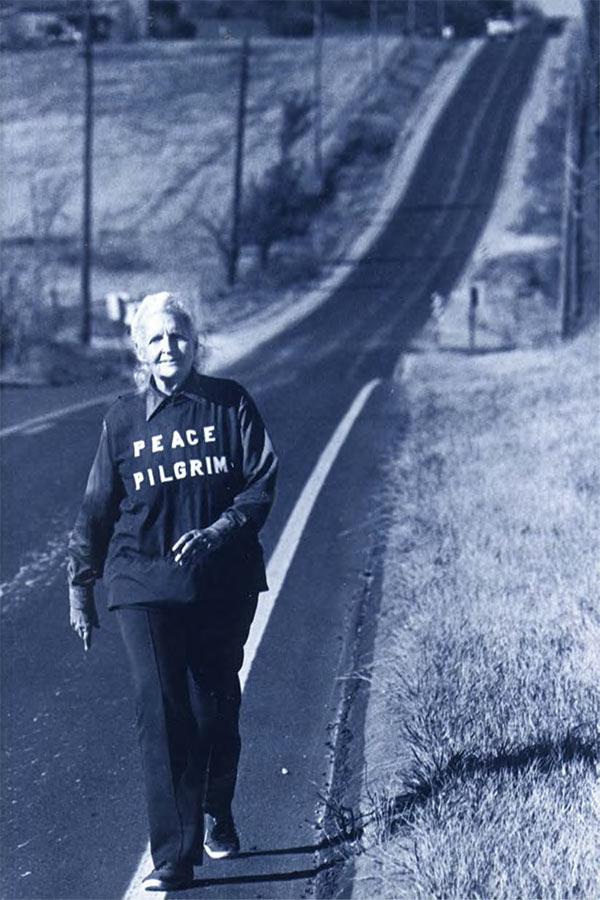
[.imgcaption]Peace Pilgrim, photograph by Jim Burton, Topeka Capital-Journal. [.smalltext]Used by permission of Friends of Peace Pilgrim.[.smalltext][.imgcaption]
What inspired this woman to undertake such a whimsical mission with an attitude of complete surrender to the unknown? In her own words, she was rich in blessings because she had surrendered to Divine Providence and found inner peace. “Many think inner peace cannot be attained – it’s the one who doesn’t know it can’t be done who does it.” Peace Pilgrim’s Higher Power, from what we can deduce from her writings, was not necessarily the Christian God. She spoke in general spiritual terms of God as the “Highest Light,” the “Divine Nature” that, when one is in harmony with it, leads to inner peace. “Look within for your answers. Your divine nature – your inner light – knows all the answers. Spend your time bringing your life into harmony with divine law. Work on overcoming evil with good, falsehood with truth, hatred with love.” She felt no need for dogma or the fences of organized religion, and defied classification. And yet she lived entirely by faith and trust, was unencumbered by the trappings of material possessions, and completely accepted external circumstances most people would consider negative or uncomfortable. “It is easy to speak of faith; it is another thing to live it.”
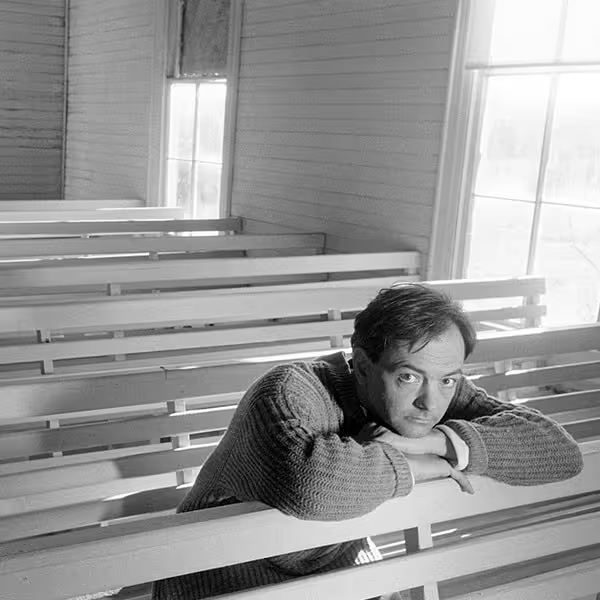
[.article__paragraph--cap][.small-caps]I was only recently introduced[.small-caps] to another modern spiritual savant, Rich Mullins, the Christian musician who died tragically in an automobile accident in 1997 at age forty-two, through James Bryan Smith’s book Rich Mullins: An Arrow Pointing to Heaven. Although I had never been an aficionado of contemporary Christian music, I found the story of this talented musician curious and inspiring. Mullins was hard to pin down. As fellow musician John Fischer noted, “Rich Mullins was a pilgrim. He passed through here, sank into his own humanity, and rose to heights of sacredness through grace. His irreverent spirituality touched many, confused some, and gave hope to many more.”[.article__paragraph--cap]
Mullins was theologically open and ecumenically minded. Raised by a Quaker mother and a Bible-believing father, his overarching concern in life was how to know and belong to Jesus more, to “be God’s.” Though he was not Catholic, he had a Catholic priest as a confessor and was greatly inspired by the life of Saint Francis. He was not a proselytizer, though his music, imbued with an overwhelming message of grace, touched millions. And though monetarily successful in the Christian music industry, he traded most of his royalties for a common man’s allowance, living simply in imitation of Jesus, “who had nowhere to lay his head.”
Mullins never really had a permanent home, moving from place to place, staying with friends, and going wherever the Spirit led him. Eventually this would take him to a Navajo reservation in New Mexico, desiring to teach the children music. He performed barefoot and often wore shabby clothes. He was acutely aware of his own brokenness and more than ready to admit it to anyone. His obsession was living out the commandment of Jesus to love God and love your neighbor. And he was loved back, because he himself loved deeply and was intentional about putting others before himself.
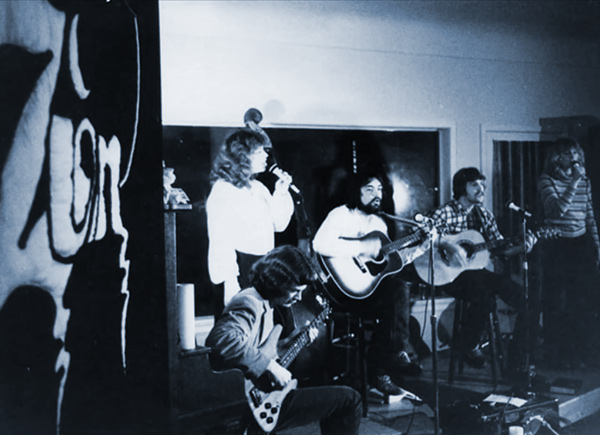
[.imgcaption]Rich Mullins and his first formal band, Zion, in 1979. [.smalltext]Wikimedia Commons (Public domain).[.smalltext][.imgcaption]
[.article__paragraph--cap][.small-caps]Peace Pilgrim and Rich Mullins[.small-caps] are uncomfortable to me as a Catholic, because while their life is inspiring in many ways, they “fall outside the lines” of expected behavior for a believer. The Scholastic tradition of Catholicism put things neatly in boxes so we know what to make of them. Even the canonization process is a bit of an inquisition: it requires investigation, testimony, and documented miracles attributed to the would-be saint’s intercession.[.article__paragraph--cap]
Many passages in scripture indict those who would rather talk about the works of mercy than perform them: the story of Lazarus and the rich man in Luke 16; the sheep and the goats in Matthew 25; the fool who stores up grain in Luke 12. As the years have gone by, I have perfunctorily regarded my attendance at Mass or other devotional practices as sufficient, and Christian service as optional or above and beyond. Yet I realize that spiritual pilgrims “outside the lines,” such as Peace Pilgrim and Rich Mullins, have something I don’t have – a trust in Divine Providence that informs all their actions, allaying fear and putting service to humankind at the forefront of their lives.
Obviously, service to the poor, the outcast, the lonely, and the disenfranchised has a rich history in Catholicism among the saints – Damien of Molokai, Teresa of Calcutta, John Bosco, and Mother Cabrini, among many others – men and women who did not see worship and Christian service as an either/or proposition. And we even have our own history of mendicant savants such as Francis of Assisi and Benedict Joseph Labre, who never felt at home in this world and often had no place to lay their heads.
We have figures like this in Christian history not to indict us, but to inspire us – even when their work and legacy seem absolutely absurd by the standards of the world. The diversity of this eclectic group of saints and pilgrims shows that God values our unique gifts and talents (which he himself has bestowed on us). He doesn’t want us burying our talent in the yard.
Pilgrims know that attachment to the things of the world weighs us down and keeps us from traveling lightly. They forgo the armor of Saul for the sling and stones of David. They go where they are led. They have turned over their lives to a Master whom they follow, who sets a path for them to carry out his work.
[.article__paragraph--cap][.small-caps]When I was at the Catholic Worker,[.small-caps] my partner in ministry, Bruce, once confessed to me while we were smoking cigarettes on the back porch overlooking the neighborhood: “Rob, my biggest fear in this life and work is that my heart will grow cold.” That fear has revisited me in recent years, now almost thirty years a Christian and finding myself at the bottom of the “U-shaped trough” of middle age. Will I wall myself up in the sanctuary, away from the messiness and heartbreak of Christian service? Will I close myself off from the work of loving – the true work of a Christian? Will I retreat to spiritual books and spiritual podcasts and spiritual discussions while neglecting the spiritual (and corporal) works of mercy? As Peace Pilgrim says, “It is easy to speak of faith; it is another thing to live it.”[.article__paragraph--cap]
I don’t want to be a critic in the world of faith. I don’t want to talk theology and hermeneutics and Christian apologetics ad nauseum. I want to know where the fresh water is to baptize, to wash feet, to give drink to the thirsty. I want to know what a man on death row wants besides his last meal in his final hours. I want to learn how to pray, so I can know how to love, and so my heart doesn’t scab over with the frost of indifference.
We are called to work, the hard work of learning to love as Christ loved, in word and deed. Pilgrims, even those outside the lines of a neat and tidy orthodoxy, might be the best people to teach us this. In walking the walk, they have found the freedom of Christ, and they show us where to find it for ourselves.