




Subtotal: $
Checkout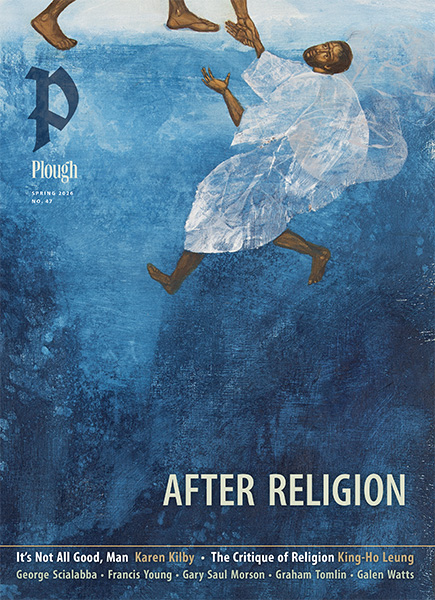

Faith in China
In this episode, Easten Law sheds light on the complexities of Christian faith in contemporary China.
By Easten Law and Joy Marie Clarkson
April 21, 2026
0
Comments
0
Comments
Post a Comment
[You can listen to this episode of Another Life on Apple, Spotify, Amazon Music, or wherever you get your podcasts.]
Transcript
Joy Marie Clarkson: Welcome to Another Life, a podcast of Plough magazine. I’m your host, Joy Clarkson. In this series of episodes, we’ve been exploring the theme of after religion. And by this, we mean two things. Both were wrestling with the idea that we live in a time that is after religion, that’s post-religious, where fewer and fewer people identify with a specific traditional religion. But we’re also thinking about the ways that in that context, especially in the West, people are after religion, how they are seeking after religion. But today, my conversation partner is someone who’s going to bring us a bit further afield than what we mean when we say the secular West. We’re going to speak to someone who knows a lot about Christianity in China. Today, I am delighted to welcome to the show Dr. Easten Law, who is the Associate Director of the Overseas Ministry Study Center at Princeton Seminary. His research focuses on Christianity in contemporary China with an emphasis of thinking about public life and religious pluralism and some other things I’ll talk to him today about including the role of migration in faith and discipleship and how we understand ourselves as Christians in the story of God. So welcome to the show, Dr. Law.
Easten Law: Thank you so much, it’s a pleasure to be here.
Joy Marie Clarkson: So I always like to begin with a little bit of a homey question. So I am speaking to today from my very chilly London flat. We recently got new radiators, but they are fighting hard against the sudden plunge in temperature. So I have my cup of Yorkshire Gold tea, and this is the end of a research day for me. But I’d love to know where are you speaking to me from, and how in general do you spend your days?
Easten Law: A lovely question, especially as we consider the holidays. I am joining from Princeton, New Jersey. I am actually at the Overseas Ministries Study Center house. We call it the OMSC house for short, which is a historic house on the campus of Princeton Theological Seminary. It’s actually a 200-year-old house that dates back to the first professor of the seminary, Archibald Alexander. So he stayed here in this house. So it’s always nice to be working and thinking in a historic space where many other theologians and scholars have thought before.
Just to riff off a little of what you’ve shared, here in the United States during the fall and the summer, I mean, during the fall and the winter, all different flavors of coffee appear. There are those spiced pumpkin lattes, which I’m not a fan of, but I have found myself enjoying the holiday blends of certain types of coffee where they’ll do a little bit of, you know, cloves and cinnamon and that’s the nice beverage that I’m enjoying at the moment. And my days here at OMSC are very nice because we’re a research and training center that engages with the world church.
On a day-to-day basis, I get to intersect with, learn from, and consult with scholars from many parts of the world, not simply China. I work with professors from Nigeria, missionaries that are serving in Central America. This year also a professor from Kenya, as well as a doctoral student from India. So the day-to-day here at the Overseas Ministry Study Center is a treat because not only do I get to engage in my own research on Christianity in China, I get to learn from the research of others. And that’s a real joy and a privilege.
Joy Marie Clarkson: That must be very exciting. Dr. Law, I want to ask you many questions. But I’d love to just begin by getting a sense of the scope of what you specifically research – and maybe how you came to be interested in researching what you do.
Easten Law: Thank you for that question, Joy. When I think about my area of research, which is Christianity in contemporary China, there is a very personal reason for that. I am a second generation Chinese American, born and raised here in the United States.
In college, my father took me back to the People’s Republic of China for the first time. My heritage is in Taiwan, but my dad took me on this trip to China. And it just left such a deep impression on me that I decided that I wanted to go back. And after I graduated college, I spent some time in China teaching, worshiped with unregistered churches, sometimes known as house churches or the underground church, as well as with registered churches, the ones that are government approved. And just experiencing worship and life with these churches brought up so many questions about what faith and religious life mean in a very different social political cultural context and those questions lingered when I returned to the States It’s what led me to seek a PhD And so my doctoral research was on how do young adult Chinese Christians navigate their faith in contemporary China? It was broad open question at first. That question has since evolved into this bigger question of how Chinese Christians negotiate their faith across different types of cultures and boundaries.
So I’ve worked recently with Hong Kong diaspora Christians in light of what’s been taking place in Hong Kong over the past couple of years and I continue to work with this question of what does the diversity of Chinese Christianity mean for Chinese theology and the Chinese Church? Many people, when they think of China, including many Chinese themselves will think of a more homogenous united story of all China, which has 5,000 years of unbroken history. This is a very common term, right? And even when people think about the Chinese diaspora, there is this central, peripheral view that, you know, Chinese culture and civilization is this thing. And when you’re in diaspora, you move farther and farther away from it, like myself as a Chinese American. But I’ve become very interested in, well, let’s really take a look at the diversity of Chinese experiences, because Chinese have migrated all over the world, multiple generations and the Chinese church has migrated with it. And just as we talk about the diversity of the world church, there is a great diversity in the Chinese church now. And so that’s sort of my current big question. And that’s where I spend my time thinking and doing some research.
Joy Marie Clarkson: That’s really exciting. Maybe we’ll come back to this later. But – in London, there is a large population, especially in the last two years, I think, or three years of Hong Kong community that’s migrated since the security law. And it’s really interesting to see how belonging takes up a new space in a new city and a new place and the way that that’s mediated through food, but also that it’s also often mediated through church because a lot of people that I’ve encountered are Christian and often came to that through different denominations, whether it was a lot of Anglicanism because you have the colonial heritage, but also other ways. So even just in my own day-to-day life in London, I’ve experienced a little taste of the diversity that you’re describing. So this runs against what you just said, but can you give us a little bit of the lay of the land in broad generalization of what’s going on with Christianity in China today?
So you described the registered churches and the unregistered churches. That’s something not everyone may know about. So that would be helpful to know. And then, you’ve already done a bit of this, but what are some of the myth-busting things that you might say from your experience and your research of what people might think about Christianity in China that may or may not be true?
Easten Law: Sure. It’s always good to sort of set the parameters and definitions of any discussion. And when we talk about the church in China, there are a lot of generalizations around persecution of the church in China, right, depending on the circles that you’re in. And this is largely what people think of when they hear about what is best technically referred to as the unregistered church.
And as I said, sometimes called the underground church or the house church, right? So when the Chinese Communist Party took over the nation in 1949, they quickly moved to consolidate religious life. And they created these, and at least initially the government did not seek to get rid of religion.
OK, so we’re going to touch a little bit on this theme of after religion, The Chinese Communist Party did not immediately say we need to get rid of religion. What they thought is we need to consolidate religion and create spaces where religion can support this larger communist vision, right? So they created something called the Three-Self Patriotic Movement in China, which is a fancy name for the Chinese church overseen by the Communist Party. Of course, there were numerous churches that refused to register with this new body called the Three-Self Patriotic Movement. And these would become what we now know as the unregistered or the house church. Basically, they refused to work with the government. But there was a group of churches that decided, yes, we will work with the government. We can find things to see eye to eye on, even if you’re the atheist communist party or Christians, but maybe we can work together. And so they did join this government association. And they’re most easily referred to as the registered church. And so that’s an easy way to look at it, registered versus unregistered.
Joy Marie Clarkson: Can I say too with the registered church, that’s across a range of denominations, right? Like there are registered, in my understanding, Roman Catholic. Is that true?
Easten Law: Well, it’s interesting you asked that question. So there’s two quick answers to that – I won’t dive into the history lesson behind each of these – first, it should be noted that in China, the popular conception is that Roman Catholicism and Protestant Christianity are two completely different religions. That’s the popular sensibility. Why? We can thank, actually, Western missionaries for that because the Protestants and Catholics didn’t like each other at that time and they actually worked to distinguish themselves from one another and the Chinese just accepted it. And so the Catholics actually have their own government registered association that is different from the Protestants.
So that’s one perspective. The second perspective is when the Chinese Communist Party decided to create a registered church, they also decided we need to get rid of denominations. Because denominations are historical roots to Europe or the West. And we’re going to be the Chinese church. We’re not going to be a church with our heritage in England or Germany, etc. And so the Three-Self Church by their own confession, they call themselves a post-denominational church. That’s the term that they use. Now …
Joy Marie Clarkson: And after denomination, if not after religion.
Easten Law: Yeah, a post-denominational church. Now this gets expressed in interesting ways because the way that the registered church is set up is top-down. So there’s sort of an Anglican-ish, you know, setup where people oversee layers of the church moving down. So it does have sort of an Episcopal structure. But, then there’s within this body of different churches, at the local level, many registered churches know their history. So they’ll know, yes, this church was a Methodist church, and now we’re part of the registered Three-Self Church. So they know their denominational history. And they might even carry it with pride, but officially, they’re all just part of the registered Chinese church, the Three-Self Church.
Joy Marie Clarkson: That’s very fascinating. And I had vague impressions, but now I have greater clarity. OK, so that helps us get a lay of the land, generally. Now what are some of the impressions and some of the myth-busting that you would do?
Easten Law: Absolutely. So one of the most common myths devout Christians in the West will gaze over at China and ponder is, what’s going on in the church? There is this sense that the church is continually persecuted. But when we say that, we’re really thinking about different historical periods in modern China. Like I said, initially there was not a great persecution of churches. There was this attempt to consolidate them, but many churches refused to. Once you move into the period of time around the Cultural Revolution, this is the ’70s, then you did see the Chinese Communist Party make a pivot to trying to end religion. Right? And at that point, it didn’t matter if you were a registered church or an unregistered church. They were trying to close all the churches. They were trying to end religion. It was a particular moment. Interestingly, with the opening up the economic reform period in the ’90s when China opened itself to the world, there came with it a certain sense of religious revival. So you talk about after religion, as in post-religion, and after religion, like people are after religion.
This is the Chinese story, because after they tried to, the Communist Party tried to end religion, they – as they opened up economically, they also loosened their grip and they let the churches rebuild. The registered church rebuilt and the house churches rebuilt to the point where in the late ’90s through the 2000s, the unregistered church was probably the most public it had ever been. Sure, didn’t own buildings and they didn’t have signs that said there’s a church here, but the government was very open to them to continue to meet – they would rent out entire floors of business buildings or hotels, you know, and many non-registered Christians would come together to worship and the government would sort of just turn a blind eye and say it’s fine. And there was a certain social exchange here that as long as you keep to yourselves, we’re fine with it. And as long as you do good for society. So these unregistered house structures during the 2000s through 2010, they became actually very public.
And this is one of those myth busters, right? That they opened Christian bookstores. They had nonprofits that served communities. Churches opened up elderly care centers. And the local governments were happy with this because there was this sense that churches are contributing to social harmony. Harmony was sort of the big word at that time. And so that’s actually when I started to learn more about the Chinese church and why I was so interested in changes in the church, right?
But if we keep moving through history by the time we’re now 2010 through 2015 when Xi Jinping, the current president of China, stepped up, now we’re seeing that tightening again. And so a lot of unregistered churches are now feeling similar pressure, not to the same extreme as during the Cultural Revolution, but they’re feeling similar pressure. Churches are getting shut down, leaders are getting arrested, and so you’re seeing that tightening. And so if I could summarize this again for our listeners here, since the Chinese Communist Party began to rule China, there’s been this tightening and loosening over time in their relationship to religion and their relationship to Christianity. It hasn’t been this persistent persecution nor has it been this open embrace. There’s been sort of calculated political decisions around how should the church play its role in Chinese society. And that’s important to recognize – that there are ebbs and flows in the experience of the Chinese church. It’s not all persecution. It’s not all open. It’s somewhere in between.
Joy Marie Clarkson: Thank you. That is really fascinating and really clear and helpful. It also makes me understand my own experience better. I was able to visit China, both mainland China and Hong Kong in 2009. And it was because it was right after the Olympics. So Beijing’s air was very clear and it was exciting. And the reason I was there was that – so my mother is a Christian author, and her book was translated. And part of the logic about why it was translated was it was about parenthood, and that this was good for parents, it was good family values. And I remember being surprised by how we would go and there would be 1,000 people. And it was very different from my mental image of what the church was like in China.
So you said that now is in a state of tightening, that there’s more pressure on the churches. And I assume that’s both unregistered and registered to some, they’d both be experiencing more tightness?
Easten Law: Yeah, in different ways.
Joy Marie Clarkson: And I followed that with some interest, both with the Roman Catholic Church, and there’s various dramas and Difficulties, especially over Pope Francis’s decisions about various things. I guess my question is, does that tightening – and it might be difficult – this is me just asking you questions I’ve had and never been able to ask somebody who knew. Is the church growing, shrinking? Can you tell? Is there a way to meaningfully calculate these things demographically? What’s your perspective on that?
Easten Law: So the short answer to your question is no. We really can’t tell how many Christians there are in China. It’s impossible to track that number because there are just competing numbers. Generally, the official estimates by the government in China tend to be on the low end. Zealous Christians overseas will tend to put that number higher. And so I just generally take a, you know, when I look at the numbers, I just pick the one in the middle, right? And so the general conception is probably around 5 percent of China is Christian. There’s estimates between 2 to 3 to like as high as like 10 percent, sometimes. And so I would venture to say it’s about 5 percent. And this question of is Chinese Christianity continuing to grow in China, the People’s Republic of China? The people tend to – demographers and scholars of Chinese Christianity at the moment tend to think it’s starting to flatline actually.
So if you remember from something I shared earlier, when China opened up economically, you know, and started on this journey to becoming the economic powerhouse it is today, you know, join the WTO in the ’90s. As it economically began to thrive, people were getting richer. There was also this longing for a sense of spirituality to go with that, because all of the economic boom created a certain wild west of trade and capitalism and morals just felt really lax and people wanted like a spiritual center. So during this time, Christianity boomed. You saw an incredible increase in the church between the ’90s through the 2000s. That’s when, I’m not a demographer, I’m bad with numbers, but if you check the charts, it sort of just zoomed right up, right? The interesting thing is it’s not just Christianity that boomed, many religious faiths made a strong comeback. People were turning to Buddhism again. People were turning to Taoism. Just a myriad of spiritualities to try to anchor themselves amidst all of this economic change. So there was a big boom and now we’re starting to flatline a little bit in terms of people’s interest in, or people’s conversion to Christian faith. And I’ll just end with a note on what you said about the different types of pressures that are currently being experienced. Because religion made this big comeback, again not just among Christians but among all types of faith traditions, yes there’s more persecution but with those that are part of the registered religious communities, whether it’s the church, Christian church or the Buddhist societies, those that work with the government explicitly.
The government has created this campaign of what they’re saying they want to Sinicize Christianity. I mean, Sinicize religion, including Christianity. And by Sinicize, you know, it means to make Chinese, you know, to make these religions truly Chinese, which is a little bit silly when you consider Taoism which has a religious association and order and was founded in China. So how do you make Daoism more Chinese than it was before when it started in China? And so what the government actually means when they say to Sinicize religion, they’re actually saying what does it mean to make it more communist or socialist? – Because it needs to fall in line with – it needs to join the party line. We’ve let religion thrive but now it’s time to bring it back in and everyone should fall into step. And so while the unregistered churches are struggling with the more traditional senses of persecution, leaders getting arrested, churches being shut down, those in the registered church are put in this position where they have to theologize very carefully. They have to theologize in dialogue – at best in dialogue, sometimes in careful submission to what the party says Christian theology should be. You know, the registered church has always done this dance.
There’s this myth, again, there’s this myth that the registered church is just – they’re just stooges of the party, right? They just do whatever the party says. That’s definitely not true. They are genuine Christians. They but they just have a different sense of church and state. And what they do is this dance in this negotiation with the party. Sure, they’ll write documents that they need to write. They’ll make speeches that they need to make about, in this case, the Sinicization of Christianity. But they’re also really taking care of congregations and they’re really trying to help people walk in faith. And so they’re doing both sides of this. And so they have a different negotiation process with this tightening than the house churches do that are simply sort of resisting and hiding and moving around. Those answers hopefully hit both ends of your question there.
Joy Marie Clarkson: Absolutely, yeah. So you’re seeing with the unregistered churches, as you said, imprisonments and shutting down churches, but there’s maybe a more delicate pressure that’s on the registered churches. And there’s reasons why they would want to continue to be in good stead with the government, one would assume, that is part of how they continue to be able to minister to their congregations. Are there ever moments of breaking points with registered churches where they feel that they can’t, or would you just not know? I guess it may not be publicized.
Easten Law: I’m confident that there are church leaders in the registered church movement that are very frustrated. But the reality is you won’t hear that frustration publicly aired, it’s not possible. China has created a system, especially since Covid, a security system that is the envy of oligarchs all over the world. They have leveraged probably more and more AI, although I wouldn’t know how, but just surveillance on a level that is just unparalleled, I feel like in many countries.
If you go to China today, there are cameras everywhere, there’s facial recognition everywhere. During Covid, they instituted systems where you would scan in and out of restaurants, so they actually knew where you were because of your phone. And so because of this strong sort of public control, for that freedom of speech that did exist, technology has helped tighten China’s controls on the freedom of speech over the past decade. And this is a bit of an aside, I guess, but all types of thought, Christian, otherwise, Chinese are very cognizant that there’s always the possibility that what they’re thinking or saying could be used against them. So it’s a very difficult time for freedom of speech as a whole.
Joy Marie Clarkson: Yeah, and I think that context for other religious minorities or systems of thought and how that’s affecting them is helpful. It’s a more filled out sense of Christianity’s place in the People’s Republic of China. I heard someone recently say to me in a darkly humorous way that China is the safest place in the world in large part because it is so surveilled. You – can’t hiccup. And it’s interesting because that is, I think, actually a part of the way that it markets itself as this flourishing place where no crimes happen, unlike in that dirty city, London. Which I will say, London is pretty safe. But I think that is a narrative that I have heard from those who live in the People’s Republic of China. But of course, as you said, that comes with the underside of extreme limitation on freedom of speech in many places.
Are there meaningful ways that churches or Christians in the West can support or help the church in China?
Easten Law: Yes. The good news is that with every wave of tightening or persecution, the Chinese church has adapted and really learned to – thrive might be too strong a word – but has learned to grow in their faith in such a way that they don’t need the West, or they don’t need churches outside to support them in terms of their spiritual lives. They’ve found ways to support one another, to grow. I would say what is often seen as the need is more so in the world of theological education in terms of resources and such. There’s always a sense that we need to train more pastors. We need to train more teachers. And that’s often been a way that many Christians outside have thought about what it means to support the Chinese church. And to tie this to your question even about migration and the Chinese diaspora, I would say that the Chinese continue to be global players on multiple levels globally and this goes from construction, you know, laborers that work on construction to – students studying at elite schools. The Chinese are going all over the world and so for example in London, in the United Kingdom, there are sure to be many Chinese there.
And the best thing that any church anywhere can do would be to truly be hospitable, welcoming, and engaging hosts for the Chinese that are there. – That would actually surprise them in some ways because, you know, yeah, there’s Chinese churches and of course they’re going to be hospitable to the Chinese that come. But what does it mean for English churches to be? And I think, you know, I’m familiar with what took place as the Hong Kong diaspora moved to the United Kingdom and there was like this great mobilization of different sectors. And that was an amazing witness, right? So I would say one of the best things that the church around the world can do as China globalizes is to be a witness through their hospitality to Chinese, whether they’re elite Chinese or if they’re laborers working on highways in Africa because their governments have made a deal. – That’s the way to create those strong relationships. And it helps because it gets us away from the sense, we’ve talked a lot about the Chinese government and its policies, but the Chinese people are dynamic, negotiating all kinds of questions about faith and spirituality and power and the Chinese people are not the Chinese government and for the church in other parts of the world to truly be hospitable and welcoming, you’re building relationships with the Chinese people which is a whole different process that is worth well worth investing in.
Joy Marie Clarkson: That is a very inspiring thought to take with me and hopefully with the listeners as well. So as we’re coming to the near the end of our conversation, when I was doing a bit of research on you, as I do on all of my guests, I discovered a talk you gave meditating on the role of migration. Now I know that can sound like in some ways, I migration can sound like a very academic word. But it’s the sense of I think what you’re getting at is the way in which we can look back over generations and see families move from one place to another and negotiate things like how a faith is sustained from one generation that maybe is living in China to another generation is living in America. And how do we understand and form our sense of belonging in the Christian faith and also to our families? So I’m blah, blah, blah-ing, but I would just love to hear your thoughts on that theme of what is the role of thinking about migration in the Christian faith and in Christian formation and how we understand ourselves.
Easten Law: Yeah, this is a topic that is near and dear to me, in part because I’m familiar with my own family’s story of migration. But it’s also sort of a, it’s becoming, if you will, a theological passion of mine too. And there’s growing literature on theology of migration, or migration theology. My mentor Peter Phan recently published a book on it.
For me, as – a practical theologian, as somebody that cares about spiritual formation, I was looking at migration, not necessarily in relationship to theological doctrines, which systematicians are great at, but more what does it do for our own sense of faith, right? And I’ve walked away with this strong conviction that the Holy Spirit sanctifies us through many things, but in part through migration and through an awareness of that migration for those who might feel like, I haven’t migrated anywhere. This is where the multiple generations comes in, right? Even for the person that was born and raised in, you know, maybe southwest England and never moved away or somewhere in the Midwest in the United States. You go back a couple of generations, your family did move. We’ve all moved. And that awareness of how God is present to us as individuals, our families, multiple generations, I think it’s deeply biblical and it’s deeply formative when we really sit with it. You know, that God has been faithful to me and my family across generations. And once you take that lens and you look at scripture, you look at the Bible, suddenly the whole Bible makes more sense to me. Right, you talk about the migrations in Genesis, the migrations in the books of the prophets, the migration of the church in the New Testament. God is present with those who are moving, and it’s in the moving that we become closer to God. It’s in the moving that we become more Christ-like if we’re going to lean into that sort of Christian sensibility.
And I guess to bring that all the way back around to even this theme of religion after religion after religion, the word religion, right, to get nerdy, comes from the term religio or to bind, right? So that religion somehow binds us to one set of beliefs, and one’s identity, and one’s doctrine, right? – And there’s a part of me that thinks that in that sense, we do need to get beyond religion, that it binds us to one identity and we don’t want to explore and engage other places or other movements, right? We need to get out of that – we should be unbound to take our spiritual journey seriously and go elsewhere. But in doing so, we’re also going after religion in the sense that we’re going after something new. We’re attempting to understand something new. And there’s a movement there from after religion in one sense to after religion in another sense. And that, I think sums up in many ways what I think is so important about having a – let’s say a migratory consciousness. We talk about historical consciousness – migratory consciousness is a part of that, I guess, historical consciousness. That, you know, we have all been migrants, if not physically, then spiritually, emotionally, just moving through seasons of life. And that’s how God shapes us, right? And I think the more we become aware of it, the deeper the Spirit is able to work in us.
Joy Marie Clarkson: I really love that. So an element of my story, which you would have no cause to know, is that my family moved, as my mother loved to tell people, sixteen times and six times internationally. And for a long time, I really struggled with that because I had this sense that if I belonged somewhere, if I belonged to a place or even to a particular church tradition, because we were vaguely non-denominational, that I was just missing something that if I could belong somewhere, put down roots, that there would be some existential meaning that would return to me. And I think it has been a really important part of my own spiritual journey to actually see that, you want to call it migratory aspect of life, is actually the space in which God is working in my life and the place in which I see that work happening. several things that were helpful for me in thinking about that, and I was thinking of this when I was listening to the interview that you did, was, A), that there is a lot of migration that happens in scripture, as you said, whether it’s Abraham going out into being a stranger, you know, or Moses, the actual Exodus itself.
And then how frequently the language of God traveling with us or being with us is there and people have all kinds of feelings about Augustine and I get that. But something I love about his theology is this idea that the fundamental metaphor for the Christian life is pilgrimage, right? That there is some sense in which we are – in some ways has become unpopular to say this because I think there’s been such an emphasis on incarnational living and home and belonging and people love reading Wendell Berry that it’s become popular to remember that there is this sense that we are strangers in a strange land that we are longing for some full redemption. And so we do live both in our own individual biographies, but also as a church in this pilgrimage attitude. And coming to actually claim that was a very important part for me of figuring out what it meant to be a human being and what it meant to be a Christian. So I guess that’s just a way to say, I affirm what you’ve said and I agree with it and it resonates with me.
Easten Law: Well, thank you. I appreciate you sharing a piece of your journey. And, you know, I would challenge, that’s too strong a word, I would invite, I would invite the listeners of this podcast right afterwards to just take three to five minutes, maybe a piece of paper and a pen and just think about like, well, how many generations back do I know and how much movement has taken place, you know, and when, what happened in those movements that I can say, yeah, God was faithful, maybe not to me, but to my mother, to my grandmother, you know, and I think just by doing that, even if you’re not a Christian, even if you’re not spiritual, even if it’s after religion for you, I think it fosters a great sense of gratitude – for who, for where you are and that you are the culmination of many hopes and prayers and fears, you know, and it’s a great practice. Yeah.
Joy Marie Clarkson: Yes. And that you are the testament to survival – of many generations of survival.
So I like to end these conversations – by asking people, and we’ll see what comes up because I told you this earlier and now you’ve had forty-five minutes to ponder it. If you could share with us one thing, it can be anything. It could be a person, it could be a practice, it can be a movie, it can be a snack. One thing that reminds you that another life is possible.
Easten Law: Great. Well, I know we’ve talked about a lot of rich theological things and history and politics in the context of China. But the funny thing is when you asked me to prepare for that question, we have our everyday lives and there’s always certain popular things that are happening in the moment. And I’ll just be absolutely honest, the first thing that came to mind was the Netflix series Stranger Things, which I have been watching with great interest and so why Stranger Things? Well, obviously, all popular shows that captivate the imagination show you that another world is possible.
And I know that Plough and the tagline, another world is possible, it tends to push toward the positive imagination that another world is possible. Stranger Things pushes toward the negative imagination of another world is possible. It’s like there’s the upside down world.
These terrible things hidden in this interdimensional crevice that are just pouring out into Hawkins, Indiana, that another world is possible and it’s bad. But I think that’s also important to keep in mind, that when we think another world is possible, there are terrible worlds that are also possible. And the thing that I like about Stranger Things is, you know, the Duffy brothers were very intentional about, you know, as dark as it can get, there’s really kids growing up at the center of the narrative arc. And these kids fight for their world, right?
And because the series has taken so long to make, these kids are adults now, right? – But they’re still supposed to be high school students in the TV series. But it’s the sense of when another world that is possible is so negative that you fight for the world that you love that does exist, right? And it’s interesting. I feel like that there’s some social political resonance to that at the moment.
We’re seeing other worlds that aren’t so lovely that we maybe thought were impossible that we had moved beyond these things. And they are, they’re not just creeping up anymore, they’ve broken free in many different places. So Stranger Things is fun and captivating as entertainment, but I think it reminds me that we fight for the worlds that we want to keep – against negative possibilities as well.
Joy Marie Clarkson: I love that. I love a good pop culture reference. The last few have been way too deep or contemplative. And this also inspires me because I have not seen the newer season of Stranger Things. So maybe that’s in store for me.
Easten Law: Well, season four’s got some really long episodes, so you know, make sure you set aside some time. And then season five comes out next week, so I don’t know when this podcast will go up, but it’s, you know, it’s a free advertisement for a company that needs no advertising. Oh well.
Joy Marie Clarkson: Yes, well, I’ve got some homework to do clearly. So, well, thank you so much for joining us, Dr. Law. This has been such a wonderful conversation and I just really appreciate it.
Easten Law: Well, thank you for your invitation. It’s a pleasure to be able to share these thoughts with, like you’ve said, somebody who is also resonating with this. And I’ve read a number of articles in Plough that have showed up on my different feeds, you know, thank you algorithm. And I appreciate the way that Plough does try to attack, – attack’s a bad word – engage topics from multiple angles. That’s one of the things that I have appreciated about the publication. So it’s lovely to be able to be a part of it in this way.
Joy Marie Clarkson: Yeah, well, we’re very happy to have you. And the Bruderhof, which runs the Plough, are nonviolent when it comes to all things, but perhaps not to ideas. So I think they could say they attack things from time to time in literature. So thank you so much for joining me. And yeah, it’s been a great conversation.
Easten Law: OK, my pleasure, thank you very much.


You have ${x} free ${w} remaining.
This is your last free article this month.
We hope you've enjoyed your free articles.
This article is reserved for subscribers.
Already a subscriber? Sign in
Try 3 months of unlimited access. Start your FREE TRIAL today. Cancel anytime.