Podcast
An Artist Reinterprets Classic Nature Poems
The comic artist behind Plough’s new anthology of nature poems talks to Joy Clarkson.
March 24, 2026
Try 3 months of unlimited access. Start your FREE TRIAL today. Cancel anytime.
START FREE TRIAL NOWThe comic artist behind Plough’s new anthology of nature poems talks to Joy Clarkson.
[You can listen to this episode of Another Life on Apple, Spotify, Amazon Music, or wherever you get your podcasts.]
Joy Marie Clarkson: Welcome to Another Life, a podcast of Plough magazine. I’m your host, Joy Clarkson. I am delighted to be back today, speaking with you all. It is a sunshiny, crisp springtime day in London, where I’m recording this. And it feels particularly appropriate that I spent the morning, after doing some writing, walking around and admiring the daffodils and the blossoming cherry blossoms in my area and enjoying the opening beginnings of spring here. Because today I’m going to welcome to the show Julian Peters, whose recent book Nature Poems to See By helps people both have words and images to see nature by. So welcome to the show, Julian. It’s great to have you.
Julian Peters: Thanks so much. I’m glad to be here. Thank you, Joy.
Joy Marie Clarkson: So I always like to begin these conversations with a little bit of grounding of where you are physically in the world and how you spend your days. I will start. I’ve already given away my cards, but I am in London and I usually sit in my cold little flat in East London. But today it’s slightly less cold than it has been for the last six months of episodes that I’ve recorded. So I’m in my hope-filled springtimey East London apartment. I’ve just drunk a cup of Yorkshire Gold tea, hoping that it will inspire my brain cells to work in the early afternoon. And that’s me and everyone knows what I do. So tell us where you are in the world and how you spend your days.
Julian Peters: Well I’m here in Montreal where it’s pretty wintery. No signs of spring really. I’m looking outside the window. I haven’t been outside yet today because it’s morning here but there’s some snow falling. Snow covers the ground. So even though I believe today is officially the first day of spring it seems like we’re in for a few more weeks of winter here.
Although the local bear in our ecomuseum zoo apparently came out today from her den. So she’s out of hibernation. That’s supposed to mark sort of, that’s a good sign that spring has arrived in Canada apparently. So today’s Friday and I teach in a college, but I have Fridays off this semester. So that’s very nice to have a longer weekend, and to speak with you from home.
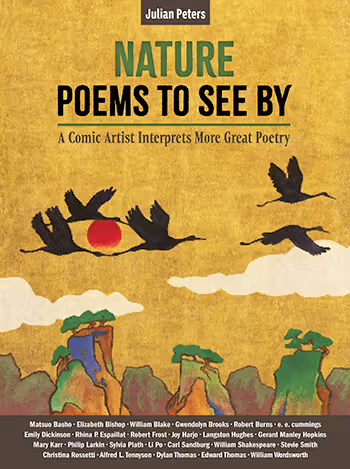
Joy Marie Clarkson: Wonderful. So today we’re going to talk about your book that will be coming out on the day that this podcast releases, which is Nature Poems to See By with the subtitle, A Comic Artist Interprets More Great Poetry, which anticipates the fact that this is actually the second installment of the series of Poems to See By. Can you tell us a little bit about this project and your vision for it.
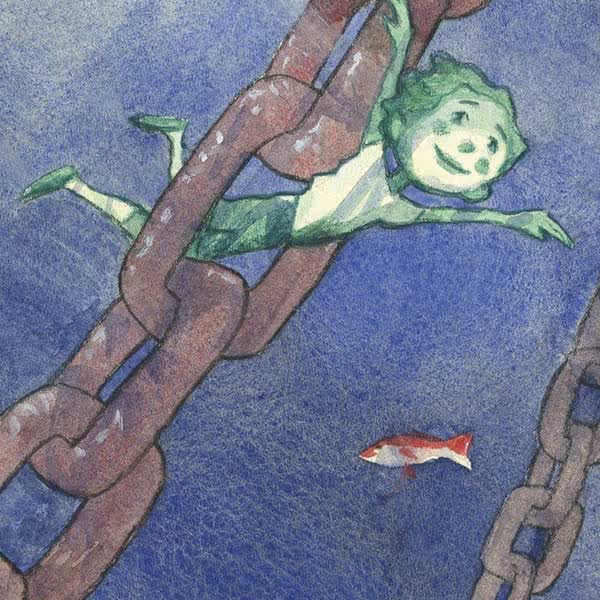
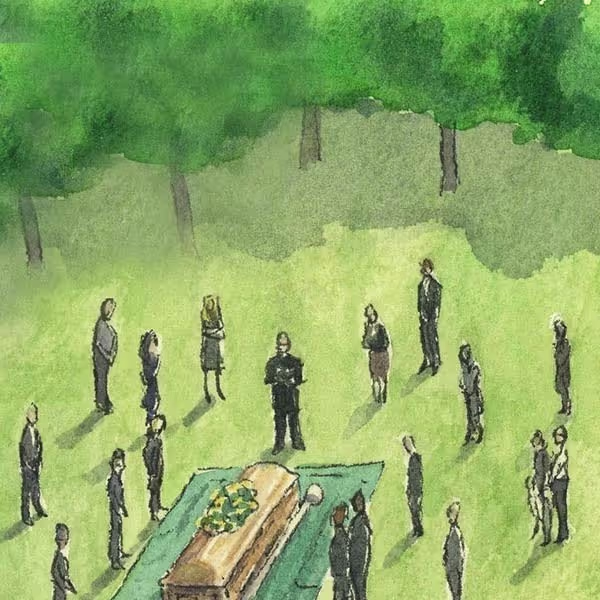
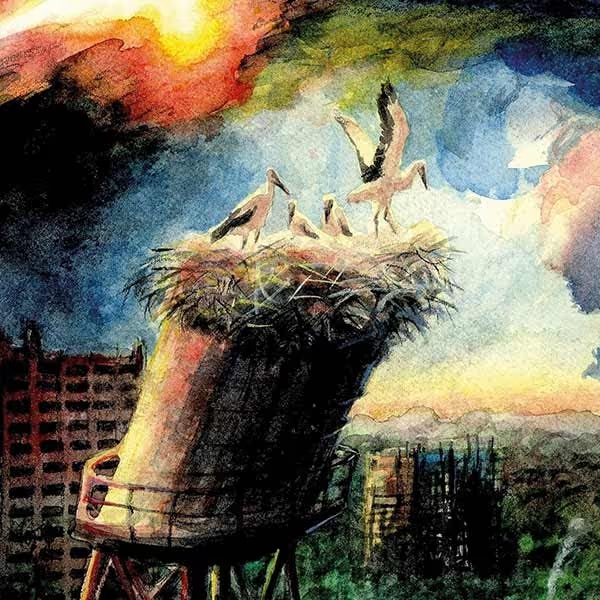
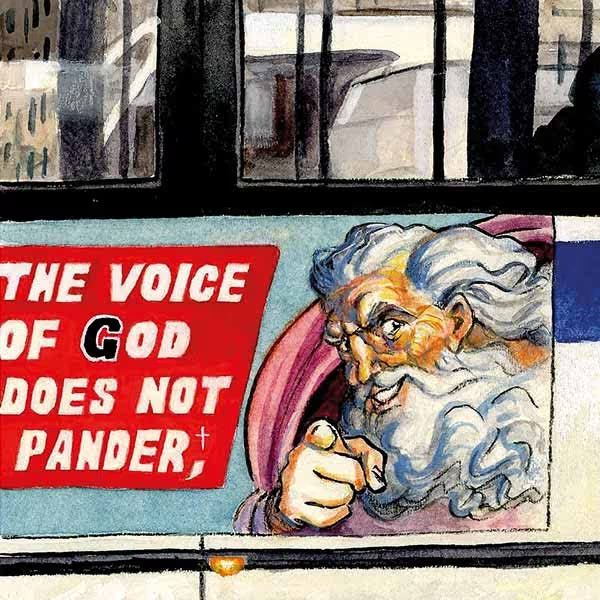
Julian Peters: This book is an extension of the first book, Poems to See By, which is, well, both books are a collection of twenty-four poems, mostly classic poems from the nineteenth, twentieth century, but some contemporary authors. They’re poems that have been adapted or almost like translated into the medium of comic books. So rather than simply being like accompanying a poetic text with an illustration, it’s a representation of the words of the poem through comic book panels. So more or less on average, each line of a poem is given its own comic book square, its own comic book panel. And this allows for a constant dialogue between word and image throughout the reading experience, I guess. So this is my version of poetry comics that I’ve been doing for years and years now, long before even the first Poems to See By book came out. I started adapting poetry into comics in my early twenties.
I’ve gone through a bunch of those kind of projects using different languages, mostly English poetry, but also French language poetry, Italian poetry. But this work with Plough is kind of like the culmination of that experience, a real anthology book project.
Joy Marie Clarkson: Yeah, I was so excited. I came home from a long trip to have the book in the mail. And I was really delighted as I was flipping through this most recent one, which is Nature Poems to See By. It reminded me, well, it reminded me of a book of my childhood that I don’t actually remember the name of, but that was very formative to me, which was a series of classical or just famous poems that were illustrated. And in that way, it reminded me of it because I still have this very vivid memory as a child of reading the Blake poem, “Tyger, Tyger.” And there was this really amazing illustration to it. And it stuck in my head as a child, both because of the words themselves, which were wonderful, but also the way the image somehow brought it to life for me in a special way. So in that sense, I was reminded of that book in my childhood and how it kind of ignited a love of poetry and helped me see poetry as something that is about images and the way that we see the world. But then the way in which it didn’t remind me of that is that, as you said, it’s not just illustrations of the poetry. It’s more like the metaphor that comes to mind is it’s almost like, sometimes you’ll hear someone say there’s a musical setting of a poem, and that when you do a musical setting it’s like a whole new piece of art because it’s set to music. And I feel like your comic illustrations do that, where it’s not just illustrating the poem, but it’s that it brings this whole new life and interpretation to the poems themselves. And it’s really fun because each of the comics for each poem are different in their styles and in the ways that you draw them. Some are, I think I’m not making this up, some are black and white, right?
Some are in color. Some have, I’m no great expert, but some have kind of aspects of anime. Some have more classical styles. And so each one is really just a treasure. And I got excited, I’m now just effusing about the book. I will ask you questions about it. But I got excited about showing it to my nieces and nephews who are – how old are they? Give myself a challenge. I think they’re eight, just about to be six, five, and three. But especially the older ones, I was just thinking, they’re just at the age where I think that this will kind of begin to capture their imagination. And so it’s a really exciting book, but it also made me curious. I had all kinds of questions for you after reading it. So it’s in this very specific … to me, it has this high value and this marriage of poetry and images. So those are two distinct things to love. So I was curious, how did you come to care about poetry and how did you come to care about comics and images? And were there any people in your life that helped you love these things?
Julian Peters: OK, great, great question. Well, I definitely became interested in comics long before poetry because I think I’ve been drawing comics since before I could even write.
I would draw comics as a little kid and I would bring, I would leave the speech bubbles blank and then I would bring them to my dad and tell, dictate to him the dialogue that I wanted the characters to be saying. like there’s some very old comics where there’s my, you know, very childish drawings and then like in his fountain pen, the sort of the very adult script written in.
And I read a lot of comics growing up, like most kids, I guess, but because I grew up partly in Italy because my mother’s Italian.
And I grew up then in Montreal, which has a very French influence. I read a lot of European comics, mostly European comics. So I think Europe already in general has a different relationship to comics than in North America; it was much more accepted earlier on that comics could be a legitimate art form and could be appealing to adults. There was a lot of comics that I read growing up that were kind of like presentations of classic literature.
The history of Italy in comics, that had a big influence on me, and even Catholic comics. There were a lot of those in Italy. And so it kind of gave me the idea from the beginning or like, I guess, didn’t remove the prejudice against comics that a lot of people might grow up with – that it’s only for kids or it can’t treat weighty subjects or it can’t really be an artistically valid medium.
So comics were always there basically as long as I can remember. But poetry I didn’t really enjoy as a teenager I would say until my late teens around the age of seventeen. I kind of compare it in my mind to like when you start to really appreciate music as a teenager. Like you might appreciate music as a child as well, but there’s something about music as a teenager that really grabs you in a different way. It’s very intense. And it might be even something almost like a hormonal change that leads to that. And that kind of happened to me with poetry that I went from finding poetry kind of tedious and almost a little bit irritating in a way that just seemed like an overly complicated way of saying things that could just be said much more simply. And then around seventeen or eighteen, I started to see the beauty in poetry, the music in poetry. And so I think that’s partly, as I said, just like developmental change, but I was also exposed to, around that age, poetry teachers who really clearly had a passion for poetry. A couple of them would extemporaneously just start reciting a poem from memory. And this really, I guess probably conveyed to the class like, wow, this person has taken the time to memorize this work. It really must mean something to them and be very powerful to them.
And then I also just kind of remember one of those first occasions when one of my teachers was reciting “The Love Song of J. Alfred Prufrock” actually from memory. This is the first time I’d ever heard the poem. And just like in my mind, like a whole kind of vista opening up all these – almost like a movie in my head. So that, I think, planted the seeds of a way that poetry kind of creates images in the mind’s eye.
Joy Marie Clarkson: That’s really cool to hear that. I know exactly what you mean about the kind of developmental taste for music or for poetry. I wonder if part of it is that, as you said, there’s this kind of hormonal, but also self-actualization, if you want to call it that, that I feel like begins to happen in the teens when you’re kind of aware of yourself as a self and you’re experiencing all these strong emotions and a sense of your independence. And I think that music can give the outlet for that, but poetry I think also gives language sometimes to things that are difficult to express and so it makes sense that that’s something that might become more appealing as one ages. So you studied a master’s in art history and you studied early graphic novels. I want to know what were the early graphic novels? Yeah, tell us about that.
Julian Peters: OK, well, I went to do a master’s in art history. I’ve always loved art history. And I think hopefully that comes through in the books that the drawing styles, the visual styles are taken or influenced by all different eras in art and art from around the world even. I’ve always loved Renaissance art, medieval art, but really all artistic periods. So at one point I thought I would want to become an art history teacher. So I decided to do a master’s in art history.
I realized that at the university I was at, there really wasn’t emphasis on contemporary art or at least modern art, like so post ’60s, post ’70s. And at this point I was already adapting poetry into comics. So I thought it would be good to kind of marry that passion with my academic interests and study a little bit of the history of the combinations of poetry and visual arts. And I guess I had also recently, not too long ago, read an Italian graphic novel from 1969, it was published. So this is early, or this would be considered an early graphic novel because the term graphic novel really only became current, I would say around year 2000 or so. And this graphic novel was written by an Italian novelist called Dino Buzatti, who is actually my favorite writer. And actually, he was also an artist, I have one of his prints behind me here. And he, late in life, turned to painting and illustration and to eventually creating his own comic book as a kind of logical consequence of combining his writing and his illustration work. So in his sixties, he put out this graphic novel. So that was one of the works that most inspired me. But then when I did research into it, I found out that there was actually a lot of experimentation going on between avant-garde writers, like poets especially, looking into comics and looking for the expressive possibilities of comics that they could bring in to their poetic practice.
And then, you also have a lot of dialogue between comics and high art in the ’60s, ’70s. Like, I think pop art is the most obvious example, right, where you have painters like Roy Lichtenstein are taking, you’re blowing up comic book panels and creating a new aesthetic kind of based on that. So I discovered there were other graphic narratives also being done in Canada like that. And it was eye-opening in many ways. But I think one thing is that in comics, you’re generally trying to tell a story visually in as clear a manner as possible. But in a lot of this, because it was sort of experimental because people were coming from the world of poetry, they were sort of deliberately trying to create meanings that were a little bit more ambiguous and difficult to interpret. So it was interesting to see that comic-book language being used in that way, where like maybe the word caption doesn’t have an obvious connection to the image, almost seems to contradict the image; or there’s a narrative sequence that doesn’t really make sense or contradicts what happens before. And this ambiguity, I think, is very interesting and very expressive. And it comes, probably in large part, from people that were coming from outside the world of comics. And that was interesting for me because I feel like I grew up with comics.
Comics feel very much like my own language, but then seeing people that are coming from another background creating comics with their own kind of artistic methods kind of was really interesting and really suggested some new possibilities in how to create comics.
Joy Marie Clarkson: That’s fascinating. So tell me a little bit more about phrase that comes to mind, which is a very annoying academic phrase, but I’m going to use it and then I’ll try to find a better word for it, would be what are the affordances of the graphic style of poetry? And by that I mean what does setting poetry …
Julian Peters: Affordances you said?
Joy Marie Clarkson: Yes, sorry, it’s a very obscure academic thing. By that I mean it was something I used in my PhD. Yes, well actually affordances come from affect theory, so there you go. So, but it’s the kind of sense that it’s using this, what is it? Is a graphic novel a genre or a form?
Julian Peters: Affect theory, I remember that.
Joy Marie Clarkson: What’s the right word for that? A style? Using …
Julian Peters: Yeah, I remember I was kind of like a bit in the comic book, comic studies world and there was a little bit of debate about is comics, a medium or is it a form?
Joy Marie Clarkson: Yeah. Do you have an opinion?
Julian Peters: I remember medium is not quite correct because medium usually refers to something like paint, acrylic paint or pastel or something. Maybe medium isn’t quite the right word, maybe form is better. But I do think it should not be genre for sure because there are different genres of comics presumably.
Comics is such a vast language that it can encompass, I think, any kind of genre within it. I mean, there’s certain genres that people definitely associate with comics, like superhero narratives, but there’s no reason why they have to be told through comics, right? As we see, there’s Marvel movies. I guess you could conceivably have a novel. You could write a novel about superheroes.
Joy Marie Clarkson: I’d be shocked if someone, this is an interesting question and a total tangent – have people not written novels about superheroes? I guess they really don’t. That’s a fascinating thing to think about. Surely there is one somewhere. But not that I know of. OK, we’re gonna, so rabbit trail aside. So let’s call it a form for now. The form of a comic, setting poetry to the form of a comic.
Julian Peters: I bet they probably have, I probably have, yeah. But it’s not a common thing, yeah.
Joy Marie Clarkson: What does it make possible? What does it afford? What does it make possible for reader that just reading the poem on its own or just having a picture with a poem doesn’t? Does that make sense?
Julian Peters: Yeah, you mean particularly what does, like what does this form of, or adaptation of comic, of poetry into comics afford? OK. So there’s various things for sure. Like, well, I think one of the things is that the comic book is, rather than an illustration, it’s a sequence of illustrations or a breaking down of, or maybe a sequence of many, many illustrations. So this allows you to take, to illustrate a text bit by bit, right? Like you can work your way through the comic, through the poem, excuse me. And also I think comics are an inherently narrative medium, or I should say form, an inherently narrative form. So they, by putting the poem into comic book form, one way or another, you are going to superimpose some kind of narrative to it, right, even if it’s not a straightforward story, but there is some kind of sequence that runs through it. So I think that is like, maybe overlaying stories are very powerful, obviously narrative is very engaging for the mind. Overlaying that kind of narrative onto a poem might heighten the reading experience in some ways.
And then I think like for me, especially, I find that like you were mentioning that book that you read as a child, that illustrated book of poetry, and there’s something about illustrated books that is very immersive. There’s something more than paintings on their own. Something about books, the way you turn the pages and you’re looking at the images combined with the words, like in children’s picture books. I can hardly think of reading experiences that have been so fully absorbing as children’s books, certain children’s books, really good children’s books. And comics have that too, because they’re also a combination of word and image. But in a shorter comic, like these poetry comics, there’s more time to pay attention to the individual panels than you would in a longer comic, where you’re just kind of scanning through comic book images in a fraction of a second. So I think that does create something immersive, a heightened kind of reading experience.
Joy Marie Clarkson: I was going to say, I think that when I was reading through the book, something that struck me is it almost teaches you a way to read poems, which is it slows you down. So I’m thinking particularly of the opening poem in the book, which is “Daybreak in Alabama” by Langston Hughes. I love Langston Hughes and his poetry often has these very short kind of potent phrases. Do you know what I mean? These very small images that are so powerful. And the way that you’ve – I was comparing the line-by-line poem to the way that you’ve broken it up in the images, the way that you’ve broken it apart to the first few lines. “When I get to be a colored composer, I’m gonna write me some music about daybreak in Alabama.” And each one of those is a different scene. And the fact that it’s broken up makes you kind of sit with the way that he’s broken up those lines in a way that if you were just reading the pages on the line, you might not. And it gives you the images to look at, but also almost teaches you that this is what the poem is inviting you to do with each line, is to, as you said, summon these images in your mind. So that’s something I liked about it, is it helps you read the poem like a poem.
Julian Peters: Actually, that reminds me of another very important similarity or analogy between comics and poetry, which is that they both do kind of control the pace at which you read. In poetry, the line breaks are so important because they really determine the rhythm. even that you could have spaces between lines to kind of control how fast you absorb the line.
And in comics, the panels, of course, do that too, right? Like how you break up the story and how you break up even the dialogue between panels and longer panels, bigger, smaller panels. It’s all controlling the rhythm. It’s all controlling the movement of the reader’s eye across the page. So yeah, poetry and comics have that definitely in common. There’s almost like a time-based element to it.
Joy Marie Clarkson: Yeah, and slowing down your attention in a time-based way. And I think that also, in a practical educational sense, I think it might be really helpful for kids as an introduction to poetry, because it shows them how to feel the poem, because it does slow you down and helps you sit with those lines.
Julian Peters: Yeah, because often I think poetry is taught, or that element of poetry is omitted, you know, when in the teaching of poetry, that sort of feeling the poetry rather than just understanding it, you know, like there’s, and maybe I would have learned to love poetry earlier if that had been more of the emphasis, like, just look at the beauty of this line and like the musicality of it, the rhythm, right? It doesn’t have to make … you don’t have to understand it necessarily.
Joy Marie Clarkson: It reminds me of, there’s a passage, I can’t remember which book it is, but it’s one of Madeleine L’Engle’s books. And she’s talking about how she read a lot of literature that was basically beyond her capacity when she was very young. And that somebody at some point asked her if she understood what she was reading. And she said, “I don’t know what it means, but I know what it’s about.” And I think there’s some sense of poetry where you have to get to that place where it’s almost more important with poetry that you know what it’s about in your gut and in your feeling, then that you can break it down into exactly what it means.
Julian Peters: Yeah, I love that. Yeah, and in fact, in some ways, there’s almost like some particular appeal to not understanding something. I think like, if you read something and you immediately understand it all, then it doesn’t, it’s not as intriguing to the mind as something that always has a side of mystery, something that you can’t quite put your fingers on. You know, maybe one of my favorite poets is T. S. Eliot and there’s so much of T. S. Eliot that is really obscure to me even after reading for so many years, but there’s a feeling that there is a lot of meaning to it – that you could reach this meaning but you can’t quite get to it and that’s very strong I think.
Joy Marie Clarkson: Yeah, well, T. S. Eliot is so, you know, famous, especially in things like “The Waste Land” for being disjointed. You know, there’s this sense of these disparate images that are assaulting you and you can’t figure out how they all to go together. But that there’s actually something in that disjointedness that appeals to our desire to find the connections and put them together. That that itself is what the poem’s doing to you. You know, it’s not just giving you a message. So I’m talking, I never talk about my PhD. So this is, I don’t know why this is evoking this in me, but my PhD was on – I looked at the use of art and spiritual practices surrounding death. And one of the things that I tried to grapple with is, well, what do we mean when we say that a work of art could be spiritually formative?
And there are lots of different ways to account for that. And one of the main ways people want to account for it is by being like, well, a work of art can illustrate an aspect of a spiritual or religious belief. But of course, if the thing that was formative was the religious belief that being illustrated, then there’s really no point in illustrating it, right? If the thing that’s going to form you is just knowing and believing the thing, then someone should just tell you the thing that you need to believe.
But I tried to think, my PhD was more, what is it about the kind of ambiguities and the invitations of different art forms and works of art that there isn’t a kernel of something to get out of them, but that it’s that very engagement with the ambiguity and the art form, the different kinds of art forms and self that is formative to us? You know, it’s not just getting something out of it, but engaging with it. And I think that comes through with even what you were saying about the early graphic novels and the ways that you might have a phrase that didn’t exactly correspond to the image, but that that’s actually a part of inviting you into thinking about the connection and if it’s there and what it means, what it’s doing to you.
I think as humans, our minds have an innate tendency to try to find connections between things. So even if you have completely disparate elements, you’re going to try to find some connection. And often the poetry or the artistic appeal can lie in that connection that you’re making.
So both of these books have the same intriguing idea behind them, which I would love to hear some of your thoughts on, which is they’re both called Poems to See By. Obviously, this is Nature Poems to See By. And that has the sense that words and images help us see the world in a different way. So I’d love to hear your thoughts behind that, why you chose it as a title, if you did choose it as a title, and just the general sense of how the words, the images we treasure can shape the way that we encounter the world.
Julian Peters: Well, yeah, first of all, I didn’t choose the title. It’s a great title. I was thinking about putting together a project like this for many years, but I couldn’t think of any good, catchy title that would summarize it all. So was thinking something like graphic poetry or …yeah, like very general terms like poems and comics and so Poems to See By is a really great title, I think. All poetry can help us see, think, or especially good poetry and maybe like art in general can help us see the world around us in a different way, of course, because we associate it with the art that we’ve come to store in ourselves. But it also maybe in the case of poetry creates an image in our mind. So poetry is not a visual medium, but it’s often very imagistic. So it’s creating an image in the mind’s eye.
And certainly for me, like it creates a lot of imagery, maybe because I’m a very visual person. So these poems are a way, or these comics are a way to present my own vision, what the poem evokes for me. And then hopefully, well sometimes, what happens is people will say to me that this is exactly how I also saw the poem in my head. That’s kind of a nice feeling of connection, right? There’s something, some shared collective consciousness or some vision that somehow it’s, it’s kind of remarkable to see that. And then at other times, maybe it might not have been the way someone saw the poem, but it will give them a new insight or a new vision of the poem. Or it could be that they really disagree with that particular vision of the poem and that might help you to reflect or lead you to reflect on your own vision of the poem more in contrast with that vision. But for me it’s also like I feel like often when I read a poem I have this image in my head but it’s hard to quite grasp it, quite. I feel like once it’s on paper, I know, OK, that is what I had in my head. But I don’t quite have it in my head until I figure out how to put it down on paper. It’s probably a mental illusion, but I kind of feel sometimes when I do get the image down on paper in a way that pleases me that it is, that’s what I had in my head all along when I read that line, that it’s true to my original vision of the poem.
Joy Marie Clarkson: I love that. And as I said, the poems are so different and I could go on about them for a long time, but one of the ones and your settings, the poem was different. One of the ones I really enjoyed was you had, well, I’ll mention a couple. There’s the William Blake one, which is, I can’t remember the title of poem, but it’s the, “And did those feet in ancient times,” which is usually called “Jerusalem.” There’s a definite strain of very sincere Anglo-Catholics that truly believe that Jesus did in fact walk on English soil because of this poem. So I enjoyed that for that reason. But you illustrate that one in the style of Blake. So that one, kind of has these reminiscences of Blake’s own style of illustrations, which to me all kind of look like fire. They have this movement. So, I loved that one. I also enjoyed, I think it was a Christina Rossetti one that’s in black and white and has a, I could be wrong, but the eyes look very anime to me. They look very… anyway, so I would just love to know how did you decide, obviously you can’t tell us all of them, but tell us about your process of deciding kind of what illustrations or styles belonged with which poems.
Julian Peters: Yeah, well, a lot of it is kind of instinctive, or at least the initial decision, then I flesh it out logically. So in the case of Blake, you know, Blake is such an amazing visual artist as well as a writer, like, is kind of a rare case of someone who is so much of a genius I would say in both areas and when that happens though it’s very hard to imagine the writers’ words in anything other than their drawing style so it just made sense to me to imitate Blake. But at the same time to just be illustrating Blake in the style of Blake seems a bit redundant when you’re not Blake.
But the thing is then that partly led to the decision to set the poem in contemporary England or in the contemporary world, or even like in a future world at the end where you see a vision of a more environmentally friendly society. So I think there it’s adding something by having the style of Blake applied to modern day depictions of tracked housing and smokestacks and there’s an oil platform and then big SUVs being lit on fire by his chariot of fire. So that was, that’s how I felt that I could add something to that style. Yeah.
Joy Marie Clarkson: Which if I can just very briefly cut in, feels very appropriate to Blake because he does have this kind of prescient futuristic feeling. And so I love the last panel, “Till we have built Jerusalem in England’s green and pleasant land.” And it has this very, like a high-speed train with people out in gardens. And so I love that you did that. And it’s, I think it’s a reflection of how much you got into Blake’s head that it just makes sense that it will be futuristic. So it’s quite cool.
Julian Peters: Yeah, that’s true. That’s visionary. His figures are dressed in those kind of like timeless robes, right? Like, yeah, so that I didn’t change, but yeah, the vision at the end is a very future city where everything’s green and there’s electric trains and solar panels and biospheres. But there’s this big band at the back so that you know it is actually London. So it’s what London could be.
And then, the Christina Rossetti one. I really love the wistfulness of a lot of Rossetti’s poetry and the sort of high romantic quality. And I guess I feel like somehow like Japanese manga is often very good at capturing a sense of very strong, very over the top romanticism – kind of romantic idealism and so I mean subtle but there is definitely, like in the eyes, a manga element and in the last two panels where you just see the the eyes and the face, but without the contours of the face. So it’s like the panel itself has become the face of the character. That was something that I came across in a manga around the time I was just about to illustrate this. There was something about that way of depicting the character with just the face and without the border that I really liked, I found very expressive and I thought, I’m gonna keep that and use that. And that’s often what will happen to me. I’m reading, you know, I read a lot of comics, I’ve read a lot of comics and certain narrative or illustrative devices will stick in my head and then at a certain moment I will use them when, or it’s in the back of my mind, “Oh, that would really work well with this line.”
So yeah, that’s another use of comics. Maybe not just the form of comics, but even like the sort of conventions of comics or like manga is a comic book language all its own, like superhero comics are its own comic book language that then can be re-appropriated, I think, in a different context. Sort of like mining its expressive possibilities in a new way.
Joy Marie Clarkson: Yeah. And that each one of those different languages and styles and conventions can do something different for the reader or for the audience and some of those things. I love that you matched Rosetti with manga. That’s really delightful. And it’s funny that you say that about, so I know really like very little about manga other than that a lot of my high school friends were very into it. But I do think there’s something about the romanticism and the romantic style that does sit quite well with a lot of Japanese stuff. I was really upset when I realized that someone had already written an academic article on Miyazaki’s use of the sublime and they compared it to David … I always get this out of order, don’t know why … David Friedrich Casper, is that the name of the artist?
Julian Peters: Caspar David Friedrich, I think it is.
Joy Marie Clarkson: I get all the right names, but not in the right order – about how there is this, in a lot of his films, you have this big expansive nature in the back with a very small figure and how that conveys this kind of, it’s kind of a convention for him. Like it is something you see in almost all of his films. But that it kind of seems to draw from literally the romantic kind of sense of man against the overpowering, sometimes scary views of nature. And so I have this kind of belief that there are more connections there between some Japanese styles and the romantic sensibilities that, yeah.
Julian Peters: Yeah, I can see that. And often I think the male characters in a lot of mangas, like especially mangas like traditionally written for women, they have this very romantic quality. They’re often like sort of long haired, tall, thin, sort of delicate males, often dressed in like these flowing, you know, like almost like romantic, like Regency-period costumes. So yeah, I think that is a sensibility that Japanese respond to.
Joy Marie Clarkson: Yeah. So I could ask you so many more questions, but our time is coming to an end. I have my final, final question that will come after this. But when it comes to the book, I would love to know, what do you hope people will receive from it? What is your hope for the book?
Julian Peters: Well, like I said, I hope that it will encourage those who are not into poetry yet, maybe to see the beauty of poetry, see the … it’s sort of like, I think, once you open the door to experiencing poetry … rather than just understanding poetry or like trying to grasp the meaning, but to feel the poem, to appreciate it like, it’s like an aesthetic thing like music that can really change your perspective. So hopefully that could work for some people. And then for, you know, young readers, for children, I think I also grew up with picture books or in comics where certain images and certain combinations – like having a certain image with a certain line just really stuck in my mind. There’s something about those two things combined that really can stay with you and influence your later tastes.
So hopefully we’ll get children into poetry at a younger age than I got into it and I guess above all to create an aesthetic experience, that is its own experience. I think it’s not a replacement for reading the original poem or better than reading the original poem, but it’s its own kind of experience of beauty, hopefully, to read the two things together and to be immersed in that kind of experience. I noticed that when I read my comics over and if they’re working properly, there’s a rhythm of the panels that just works seamlessly and draws me in and then I know that I did the work properly – that it kind of feels natural.
Joy Marie Clarkson: Well, I can certainly speak for myself and say that it created such an experience for me and made me excited to share it with other people. So I do hope people will pick up a copy of the book. And as we’re drawing to a close, I would love to hear from you something I always ask our listeners is, what is one thing, whether it is a person, a poem, an image, or a practice that helps you remember that another life is possible. So it can be interpreted variously. I think for Plough, it’s usually the sense that there are lots of ways in which our present world isn’t working. And so a part of being a person who tries to live well is trying to imagine new things and new possibilities. So I suppose if I were to think of something that makes me remember that another life is possible, I would think of your final panel on the Blake poem that actually kind of creates, as you said, an imagination of what London, where I live, could be.
Julian Peters: Well, I mean, one thing I could mention that just comes to mind is when I go to certain places where all of the buildings are maybe not particularly attractive, but they’ve all been painted in different bright colors. And it just makes me question why all of the buildings have to always be gray or brown or beige and just by like adding tons of different colors to buildings, it just makes them so much more appealing and creates, usually then creates like a, you know, like an Instagram trap where everyone will go and take pictures of these places just because they’re colorful and there’s really no reason why we couldn’t do that all over the place and make much more appealing cityscapes.
Joy Marie Clarkson: I think that’s an excellent answer. Another more colorful life is possible. Nothing is stopping us! Well, thank you so much, Julian, for joining us. And I look forward to this book getting into the hands of many people. I really appreciate you taking the time and thought to have this conversation with me.
Julian Peters: Well, thanks so much for having me. It was a great conversation. It made me think a lot.