




Subtotal: $
Checkout

Freedom and Love
Love that is capable of bearing everything is omnipotent.
By Juan Mateos
April 3, 2026
0
Comments
0
Comments
Post a Comment
To feel loved is to feel free. As long as indifference, hostility, or hatred hem us in, freedom is difficult. Only in surroundings where you meet esteem and friendliness can you be free without effort. The extraordinary thing about Christ was his total freedom in an atmosphere of misunderstanding on the part of his disciples and enmity on the part of the Jewish authorities. Christ loved those who did not love him, and his cry on the cross: “My God, my God, why hast thou forsaken me?” – the cry of a desolate faith – sprang, perhaps, from no longer feeling even the love of the Father that had always been with him.
At the height of his suffering, Jesus felt his Father withdraw. God did not want Jesus’ decision to die for humankind to be the result of outward support, but to be something fully free, belonging totally to Jesus himself. If Christ had felt upheld by consolation, his death would not have been entirely his own and the merit would have been divided. He had to go alone, without any exterior factor entering into his decision. Christ reached the heights of faith and surrender: “My God, my God,” but in absolute dryness, without feeling the Father’s affection: “Why hast thou abandoned me?” It was a completely mature act without a smile or a caress. The Father’s love, too, had reached its summit when he wished his son to be fully man, to take his greatest decision alone. Omnipotence was used to make us freer; God hid his power that we might grow.
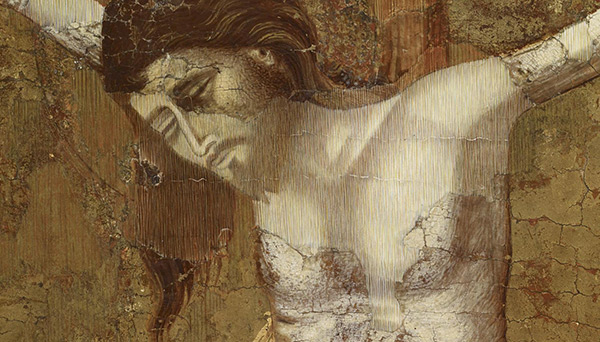
Arnau Bassa, Triptych with Madonna and Child with the Crucifixion and the Annunciation (detail), c. 1340. tempera and gold leaf on panel. Wikimedia Commons (public domain).
Yet the Father was no mere spectator; he was in the Son, and Christ’s agony touched the Father as well. For he is like the Son (John 14:9); if the Son is love that suffers and sacrifices itself, so also is the Father. To say that God is impassible would suggest that nothing human could touch him, change his being, or modify his plans. God is unwavering love without a fissure. His being and his will are unfailing love, but why should they be insensitive? Does he react only by cold deliberation? Is there in God nothing but an Olympian serenity unable to share sorrow with his creature? As a father he is the opposite of a tyrant. His love knows how to wait, he does not constrain people’s freedom. In the parable of the prodigal son, the father let his son go off and did not help him out in his wretchedness, because the decision to return had to be entirely his own.
On Calvary, God is present but hides himself and seems to abandon Christ; he makes no show of power but renounces it; he lays himself open to hurt, and lets himself be wounded by men. For love that is capable of bearing everything is omnipotent. God is the love that can endure all things without exhaustion, without changing to hatred or seeking vengeance. He can give everything and ask for nothing even to those who despise, ignore, or insult him. He knows, too, how to withdraw for the good of the world and how to remain in the background, even at the risk of being rejected. He does good without forcing himself on people; otherwise, the response would be not love, but fear and forcible submission. So as not to diminish the freedom of the one who receives, his is a discreet love which does not absorb or dazzle; it is almost incognito and reveals itself by allusions, suggestions, or hints. He wants the person to grow, to become more and more free and responsible, and so he shows himself less and less. As a person understands more fully, so does he withdraw, leaving him all the initiative. But this discreet love is invincible. Sunday follows Friday and God re-vindicates his love by showing all his might. He is omnipotent because all resources are his, and death itself is incapable of preventing his victory.
From Bread and Wine. First published in Beyond Conventional Christianity (East Asian Pastoral Institute, 1974).

You have ${x} free ${w} remaining.
This is your last free article this month.
We hope you've enjoyed your free articles.
This article is reserved for subscribers.
Already a subscriber? Sign in
Try 3 months of unlimited access. Start your FREE TRIAL today. Cancel anytime.