Living on Manger Street
A current resident of Bethlehem on the meaning of Advent in a country at war.
December 14, 2025
Try 3 months of unlimited access. Start your FREE TRIAL today. Cancel anytime.
START FREE TRIAL NOW
[.article__paragraph--cap] [.small-caps] Years ago, when we lived [.small-caps] on the edge of Jerusalem, I used to pass the ruins of the Kathisma church every time I rode the bus into the city. There it stood, octagonal, unexpected, on the side of a major road, just beyond the gas station near our house: what remained of an abandoned church from the fifth century. Tradition held that Mary, pregnant, rested there on her way to Bethlehem with Joseph to give birth to Jesus, and so it became a major pilgrimage site in the Byzantine era. Sometimes, on days when I knew that there would be little traffic, I would wander over by myself and walk among the stones, imagining the pilgrims centuries ago stopping on their own walks to Bethlehem, drinking water from the spring, lighting candles in the now-collapsed chapels. A shepherd still sometimes herded his goats through the ruins. Flowers would crawl among the fallen pillars come springtime. Each time I visited, I would sit beside the rock – once so important that the entire church had been built around it and still, stubbornly, there – that is called Mary’s Seat. Pilgrims once believed that Mary had stopped, heavy with child, to rest on it from her exhaustion. There, I would pray.[.article__paragraph--cap]
I took comfort in meditating on Mary, walking, and then pausing, tired, on the stone. That had once been an essential part of the nativity story – that it is hard, this path to Bethlehem, that it hurts sometimes. And then that part of the story disappeared, buried beneath the earth for centuries and largely forgotten, until workers accidentally found the church again when they were widening the road. That was how I thought of Advent, in those days. I had given birth to two of my three children at the Holy Family Hospital in Bethlehem. Both times, I had journeyed from Jerusalem, crossing the checkpoint. I knew what labor pains felt like. And I could remember the expectation of longing to hold a child and not being there, not yet – the hope and still the fear that something might go wrong, the journey in search of finding, if not comfort, at least some kind of sanctuary.
The Kathisma made Mary and Joseph’s journey to Bethlehem feel more human, more like ours. In time their journey to Bethlehem became my own. Whenever I passed the Kathisma, I got the sense that, for earlier Christians, pilgrimage wasn’t just walking in the footsteps of Mary and Joseph. No, it was, somehow, walking with them, across time. This journey to the manger wasn’t in the past, but ongoing. They, too, saw Bethlehem still off in the distance. They were tired as Mary and Joseph had been tired. They rested where Mary rested, stopping to drink where Mary drank, gathering the strength to continue. They knew that the nativity is also about us, about where we’re heading, what we’ve set our hopes on. Advent is always a pilgrimage, when we root our hearts in God more fully and start to make our way there.
[.article__paragraph--cap] [.small-caps] A few years ago, [.small-caps] my husband was ordained as a parish priest in the Syriac Catholic Church in Bethlehem, and so we moved from Jerusalem to Bethlehem. In Bethlehem, the orientation of all of our lives changed, without us even noticing it. That is the pull of the manger, for to spend one’s days here is to constantly be reminded of God coming into the world. As I write this, our house stands beside our parish church on Manger Street, up a long flight of stairs. We live a ten-minute walk from the Basilica of the Nativity, where Jesus was born. Now, I can drop in whenever I want, to light a candle, to say a prayer, or simply to be.[.article__paragraph--cap]
Yes, to live on Manger Street in Bethlehem is a good way to try to always live in Advent. From this very place, now, on the way to. From this vantage point, the rest of the town becomes invitation. Beneath the stairs, Abu Yazan is busy baking bread at the Manger Bakery. The taxis honk and the drivers call out – and I know that they sometimes take my son for free when they see him cross the checkpoint to walk home, an unspoken kindness.
A bit further down, a stone marker on the sidewalk announces: Shepherds’ Field, 3 km. Then the road splits off in three directions. If you descend the hill, you’ll cross the green fields where the shepherds met the angels and made their way to the manger from that place. If you climb the hill behind us instead, you arrive on Star Street, where tradition holds that Mary and Joseph neared the end of their journey, and the wise men followed the glistening star. Or you can simply continue to walk straight on Manger Street, as we do, the easiest path to the cave, mercifully without much climbing. From any direction, the roads converge, seemingly pulled by gravity, leading us to the same place.
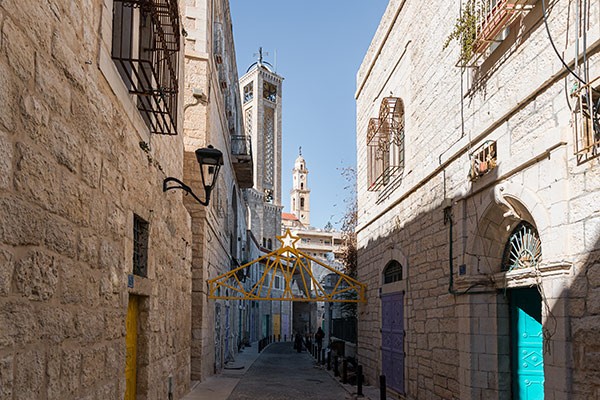
[.imgcaption] Star Street. [.smalltext] Photograph by svarshik / Adobe Stock. [.smalltext] [.imgcaption]
Yes, to live on Manger Street is a perfectly good way to live in Advent, for it is to be drawn into, as Hopkins wrote, the “dearest freshness deep down things.” I descend the stairs in the morning, my daughter in her pink sneakers, her backpack bouncing. I know that in an apartment down the street, Maurice Mikel, the ninety-year-old Palestinian photographer who took pictures of four popes, is also getting up to start his day. When he was a boy, he walked down Star Street holding a candle lit inside the peel of a carved-out orange, because they hadn’t put most of the streetlights in yet. He walked to the church at daybreak for the ten days before Christmas, standing vigil at the manger in anticipation.
Where else would I find such Advent teachers? My friend Hanadi reminds me that, as a girl, she celebrated the Feast of Saint Barbara at the very onset of the season. She would plant lentils and wheat seeds on that day, watering them regularly to keep them moist, her own vigil. By Christmas Eve, they had already sprouted. She would lay the green shoots around the manger in her nativity scene, so that the baby Jesus would be born Christmas morning into a green, abundant world. So it was that her Advent vigil was transformed into her gift for the child.
Bethlehem is a school where we learn how to turn our hearts toward the beautiful. My neighbors have taught me to surrender to the now-ness of things. My nine-year-old daughter, Carmel, who seems to embody that she was born here, takes my hand and leads me to the market, where Musa, who sells the best parsley and coriander, always asks after my husband. Where the butcher pours a cup of coffee for me to drink while we wait. Where Um Nabil sells wild herbs, where everything comes in its season. Where people whisper: “Don’t buy the apricots this week – no, not yet. Only next week will they reach their sweetness.”
Yes, it is possible to know that Christ is already everywhere and still to live in expectation.
[.article__paragraph--cap] [.small-caps] Perhaps one day [.small-caps] my children will read these words and wonder why I speak so much about beauty and fail to mention what overshadows our lives, the fact that there is a war. I would be lying if I said I didn’t sometimes worry that this focus on beauty is a way of bypassing this terrible reality. But Advent does not train us to look away from suffering. No, it gives us the strength with which to face it. A cup of water. A stone on which to rest. A star to guide us. And the essential hope to know that somewhere, a door is opening.[.article__paragraph--cap]
Advent is how we survive, for to live in Advent is to root ourselves in the essential gravity of things, to know that love and goodness are always stronger than whatever seeks to defeat them. We train our eyes on the small and know that it matters. A flower. A kind word. A child in the manger. That is the way that God breaks through the void.
[.article__paragraph--cap] [.small-caps] Last year, on Christmas Day, [.small-caps] my daughter Carmel took my hand. She was wearing her green velvet dress, embroidered with red flowers. We had already opened our presents, and so we decided to walk together to the Church of the Nativity. It was Christmas day, after all, and we live in Bethlehem. It was time to finish our Advent pilgrimage.[.article__paragraph--cap]
There were hardly any tourists because the war had kept them away. In truth, we were both tired. And when we arrived at the tiny door of humility at the entrance to the basilica, and lowered our heads to enter inside, we were astonished when we raised them again to find the church almost empty.
Carmel squeezed my hand. Together, we approached the cave where Jesus was born on that very day. We descended the small flight of stairs and lit our candles. We kissed the star on the ground. And then I left her.
I watched her approach the place of the manger at the side of the cave, kneeling where Mary had placed the child Jesus on a morning long ago. I remembered giving birth to her in Bethlehem. The long journey. The exhaustion. And finally, joy.
I could hear Carmel quietly singing to the manger. I could not recognize the song. It was nothing I had ever taught her. No, it was a song she had learned in her choir to sing in Spanish.
[.blockquote] A la nanita, nana, nanita, ea!
mi Jesús tiene sueño, ¡bendito sea! [.blockquote]
It took me a moment to understand. She was kneeling at the manger and singing the newborn baby Jesus a lullaby.
And Christmas arrived in its fullness. A child born to us. Here and now.