Caroling to Neighbors
Caroling with children may feel awkward, but it’s a great way to share Christmas with neighbors – and to recall Mary and Joseph going door to door.
December 22, 2025
Try 3 months of unlimited access. Start your FREE TRIAL today. Cancel anytime.
START FREE TRIAL NOW
[.article__paragraph--cap] [.small-caps] “God rest ye merry, gentlemen, [.small-caps] let nothing you dismay!”[.article__paragraph--cap]
Our song sounded small and ragged. I glanced over my shoulder and saw that my fellow carolers were yards behind me, straggling up our neighbor’s driveway. Only my extroverted daughter, eager to deliver the pumpkin bread we had baked, stood with me at the door.
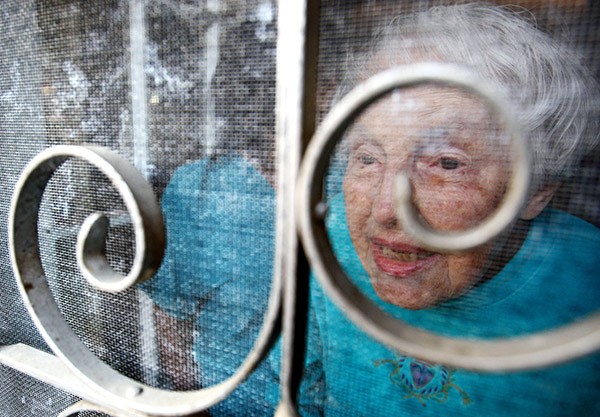
“Remember Christ our Savior was born on Christmas Day!” I continued, gesturing for the others to come closer. They did, reluctantly, just as our ninety-year-old neighbor opened the door. Her vision was failing and she didn’t recognize us at first, but as we started the second verse, she smiled and began to hum along. My daughter gave her a loaf of pumpkin bread, and we turned back to the street, looking for the next house with a porch light on.
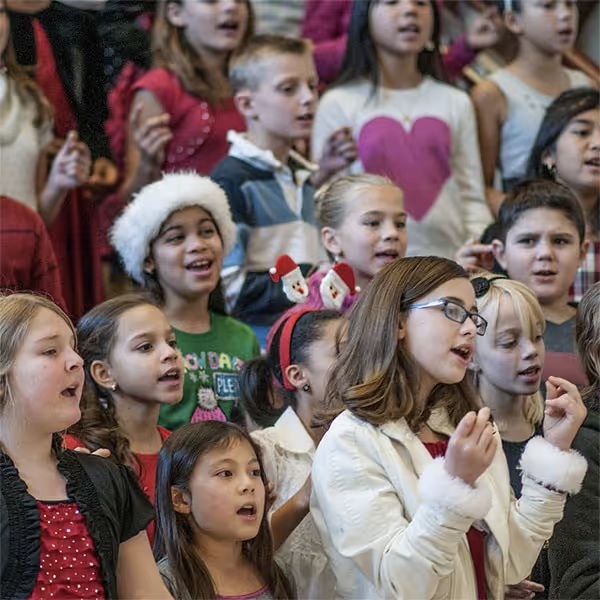
[.imgcaption] [.smalltext] Photograph by ZUMA Press Inc. / Alamy Stock. [.smalltext] [.imgcaption]
“This is so weird!” my four-year-old son shouted gleefully as we continued along the darkened street. He was right. Merry carolers appear frequently on Christmas cards and in holiday films, but most Americans don’t actually spend their holidays ambling through darkened suburbs, startling their neighbors with amateur performances. Even within my own circle of community-minded, zealous Christians, I don’t know anyone else who carols from house to house at Christmas.
It is tempting to blame this neglect on modern isolation or busyness, but history suggests that caroling has always had a wild edge. In the English-speaking world, Christmas caroling grew out of the tradition of wassailing, in which midwinter revelers would visit the homes of neighbors, wishing them good health in exchange for food or drink. These outings were often rowdy. In one ancient carol, the singers threaten violence if the butler doesn’t provide the best beer, while in the more familiar “Wassailing Song,” the singers try to dispel suspicion, insisting, “We are not daily beggars / that beg from door to door; / but we are neighbors’ children, / whom you have seen before.” Our neighborhood caroling is never drunken, but there is a tacit sense of trespass when we set out into the dark, as though we should know that all decent people spend their winter nights quietly at home.
Even as our children are delighted to be out after dark, we take care to minimize the alarm our neighbors might feel when they hear a knock at the door. In a typical American neighborhood, it is quite unusual to spend much time at all outdoors, much less to do so after dark. Lest our neighbors think we are heralds of bad news or threatening strangers, our caroling group begins singing before we ring the doorbell. We pick the most cheerful tunes for this approach, bellowing “Joy to the world!” or “Good Christian men, rejoice!” at top volume. If the residents hear music as they approach the door, they are less likely to be afraid.
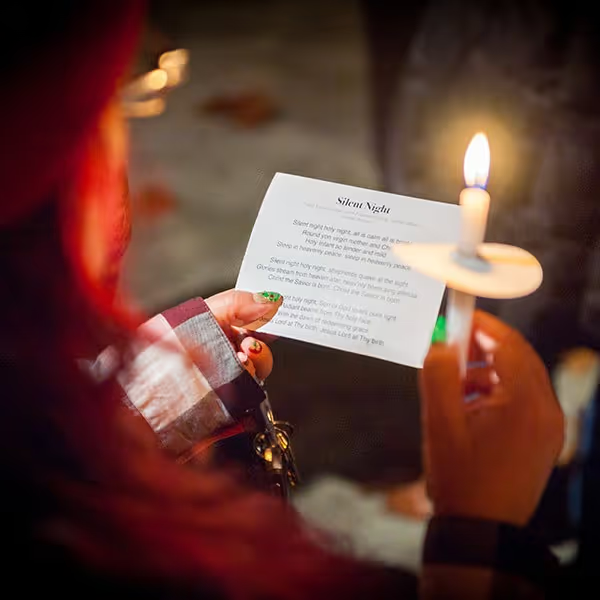
These precautions might reassure our neighbors, but they don’t diminish my own worries. Some of my anxieties are logistical, knowing how tricky it is to coordinate a group of singers. The first year I led a group of friends caroling, our party included four adults, five children (including one newborn), and a Great Pyrenees. In many ways we were more fumbling than merry: most of the adults had to use their phones to find the song lyrics, the children ran wild in our neighbors’ yards, and the dog did his best to drown us out with his barking. Since then, we’ve refined a few key practices. I’ve printed booklets of songs to replace the phones, and we try to keep the children busy delivering baked goods. We leave the dog at home.
Even with these improvements, Christmas caroling remains a ritual beyond the edge of comfort. There is always a chance that someone might slam the door in our faces or call the police to report strangers at their door. More than once we have sung to doors that never open. Sometimes we sing to neighbors we know are not likely to live to the next Christmas.
Within our band of carolers, we sometimes feel the weight of our work, trying to set aside our own world-weariness and doubts in order to call, “O come, all ye faithful, joyful and triumphant.” Rather than ignore this weight, we sing into it. “The hopes and fears of all the years are met in thee tonight.” In addition to the standard caroling repertoire – “The First Noel,” “Hark the Herald Angels Sing,” and “We Wish You a Merry Christmas” – I always include a few lesser-known carols. It’s important to practice these songs once or twice before your group sets out, or half your carolers will end up mumbling through them. But the extra work is worthwhile. Many of these songs can draw our hearts with a power second only to scripture itself. The haunting melody of “Let All Mortal Flesh Keep Silence” creates, rather than commands, awe-struck humility before a mighty king. And then there is my favorite, the first song I sang to my own baby, born at Christmas after I had had multiple miscarriages: “Brightest and best of the stars of the morning / Dawn on our darkness and lend us thine aid! / Star of the east, the horizon adorning / Show where our infant Redeemer is laid.” That is a song for singing through the darkness, hoping against hope.
[.article__paragraph--cap] [.small-caps] Going caroling can complicate [.small-caps] our cozy picture of a merry Christmas, and we thank God for that. After all, the Advent and Christmas seasons are charged with the tension between the strange, world-altering fact of Christ’s incarnation and the largely secular warmth that comes from celebrating family, togetherness, and winter merriment. When we are feeling a little too warm by the fire, queasy from one too many cookies, caroling calls us into the bracing night air, demanding we sing of promises we believe but have not yet seen fulfilled. “Chains shall he break, for the slave is our brother, / and in his name all oppression shall cease.”[.article__paragraph--cap]
More than any liturgy or pageant or private devotional practice, caroling draws my body and imagination into the Gospel accounts of Christ’s birth. Like the angels we surprise our listeners in the night, proclaiming the birth of a Savior: “Go, tell it on the mountain, over the hills and everywhere.” At the same time, we walk alongside the Holy Family who sought shelter in Bethlehem, knocking on many doors to uncertain reception. “Away in a manger, no crib for a bed.” We do all this while we warn our children away from the middle of the road and argue over which house to choose next. Carrying our home-baked gifts, we think of the magi, far from home but determined to find the king whose name is written in the stars. “Bearing gifts we traverse afar.” We walk, look, sing, and knock, asking ancient questions of our bewildered neighbors. We come with good news and we come in great need, seeking tidings of comfort and joy.