Living with the Dead
In a village in Moldova, I learned that death is part of life – and can be part of the resurrection story.
May 6, 2026
Try 3 months of unlimited access. Start your FREE TRIAL today. Cancel anytime.
START FREE TRIAL NOWLiving with the Dead
In a village in Moldova, I learned that death is part of life – and can be part of the resurrection story.
[.article__paragraph--cap][.small-caps]Margaret, my wife’s grandmother,[.small-caps] was still in her home two days after her death when Maria and I arrived in the village of Cruglic, Moldova.[.article__paragraph--cap]
Cruglic has been slower to change than most of the rest of the world. Indoor plumbing is a novelty of the last decades, cars and tractors are a new luxury, the rhythms of the seasons and connectedness to the land are still the foundation of small-town communities. And living with the dead is a part of life, not that different than it would have been in the West a hundred or even a thousand years ago.
Margaret was dressed beautifully when we entered the home she and her husband had built with their own hands. She was wearing a red cardigan, a dress she had sewn herself, a yellow floral shawl covering her hair, and a thin paper crown depicting an iconostasis over her forehead, with Christ, Mary, John the Baptist, an angel, and the apostles. She wore an expression not altogether different than that which she had worn in life, both accepting and determined, not joyful but peaceful. Her eyes, which had always been her most expressive feature, full of wisdom and sometimes laughter, were closed. She held above her chest an excerpt from the gospels. She was wrapped in a thin shroud that displayed images of the church, the cross, and the angels. She wore a small gold cross and another icon and cross rested over her arms.
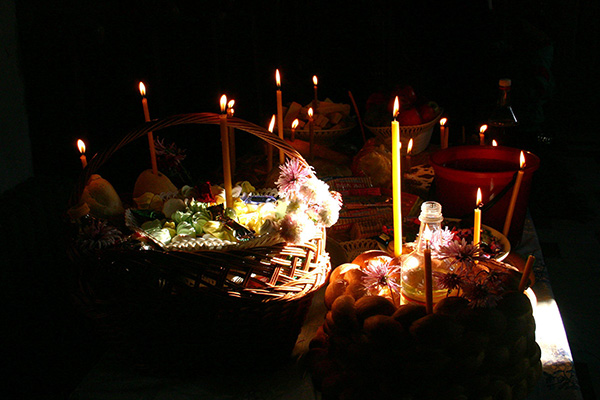
Her coffin was filled with flowers and rested in the big room of the house where the dining room table would normally have been. It was cold the week of her funeral, and like most homes in small town Moldova, there was no heat in that part of the house, so it was cold inside as well. The room was relatively bare except for a few photos of Margaret and her husband and the candles that were continually being lit by friends and family who steadily came to visit Margaret one last time.
[.imgcaption][.smalltext]Photograph by Emanuel Tanjala / Alamy Stock.[.smalltext][.imgcaption]
The house was always open and visitors would arrive at any time. Each of these visits followed the same pattern. They were always offered a glass of wine and a few candies and cookies on behalf of Margaret, which when accepted, the response was always, “May God forgive her.” Then, after kissing the icon and cross and spending some time sitting with Margaret they would usually come to the kitchen for a full meal.
This pattern was not altogether different than it had been in Margaret’s life. Her home had always been open to friends and strangers. She did not live an easy life but an intentional one where hardship is transformed into a gift, into the raw material with which a house can be built, animals raised, nothing wasted, and everything belonging to a season and place. It couldn’t have mattered less that her education had not continued past the earliest grades; she possessed a wisdom not found in books. It didn’t matter that in strict economic terms, she lived a life of poverty; she possessed a wealth that riches could never contain. Her death was not at odds with life but expressed the harmony her life possessed.
Until the day of the funeral, Maria and I slept in the room beside Margaret, passing by her body in the middle of the night when we got up to go to the bathroom or intentionally sitting with her throughout the day and visiting with friends and family. During the time we spent with Margaret’s body, every exchange was illuminated by her presence and the fact that she both was and was not still with us. At times, it seemed that all that was needed was for her heart to begin to beat again, for her to take a breath, sit up, and begin talking with us again. More often, her presence felt like an invitation to contemplate life itself, mortality and eternity, and how Christ is the model for both death and life, for both the physical and spiritual body.
This liminal space was shared by all, as if living with the dead, even just for a few days, pulled back the veil on what death really was.
On Thursday, Margaret’s grave was dug and Maria’s uncle explained that until recently this work was the family’s responsibility. In previous years, the grave would have been dug by her grandchildren, but now that everyone had jobs or had moved away, no one had the freedom to do this work any longer so they had hired a gravedigger.
In the meantime, Maria’s mother worked constantly with her sister’s-in-law to prepare gifts for everyone that would attend the funeral. In many cases, these gifts had been determined by Margaret, items of her own that she wished to share with her friends. But in all cases, everyone who attended the funeral would receive a loaf of bread and a lit candle which were presented on behalf of Margaret, like the wine and cookies and to which the response was always the same, “May God forgive her.”
I was the only one for whom there was novelty in any of this. For everyone else, it could not have been any other way. Death is a time for gifts. And in every other home in Cruglic, it would have been the same. Bread and homemade wine with grapes grown in the nearby fields were shared on behalf of the deceased, not because they are the image of the body and blood of Christ, not even because they are a reminder both of the physical need for food, of meals shared with friends, an image of the harvest and the passing seasons, and the distance between the living and the dead, but for a more simple reason, because this is what has always been done.
This pattern of communion between the living and the dead continued in Margaret’s home until Friday, the day of the funeral. In the morning, the temperature dropped fifteen degrees and the mist which had been rising from the ice-covered dirt roads turned to light snow and a cold gray sky reigned over the horizon. Guests from across the village began to arrive, mostly on foot and a few by car.
Then the village priest arrived. Armed with a thurible and a small Orthodox cross, he entered the room where Margaret lay, and the service began. A candle was lit and placed in Margaret’s hands. Her daughter knelt by her side weeping, holding the candle. Then the priest began to sing. And the room which Margaret and her husband had built with their own hands, constructed with the stones of the nearby ground, was filled for a final hour with the chanting of the psalms and prayers for her eternal rest. The priest circled Margaret, filling the room with the sweet-smelling smoke of incense, holding the cross in one hand and the thurible in the other. His voice, plain and beautiful, addressed God directly in a prayer of forgiveness and blessing. He bowed to kiss the cross and icons, kissing as it were, the most beautiful vision of Margaret, treading the veil between life and death, more like a warrior than a priest.
As the service concluded the priest invited everyone present to bid Margaret farewell, to kiss the icon and cross and touch her hand.
We then walked with Margaret up the hill to the cemetery, traversing the ice-covered road under a winter sky. The procession stopped to pray and offer a gift at each of the ten or so wells along our route. Money was also left at each of these wells and a gift offered to a nearby resident. Maria explained to me that as a child, this was her favorite part of funerals because they would run after the procession to collect the money to buy candy.
When we arrived at the grave, the final prayers were said, then the thin shroud with the images of the resurrection of life was pulled over Margaret’s face, the coffin was covered, and she was lowered into the ground and covered by handfuls of earth by all those who loved her.
We walked back down the hill to Margaret’s home, where the table had been set for forty guests, a table which had to be filled with guests twice. And we ate in the same unheated room where we had visited and prayed for Margaret just moments earlier.
The coherence of space between grief and celebration, life and death, continued into the evening and for the following three days, when we went to Margaret’s grave just before sunrise to drink tea, eat cookies, and to bring Margaret wine, wine poured in the shape of the cross over the ground where she is buried, and to light a fire, a fire walked three times around the grave.
The significance of these three days transcended any language barrier. I was reminded of Christ’s death and burial, and of Mary Magdalene visiting Christ’s sepulcher before dawn, anticipating the resurrection. Just as eating together, breaking bread, and drinking wine after the funeral in the home where Margaret lived and died, recalled Christ’s disciples, who only recognized him as they broke bread together. Just as the days spent living with Margaret after her death, beholding her face and touching her hands, reminded us of the promise of the resurrection of our bodies. In Moldova, this does not need to be explained to be understood; it is practiced and shared. At the graveside on the third day after Margaret’s burial, as the sun rose over the frozen ground and we drank tea and ate cookies, I glimpsed the miracle of resurrection.
Although my wife and I had tried to have children for more than five years, my wife had never been able to get pregnant naturally. That is, not until the three days after Margaret’s death.