In Defense of Iconoclasm
Any beautiful object can become an idol. Maybe the iconoclasts were on to something.
February 3, 2026
Try 3 months of unlimited access. Start your FREE TRIAL today. Cancel anytime.
START FREE TRIAL NOWJoy Marie Clarkson: Welcome to Another Life, a podcast of Plough magazine. I’m your host, Joy Clarkson. It is a properly wintery day here in London, and I’m recording this as we’re wrapping up the end of the first semester, although I think this will release sometime in the new year. So by the time we listen to this, the coldness I’m experiencing now as we wind down the darkness will hopefully be branching out into the sense of newness that comes with a new year.
And today I am delighted to welcome on to the show Natalie Carnes, who is professor of theology at Duke University. And I’m so excited to speak with her about her piece in the Beauty issue and also about what led her to write about things like iconoclasm and iconophilia, and what role the arts can have in helping us do the task of theology, of coming to know things about God, and in relation to God. So welcome to the show, Natalie. It is wonderful to have you.
Natalie Carnes: Thank you, Joy. It’s wonderful to be here.
Joy Marie Clarkson: Speaking of here, I always like to begin by hearing where people physically are. So I’m in my chilly little East London flat. Where does this conversation find you?
[You can listen to this episode of Another Life on Apple, Spotify, Amazon Music, or wherever you get your podcasts.]
Joy Marie Clarkson: Welcome to Another Life, a podcast of Plough magazine. I’m your host, Joy Clarkson. It is a properly wintery day here in London, and I’m recording this as we’re wrapping up the end of the first semester, although I think this will release sometime in the new year. So by the time we listen to this, the coldness I’m experiencing now as we wind down the darkness will hopefully be branching out into the sense of newness that comes with a new year.
And today I am delighted to welcome on to the show Natalie Carnes, who is professor of theology at Duke University. And I’m so excited to speak with her about her piece in the Beauty issue and also about what led her to write about things like iconoclasm and iconophilia, and what role the arts can have in helping us do the task of theology, of coming to know things about God, and in relation to God. So welcome to the show, Natalie. It is wonderful to have you.
Natalie Carnes: Thank you, Joy. It’s wonderful to be here.
Joy Marie Clarkson: Speaking of here, I always like to begin by hearing where people physically are. So I’m in my chilly little East London flat. Where does this conversation find you?
Natalie Carnes: I am in Durham, North Carolina, and it’s also a wintry day here. It’s actually not cold enough to be snowy, but it’s rainy. It was cold enough that all my daughters were hoping for a delayed start at school, but it didn’t quite get that cold. So I’m here in my home in North Carolina near a fire and also just keeping cozy.
Joy Marie Clarkson: Is that a real fire in your home?
Natalie Carnes: It’s a real fire. It’s not real logs, but it’s a real fire.
Joy Marie Clarkson: There is something wonderful about the experience of a real fire, even if it’s a gas fireplace. I miss that about my parents’ home in Colorado. So, before we dive into your article and some of the questions I want to ask you today, tell us a bit about how you spend your days at the moment and what it is you’re up to academically and vocationally.
Natalie Carnes: I am newly returned to Duke. I did my doctoral degree here years ago and then moved to Baylor where I’ve been for the last fourteen years. I’ve just come back to Duke, and I’m adjusting to life here with my family. My husband is also teaching at Duke. My days have been spent teaching a lecture class for Introduction to Theology and helping my girls get situated into their new life here in Durham. I usually start my day with either some contemplative practice or by going to the gym. I’m either doing something physical or something spiritual – maybe both depending on your theology. And then I spend my days mostly teaching and mentoring, and going to committee meetings like all academics, and just generally trying to figure out how to start a new life here in Durham.
Joy Marie Clarkson: I just moved to London despite having worked for Kings for several years. I moved to London last year, and it’s so exciting to move back – I lived in Oxford before – but to move back to a place you’re familiar with, the experience of moving and everything being new, it takes 40 percent more energy to do anything. At least that was what I found. And I’ve only just started to feel like I don’t have that extra expense of energy probably in the last three or four months.
Natalie Carnes: Especially for you when you’re moving to a different country… We’ve spent a couple different semesters in Scotland, and one semester I spent two months putting dishwasher soap into the laundry machine, and then laundry detergent into the dishwasher, and wondering why the appliances weren’t working – all those day-to-day things, you have to relearn in a new place. The move from Texas to North Carolina is not quite as big of a move as from the States to London, but there are still new systems, new medical establishments, school systems – all of that that has to be relearned.
Joy Marie Clarkson: And all the many forms you have to fill in to get into those things. I didn’t realize adulthood had so much admin. I will move on to your piece eventually, but I was interested to hear that you’re teaching the big Intro to Theology class, because when I was doing my PhD… You spent some time at St. Andrews, so you probably remember how it works: you have the lectures, but then you have the tutorials. For a few years, I taught on the big Introduction to Theology class, which at that time was taught by Christoph Schwöbel and Katrin Bosse. I don’t know if it’s the same at Duke, but it can be tiring because there are usually lots of students if it’s one of those core classes, but I just found it so fun to touch on these basic things. If you’ve been training as a theologian for a long time, you can sometimes lose touch with how interesting or radical or actually how basic some of these concepts are. I don’t know if you felt that way, but I really love doing Theology 101 courses, and I love being able to experience that. And there’s so many different ways to do it too.
Natalie Carnes: I remember the first time I was teaching Intro to Theology right after I got my doctorate, and it was this really challenging but wonderful experience – all your training and doctoral work is you learning to get more and more academic and rigorous and deeper and deeper into these esoteric conversations that fewer and fewer people understand. And then suddenly when you’re teaching Intro to Theology, you have to distill all that knowledge back to the level of someone who hasn’t been initiated into any of it at all if they’re undergrads, and then if the master students, they know more. But I just found that to be such a challenging but stimulating intellectual project that I think ultimately made my writing a lot better and helped me figure out who I was as a theologian. And then coming back to Duke, I’ve been teaching Intro to Theology for a while, but I’ve been teaching it as an undergraduate seminar. Teaching it as a master’s lecture class for people, many of whom are preparing to be ministers, is a really different thing. And trying to figure out what I think is really important for a minister in training to know about theology.… And I found that also to be, intellectually and spiritually, a really wonderful challenge.
Joy Marie Clarkson: Well, as promised, I am going to actually ask you about your article in the Beauty issue now. As I shared with you earlier, thinking about the beauty issue, our tagline at Plough is “Another life is possible.” There’s this real emphasis on the practical, the pragmatic, and the day-to-day touchable things of life. And so doing an issue on beauty was almost outside of our comfort zone because we were concerned – not concerned, but if you think about wanting all of our articles in some way to answer that question of another life as possible – you could get really airy fairy and ivory tower with beauty. But one of the things I was struck by with your piece was first of all how it started in a very experiential way that I related to. I could smell the church and hear the chatter in the hallways of the church you described. And it shows how our relationship to beauty is something quite practical. It is something that affects how we decorate spaces, how we worship, the songs that we use, the things that we consider devotional. And that this question – the question both of beauty, but then also the connected question of images – has been a very practical question down the ages for Christians that’s affected how we worship, how we imagine God, and also how we relate to our brothers and sisters both within the church and without.
I wanted to start with perhaps a slightly more personal question. You open your lovely essay, which is a slight defense of iconoclasm, which I enjoy... You begin by talking about the ugly or at least plain church that you came from that was devoid of images. And then you move towards the fact that you are perhaps in a tradition that’s more comfortable with images now, but that there’s something you cherish or value about the aesthetic quality of the ugly church. Could you tell us a bit about the journey from the aesthetic to the non-aesthetic, and what it is you find valuable about the simple church of your childhood, and how you can still value that while being in a slightly different space now?
Natalie Carnes: Thanks for that question, Joy. I grew up in a church that was itself deliberately unbeautiful as a way of expressing something about what faith is. Faith is evidence of things unseen, and faith is a relationship to this God who transcends all the things of this world. But it wasn’t a community that was devoid of beauty. I think it’s very hard for humans to live in denial of beauty. In this case, for example, in my family, my mom made art and my sister was an artist. The women were held to particular standards of beauty in ways that might also be problematic but also expressed a way that beauty was valued. And there was the church gardening day where we cleaned up the grounds to make it beautiful. So even as beauty was minimized in the worship spaces, it still cropped up all around the community, both around the church and within the church in terms of what it valued. It’s not like I understood that beauty was something in and of itself that was problematic. It’s just that when it was in worship spaces it was seen to be in competition with the most important things of the world. And I think that there’s a way in which that’s true. But it’s true not because beauty is bad, but because it is so good.
In many ways, I’m very shaped by the fourth-century theologian Gregory of Nyssa, but in my understanding of idolatry I’m in very shaped by Augustine, who believes that everything in the world can become an idol, and all of creation is a sign of God that can point us to God. And it’s the very best things, the very highest things, the greatest gifts, the greatest graces that can become for us the most dangerous idols. I do see the way that beautiful things, beautiful objects, beautiful ideas, beautiful people, can become for us signs that draw our desire deeper into the life of God, and the way that those things can become stumbling blocks where our desire isn’t invited onto God, but is absorbed by the beautiful object itself, which then becomes for us an idol.
The danger of idolatry is always with us. It cannot be eradicated by eradicating beautiful things. Idolatry is always going to be cropping up someplace. And so the really important thing is that we learn to identify that temptation and learn how to live with it well. And in that way, learning to live with beautiful things is like learning to live with all of creation. My journey was a journey of identifying the ways that beautiful things have been really important for much of Christianity to how people are drawn into the life of God. Gregory of Nyssa even calls God beauty. It was a divine name for him. And also the danger of idolatry isn’t something to minimize.
Joy Marie Clarkson: I think that’s a really helpful way of encasing the conversation. This term, I’ve been teaching an MA class at King’s called The Idea of Beauty in Western Theology. And I was just thinking as you were speaking about that – we read Book X of The Confessions, and you have this wonderful moment where Augustine is looking within himself, remembering these experiences of beauty – and he does describe it as beauty – in the natural world, and he will look at the breeze or the sea or all these beautiful things and say, “Where does your beauty come from?” And then there’s this lovely moment where a chorus says, “We come from God,” and they gesture beyond. And that’s his way of saying that beauty can be this thing that pulls us through to God. But of course, while Augustine radically affirms desire and the way in which the things in this world can draw us to God, it’s so easy to get stuck on the beautiful things rather than the beauty that comes from God through them.
And I think that as someone who also came from a more beauty suspicious spiritual heritage.… My dad was Church of Christ back in the day; they don’t even do instruments, which people think of as quite extreme, but the non-instrumental thing was actually a fairly commonly held view for instance in the early Church Fathers. But for me, I think there was this affirmation of beauty, but in my older years – it sounds as though I’m old; I’m still quite young – but I’ve recognized that there was still a wisdom in that holy fear of becoming too attached to the beautiful things, not to the beauty, but to the beautiful things. And that that’s actually something worth affirming and keeping in our minds. It’s something that is there all throughout the tradition.
Natalie Carnes: There’s this saying that keeps coming up among people who study iconoclasm. I’m not sure who was the first to say it; it might have been Horst Bredekamp, the German picture theorist who says: the iconoclasts are the real iconophiles. It’s the people who are most suspicious of images that take them the most seriously, because they see images as things that are actually powerful. Whereas a lot of times we just, we’re dismissive towards them. We don’t take them seriously as powerful agents in the world. And maybe similarly, we don’t really take beauty seriously as something that can change us, that can claim us. We think it’s something that we can master ourselves. And there’s a way in which these beauty-suspicious traditions, they might seem to be minimizing our sensory life, but in a way, they’re taking it much more seriously than a lot of us who don’t take as much care with how it is we’re exposing ourselves to various sensory experiences.
Joy Marie Clarkson: Absolutely. So that actually connects me to another question I wanted to ask you about. I find when I’m teaching this beauty class that people make an immediate connection between beauty and images. And that makes sense in some way because often when we think of beauty, we think of art. Usually, it goes in the other direction. We think of art; we think of beauty. And that has been the case, especially in the Western tradition of visual art. But of course, they’re not always connected. There is, as we see in your research, this long anxiety about images in the Christian tradition, but also quite a strong affirmation of images in some ways, and there’s this pull back and forth between the two. And I think it’s worth noting that, for instance, images in the other Abrahamic faiths, in Islam and Judaism, most images, especially images that refer to God are not affirmed, whereas Christianity does, at least sometimes, and officially in creeds, affirm them. I thought I would ask you to give us a crash course for beginners in why Christians are so anxious about images, but also why in some cases we are able to affirm them, and why in the council we ended up affirming them.
Natalie Carnes: That’s a big question. The anxiety about idolatry runs throughout the Christian tradition. It’s a big part of the story of the Hebrew people, the people of Israel, and their relationship to God. We might think of the story of the golden calf and the second commandment not to make graven images, and the commandment not to make any idols, and the way that Israel is constantly being called back from idolatry, and unfaithfulness is termed as idolatry. So, there is this long-standing fear of idolatry in the Christian tradition and a sense that we worship a God who is beyond representation. And that doesn’t change with Christianity, actually. What changes is not that God ceases to be beyond representation. What changes is that God becomes human in Christ. And because God becomes human in Christ, God becomes circumscribable. In the debates about images, they’re playing on this word, “scribere” meaning to write or to draw, that there is a way in which God made Godself representable. Because God became human in Christ, the divine is depictable in Christ. But the divine nature as such is not depictable any longer. For example, what’s really interesting is that in the seventh ecumenical council where they affirmed the making of images of Christ, it’s not the case that the Father or the Spirit are therefore depictable as an image. The Father and the Spirit can be depicted symbolically. So that’s why you see images of a dove to symbolize the Holy Spirit, but that’s not the same way that we can depict Christ as a human, as an image. What’s tricky then is that the Father is symbolized through the “Ancient of Days” image, and the “Ancient of Days” image happens to look like an old white man. And then when the symbols of the “Ancient of Days” and the dove get put in the same image as Christ, it looks like the Father and the Son depictions are operating in the same register, whereas they’re completely different registers. One is symbolic and one is an image. And then we start to think that the Father really is more like an old white man than like any other creature. So anyway, there is a way in which, even in the resolution about images, there’s this nuance that ends up coming back to haunt Christianity because of the ways that the “Ancient of Days” symbol is taken up as if it’s an image. So that’s one thread.
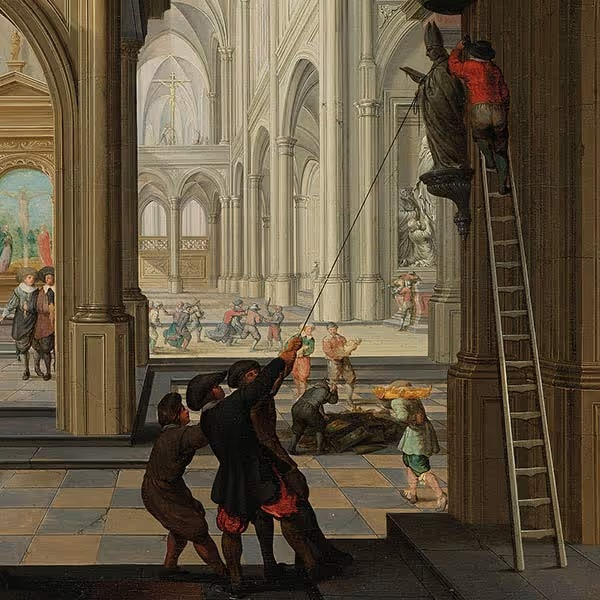
But then throughout the Christian tradition, we have these images, and these images are supposed to be things by which we worship and adore the Lord. But occasionally, the life with images for some people in the tradition starts to go awry in a way where people feel like the image being worshiped is an end in itself. And, for example, with the Reformation, you get these really interesting acts of idolatry that are supposed to be pointing back towards the omnipotence and the sovereignty of God, where people perform their iconoclasm. They take the image out into the square, and they whip it, or they defecate in it. And they say things that sound like they’re crucifying the image – “if you’re God, then save yourself, but if you’re man, then bleed” – to try to demonstrate the impotence of the image, which is a way of trying to reaffirm the God who was beyond all imaging and the God who was beyond all representation. So anyway, I think it is really interesting that throughout the Christian tradition, you have people continually making images, but the fear of iconoclasm that responds to this image making also runs throughout tradition. It’s never fully stamped out. And why is that? I think that’s just because of the way that anything in the world, including an image, can also become an idol.
Joy Marie Clarkson: We’ve been going through the Reformation in our beauty class. I think sometimes if you’re someone who’s gone from a beauty suspicious tradition to beauty affirmation, you can ask, what were the reformers up to? Why were they on about this? But when you really sink into that era, you can see that it wasn’t purely trollish behavior. They were responding to this real fear. Some of it was purely trollish, but a lot of it was this sincere concern that images had become the source of idolatry, this thing to which people had attached. And it’s interesting because even reading Calvin, he really couldn’t stand crucifixes, at least that is what I have read of him. But it doesn’t seem like he objected to them purely on theological levels. I think it was partially about what it was doing to or for people on a pastoral level, which is an interesting thing to think about, how that’s taken up.
Natalie Carnes: When crucifixes became really important in the Christian tradition and in piety? It’s especially in the wake of Francis and the piety around the Franciscans. What happens when the set of practices around a particular image by which people developed a relationship to that image and it spoke to them and it shaped them? What happens when those practices are no longer present? How does your relationship to the image change? And you can see how an image that in one time period spoke powerfully to people. And in another time period with a different set of practices, a different set of cultural understandings, the image doesn’t speak to them in the same way. Images always exist in a set of practices and are negotiated as a relationship.
Joy Marie Clarkson: It’s interesting with the Franciscans too, because of course Francis’s story begins with an image, the San Damiano Cross, where he prays before this image of Jesus, and it speaks to him. So that whole movement of affective piety and its attachment to images as this source of nourishing a connection with Jesus is really powerful and fascinating and interesting to think about that tying down to a painting that you can go see, which is quite amazing.
Natalie Carnes: Yes, and there’s a real austerity, and asceticism, and maybe even iconoclasm to Franciscan piety, because on the one hand, what is Francis called to do? “Go rebuild my church,” which he first takes to be literally repairing these hovel churches, and then maybe more spiritually repairing the church. The repair of these hovel churches is very austere. Where can you lavish any kind of sensory adornment? Only on the chalice, on the things associated with the Eucharist, but not anywhere else. You’re not having lavish images in Franciscan churches. When the Basilica is built when Francis dies, it’s very controversial because of the way people see it as betraying the Franciscan charism to poverty. So, I think it’s also interesting that even in these Catholic and more image-loving traditions, you can have real austerity, asceticism, and even what we might call iconoclastic impulses.
Joy Marie Clarkson: Totally. I want to try out an idea on you quickly, which is that with the tendency towards idolatry, I think there can be two purifying impulses. One is the iconoclastic impulse, which is to take away images and focus. But the other one – which my advisor Gavin Hopps, who you would have met at some point along the way, liked to say – is to be so cluttered with images that you never become too attached to one particular way of depicting. And I actually think that is a very Gavin point to make. But I think there is wisdom in it. I was thinking about this recently. The postal service in the United Kingdom just came out with their annual Christmas stamp. There was this fake outrage or actual outrage on the internet, because it had this beautiful little image of Mary with Jesus. And first a whole bunch of people reacted to the fact that she seemed to have darker skin, which of course is ironic given the fact that Mary most likely would have had darker skin. But then secondly people were really upset because it had a pink head covering instead of a blue one. And I thought this was interesting because it was this almost idolatrous attachment to Mary being depicted in this one particular way with the blue. And of course, there’s a rich meaning and heritage to the blue that Mary usually uses in its royalty, etc. But there’s something that helps us not become idolatrous. We have all these different images. And we remember that what they’re celebrating is that Christ can be depicted because he’s circumscribable, not that the exact depiction we’re used to is exactly what he looks like. And so, there’s this sense that this monomaniacal focus on one way of representing tends towards an idolatrous attitude, whereas if you have, in Gavin’s words, a clutter of images, you’re less likely to treat particular images as idolatrous. So that’s my theory. I don’t know if you agree with that or not.
Natalie Carnes: Yes. Gavin and I are in this way and others kindred. In my book, Image and Presence, I talk about two different kinds of iconoclasm that I call, along very similar lines, the Baconian and the Wittgensteinian. And the Baconian iconoclasm, after Francis Bacon, philosopher, not painter, is the iconoclasm of critique. It’s the smashing of an image. It’s at a conceptual level rather than just imagistic level. It’s the iconoclasm that’s says, “You thought this was about love, but really, it’s about evolutionary biology. You thought this was X, but really, it’s Y.” That’s the form that Baconian iconoclasm takes. It’s the smashing, the unmasking of a concept, the taking away of an image, exposing it. The Wittgensteinian iconoclasm – I take that term from Wittgenstein in Philosophical Investigations. He actually goes back to Augustine, tracing Augustine’s picture of language acquisition. And he talks about how a picture has held us captive. But his response isn’t Bacon’s response of unmasking that picture for its falsity or smashing the false image. His response is to point us to what he calls an album of sketches. So, it’s not that Augustine is wrong, that language is never acquired in this particular way, but that this is one small way of thinking about language among all these other ways that illuminate the complexities of how it is we acquire language and how it is our life with words works. And I think that thinking about iconoclasts through a more additive way is really interesting. And the additions can work in any number of ways. And one of the ways it can work is to loosen the captivity that our mind is in around this particular image, that Mary must look this particular way. It’s complicated when affection becomes idolatry, because there are the preferences of affection, but when those preferences need to be aggressively enforced for other people as well as ourselves, I think we need to ask ourselves whether those affections have become idolatrous.
Joy Marie Clarkson: Yes, and perhaps in that small way the stamp is doing its part to loosen the hold of some incidences of how images have to be portrayed to us. It reminds me a little bit of that TED Talk. I’m not usually a TED Talk person, but it stuck with me for many years. “The Danger of a Single Story” by Chimamanda Ngozi Adichie where she tells how when she was growing up, she loved English literature. She grew up in Africa. You don’t need to destroy the English literary tradition, but that there needs to be more stories that she could imagine herself in. And I think that’s something similar to this idea of the Wittgensteinian images, that more can be better sometimes.
You touched on something that relates in my mind to your most recent book, Attunement, which I really enjoyed. One of the master dissertations I supervised over the summer got really attached to it and used it as the framework for her piece on medieval women and food, which was really delightful. But in that book, you’re thinking about – and you can tell me if I summarize any of this wrongly – what is the path forward for feminist theology, which often can become siloed. Part of that is thinking about how we deal with the question of critique. The question of looking at everything through this lens of, as Paul Recour puts it, the hermeneutic suspicion. And, of course, there’s a place for that, for acknowledging the ways in which women haven’t been treated well both in the theological sense or in a practical sense. But we want there to be paths forward in places where we’re always stuck. And your answer to that is this idea of attunement, which you describe as aesthetically invested. I feel like I’m just summarizing your own work to you. But we’re touching on things of beauty and images and the arts at some level. What role do you think this attunement to the aesthetic or the beautiful can play in the task of theology, be it feminist theology or just theology in general, of finding ways to speak about God and things pertaining to God.
Natalie Carnes: With Attunement, I’m thinking, as you said, about critique and its sister strategy avoidance. These have just been the two dominant strategies in feminist theology, which have helped build the field and make it what it is. They’ve been very successful. Critique is a way of unmasking strategies of domination within a text, which is really important because it keeps us from replicating those strategies of domination. And avoidance is a way of avoiding the most patriarchal text or artifacts or the most patriarchal aspects of those texts or artifacts so that we can find our constructive resources elsewhere and amplify more generative voices, whether that’s someone from outside theology like Judith Butler or if that’s someone like Julian of Norwich who was historically on the margins of theology. I haven’t actually talked about this book right up against Image and Presence. I know it’s very influenced by my work on iconoclasm in Image and Presence, but I don’t know if I’ve ever narrated this in a public conversation before. It’s a Plough exclusive, that’s great.
You might hear in the way I’m talking about “critique” a real kinship to the Baconian iconoclasm that I just described of “you think that this text is just about doctrine of God, but look at the ways that it’s also about upholding the patriarchy,” for example. And there’s ways in which attunement is an aversion of a Wittgensteinian iconoclasm in that it is a constructively oriented way of engaging these texts that’s also attentive to the aesthetic dimensions of these texts. I’m interested in whether critique and avoidance has helped feminist theology establish a foothold in the theological world. By themselves, these strategies reaffirm something that we already know, which is that women are not fully human characters in most of Christian theological texts and artifacts. The way that women show up in The Confessions, they’re not the fully orbed human character that someone like Augustine is in that text. And so they also reaffirm the way that these texts are not our texts. And so feminist theology can create silos, which are really important for being able to have safe spaces to do other kinds of work. But I’m also interested in another strand that I can see inchoately in the history of feminist theology and women claiming a voice even before feminist theology, which is thinking about how we can claim these texts as ours and do so as feminists in a way that changes what the texts can mean in the world. It’s a vision of textual meaning that’s co-created, not just by the reader, but by a whole constellation of communities and histories and artifacts.
My first experience of this was writing my own book, my post-tenure book. I wrote Motherhood: A Confession in conversation with Augustine’s Confessions. It’s a memoir. And thinking, “What a weird little book I just wrote,” and then looking around in feminist theology, and seeing that a lot of feminist theologians are writing weird books, not just memoirs but also thrillers and dialogues and all kinds of creatively invested genres. And why is that? And I began to see that as part of a longer history. Feminist theology, unlike other forms of theology in the modern period, was born in the realization that the symbolic imagination is deeply important, that the fight for gender equality is going to be fought and won or lost in the symbolic imagination. So from the beginning, feminist theologians are attentive to metaphor, to symbol, to image. You even see images a lot of times in these early feminist theological texts. And so, aesthetics is taken to be central to how arguments have purchase, and what texts can mean in the world.
That even goes back farther than feminist theology. You see that in the way that marginalized people are able to claim a voice. For example, someone like Hildegard of Bingen: How was she able to have the authority to preach to men and women in the eleventh century when that’s not allowed, not to mention comment on scripture? And she’s able to do that because she has these visions from the Lord. But how do we believe she has images from the Lord? Well, it’s because not only does she have them represented as visual images, but she also tells the story of the image in a way that is so vivid, and she makes the reader encounter the divine figure who comes to authorize her, so that the divine figure is speaking in second person. You’re overhearing Hildegard’s scene of authorization. And it’s this aesthetically vivid experience that makes you believe Hildegard’s authority such that she can go out and claim this public voice. So, I saw the way that aesthetics is something that’s really tied to how women have been able to claim a voice, to what our texts and artifacts have meant throughout the world and throughout our history. And that it has real potential if we are to think about that more explicitly as part of how we approach our texts even today.
Joy Marie Clarkson: Yes, that was beautifully said. And if people are interested in this, I really encourage them to pick up your book. I think one of the things I appreciate about it most is that it offers us a way forward when it comes to what is behind, in the sense that we don’t have to either leave behind all of these texts, which may be problematic or difficult or confusing. And neither do we always only have to be in a mode of critique, but there are things that can be prized out of these many centuries of complicated engagements with women in the Christian tradition and with texts about women in the Christian tradition. It’s a confidence that there’s still something there, there’s still an ongoing affirmation of the presence of women and their humanity throughout the tradition that we can prize out and not feel a helplessness towards when we look to text in the past. And so that’s what I really took from it and appreciate in it. And it also offered a methodological way to approach that, which I think is so necessary.
So, as we’re drawing close to the end of this conversation, I thought I would ask you – since we talked so much about images and their power over us, and their power to help us hopefully worship better rather than worse – I was wondering if there are any particular images that have influenced you in your life or thoughts.
Natalie Carnes: There have been a number of images. “Our Lady of Ferguson” is the one that’s on the cover of Attunement, and it’s the one that I think through in the last chapter of that book. But I think right now I just happen to be looking at the image from the cover of Image and Presence, which is the image of a gravestone being broken through. And I think the figures and the images that I’m drawn to right now are darker ones. “Our Lady Ferguson” is both dark and hopeful, and that’s really important. But lately I’ve been thinking about… my husband works on Oscar Romero, and so I’ve been thinking about people like Oscar Romero, and Dorothy Stang, and Jesus Christ – people whose lives ended in failure, who did not succeed in bringing about their cause before their death, in their death that actually seemed like failure. Romero in El Salvador, he was shot and killed in 1980 and the Civil War that he’d been working so hard to stop, broke out immediately. And yet, their lives and witnesses continue to bear fruit even beyond that death – the ways that death is not the end of the story, that even in what seemed like the most hopeless and darkest places God is still at work, and the kingdom of God is like a mustard seed, tiny and invisible to our eyes, but growing into a mighty bush. And I think the kinds of images and people and symbols that I’m gathering around me right now are the ones where it’s almost complete darkness. And yet we’ve seen that there’s light that comes after that.
Joy Marie Clarkson: I really love that. And it reminds me of a piece that is hopefully coming out in our next issue on the theology of failure, and of ends, and of diminishment. What do we do when things look bad and, in the earthly sense, don’t get better? But that in some way we have a faith that has the resources to look upon that and not despair. Thank you so much for your time and for that comment.
And I will end with one final question that I ask all of our guests. And in a way, I feel like you’ve already answered it, but I have to ask it anyway. So, what is one thing, whether it is a practice, a person, it could be food, it can be work of art, that reminds you that another life is possible?
Natalie Carnes: Staying with the example of Romero in part because of my husband… I got to be at the canonization ceremony for Romero. And my husband’s giving a paper on Romero on Thursday. I’ve been asked to preach my first sermon in my life, which they meant to ask me for the eve of the Annunciation, which is also the feast day of Romero. And it brought me back to the canonization of Romero, the coincidence of the eve of the Annunciation, where this beautiful ceremony ended with this call and response of “Hail Mary, full of grace,” back and forth until it finally resolved in the whole Hail Mary. And this vocation that we were all called to – a way of responding to the life of Romero – is that we are called to be Mary and to go forth and to bear Christ into the world. And this is a vocation that’s never going to be separable from the threat of death. From the moment Mary has conceived, we say a sword has pierced her heart also because the death of Christ and the conception, the birth of Christ, are all bound up in the iconography around the Annunciation, and the Virgin and Child iconography.
And yet that death makes the birth no less hopeful and no less miraculous and points us towards the second birth, of course, the birth of the resurrection that is our ultimate hope. And so, I think that togetherness of the martyrdom of Romero, the Marian calling to bear Christ in the world, the way we know such Christ bearing ends in death and sorrow, and we know that death and sorrow is not the end of the story. That togetherness of death, birth, death, birth, and the hope that it is birth ultimately that we are called to.
Joy Marie Clarkson: Thank you so much, Natalie, for joining me today, and for sharing your thoughts, and following my ramblings, and especially for that last image, which has given me a lot to ponder. Thank you so much for joining us.
Natalie Carnes: Yeah, thank you, Joy. Thanks for having me. I’ve really enjoyed it.