Bake and Pray
Discover the messy beauty of rolling up your sleeves and making bread – recipe included!
February 20, 2026
Try 3 months of unlimited access. Start your FREE TRIAL today. Cancel anytime.
START FREE TRIAL NOW
[.article__paragraph--cap] [.small-caps] “Tell me about a bread [.small-caps] that is meaningful to you.”[.article__paragraph--cap]
This is the way I begin every retreat at Bake & Pray , the program I facilitate for churches, colleges, and leadership teams to teach the making of bread as a spiritual practice.
Without fail, this question elicits stories about family members, friends, or local bakers who had nourished our retreat participants at a significant moment in their lives. I watch as those gathered close their eyes and invoke the scent and taste of their chosen bread, feeling the warmth of a loved one’s presence.
For many people, the smell of bread prompts a desire to be transported to a time or place apart from the present. Sometimes this desire is for a time or place one has experienced before, and sometimes for a time and place one has only dreamt of knowing.
At no time has the nostalgic power of bread been more apparent to me than in the last five years, as breadmaking content has surged in popularity on social media platforms like Instagram and TikTok. Bread makers capture the joy of their baking through video – as they combine flour, water, and sourdough starter – oftentimes in a picturesque kitchen, wearing a muted-toned apron. Natural light fills the room.
These videos invite viewers into a slower rhythm – into a life where they have time to make a mess, on their hands and in the kitchen, time to wait for yeast to slowly transform and grow dough, time to appreciate the sweet scent of caramelizing wheat emanating from the oven and the sound of a crackling crust as it cools.
Many friends and workshop participants joke with me that they love to watch breadmaking videos online, but they never actually get their hands into dough themselves. They love the feeling this content provides them. The mess of actually baking, though? That’s not something they care – or dare – to try.
[.article__paragraph--cap] [.small-caps] The technologizing of the early [.small-caps] twentieth century brought many benefits to society, but it also had its perhaps unintended detriments. Shrewd inventors and business owners developed machines capable of making bread that, from start to finish, was never touched by a pair of human hands. The result was loaves that all looked the same – soft, fluffy, white – and could be produced at a much faster rate than loaves made at home or in a traditional bakery. This bread was marketed as the safest, cleanest, purest form available, and it quickly became the favored bread of housewives nationwide.[.article__paragraph--cap]
The transformation of flour into dough is a deeply embodied practice. It requires the baker’s hands to be intimately engaged with the ingredients: mixing, kneading, shaping. The advent of mass machinery placed an unnatural divide between homemakers and a natural, home-making process. American consumers began to feel daunted by the messiness and uncontrollability of breadmaking. How much simpler to simply buy bread in a store!
In the decades since, the downsides of these “safe” loaves have become apparent. Not only does the extraction of human engagement from baking result in less flavor and degraded texture, it diminishes the digestibility of bread as well. The human body struggles with processed wheat that has not undergone a long fermentation from the wild and unpredictable microbes found on a baker’s hands.
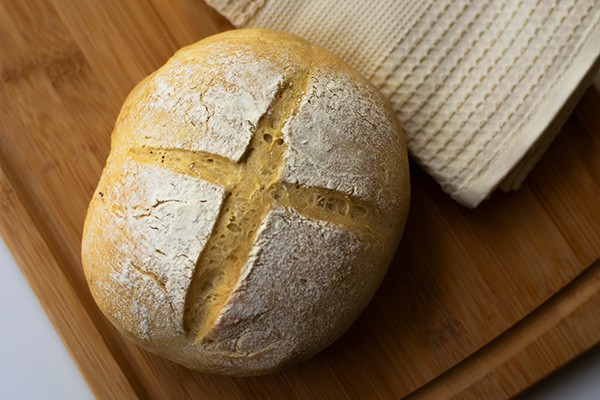
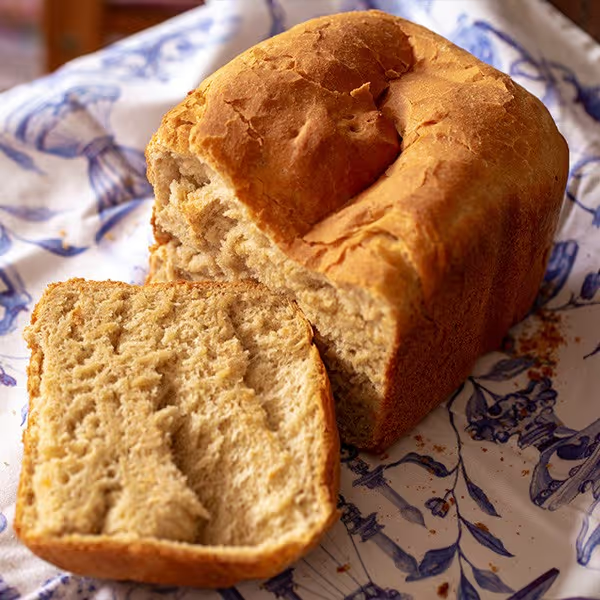
[.imgcaption] [.smalltext] Photograph by Mehriban / Adobe Stock. [.smalltext] [.imgcaption]
The contemporary surge in sourdough bread is a response to the harm caused by these industrial loaves. Consumers long to enjoy the nourishment of good, flavorful, easily digestible bread again, and they are open to the revival of artisan methods in order to make this possible.
But I fear that the mediation of this longing for nourishment through video content online only recapitulates the errors of a century before. Watching the process of artisan bread baking today serves as a symbol of the life we wish we could live, in a world where we all had the time and the space to be bakers. It invokes nostalgia for a peaceful, pristine home that produces loaves as predictable as the machines created a hundred years ago.
It’s tempting to see this bread, or rather this breadmaking content, as a form of beauty. But the question I keep returning to as a baker enticed by the same online content is whether the story it tells – the life it promises – is actually true.
[.article__paragraph--cap] [.small-caps] As a baker, I know that making bread [.small-caps] requires getting dough stuck between your fingers, dried shards of it wedging between the nail and nailbed as you scrub a mixing bowl clean. It means getting burned more often than you care to admit, and standing on your feet for hours on end. It requires tending to a sourdough starter day after day, getting out of bed – before you fall asleep – when you realize you’ve forgotten to feed it. It requires taking the lives of those bubbling microbes in order to transform the dough into something to be consumed.[.article__paragraph--cap]
Making bread is sticky, it’s messy, it’s smelly, and sometimes painful. It requires a knowledge retained in the hands and the nose through the repetition of baking over a long period of time. It requires failure and frustration, and it bears witness to both death and life.
Despite this difficulty – or perhaps because of it – making bread is beautiful too.
Baking bread forces the baker to slow down and pay attention to the sensorial experience at hand. It challenges the baker's assumptions that rest is a waste of time. It connects the baker and the eater with bread makers throughout history and around the world, while inspiring them to become acquainted with the particularity of their own time and place.
But the real beauty of bread rests in its utility. What is the good of a loaf, no matter how stunning, if it is never consumed? Unless it is lacquered with plastic and put on display, the loaf will mold or go stale. The beauty of bread cannot be divorced from its function, and therefore its ephemeral nature.
When we chase the nostalgic power of bread through the consumption of breadmaking content alone, we buy into a false story. We do not know what happens to the loaf we’ve viewed after it is filmed. We do not know how it tastes or whether it is consumed. It exists for aesthetic enjoyment alone – it hints at the possibility of nourishment, and thus the possibility of beauty, while somehow remaining eternal, never going stale. Bread content remains long after the loaf is gone.
There is beauty in bread, in the making, the sharing, and the consuming of it. But it is a beauty that can only be captured in the embodied engagement with the physical loaf itself. The practice does not always look or feel as idyllic as content creators make it seem, but it forces the baker to engage with what is true. By becoming intimately acquainted with the dough, and learning to work within the limitations and needs of the present moment, the baker is invited to find beauty and joy in the ordinary rhythm of his or her days.
Bread, at its best, ought not serve as a symbol of the way we wish things could be, but as a tool to help us see the beauty already present in our lives today – rather than in the curated, sterile glamor of an Instagram reel. Bread connects us with friends, family, and bakers across time. It’s not a means to escape our current moment, but a way to ground us within it.
Learn more about the method behind this recipe in my book, Bake & Pray: Liturgies and Recipes for Baking Bread as a Spiritual Practice :
3 cups (360 grams) all-purpose or bread flour
1/2 cup (65 grams whole-wheat flour
1 1/2 teaspoons kosher salt (10 grams)
1/4 teaspoon instant yeast (1 gram)
1 1/2 cups (340) room-temperature water
Inhale: My soul finds rest
Exhale: in God alone
The dough will feel pretty soupy at first, but that is OK! Cover the bowl with plastic wrap or a damp tea towel and let sit for thirty minutes.