Essay
A New Fairytale Ballet
In a world of evil and death, some suggest it is dishonest to make beautiful art. Duncan Stroik’s celebration of his daughter’s life proves them wrong.
May 4, 2026
Try 3 months of unlimited access. Start your FREE TRIAL today. Cancel anytime.
START FREE TRIAL NOWA New Fairytale Ballet
In a world of evil and death, some suggest it is dishonest to make beautiful art. Duncan Stroik’s celebration of his daughter’s life proves them wrong.
[.article__paragraph--cap][.small-caps]The first mention I heard[.small-caps] of Duncan and Ruth Stroik’s new ballet Raffaella was from Duncan Stroik himself. In a conversation about libretti, Stroik mentioned that he had written a libretto for a ballet in honor of his daughter Raffaella, a gifted ballerina who died in a tragic swimming accident at the age of twenty-three.[.article__paragraph--cap]
Raffaella is a fairytale ballet, similar in genre to classical ballets like Giselle, The Sleeping Beauty, and Cinderella. The plot is a stylized retelling of Raffaella’s life, set in an eighteenth-century Italian village on the shores of Lake Como.
The very idea of the piece struck me as unusual. A brand-new but deeply traditional fairytale ballet? I was intrigued but a little worried that the piece would be retrospective and overly sentimental.
Across genres, contemporary artists who work in classical forms face a challenge. In his 1951 essay “Cultural Criticism and Society,” Theodore Adorno writes, “Cultural criticism finds itself today faced with the final state of the dialectic of culture and barbarism. To write poetry after Auschwitz is barbaric.” Adorno was exploring the psychological and spiritual crisis that debilitated Europe and the West after the two world wars. The pointless killing fields of World War I battles such as Passchendaele; the slaughter in the concentration camps; the husks of Nagasaki and Hiroshima – in the presence of these historical realities, Adorno believed that art (in his quote, “poetry” encompasses all art) had to change, to be transformed. What, in this context, is the role of classical forms and traditional conceptions of beauty?

[.imgcaption]Raffaella, Act II. [.smalltext]Wikimedia Commons (Public domain).[.smalltext][.imgcaption]
Even the great champions of traditional forms have struggled with this question. Roger Scruton, in his incisive little book Beauty, says, “We might even go so far as to say, of certain works of art, that they are too beautiful: that they ravish when they should disturb, or provide dreamy intoxication when what is needed is a gesture of harsh despair.” As examples of this particular flaw, which I call the flaw of overbeautification, Scruton offers Tennyson’s In Memoriam and (“maybe,” he qualifies) Fauré’s Requiem.
Now, Scruton quite admired In Memoriam, and the Requiem too, noting that “both are, in their ways, supreme artistic achievements.” Nevertheless, his suggestion is intriguing: Is it possible for a work of art to be technically proficient and aesthetically appealing, and yet fail, through that very success, to be comprehensively true? Scruton seems to indicate that this is a real danger, and that a work of art could potentially lull us with its very beauty into an inappropriate acquiescence to the existence of evil. In Memoriam is a particularly intriguing example, in the context of the new Raffaella ballet; it is a long tetrameter composed in memory of Tennyson’s friend Arthur Henry Hallam, who died suddenly of a stroke at the age of twenty-two.
This was the question batting around in my head as I watched the development of Raffaella from afar: Would this contemporary classical ballet, developed by an artist with deeply traditional aesthetic, be overbeautified? Or could it find the necessary disturbances, the appropriate notes of Scruton’s “harsh despair”?
I missed the premiere in South Bend due to pregnancy, but a few months later, my family – my husband, me, my six-year-old son, four-year-old daughter, and our newborn – gathered to watch the video recording of that performance.
I did not know if the children would be able to focus for the entire eighty minutes. They had never watched a full-length ballet before, but we decided to give it a try.
Our misgivings were unnecessary. The whole family (minus the newborn, who went to bed) sat spellbound for the entire performance. The ballet is a celebration of innocence: Raffaella, in her white dress and transcendent movements, full of a vast joy, is riveting. Her every motion brings delight to those around her in the ballet and to the audience. She is a remarkable character, pure as a child but with the grace and beauty and power of a woman. The pristine simplicity and inviolate beauty of the heroine makes the heartbreak of the story more wrenching, when Raffaella chooses to leave her family to accompany the transcendent Prince to his heavenly kingdom. By the end, there is an inescapable wash of grief over the beauty.
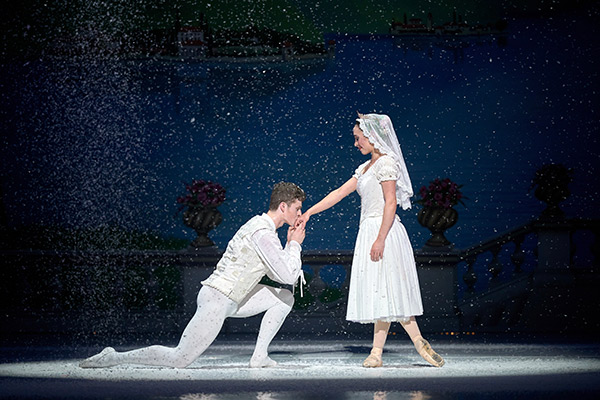
[.imgcaption]Paul Zusi and Leah McFadden in Raffaella. [.smalltext]Wikimedia Commons (Public domain).[.smalltext][.imgcaption]
Raffaella acknowledges that reality is not univocal; it is not all grief, or all chaos, or all loveliness, but like the fairytales it is rooted in, the ballet is confident that beauty is not an illusion. Order, innocence, and virtue are as real and powerful – even more so – than chaos, temptation, and violence.
Raffaella’s is no insipid, treacly story. There is evil and darkness in the drama; the ballet’s climax is a battle between angels and demons for Raffaella’s spiritual innocence. That innocence, the ballet asserts, is freedom. The dark prince holds her down, but in the arms of her Prince, Raffaella flies.
This unexpected “contemporary classical” ballet, with its innocence, its sweetness, its elegance and beauty, does something spectacular and challenging. It dares to give us a story that is delicate, yet dense. It dares to claim that virtue can survive reality and that innocence is not destroyed by death. It dares to acknowledge the many bewildering perspectives that make up our reality here on earth, while also insisting – beautifully, gently, yet confidently – that the artist has the right to step back and see our lives and our world from the perspective of heaven.