Why Minneapolis Needs Potlucks Now
When my neighbors are threatened with deportation, is it naive to think sharing food can make a difference?
January 24, 2026
Try 3 months of unlimited access. Start your FREE TRIAL today. Cancel anytime.
START FREE TRIAL NOW
[.article__paragraph--leading] [.smalltext] With Minneapolis in the news, we asked [.smalltext] [.smalltext] Plough [.smalltext] [.smalltext] author and Minneapolis resident Rachel Pieh Jones, who spent years living and working in the Horn of Africa, to give her firsthand view on the developing situation. —The Editors [.smalltext] [.article__paragraph--leading]
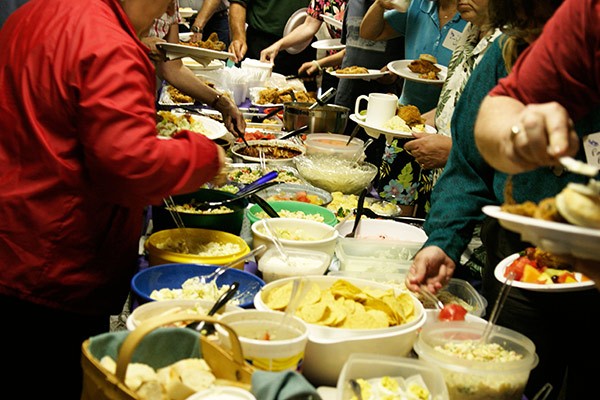
[.article__paragraph--cap] [.small-caps] Three days after [.small-caps] President Trump referred to Somalis in Minnesota as “garbage” in December 2025, my neighbors and I did what Minnesotans often do. We broke bread together. We gathered at the Karmel Somali Mall in south Minneapolis for a potluck. Somali Minnesotans, Chinese Minnesotans, Swedish Minnesotans, and many others did what we do when people we care about are suffering. We showed up and brought food. We ate Rice Krispy bars and sambuusas, chocolate chip cookies, and falafel.[.article__paragraph--cap]
In writing about Christian and Muslim hospitality, Matthew Kaemingk writes that what Christians need “is an argument against hatred and hegemony that is not so much theological but sensual, habitual, aesthetic, and narrative-based.” If that’s so, a potluck is one argument we can wield against hatred. Potlucks require sharing and receiving, preparing a big dish and delighting in a surprising new dish. Potluck feasting means having conversations about the origins of a dish or tradition, asking for new recipes. It means celebrating the heritage of food and honoring the Giver of the universal gift of sustenance.
[.article__paragraph--cap] [.small-caps] That was six weeks ago. [.small-caps] Since then, the rhetoric and violence have escalated to such an extent that this potluck gathering feels quaint and naive. Were we foolish to think that food could solve anything?[.article__paragraph--cap]
Minnesotans know the comfort of good food on an icy midwinter morning. We know how to do the penguin walk over icy sidewalks. We know how to drill through ice to catch fish. We know how to use salt to save delivery drivers from slipping at our ice-covered doorsteps. Now we are also learning how to take care of neighbors when ICE agents descend.
[.imgcaption] [.smalltext] Photograph by Daniel Templeton / Alamy Stock. [.smalltext] [.imgcaption]
Their stated aim, as part of President Trump’s “Operation Metro Surge,” is to apprehend undocumented immigrants. Of course, “apprehending” doesn’t quite capture the reality of tear gassing at schools, smashing car windows, knocking people to the ground, searching without warrants, and roaming city streets in heavily armed patrols. And many of the people being confronted, injured, or detained have legal rights to be in the United States: Green Card holders, asylum seekers, refugees, citizens, even Native Americans.
The president takes his mandate from his narrow election win, propelled by a near-majority of voters who either wanted the immigration crackdown he promised, or believed it was merely campaign bluster. Now the world is seeing another side of America: just how many people are willing to stand by their immigrant neighbors, propelled by a much older mandate: “Love your neighbor as yourself.”
[.article__paragraph--cap] [.small-caps] As I board a plane [.small-caps] in Minneapolis to return for a visit to Djibouti, my home of more than twenty years, half a dozen ICE agents, some armed, stand between the check-in counter and the walkway, interrogating certain people.[.article__paragraph--cap]
The irony is not lost on me. I have been an undocumented foreigner occasionally, in a region of the world that has been referred to as a shithole.
In Djibouti, we tried to keep our residence cards valid and up to date, but that wasn’t always possible. The offices were closed, there was a massive backlog, the wrong box was accidentally checked. For any number of reasons, there were periods of time in which my papers were not valid. This was never a problem because the government understood we were following legal procedures and that things take time. We knew the government had the right to decide what to do with us in the interim period.
Also, I had a traffic violation.
If the situation were reversed, ICE could be coming after me, slamming me to the ground in front of my children’s school, pointing loaded guns at me, locking me in detention with no legal representation and possibly none of the medication I require daily as a cancer survivor, and then shipping me off to who knows where without my husband or children or even identity and medical records.
That never happened to me in Djibouti. No one chased me with guns, demanding to see my papers. There was the possibility of needing to pay a fine, which never materialized. There was no threat of arrest or deportation or violence. I was not afraid to leave my house.
In part, this was because my husband and I are white American citizens, born and raised in Minnesota. Other foreigners living in this country were afraid to leave their houses sometimes. They were threatened with arrest and deportation, though never with guns.
This week I have been sitting with that reality, that privilege, that perspective, trying to parse out what it means. Being slow to react has allowed me to reflect on my experience and let it shape my response to what is happening in Minneapolis right now.
[.article__paragraph--cap] [.small-caps] Timothy Paulson, [.small-caps] a volunteer for immigrant communities in Minneapolis, tells me about an Afghan friend who was detained three days ago. This friend is in the United States on permanent asylum status. He assisted the US military during the war in Afghanistan, and going back could be a death sentence. He didn’t have his asylum papers on him and was taken to an ICE detention center and held in inhumane conditions for twenty-one hours. He couldn’t sit or lie down; the cell was too crowded. There was no water and only scant food. All the men urinated in a corner. Eventually, he was released, but not until after sitting with the terror of being sent back and the fear for his family. He declined to be interviewed because the trauma is too fresh.[.article__paragraph--cap]
Timothy had to go to the side of the highway to retrieve the vehicle left behind by another Afghan legal resident who has been detained. Instead of being released, he has been moved to another state and tracking his location is growing more difficult.
When I text Timothy later for an update on his Afghan friends, he writes back, “I’m on unexpected ICE patrol right now.” He and others in a Signal group, are tracking everyone they know who has been detained. When a refugee is taken, Timothy and others try to find free legal help. They search for relatives to find out the stories of those taken. Tracking them is urgent, as they are sometimes quickly moved out of state.
One thing detainees often need is their documents, but their families are afraid to bring them to detention centers. A Somali employee of Lutheran Social Services put it plainly when she asked Timothy if he knew any white people who would be willing to deliver passports, birth certificates, asylum papers, and anything else necessary to those in detention.
[.article__paragraph--cap] [.small-caps] From half a world away, [.small-caps] I watch the news from home: high school students taken without their parents’ knowledge, mothers taken in front of their children, people pulled from vehicles and the abandoned vehicles rolling into streets. A family caught in a protest while in the preschool pick-up line were tear-gassed in their car, including the children. These are my neighbors, being targeted because of the color of their skin, for exercising their right to protest, or simply for being in the wrong place at the wrong time.[.article__paragraph--cap]
Ultimately, this is not merely about deporting immigrants. These acts are also warping how people view one another. Are masked ICE agents human? Are undocumented people worthy of respect? Should protestors who impede federal officers or scream obscenities at them be treated with dignity? And what about the officers’ dignity?
While protests and increasingly vitriolic encounters fill the news, I know that many more Minnesotans are quietly but diligently fulfilling the Great Commandment – to love the Lord your God and to love your neighbor as yourself.
We are bringing our skills and connections, sharing resources, and asking for help. We are reaching across old boundaries. We are lifting others up and learning from them. It doesn’t feel quaint or naive anymore.
When word broke of a possible ICE detention center in the suburb of Woodbury, a group gathered to refuse the proposal. Then, they started a food distribution line with Mexican chefs preparing food and the community distributing it to families afraid to leave their homes.
Funding campaigns have opened for immigrant-owned restaurants, for the legal needs of those detained, and for groceries for their families. Administrators have closed public schools to protect their students and their families. Where school is still in-person, neighbors escort children safely between home and school so their parents do not need to leave the house. Coworkers give rides to those who can’t stay home but are afraid to travel to work on their own. Some residents have designated their homes or garages as places of refuge. High school students have walked out of class demanding that their fellow students and their teachers be treated with dignity and respect. There are candlelit vigils in the street where a federal agent shot Renee Good, mirrored by candles in countless private windows. People are dropping off cards to immigrant neighbors simply to say, “We’re glad you’re here. Call if you need anything.”
My own church is holding prayer vigils, seminars on immigration law, and a fundraising effort, and has provided a list of immigrant-owned businesses in the area for parishioners to support. Our pastor urged us to make it personal. Make a phone call. Send a text. Check on your neighbors, not only immigrants but second- or third-generation Americans who are being targeted because of the color of their skin.
In December, I had coffee with a Somali friend. It was the first time she had been out of the house since the “garbage” comments, other than work. She showed me her American passport. She had started carrying it everywhere. Now she is too scared to leave the house at all. She has canceled her family’s gym membership and kept her kids, born in the United States, home from school. She wept when strangers brought her a grocery delivery.
Sometimes, all this potluck resisting feels hopeless. As I am typing, my phone is buzzing with messages. One tells me that the verdict has come down in a case for a man who was taken over a month ago. He owned a construction business and was in the country on a legal temporary residence permit. He got a DUI several years ago. He has a Minnesota-born wife and two children. He lost his case and will voluntarily deport. Another family ripped apart – or uprooted, if his wife and children follow him.
Can breaking bread together – literally, or metaphorically through other forms of community solidarity – make any difference? I know many Minnesotans are weary. We have been through Covid, George Floyd’s death, the shooting at Annunciation Catholic School last August, and now this. But we are also resilient. We know that ice lasts for a season, but when the spring thaw comes, it is glorious in its abundant, life-giving power.
Till then, we’ll do our best to sustain each other. We’ll show up, feed people, and pray.