Eliminating the World’s Most Dangerous Epidemic
In a new book, The End of Violence, an epidemiologist claims violence is a contagious disease that can be cured.
May 12, 2026
Try 3 months of unlimited access. Start your FREE TRIAL today. Cancel anytime.
START FREE TRIAL NOWEliminating the World’s Most Dangerous Epidemic
In a new book, The End of Violence, an epidemiologist claims violence is a contagious disease that can be cured.
[.article__paragraph--cap][.small-caps]Violence is an epidemic[.small-caps] that can be cured. So says Dr. Gary Slutkin, and as someone who spent most of his career as an epidemiologist with the World Health Organization, he knows what he is talking about.[.article__paragraph--cap]
The author spent decades ending epidemics with the WHO all over the world. When there was an outbreak of malaria, typhus, AIDS, or Covid, Slutkin flew to whatever country he needed to “adapt the basic epidemic playbook to investigate, diagnose, and control a contagion to the epidemic at hand.” He applied his method to one disease after another, each time adapting and learning from experience, always with good results ranging from slowing transmission to complete elimination. It was straightforward, tough, and rewarding work, but also tiring and isolating. The sheer scale of the suffering as well as working with foreign governments, including a dictatorship, left Slutkin depleted.
So in 1994, after fifteen years abroad, he returned to Chicago to spend time near his aging parents. It was time for watching the sun rise, meditation, and multiple readings of The Tibetan Book of Living and Dying. Although he didn’t know what his next life move would be, Slutkin was not looking to face another deadly epidemic crisis. But the steady stream of Chicago Tribune headlines bothered him. Why were so many young people and children losing their lives to violence? One kid was so young that after being arrested for a murder he committed he cried and asked for his mother. What was going on here?
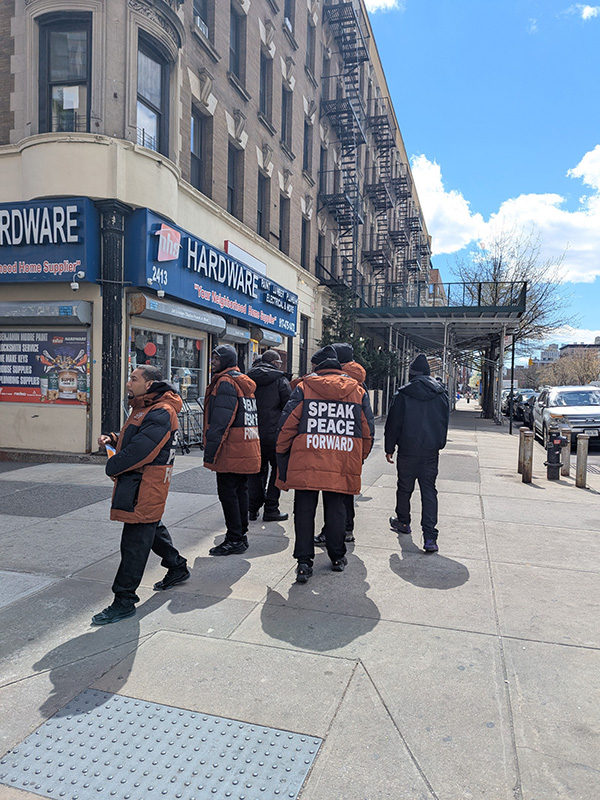
[.imgcaption]A SCR team on the street. [.smalltext]Photographs courtesy of Tim Maendel.[.smalltext][.imgcaption]
Years before, Slutkin had shared the mood of the general public that this was merely senseless violence, but now as a seasoned fighter of epidemics, he saw something else and his honed instincts put his mind to work. With time on his hands, he started studying patterns of violent outbreaks by making maps – maps that looked very similar to the disease outbreak maps he had been creating for years in other countries. Could it be that violence, just like tuberculosis in other parts of the world, followed the same pattern as an epidemic? It sure looked like it, which meant that violence could also be interrupted and stopped. He started asking law enforcement, city officials, and members of the public what they thought and he received a disturbing message – that there was little that could be done. Convinced that this deadly epidemic could also be cured, his career break was over: it was time to get to work.
The more he dug into violence, the clearer it became. In the book, Slutkin writes, “What I can tell you now with certainty is this: violence is a contagious disease. I don’t mean that metaphorically. I mean that violence infects a population via the same rules and processes as other infectious diseases: exposure leads to infection, which progresses to disease, which leads to transmission and further exposure.” The idea of “senseless violence” is nonsense. “When you get the flu, your doctor doesn’t throw up her hands and declare it senseless.” No, there is a logical explanation for each progression of the disease and the same scientific approach can be used to make sense of the rise in violence.
Exposure was seeing violence. Think about growing up in an environment where your role models talk about violence as the solution, perform it in front of you, and brag about their acts even if they have served prison time for them. For most diseases the body has defenses – nasal mucosa for flu and cold viruses, stomach acid for intestinal parasites. Violence infection, however, goes from your eye to your brain in milliseconds. Once you see something, it translates itself into your brain, which is now newly coded, waiting for possible activation. And your brain can stay like that for decades. Infection has occurred and your brain now has a script to go by if you feel you need “relief” from pain or fear.
Slutkin tells us that apart from a few rare exceptions, the disease of violence is started by violence itself. Luckily, the human brain can distinguish between real and acted violence such as that in a violent movie or video game. We know it isn’t “real.” But real violent acts that are seen infect. Social media, with its real-time images, videos, threats, humiliations, and anger, is a major spreader of the disease.
America’s criminal justice system has failed in its attempts at fighting violence, instead perpetuating more violence: “Prisons do not contain violence, if anything they are incubators of the disease,” writes Slutkin. Punitive measures don’t stop but rather accelerate the transmission of the disease.
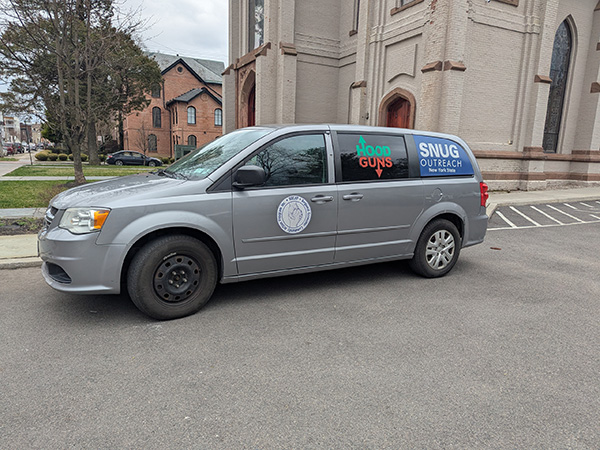
[.imgcaption]SNUG vehicle. [.imgcaption]
The way to end an epidemic is to prevent transmission by not allowing those who are infected to infect others. The sequence of contagion needs to be interrupted. In the spirit of this philosophy, Slutkin started CeaseFire (later called Cure Violence) with teams of community workers and “violence interrupters” to do just this task. The measurable results came quickly. Only a year after its implementation, a newspaper headlined the approach: “Treating Crime as a Disease Works.”
The Department of Justice funded an evaluation of the first seven years of CeaseFire’s work, finding a 41 to 73 percent decrease in shootings, and a 50 to 100 percent drop in retaliation killings. State officials came to respect CeaseFire so highly that they seemed to see it as a failure of the organization itself when there was a shooting in the neighborhood where they worked. In 2011 a documentary on CeaseFire’s work called The Interrupters was commissioned and aired around the country and world.
It's inspiring to learn about the men and women behind CeaseFire’s mission and success. One might imagine that violence interrupters are peaceful people who through their lifestyle and loving finger-wagging convince would-be shooters to lay down their weapons. Not so. The best interrupter has earned maximum street cred by previous personal involvement in violence. Many of the leaders are former gang members who have committed their share of crimes and paid for them in prison. Sometimes they catch themselves talking like they did in their pre-reformed lives, which helps with credibility. They are called into situations where violence has just occurred, or threats of violence have been made. Their mode is to listen, slow down, and use reason to point out the most likely result of the proposed action. They don’t pass judgment, take sides, or minimize feelings. And they do not talk to the police. An interrupter comes as a friend who sees through the smoke of anger and proposes alternative behaviors and then lifestyles. There is no behavior change without public education, so their work in the area includes using posters with messages as simple as “Stop Killing People” or a picture of a young boy’s face with “Don’t shoot, I want to grow up.” Marches and vigils after a violent act play a big part, but they always offer an alternative, not casting blame. The goal is to make violence simply unacceptable in any form.
Violence interrupting is a full-time job that requires training and commitment; it is not just for part-time volunteers. Cities recognize this by providing serious funding. With measurable drops in shootings and killings, return on investment can be calculated in terms of gun violence costs.
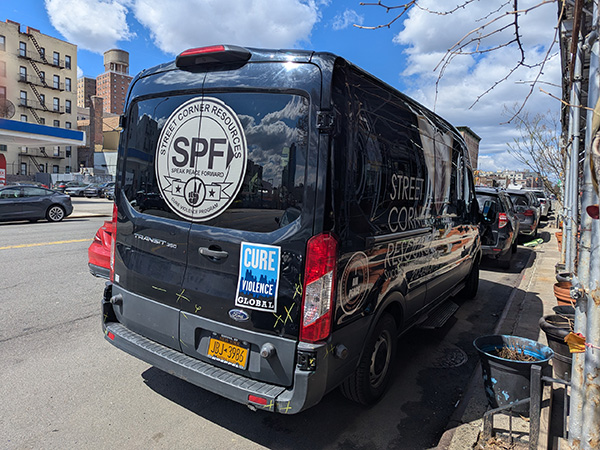
[.imgcaption]SCR van with Cure Violence sticker. [.imgcaption]
Prior to reading the book, I’d seen the name Cure Violence on signs and vehicles in Harlem and met some interrupters in Newburgh, New York. I had even joined some of their vigils without realizing the depth of their work, or its origins. But after reading the book, I had some questions, so I went to the neighborhoods where Cure Violence was at work to ask the interrupters myself.
When I spoke to Milford Jacobs, one of the leaders of SNUG (guns spelled backwards) in Newburgh, he told me that “most of us were out here creating these problems ourselves” in a former life, which “makes us credible messengers.” He went on, “If these kids meet a new face, they go back and ask their community and their friends who this person is; if it checks out we are ahead of the game.” When the work is more urgent, like in the response to a recent shooting, Ali George, another interrupter, uses a basic technique to start the conversation. “People need food and respond to that,” he said. “I often offer to get them pizza or something to drink. It calms them down and we can start to talk.” Building trust takes persistence and is often met with rejection. But people like Milford Jacobs and Ali George keep showing up. Once they hear of plans for violence in a conversation, then it is time to help with “consequential thinking.” When a plan to go shoot someone is spoken out loud, George will ask for the details: “Where you gonna hide the gun? And where you gonna go hide after that? When you speak it out loud to somebody else it might not sound that smart and then the person changes their mind.”
Their marked shirts, vehicles, and pamphlets make a full display of their intentions. “We want people to know exactly what we do and represent. It is also a safety measure, because, I mean, if you didn’t see these clothes you’ll probably think I’m one of these kids out there holding a gun and selling drugs because we look just like them,” explains Jacobs.
I asked them if they were ever pressed by law enforcement for help with investigations. “No, never,” George quickly responded. “They know our job is prevention.” Instead, the police help Cure Violence by identifying areas of the city that need more attention.
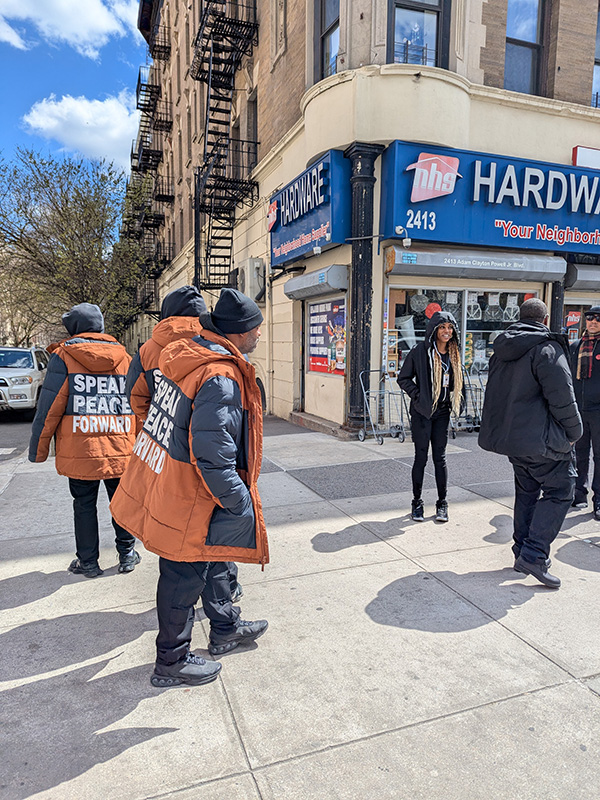
[.imgcaption]SCR street team. [.imgcaption]
My next stop was Street Corner Resources in Harlem. When I arrived, meetings were going on inside while outside team members swept the sidewalk and watered planters. All the interrupters were wearing similar shirts with slogans like “Speak Peace Forward” and “I Am Peace.” They were doing their most important work – prevention – by maintaining a visible presence and planning group activities that offered an alternative to violence. They know the hangout spots and prioritize those areas for these activities. Violence drops as a “not on my block” attitude grows. Founder Iesha Sekou stressed that their work starts long before an incident of violence. They form relationships with the youth by working with them in block beautification teams, music and poetry performance, and boxing classes. Groups also write skits that show the “start, middle, and end” of a conflict to spawn discussions about how violence can be diffused. Through time together, friendship and trust are built, and communication about life’s difficulties follows. “Conversation becomes the help,” and before long “the kid becomes the counselor” and can help peers, Sekou explained.
Social media serves as a radar for brewing conflicts. The team members stay well-apprised. When interrupters show up at fights they are often met with surprise. They do not train their team to break up fights as it is far too dangerous in situations where guns come out fast. Rather, they intervene by helping young people, in Sekou’s words, “to look at the end while you are at the beginning.”
Slutkin’s efforts and prescriptions are not limited to urban violence. He has taken part in peace processes in the Middle East and North Korea. He notes that leaders of nations often flex like gang leaders but want someone to say, “You don’t have to do this,” providing an off-ramp before international catastrophe. He recently explained this on NPR’s Here and Now in the context of the current conflict in Iran.
At one point in the book, Slutkin reminds us that diseases like plague, leprosy, and smallpox essentially exist only in history books and suggests we could use the same public health strategy to control the epidemic of violence. The book ends with an action plan, not just for interrupters but any reader, since we all have our brushes with violent thoughts on some scale. I was struck by his advice, such as, “Remind people that the reason for violence is not because people are evil, but because people are copying, following, or hurting. Nobody really wants to be violent or be around violence.” How’s that for a refreshingly hopeful approach? This really could be a step toward “the end of violence.”