




Subtotal: $
Checkout

Everybody Is Interested in Pigeons
Throughout history people have fancied pigeons for food, pharmaceuticals, and hobby breeding.
By Karen R. Jones
February 10, 2026
0
Comments
0
Comments
Post a Comment
Humans domesticated the rock pigeon somewhere in the region of 10,000 years ago, the time when Neolithic communities in the Tigris and Euphrates valleys began to grow cereals and raise sheep, goats, pigs, and cattle. Their image features on ancient Mesopotamian tablets, Sumerian temples, and Egyptian hieroglyphs. Easily captured and easy to raise, these birds were a popular husbandry choice and, from the Fertile Crescent, spread with human communities across Asia, Africa, and Europe. Domestic pigeons reached Britain with the Romans, who bred them for food and wrote about them in agricultural and medicinal manuals. In On Farming (AD 36), Varro created an evocative picture of a tended Mediterranean landscape where birds roosted in the walls of farmhouses and high turrets, from which they swooped down to feast on nearby fields.
The Norman Conquest brought a major influx of Colombidae, a bird family consisting of doves and pigeons, to Britain, as lords of the manor purposely cultivated pigeons for the table. Commoners were not allowed to own them (on penalty of fines and prison sentences) and, accordingly, they grew to hold a certain decorative prestige. Tudor physician Andrew Boorde remarked: “The country gentleman’s residence is not complete without a dovecote, a payre of buttes for archery, and a bowling alley.” This also made them highly contentious animals, especially for peasant farmers whose strip plantings of barley, oats, and legumes were routinely consumed by hungry flocks. A flock, incidentally, is the collective noun for a group of pigeons on the ground. On the wing they are known as a loft, litter, or kit.
Many dovecotes were smashed up by parliamentarians in the English Civil War as symbols of lordly oppression. As one soldier put it: “Pigeons were fowls of the air given to the sons of men, and all men had a common right in them that could get them and they were as much theirs as the barons.”
Medieval pigeon husbandry was pretty straightforward: they needed little looking after and cost nothing to feed. The key ingredient to a successful avian economy rested on the provision of an attractive and safe house where birds could return at the end of a day’s feeding, sleep, and raise young without fear of attack from predators (birds of prey, weasels, foxes and, at that time, the odd wolf) and which could be accessed easily by humans to gather them for slaughter.
Roosting holes were built into the gable ends of houses and churches, while free-standing circular towers made of stone provided lofty perches for two hundred to five hundred pairs. The oldest surviving dovecote in the United Kingdom is located at Garway, Herefordshire; it was built in 1326 by the Knights Templar and once housed more than six hundred pigeon pairs.
Feudal lords, monastic communities, and church authorities eagerly built their own columbariums, from which they generated significant nutritional capital. A de facto poultry farm, the prodigious capacity of pigeons to reproduce meant a regular supply of squabs, which were killed at three to four weeks old and prized for their tender meat (which was cooked on a spit and baked into pies) from late March through to the end of November. These utility animals were also useful in producing feathers (for stuffing mattresses) and guano, which was used as fertilizer and as a key ingredient in gunpowder (saltpeter or potassium nitrate) from the 1500s.
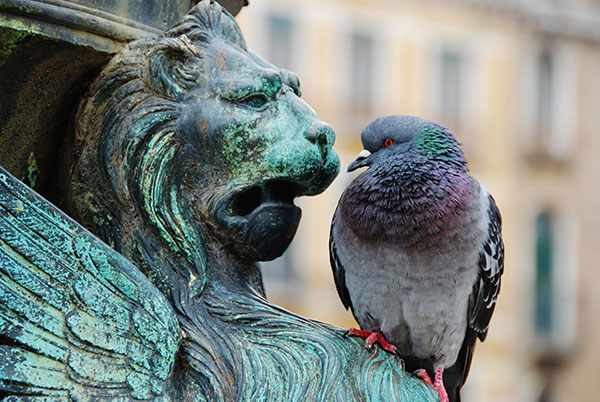
Photograph by Dustin / Adobe Stock.
The medieval trade had a powerful linguistic legacy – one which split the ancestors of the rock pigeon into two avian camps based on their status as edibles. Pigeons were definitely for the table, their name heralding from the French pipiare (chirp), whereas the nonedible and smaller varieties (doves) were named after the old English or Germanic for dip or dive. To add a confusing twist to the nomenclatural rail, however, pigeon houses were still called dovecotes regardless of which species roosted in them. There were some 26,000 of these in Britain by the early modern period, including timber-framed buildings, rectangular structures, and octagonal houses. Each was typically built from local materials and in the local architectural style, meaning that no two were quite the same.
Allied to the nutritional was another use: as all-purpose medicine. Building on the classical tradition of the four humors, so-called “hot” bird species were used for phlegmatic and melancholic conditions. Blood from under the wing of a pigeon could be applied directly into the human eye to alleviate a bloodshot sclera, while a diet of their meat was seen as a healthy prescription for keeping fever at bay. Those suffering from plague were advised to place a live pigeon on the soles of their feet, a treatment favored by Queen Catherine, wife of Charles II, and described by Samuel Pepys in his diary. According to The London Pharmacopoeia (1618), the very best results were to be obtained by plucking out a few feathers, keeping the beak closed and pressing the exposed skin onto a lesion to extract the “plague venom.” For conditions including gout, vertigo, colic, joint pain, swellings, and angina, feces could be dried, ground up, and taken as powder or made into an ointment, while William Salmon’s Pharmacopoeia Londonensis (1716) heartily recommended cutting a pigeon in half and placing the dead bird on the head of a patient to relieve “Headaches, Frenzy, Melancholy, and Madness.”
The early 1700s brought big changes for Britain’s Columbidae. Attention to the laws on domestic pigeon possession had become more relaxed by the turn of the century (though statutes formally stayed in place for another two centuries) and some small farms added utility breeds to their husbandry portfolios. In general, however, medieval meat economies (dovecotes, warrens, and fishponds) were on the decline, in favor of a shiny new system founded on improvement, enclosure, and higher returns. This agricultural revolution brought new technology in the form of seed drills and plows, as well as resilient root crops such as turnips. With huge increases in the land under cultivation, wild wood pigeons, traditionally seen as forest dwellers, found themselves with a surfeit of food and a burgeoning reputation as “voracious and insatiable vermin.” Meanwhile, as affluent landowners turned to remodel their country estates into ornamental landscapes, domestic breeds successfully leapt the fence to become objects of fancy.
Breeding and bloodlines became the talk of the hour. Columbarium, John Moore’s famous book on breed standards and aesthetics, was published in 1735 while, across the country, a frenzy of decorative dovecote construction took place. Lord Atherton (colloquially known as “Mad Richard”), owner of Atherton Hall, Lancashire, built four turrets on top of his new stately home (1723–42), where birds were grouped by breed and heredity. Forcett Hall, Yorkshire, renovated in the Palladian style in the mid-eighteenth century, included an octagonal dovecote in its parkland which incorporated a cattle byre on its ground floor and was designed after the fashion of a bandstand from the Vauxhall Pleasure Gardens. Another particularly dramatic rendition, the “doo-house” of Mounthooly, Aberdeenshire, built in 1800 by a local landowner on the top of a hill, presented a mock-Gothic mash of functional avian space and castellated folly. Many of these grand pigeon houses have long since fallen into disrepair, though the 1,500 or so that survive today pay heed to a time when the design of your poultry house provided an opportunity for architectural flourish and bragging rights over your neighbors.
Neither did the world of nineteenth-century industrialism extinguish the fire of pigeon fancy. Instead, a fresh round of avian obsession drew from period interests in scientific agriculture, natural history, pet keeping, animal breeding, and aesthetics. In this Victorian explosion of “fowl mania,” the elite flocks of the Columbarium Society (1750) were joined by an urban audience that included people (well, men: even in 1931 only 1 percent of pigeon enthusiasts were women) from all walks of life. London’s Spitalfields emerged as an early hub, located near the famous animal markets of Club Row and home to Huguenot silk weavers from France whose wooden houses contained weaving workshops atop which were ad hoc pigeon lofts. Before long, the fancy had spread across the country, to small towns and villages and especially the industrial towns of the Midlands, northern England, and South Wales.
Joining together in local societies and sharing expertise across specialist print media – including Fancier’s Gazette (1874) and The Feathered World (1889), the latter of which had a circulation of 34,000 in 1896 – avian aficionados from a broad social spectrum jostled to create the perfect specimen, based on what George Ure, author of Our Fancy Pigeons and Rambling Notes of a Naturalist (1886), described as a union between “the forces of nature ... and the control of human will.” According to Charles Arthur House, writing in Pigeons and All About Them (1920), those who took up the hobby did so for various reasons: income, pleasure, relaxation, and to add “zest” to their lives. The scene was a great leveler, he noted; anyone might cultivate the most prized bird, based on what Joseph Lucas, author of The Pleasures of a Pigeon Fancier (1886), called “the art of propagating life.”
English carriers, fantails, and ornamental varieties inspired particularly devoted attention, and specific geographies (and climates) came to specialize in different types, hence the creation of subcultures around the London Beard, the Norwich Cropper, and the Birmingham Roller, to name but a few. The principal venues for the fancy were the local club – of which most towns had at least one by 1900 – and the public show, the first of which was hosted in London in 1848 and went on to grace municipal halls and county shows the length and breadth of Britain. One particularly striking event in the pigeon-fancy calendar was London’s Crystal Palace Show, established in 1869 and featuring row upon row of remarkable specimens, strutting their stuff in special cages, parading excellence in size, color, frills and feathers, or acrobatic or behavioral traits. Kate Whiston, expert in “pigeon geographies,” counted some two hundred shows with pigeon classes in November 1895 alone.
With up to one million birds bred annually and some 100,000 fanciers, some choreography was needed, and this was provided by the Pigeon Society (1885) which was formed to promote the fowl fancy and to crack down on foul play. According to Reverend Willam Lumley, who raged in the pages of The Feathered World, the hobby was rife with “pot hunters” who flew from regional show to regional show and stole all the prizes.
The pigeon fancy, of course, counted many upstanding devotees, not least Charles Darwin, who was an enthusiastic bird-keeper and became “immersed” (by his own admission) in the mechanisms by which centuries of human breeding had created a multitude of ideal types. Observations of pigeon behavior critically influenced his emerging thinking of natural selection and adaptation (Darwin famously became so attached to his loft that he was unable to kill any of its residents). On the Origin of Species thus owed as much to the domestic pigeon as the Galapagos finches. Not that everyone saw the merit in Darwin’s approach. Many fanciers pooh-poohed his contention that all Columbidae had one common ancestor in the form of the rock dove, while an early reviewer of the manuscript, clergyman Whitwell Elwin, had advised him to ditch the “wild and foolish imagination” of evolutionary theory and write a much shorter book focused entirely on the birds he studied. After all, he argued, “every body is interested in pigeons.”
Excerpted from Beastly Britain: An Animal History by Karen R. Jones (Yale University Press, 2025). Used by permission.

You have ${x} free ${w} remaining.
This is your last free article this month.
We hope you've enjoyed your free articles.
This article is reserved for subscribers.
Already a subscriber? Sign in
Try 3 months of unlimited access. Start your FREE TRIAL today. Cancel anytime.