

Published
January 4, 2018
ISBN:
9780874868302
Length:
168
Laurie Gagne (Editor)
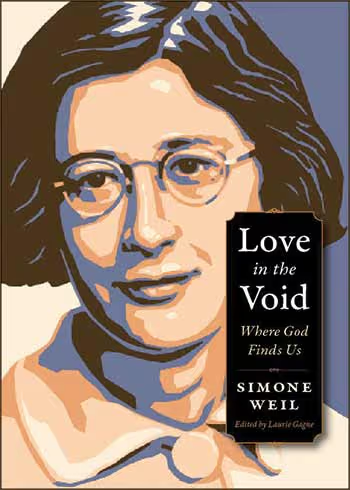
Why is it that Simone Weil, with her short, troubled life and confounding insights into faith and doubt, continues to speak to today’s spiritual seekers? Was it her social radicalism, which led her to renounce privilege? Her ambivalence toward institutional religion? Her combination of philosophical rigor with the ardor of a mystic?
Albert Camus called Simone Weil “the only great spirit of our time.” André Gide found her “the most truly spiritual writer of this century.” Her intense life and profound writings have influenced people as diverse as T. S. Eliot, Charles De Gaulle, Pope Paul VI, and Adrienne Rich.
The body of work she left – most of it published posthumously – is the fruit of an anguished but ultimately luminous spiritual journey.
After her untimely death at age thirty-four, Simone Weil quickly achieved legendary status among a whole generation of thinkers. Her radical idealism offered a corrective to consumer culture. But more importantly, she pointed the way, especially for those outside institutional religion, to encounter the love of God – in love to neighbor, love of beauty, and even in suffering.
In this intellectually and spiritually demanding sampler, philosopher and Christian mystic Simone Weil (1909–1943) addresses love, beauty, suffering, and idolatry…. Weil combines aphorisms and perceptive observations to lead readers into “the void,” “the dark night,” where suffering “puts a little seed in us” and inspires questions about the afterlife. This beguiling book is a fine introduction to Weil’s work.
Publishers Weekly
An exciting encounter with an extraordinary mind.
Booklist
Love in the Void is a reminder to neophytes and the experienced alike that Weil’s writing is meant to be concrete, accessible, and useful – more than simply ideas to ponder, but an invitation to change our lives. Plough has done an admirable job in assembling a condensed version of Weil’s most pertinent writing. This is Weil burned down to her essentials.
Scott Beauchamp
Weil’s thought is bound to Christian faith, yet she moves fluidly through her diverse influences in theology and philosophy. Because of this, Weil remains a woman of many paradoxes. Love in the Void acknowledges that and invites us to explore it more closely…. We see ourselves in her intellectual lucidity, spiritual intoxication, and courage.
The New Criterion
An excellent introduction to Weil’s writings and also a valuable guide and stimulus for cultivating a life in which intellectual and spiritual honesty are inseparable, and in which the difficulty of attaining them is seriously confronted. It is ideal for classroom use, for introducing a friend to Weil, or for revisiting her long after an earlier encounter to be reminded why she is such a compelling and challenging interlocutor.
Mark Shiffman, Front Porch Republic