The Hidden Shrine
The Kirishitan Hokora – the Christian Shrine – was always supposed to be mistaken for “just rocks.”
May 16, 2026
Try 3 months of unlimited access. Start your FREE TRIAL today. Cancel anytime.
START FREE TRIAL NOWThe Hidden Shrine
The Kirishitan Hokora – the Christian Shrine – was always supposed to be mistaken for “just rocks.”
[.article__paragraph--cap][.small-caps]“It’s just rocks.”[.small-caps] This was the incredulous response by a friend of mine who knew Japan well when I said I wanted to write about the shrine on Mount Yasumandake, a rural and, admittedly, very rocky part of Japan about two hours northwest of Nagasaki, on the nation’s southeastern coast. The mountain rises over the great mass of green which is the countryside on Hirado Island before undulating down toward the sea. The top of the mountain itself is made up of a flat, long ridge and then a sharper, more obvious peak. Slicing their way up to this rather underwhelming summit are a series of paths, some no more than faint outlines in the dirt but others, more established, made up of shallow steps, designed to help the ascendant. Beside these paths are shrines, the little marks of public religion that you see all over Japan. As a general rule, they are not elaborate edifices. Many are simply a collection of rocks beside which people leave offerings.[.article__paragraph--cap]
Someone had left a bottle of wine on the ledge at the Hakusanhime shrine on Mount Yasumandake. It is something of an all-purpose shrine, hallowing both Buddhist deities thought to reside in or on the peak and also Shinto spirits of the ancestors of people who live there. Such an arrangement – a syncretic bringing together of the two dominant faiths in the island grouping – is not unusual. It’s a sign of the remarkable mixed-mode toleration which Japan historically extended to a number of religions. Except, very notably, one. Hidden a little way from the Hakusanhime shrine is another shrine. It consists of little more than a short central column, now struck at an irregular angle, and a clearly carved stone acting as a pagoda-style roof. They might attract the eye’s briefest scan of attention, but then again, in a nation where shrines are the norm, it might be mistaken for a misplaced bollard. To most passersby it appears to be simply a crude collection of stone – the “just rocks” my friend warned me about. This is the Kirishitan Hokora. The Christian Shrine.
Of course, there are some churches – such as the Templo de las Americas – which are shadows of what they once were, mere theme park reconstructions of the original church. There are others, like Hagia Sophia, which no longer fulfill the purpose for which they were built. The Kirishitan Hokora is not like that. It was always supposed to be mistaken for “just rocks.” What it has in common with those other churches, unlikely as it may seem, is that its form and its purpose are inherently tied to the people who used it to worship God and speak the name of Jesus Christ. It is inherently linked to their quest to keep their faith.
[.article__paragraph--cap][.small-caps]To “keep faith”[.small-caps] in something is a phrase much bandied about. There are lots of things that purport to inspire faith in the modern world. As the Roman Catholic moralist and popular author G. K. Chesterton was purported to have remarked, “The first effect of not believing in God is to believe in anything.” We profess faith in celebrities, in abstract concepts, in processes, and in people. In everything from whether our football team is going to win to the much knottier concept of humanity itself.[.article__paragraph--cap]
Establishing how we might simply define the Christian faith is, inevitably, a tricky task. At its center, though, is the belief in Jesus Christ as Son of God, in his incarnation, resurrection, and ascension. And that these truths about Christ have totally changed who humans are in the sight of God and how they engage in the world. Making that initial leap of faith is, for many, hard enough. However, allowing for that, the question then becomes one of how did Christians keep their faith, given the ups and downs of the history of the church from the very earliest days? There have been many attempts to make followers of that faith renounce it: some by force and some by the temptation of easier or simpler or more immediately rewarding beliefs and practices. Some have worked, many haven’t.
Of course, Christians were told that this would happen; a recurring theme in all the Gospels is a warning that belief would lead to persecution, even to death. However, Jesus also promised, alongside each prediction, that in being persecuted, his followers would, in fact, become closer to him and become blessed. Alongside his predictions of martyrdoms, Christ also warned of other forms of “falling away,” other failures to “keep the faith.” In the parable of the sower, Christ talked about those who will “fall away in temptation” or who are “choked with cares and riches and pleasures in this life.” Keeping the faith, then, is not just a story of how Christians coped in times of intense persecution, but in times of comfort as well, when people, as per Chesterton, felt they no longer needed a faith in God, such were the wealth of other options available.
[.article__paragraph--cap][.small-caps]Luis Frois was a fastidious man[.small-caps] with an eye for detail. He noticed things of the most prosaic and, at times, unnecessarily close-quarters kind. “In our latrines,” he wrote, “we sit, whereas they squat.” Fois was from Portugal, the nation whose merchants had, at some point in the early 1540s, been the first documented Europeans to set foot in Japan. Twenty years after that first contact, in July 1563, Frois arrived in the port town of Yokoseura sponsored by the Society of Jesus, a Catholic order more commonly known as the Jesuits. He took part in missionary work, but his real gift was in observation. Faced with a culture so vastly different from his own, Frois set about doing what, to him, was the most logical response: listing every possible way he could think of that Japanese daily life differed from the existence he had lived as a young man on the Iberian Peninsula. As well as an in-depth analysis of lavatorial habits, Frois wrote chapters on medicine, costumes, dress, music, and the use of horses. Strange and occasionally inaccurate though his observations might seem, they remain an extremely useful source for understanding ordinary life in seventeenth-century Japan; after all, cultures very rarely write about things which are to them normal day-to-day habits. What the Japanese thought of this Jesuit who wanted to watch and take notes while they relieved themselves is sadly not a matter of historic record.[.article__paragraph--cap]
Alongside these quirkier observations about their vastly different cultures, European and Japanese exchange was, initially, mutually profitable. Japan’s politically fragile and militarily focused domestic situation made the importation of European weaponry a priority for its myriad local magnates. For the Europeans, Japan represented all that the age of exploration had sought to find: a wealthy trading power keen to do business with the West. It is worth remembering that Japan and her surrounding islands were the intended destination of Columbus’s first voyages. As with Columbus, when Europeans finally did reach Japan, Christianity became inexorably linked to commerce and to the possibility of conquest. These links were to prove both an opportunity and, in this case, its undoing.
[.article__paragraph--cap][.small-caps]Christianity was originally welcomed[.small-caps] by the Japanese establishment, as well as proving incredibly popular among ordinary people. In particular, major trading ports, such as Nagasaki at the south of the Japanese mainland, became centers of missionary activity, with large numbers of local converts. Initially these were focused on the merchant community but, with remarkable speed, ordinary Japanese in rural and remote coastal areas came to be baptized and declare themselves Christians as well. However, the Jesuits knew they were playing a carefully balanced game. The Japanese authorities, disparate and unstable though they were in the sixteenth century, were acutely aware of Spanish colonial expansion in the Philippines to their south and the presence of Portuguese troops at the trading stations on the Chinese coast. By the late sixteenth century, Shinto advisors to the de facto ruler of Japan, the former peasant turned Regent and unifier, Toyotomi Hideyoshi (豊臣 秀吉), were alarmed by the rate of Christian conversion and sought to discourage it. In 1587, Hideyoshi issued an edict known as the “Bateran Tsuiho Rei” or “The Edict of the Padres,” a reference to the warning it gave to missionaries to leave the country because of their consistent broaching of “the free will” of Japanese people, which went against Buddhist law – that is to say their success in conversions. With this warning in place, active persecution by the authorities was constantly one incident away.[.article__paragraph--cap]
[.article__paragraph--cap][.small-caps]Initially, the response was localized.[.small-caps] Hideyoshi demanded blood from the most prominent Christian community in Japan in an attempt to dissuade Japanese from converting. In early 1597 a group of twenty-six men and boys, mostly, but not all, Franciscans, and mostly, but not all, European, were taken to a hill outside Nagasaki and nailed to crosses. The victims, some still children, were then pierced by spears and lances in a deliberate echoing of the events at Golgotha. Watching the grisly spectacle from the safety of a boat in the harbor was a Franciscan named Marcelo Ribadeneira. As he returned to Europe, he was determined to write an account, because it was “necessary to provide truthful information.” The scene he described shocked Europe, but it appeared to have the opposite effect to that which Hideyoshi had wanted. Rather than the stream of missionaries drying up, if anything, more volunteered for the mission, smuggling themselves in disguised as fishermen or hidden in boxes of goods.[.article__paragraph--cap]
The more Christians there were, the more intense the persecution became and the more the martyrdoms spread. By the second decade of the seventeenth century, the prosecution and execution of Christians, both European and Japanese, was widespread. Crucifixion remained a particularly favorite method of execution. As well as those killed in the manner of those outside Nagasaki, Christians who had previously been subject to torture at the hands of the state’s Shinto and Buddhist inquisitors would be tied to crosses at low tide. The incoming spray and surf would lash them, filling their wounds and lacerations with salt water – a tactic deliberately designed to cause maximum pain. Eventually, their lungs would fill with that same water, or they would be ripped up from their crosses by the power of the tide and dashed against the rocks, and they would die – die for their faith.
It wasn’t just crucifixion. Other methods were employed. Freezing to death in the mountain lakes that dotted the Japanese landscape, being covered with boiling water, being thrown off cliffs, being burned alive, being beheaded – although this was generally reserved for the newborn babies of Christian parents who were often given the arguably even more horrific punishment of having to watch. There was even an entirely new method of torture crossed with execution that was devised especially for Christians. Ana-tsurushi was a punishment by which the Christians were hung upside down, generally over a pit. To alleviate the pressure in their heads, and so keep them from passing out, sometimes cuts would be made in their foreheads. In the pit was rotting meat and offal, which would mix with the victim’s blood and make a horrifying stench. Over a matter of days, the pit would be filled with water and, if they still had not recanted their Christian faith, the victim was lowered into it until they drowned.
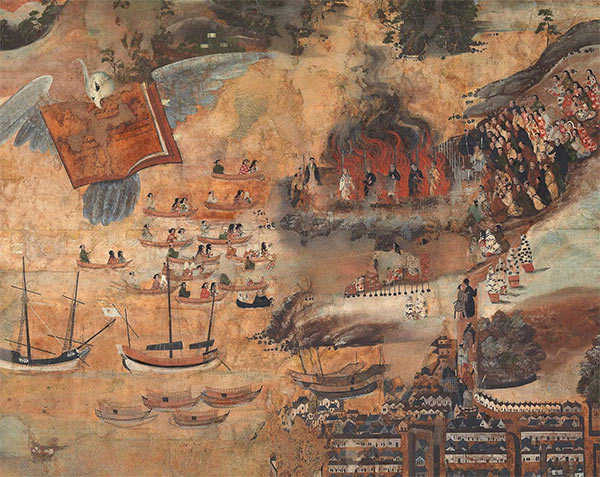
[.imgcaption]Anonymous Artist, Martyrdom of Blessed Leonardo Kimura with four other Christians in Nagasaki on November 18, 1619. [.smalltext]Wikimedia Commons (public domain).[.smalltext][.imgcaption]
One such victim was a young girl. Known simply as Magdalene after Mary Magdalene, she had been born to Christian parents in Nagasaki in 1611, when persecution was already well underway. Her parents were killed at some point in her early adolescence and so she put herself entirely at the service of the Dominican Order. Its priests and European brothers had fled to the immediate countryside around Nagasaki, favoring in particular mountainous areas like that of Mount Yasumandake. For contact with the outside world, they relied on Japanese Christians, to whom they continued to give Holy Communion, preach the gospel, and baptize converts. One such go-between was Magdalene, who translated for them and brought them food and supplies. Soon she too withdrew to the mountains, but she felt that she was called to something even more. For some reason – whether to save those who sheltered her, or to hasten her own martyrdom – during a period of crackdown in the 1630s, aged only twenty-two, Magdalene went to the local judges on the island of Kyushu, where Nagasaki and Mount Yasumandake are both located, who were specifically tasked with finding female Christian leaders for execution, and volunteered herself as one of them. She lasted thirteen days until she was drowned, all the while singing praises to God.
As it became clear that there would be no relief from the persecution, whole communities found their beliefs outlawed and punishable by these increasingly creative punishments. One such village was the tiny settlement of Kasuga on Hirado Island off the coast near Nagasaki. All of the residents of Kasuga had converted to Christianity by 1561. Some Christian graves on Maruoyama Hill, just outside the village, date back to 1550 – barely seven years after those Portuguese merchants first came to Japan. Many of its residents by the early- to mid-seventeenth century had only ever known Christianity as their faith. Despite their rural location, which even today is about as far from the hyper-technological stereotype of Japan as it seems possible to be, the inquisitors still managed to make their way to Kasuga, and on the island of Nakanoshima they put to death a number of local Christians using a variety of methods from crucifixion of adults to the beheading of infants, hurling their bodies into the sea to prevent their mangled corpses from being buried as martyrs who suffered as Christ did. The persecution wasn’t just designed to eradicate faith but to suppress hope as well.
In a number of cases this approach was successful. For some, their faith simply wasn’t strong enough to continue in the face of such appalling torture. Often, the state’s agents made the choice seem astonishingly simple. Images of Christ or Mary known as fumi-e were presented to suspected Christians and they were asked, calmly and simply, to tread on them. In the Japanese cultural norms so assiduously documented by Luis Frois, this represented an absolute rejection. It wasn’t only some converts who recanted their faith. With the horrors of the alternative, some missionaries and priests did too. Perhaps the most famous example was Frois’s fellow Jesuit – the vice-principal of the order in Japan, no less – one Christovao Ferreira. After nearly twenty years as a missionary in Japan at the height of the persecution, during which he was tasked with writing about the martyrdoms of those killed by the state, Ferreira was captured. While being tortured by use of ana-tsurushi, Ferreira cracked and agreed to give up his Christian faith, even going so far as to marry a Japanese woman, take a Japanese name, and help write an anti-Christian tract entitled “Kengiroku” or “The Deception Revealed.” His case shocked the Jesuits, who prided themselves on the strength of their faith. But Ferreira serves as a reminder amid all the stories of strong faith and heroism that plenty of those who sought to try and keep their faith while under such intense pressure were simply, frailly human.
In many cases, the torture and persecution didn’t work. A whole group emerged that would later be identified as kakure kirishitan, “the hidden Christians.” These communities sought to continue their worship but with the knowledge that they would never be able to do so in public, becoming little islands of the Christian faith, ever more separate from the rest of the world. One such group was the villagers of Kasuga. At some point in the early seventeenth century, probably not long after watching their co-religionists killed just over the water at Nakaenoshima, they went up the nearby mountain and built their shrine. It became the closest thing they had to a church for the next 250 or so years, until the ban was finally lifted with the arrival of an American naval squadron and the reopening of Japan in 1853. Unsurprisingly, many hidden Christians continued their practices and shrines like the one at Kasuga. Here they had come with their hopes and dreams, their half-remembered prayers, and their concealed objects of devotion – objects often disguised as household items. Here they had made offerings to carvings which appeared to be Buddhist or Shinto deities or demigods but were, in fact, depictions of Christ or the Virgin Mary. Here, above all, they would seek to encounter the God for whom their fellow believers were willing to die, such was the strength of their faith that He had died for them.
[.article__paragraph--cap][.small-caps]Rocks have a good pedigree[.small-caps] in the Gospels: in both Luke and Matthew, Jesus talks about those who keep the faith in the light of persecution or of doubt as being like the man “who built his house upon the rock.” “Just rocks” are a very firm foundation for a faith.[.article__paragraph--cap]
The Kirishitan Hokora is itself an answer to the question that we started with: How far would people go to keep their faith? In the context of Japanese Christianity, they went to the very top of a mountain and found themselves thrown to the bottom of pits. How people keep their faith in the context of great comfort is a slightly tougher question, but it may involve people realizing what it is they have lost by believing that they have “outgrown” those “just rocks.”
The Book of Hebrews was written at some point in Christianity’s first hundred or so years to those Jews who were struggling with the implications of the new Christian faith. In it is found one of the most famous descriptions of what faith actually is: “Faith is the substance of things hoped for, the evidence of things not seen.” Put another way, for as long as the world remains imperfect, as long as there are things to hope for, to look forward to, there will be something that calls people in the deepest recesses of their soul to look to hope, and that hope will be held on to by people. That was, is, and in the future will continue to be what keeping the faith is.
In the specifically Christian context, it looks like holding on to an idea that human nature, with all its capacity for cruelty and persecution, for all its tendencies toward the comfortable and the inane, for all its flaws and fallenness, has been innately changed by the reality of Jesus’ birth, death, and resurrection. And, for those who believe that article of faith to be true, it means they have to live in a certain way, proclaim certain truths, hold a certain faith, even if doing so means swimming against the popular tide, even if doing so means being put to death.
Excerpted from Twelve Churches: An Unlikely History of the Buildings That Made Christianity by Fergus Butler-Gallie. Copyright © 2026 by Fergus Butler-Gallie. Reprinted by permission of Avid Reader Press, an Imprint of Simon & Schuster, LLC.