Humans Aren’t the Only Pebble on the Cosmic Beach
Joy and Alison discuss the importance of angels and why parishes are good.
December 9, 2025
Try 3 months of unlimited access. Start your FREE TRIAL today. Cancel anytime.
START FREE TRIAL NOW
[You can listen to this episode of Another Life on Apple, Spotify, Amazon Music, or wherever you get your podcasts.]
Joy Marie Clarkson: Hello everyone, and welcome to Another Life, a podcast of Plough Quarterly. I am your host, Joy Clarkson, and wherever this episode finds you, I’m delighted to have you. Today I have the great delight of having the Reverend Canon Professor Alison Milbank on the show to talk about many things, prominent amongst them, angels. So welcome to the show.
Alison Milbank: It’s great to be with you, Joy.
Joy Marie Clarkson: I always like to start these conversations with a little peek into where we are physically, so I am at my little flat in East London. Where are you speaking to us from, Alison?
Alison Milbank: I’m speaking from my study in my quite old house in the little cathedral town of Southwell, which is in Nottinghamshire, probably best known to your listeners as Sherwood Forest. We were once in Sherwood Forest in the Middle Ages. So, I’m in deepest middle England.
Joy Marie Clarkson: The home to Robin Hood! But you’ve just returned from some adventures. Is that right? Where have you been traveling?
Alison Milbank: Yes, I was lucky enough to go on pilgrimage to Turkey to follow some of Saint Paul’s first missionary journey to Perga, Iconium, places like that. And then to go into Cappadocia and see the amazing cave churches and monasteries from the fourth century onwards, associated with Saint Basil, Gregory Nazianzen, people like that. It was quite amazing.
Joy Marie Clarkson: That sounds wonderful! How long were you away?
Alison Milbank: Just over a week. It was quite intense. It was certainly a pilgrimage rather than a holiday, shall we say. But no, it was wonderful. We even saw whirling dervishes, which was very, very moving. And we had the Eucharist in a sixth-century monastery church in a cave.
Joy Marie Clarkson: Wow, that sounds absolutely incredible! Was there any particular site that you would pick as most memorable or your favorite?
Alison Milbank: There was a Greek city called Sagalassos – which was only excavated in 1985 – up in the mountains. It’s not mentioned in Acts, but it’s on the road that Paul would have taken to modern day Konya or Iconium. And so, we can be pretty sure that Saint Paul walked the streets. But it has everything. It has a holy fountain still working. It has tombs and monuments to the heroes, bath houses, agoras, shops. It was quite astonishing.
Joy Marie Clarkson: That sounds incredible! That’s something I would love to do someday. I remember as a twelve-year-old, I watched this – I don’t remember where it was from or how I came upon it – but it was this documentary from some evangelical Christian in America who did this journey for kids specifically through Turkey. And I think in some ways I could almost attribute my interest in the early church – which of course wasn’t particularly emphasized in my kind of nondenominational church at the time – to that. I envy you because ever since I saw that as a kid, I have just wanted to be able to do this kind of...
Alison Milbank: One strange thing when one imagines Paul’s missionary journey is that the first part of it coming up from Antalya going north is all through tree clad mountains. It’s all green. And when you read about Paul being in modern-day Turkey, I don’t think you see it like that, but it is.
Joy Marie Clarkson: That’s a very good point. I mentally picture something a bit more dusty, and open.
Alison Milbank: It has its dusty, open moments, but also its green, woody ones.
Joy Marie Clarkson: I like knowing that. That can add to my mental imagination of the New Testament. Alison, you’ve joined me on my former podcast, Speaking with Joy, when we talked about trees and about green men, so it’s interesting to return to that theme.
I would love to give our listeners a little introduction to who you are, and what you’ve done. You are a world-renowned scholar of theology and literature, you’re a priest in the Church of England, and in fact you are – I’m suddenly drawing a blank because it’s been a long day at King’s. Are you the canon of Southwell?
Alison Milbank: Yes, I’m not a residentiary canon, so I’m not there to take daily services. But I’m the canon theologian, which in some cathedrals is just an honorary title, but in my cathedral, it’s more like a job. It’s a parish church cathedral as well. Because we’re in a little tiny town, our congregation is mainly local. And although we do all the things for them as the mother church of a diocese, we are also… I’m doing children’s work occasionally, and I look after the adult education; I preach, do baptisms. All the usual things that you might do in an ordinary church plus cathedral-ly things as well. So you mentioned Robin Hood: I just had a whole series of lectures on Robin Hood, including Robin Hood’s religion.
Joy Marie Clarkson: What was Robin Hood’s religion?
Alison Milbank: According to the ballads, he went to mass every day, and he had a great devotion to the Virgin Mary. In fact, Maid Marion – there was a character called Maid Marion in the May games, but she may also be a development from the Virgin Mary.
Joy Marie Clarkson: How interesting. I wish I could have sat in on those lectures. That sounds both very educational, but also just delightful. It would be special to do that in that area.
Whenever I see you, Alison, I feel like we cross paths usually at times when we’re both traveling somewhere soon or quickly. But there are so many things I could ask you about, because you have invested yourself so deeply in different things. But I want to start a bit with your research. Tell us a bit about your research. I will not try to summarize it. Why don’t you tell the listeners a bit about it?
Alison Milbank: Gosh, well, I’ve studied both English and theology, and I’ve worked in both theology departments and English departments. But in all cases, I’m looking at the relationship, particularly the way that literature or texts or works of art do theological work, that there are ways of doing theological thinking. So I’ve written about kind of conventional things you might expect like Dante and his Commedia. I’ve written about Tolkien and GK Chesterton, but one of my areas of expertise is Gothic and horror fiction, where I showed that in the Enlightenment period, a way of questioning secular limits to experience was through the Gothic genre. And I’ve written a book called God and the Gothic, which begins with the Reformation. I look at Fox’s Book of Martyrs and see the germ of the Gothic heroine in people like Anne Askew standing up to her interrogators with witty rejoinders based on Scripture. And then showing how, in a sense, the Gothic novel replays the Reformation. But as you escape from imprisoning structures of the past, you also show yourself as the true heir to those same structures, just as people in the Reformation tried to claim that they were the true church, just the same.
So I do all sorts of things. At the moment, I’m writing a little primer on theology and literature for Cambridge Elements. And after that, I’m doing work on how God is immanent as well as transcendent in nature from the scientific revolution onwards. So we tend to think of God becoming thought of as very distant and making these immutable laws. And I want to argue that there were alternative theologies in poetry and in natural philosophy where God was both within nature as well as beyond it.
Joy Marie Clarkson: Your writing and your scholarship were part of what kind of gave me an entry into theology and literature. And it’s actually interesting that you mentioned that connection about the scientific revolution. Another conversation I recorded that will come on after this conversation was with Ben Quash, and we were talking about his love of Thomas Traherne, and how he has this moment before the closing of the door of possibility of what he called a doxological science, the sense that it’s not inevitable that a real attention to the natural world would lead to this distant view of God as being outside of the world and separated from it.
Alison Milbank: I think that’s absolutely right. And Traherne is one of the people who will feature, along with Henry Vaughan and George Herbert, in my treatment of the seventeenth century. There were also philosophers and other people working in this area, and even the Cambridge Platonists have an idea of the spirit of nature, which even has a degree of agency. Henry Vaughan was writing during the Civil War when the churches around him were all closed. And he felt that nature did the worship that humankind was not doing. And he put himself to school to nature because of its doxological capacity – that it prayed and worshiped by being itself.
Joy Marie Clarkson: Was it Henry Vaughan that I heard you give a presentation on at St. Andrews a few years ago?
Alison Milbank: I think it was. I think that was the last one that I did. That’s right, because I was working on that chapter at the time. I’m very, very fond of him and his work. He loved George Herbert, and sometimes [his poetry] sounds like George Herbert, but it has a much stronger theology of nature than George Herbert, which is interesting.
Joy Marie Clarkson: I hadn’t really encountered him other than just dropped here or there. And so that seminar that you gave really made me want to look more into him.
Now, as someone who technically has a job in theology and literature: I think it’s fair to say that even twenty or thirty years ago, theology and literature as a field, whether it was one that was coming out of a theology department or one that was coming out of a literature department, wasn’t really a thing. I don’t know if you saw this just today, but Cambridge has announced a new MPhil path in theology and literature. So it’s something that now has a lot of appeal, and I see a lot of the students coming to King’s want to study theology and literature specifically. But there was a time when literature was not very friendly as a discipline to questions of religion and belief; it was out of vogue. And likewise, thinking through literature, doing theological work, as you said earlier, was also not necessarily something that was common in theology departments. This is me getting to ask you a question that I’ve never gotten to ask you, which is: how did you come to take this path and in some ways help pioneer it?
Alison Milbank: Well, I always did it naturally. I think being a cradle Christian, a cradle Anglican, and being exposed to the prayer book from the age of two-and-a-half when I was taken to Choral Matins, I imbibed the beauty of the Psalms, of the liturgy, of the King James Bible. And I never saw in my own life – and particularly because my parents made me study speech and drama as a child; I was always having to recite poetry – I never saw any difference between them.
And I was lucky that when I was at Cambridge, I was allowed – certainly in the English part of my degree – to write as much about religion and literature as I liked. But I have to tell you that English departments are not friendly to this kind of thing. And in fact, I had a very successful – in terms of the students enjoying it – undergraduate degree in theology and literature, which they stopped. But my students used to tell me that they studied more literature in the theology department, in the sense that we would do Paradise Lost, or we’d do some Dante, or we would do medieval mystery plays, or we’d do Donne’s holy sonnets. And these were all things that they didn’t necessarily meet in a secular English department. It was wonderful when I taught at Virginia, students learnt everything. But I left in 2004, and I don’t know whether they would do that same coverage now. English departments generally have narrowed down their curriculum. They’ve opened it up globally, so that they’re much more post-colonial, and that’s an enrichment. But without understanding your own tradition, where you come from, you are quite limited.
And it’s very interesting how many theology students want to do PhDs. Cambridge would be an example because I’ve examined some of them. And years and years ago, I taught the literature bit in the theology tripos. There are many more people in theology departments doing this. I think it’s freeing for theologians that they can do their theology through anything. And Modern Theology Journal is full of this kind of thing. And similarly for students, they were almost kind of healing a wound in knowledge.
I mean, the idea that they are separate… If you were in the Middle Ages doing the quadrivium, you learned to read the Bible through studying pagan literature to do your rhetoric and grammar… Grammar was linked to theology and the order of the cosmos. Everything was much more united. Wherever you do your theology and the arts or theology and literature, you are healing something, you’re bringing something back that naturally goes together. And that’s certainly what I tried to do. We had a successful masters at Nottingham in theology, philosophy and literature. It was wonderful. But again, we got rationalized.
Joy Marie Clarkson: It’s interesting, isn’t it? Because there is such a hunger for this mending of the wound or reintegration. I think especially literature and theology have this special relationship, as you say, because they’re about reading and attending to texts. And there’s such a hunger for it, and yet institutions struggle to support it, even when there’s great hunger for it from students and interest in post-grad level, which is a sadness. Over the summer, I was at… Have you heard of the Christian Poetics Initiative?
Alison Milbank: No, I don’t think so.
Joy Marie Clarkson: It’s something started out of the States to gather scholars and early career scholars in theology and literature to basically create support for early career scholars both in theology departments and in literature departments. I think in my group I was the only one in a theology department. But because there is a sense that this is an important endeavor to do theology and literature together, they’re trying to create a network of support, especially in the States, and then there were a few of us in the UK. That was really exciting.
Alison Milbank: That’s wonderful. I think it’s particularly difficult in the States because you have religion separated from theology. It’s interesting that the first theology and literature started in Chicago Divinity School with people like Nathan Scott. I think it changed to religion and literature later on, but it began as theology and literature in that context. But the AAR struggles to… I looked at the program for last year, and I didn’t see so much of it as there once was.
Joy Marie Clarkson: Yes, but I think despite the struggle, there are growing numbers of people who are interested in this and growing numbers of young scholars. I think much of it is indebted to you and to scholars like you who’ve made a way and modeled what that really thorough growing engagement with theology through literature and engagement with literature through theology can look like. So that’s just my “Thank You,” Alison, for what you have written and what you’ve done. But that is just one of the many illustrious hats you wear.
Something else I wanted to ask you about is your advocacy for the parish. And I will give my quick aside about this, which is that this podcast is Another Life. And one of the things we talk about is the ways in which the contemporary world may not be working for people, may not be spiritually or socially fulfilling, and we discuss other possibilities, other ways of living. And when I was thinking about talking to you today, I thought of the parish, which in one sense used to be the norm, it used to be almost the given, but it is a way of another life being possible. I wondered if you could, first of all, for listeners who may not be familiar with it, describe what a parish is and how it functioned, especially in the Church of England, and then share with us a bit about your work with Save the Parish.
Alison Milbank: I’d be delighted. Yes, traditional churches – Lutheran churches in Germany, the Church of England in England, Catholic churches in Italy – they all operate through the parish as a geographical unit. I think that’s what’s different from the use of parish in America We are an established church, which means that the parish priest has what’s called a “cure of souls,” a care of souls for anybody in that geographical area. In theory, anyone can request a baptism, anyone can request a wedding, a funeral, anyone can go and ask for help. Obviously, it sounds like an overwhelming task, and it’s not necessarily the case that they do, but it’s based upon the fact that if you’re there, you belong. And the ideal parish would be one that was very inclusive, that represented all sorts of people, particularly in a place like London. In my son’s parish in Kennington, there are social housing estates, there are posh squares; it’s all mixed up. And the ideal of the parish is that this is a home for all, a spiritual resort for all those people, and that the building should be open so that people can go in and pray during the week. And I find that does happen. The church I was at as a curate, it was only open one day a week, and it wasn’t even on a main street going through the village, but people still found their way there, and we would find them there for whatever purpose. So it’s an idea of inclusivity, of an image of God’s stability, because many of these churches are very old, that God is there for the long haul. It tells an area that it matters, that it has this Christian presence. And it’s looking out for the community. It both has a worshiping community, but it also is there for everybody and will sometimes host everything from cafes to post offices to meetings of local groups. If there’s a flood… When the Grenfell Tower disaster, a great big fire in a tower block where many people died, the local church was there to organize help and support. So that’s the ideal of the parish. For many reasons, it doesn’t always live up to that, but that’s what it’s about. And it’s about an idea of being a person in relation; you’re not an atomized individual. You belong; you’re earthed to somewhere that can give you a compass point and orient you to the local in order that – just as Christ became incarnate as a particular person, in a particular place, in particular culture – from that point, you learn to be Christian and to extend the waves of your charity outwards. I don’t know if that makes sense.
Joy Marie Clarkson: It makes so much sense. I grew up in different places in America, but most of my childhood was in a place where everyone drove cars. I think this is an element of how this is another life. A parish is usually within walking distance of where one would live because it’s geographically located. Where I lived it was almost impossible to just walk to church wherever you were. And what that meant was several things. One thought of oneself inevitably as an individual, choosing from a selection of goods for which church you wanted to go to. Even if you were in a tradition – let’s say you’re not non-denominational – you were asking yourself: do I want to go to the more Anglican Catholic one, or do I want to go to the more evangelical one, or the more Pentecostal Anglican Church? There was that sense that belonging was more ideological or even aesthetic, and there’s nothing entirely wrong with that. That was one element of it. A second element of it was that it wasn’t a part of your everyday life. You couldn’t just say: I want to pop into the church. And then thirdly, it wasn’t as ingrained in the… If something happened to my family where I lived in Colorado versus where I was at church, you wouldn’t naturally come upon what happened to us. It wasn’t geographically based, and so the ability to meet needs… I should say that the church that I went to in Colorado did meet needs of the community, and it was a really amazing and engaged church, but it had to kind of push beyond itself to do that because of the kind of non-geographically located nature of churches. And we have to think creatively… In America. that just is how it is: most people do drive cars, and so you have to think in new ways about how to be creative.
I do have to say that something that I really appreciated when I moved to the UK and was able to be in parish churches was the sense of belonging that was not purely about ideology or taste but was about neighborliness. It was about my neighborhood where I lived with the weird personalities and the difficult people to deal with, but that this was somewhere where we lived, and the point of the church was not to attract similarly minded people, although it is to some degree, but that really that it was to care for the souls who were there. And I think that is quite a radical way of thinking, especially from my context in the States. But I think even now it’s become quite radical in the UK as well.
Alison Milbank: It has. Sometimes people will tell you that the UK has become more individualist because obviously in cities you have a choice of churches. But in fact, Res Publica did some research about something else actually for the Church of England, but they discovered as a by-product that over 90 percent of the people they interviewed from different kinds of Anglican churches around the country lived within a mile of the church they went to. So not as many Anglicans are choosing to go to an evangelical church, to go to an Anglo-Catholic church, as you might think. But in the country, people just go to their local church. And the real problem people have is with the dearth of clergy, getting them to go to any other, because so much do they associate church with neighborhood. It’s almost impossible to wean them. The only way to do it is through some idea of mutual hospitality, and that way they can get it. But it is a different way of life, and it’s a more integrated form of life if you can manage it.
When I was in Charlottesville, we started going to our parish church – because that’s what we thought you did – which was the big university church. It was so much like a club. It had a membership book with everybody’s photographs. We felt really uncomfortable. And also within walking distance of us was a former African American Episcopal Church, Trinity, which was very embedded in its community. And although it wasn’t exactly like an English parish church, the people there did come locally because of the neighborhood it was in and its tradition. And we felt much more comfortable there because they had a little flat that they used for social purposes, for local people who needed help. So it is possible. And it’s quite ironic really; the emerging church that was started out by inventing church from scratch is now discovering more and more traditional practices. I read a book recently where they said they discovered the parish and were trying to make themselves more like a European parish church. So it is possible in a town or a city; it’s much harder if you’re out in the sticks and have to go twenty miles to church.
Joy Marie Clarkson: But I suppose there’s a spirit of the parish even in silly things. The church that I went to in Colorado would often have small groups that would be arranged by neighborhood. And I suppose that’s an impulse toward trying to live into a geographical space. But Alison, you’re trying to save the parish. What’s happening to the parish?
Alison Milbank: Well, first of all, we have something called secularization, which in Britain was really hastened by Margaret Thatcher allowing shops to open on Sundays. This changed people’s habits, and many more things opened up. I don’t want to go into all the reasons for secularization, but this meant that obviously you have fewer people, fewer priests. But then you also have forces in the Church of England who blame secularization on the parish and say: “If only we had a much more choice-oriented, homogenous unit principle where you evangelize people in their class groups, in their age groups, in their interest groups. Let’s do away with traditional liturgy. Let’s do away with the traditional parish.” And in fact, they’ve been taking money away from it. So there used to be much more money to support poor parishes. But that’s all been taken away, and money has to be bid for. And this has had a very grave effect on the church. And it’s meant that some dioceses have tried organizing parishes into giant groups. For example, in the diocese of Leicester, where they’ve gone ahead with this, they’ve taken thirty-five churches organized into twenty-two or twenty-three parishes, and now they have two clergy who are licensed to all those churches. Now just imagine how often they get the Eucharist. And remember that in ordinary churches in the Church of England over the last fifty years, the Parish and People Movement meant that the Eucharist was their main service in terms of pastoral care. In fact, both those clergy have gone, and they’ve been told that they will only replace one of them unless they double the amount of money they give to the diocese. So there are huge pressures on the parish, and a lack of confidence in it by the Church of England hierarchy. We’re hoping great things of the new archbishop, but certainly the old archbishop wasn’t friendly to us.
And remember that in England we have 12,500 or so parishes, and in most of them the church will be grade two listed which means it’s a historic building that you have to keep up, and many of them are grade one listed, so they’re very significant, and the little parishes have to pay for all that; they get no state help, no help from the center which has a lot of money by the way, (the church commissioners, the holders of our money). But it doesn’t go to helping a little village of 300 people with a medieval church and only fifteen to twenty people who go to church on Sunday regularly. There’ll be many more at Christmas and harvest and so on. But they have to keep up and pay for their clergy. So it’s hugely challenging, but we really believe in the parish, and we believe that our society is so fragmented, mental health is so difficult, we’re so isolated in age groups, that we need the parish. We need this form of ecclesiology, which is what the Church of England is all about. And we need to come back and reclaim it. So we founded a movement called Save the Parish, and we have a website, and I do invite people, if they’re in any position, to just join our mailing list and find out what we’re up to, because we do a great deal. At the moment we’re trying to work on how to foster vocations to the priesthood which have suddenly plummeted. But you can understand it if the Church of England itself doesn’t value its clergy and give them impossible jobs. It would give you a nervous breakdown trying to deal with thirty-five churches with people.
Joy Marie Clarkson: It just sounds absurd. Thirty-five churches for one person.
Alison Milbank: It’s just laughable. Oh dear! But anyway, it’s been very successful, and we now have bishops on our side, and we are hoping to rebalance things in the Church of England, and we hope lead to a revival of what I might call “deep Anglicanism,” which I think Generation Z is really looking for. As somebody said, they want full fat faith. My son and his friends want ancient liturgy. They want prayer. They want the mystical. They want serious theology. They want an engagement with scripture. They want spiritual practices that they can integrate into their lives. We need to have confidence that we have treasures old and new that we can bring out.
Joy Marie Clarkson: Absolutely. I was thinking as you were saying all that, the sense of isolation and division in our society is so acute. And I feel that particularly in London. I’ve been pondering this and writing on this a little bit. But there’s this sense of people feeling quite antagonistic towards other people. And by other people, I literally just mean a sense of the world being out to get you and of not being able to speak or to be civil to others. And sometimes this comes across in London as some kind of propaganda of how terrible and scary London is. And it’s been interesting because living here and being face to face with people has been a wonderful experience. I haven’t had any bad experiences in London. But I think there’s something of a lesson in that for the parish: it’s so important that we don’t just get divided into our little sub-interest groups and think that everyone outside of our sub-interest groups are out to get us or inaccurate in their view of the world and need to be stopped. And if our evangelization attitude is to try and put people into those smaller subgroups and age groups, that’s quite a sad and on some level a divisive thing. It’s kind of a strange segregation mindset.
But then the other thing that struck me about what you were saying was just that I want there to be a sense of confidence in the riches of the tradition that we’ve been given, and a sense that the Holy Spirit is still working and moving. And what you’re doing with the parish communicates that, communicates a sense that this really is a valuable thing for a reason, and that people want this. We don’t need to try to brand ourselves into some perfectly palatable media thing or resource. That’s not what the Church is. It’s not what the Church of England has been, but it’s also not what the Church is even globally. Finding ways to lean into that confidence in the riches of the Christian tradition and specifically the Anglican tradition is really exciting. It does present another life as possible, another way of being, that I think a lot of people are quite hungry for.
Alison Milbank: I think they are. I was in Ruislip over Holy Week; that’s a suburb on the outskirts of London. And I was impressed by the seriousness, because it was in more of a high church tradition, and they take Holy Week very seriously, and you enact everything in Jesus’s life, and there are long vigils overnight, and it’s really serious stuff; but the number of young people that were there of different nationalities and cultures and backgrounds and all ages. I noticed the young people, but just because they’re fewer and far between sometimes.
Marcus Walker, who’s the chair of Save the Parish, is Vicar of St Bartholomew the Great, which is a beautiful medieval church in London. And that in itself attracts people. But he finds huge numbers of young people coming there because he says their lives are so inchoate – they’re always having to change flat, their jobs are so insecure, there is no way of getting a mortgage – that the church becomes something deeply attractive in its stability. But of course, he does his liturgy with great confidence. And there are ways of doing worship. You can’t just go through the motions in a lackluster way. You have to do things with intentionality and imagination. And I think there has been too much lackluster-ness in Church of England in the past: you give them a priest, you give them a church, and everything will be lovely. We have got to be missional, but I do think that that can be just doing traditional things really well. And I know a number of examples of where that is the case and has been successful. It may not be the cast of thousands that some of these resourced churches claim to get, but it’s much more long-term and relational, and there for the long haul, and it works.
Joy Marie Clarkson: It strikes me that integration is a theme of some of the different work that you do, whether it’s the integration of theology and literature, the integration of life and church. And as you were talking about young people, I was just thinking of the famous stories of the Franciscan Revolution when it was quite a dismal time, and there were lots of issues with corruption and the economy and all these things. But then in the generation after St. Francis, there was this joke that it would be the last generation because so many young men and young women joined Holy Orders; they became monks or nuns or priests. And so, we’ve seen that it can happen. And I hope and pray that that will be the case in this generation, that there will be such a movement of people, such callings of priests that we could see hope on the horizon. And I think there are reasons to hope.
So let me ask you, since you are a caretaker of a parish and a participant in a parish yourself, tell us a little bit about… Well, actually, I’m going to ask you more specifically about something in your parish church, parish cathedral. I will say also, if anyone wants to listen to it, I have asked Alison about the green men in her church on another episode. If you want to hear more about Southwell Cathedral, you can go back and find that episode where we talk about the beautiful interior of your church. But I want to ask you specifically about a window of angels. Could you tell us a bit about what Southwell Minster looks like, and then about the window of angels?
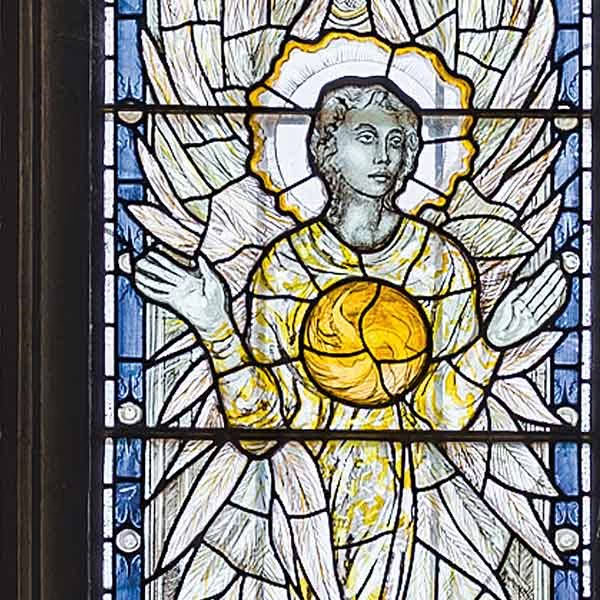
Alison Milbank: It’s a Norman cathedral with great big arches. And then at the west end, in the fifteenth century, somebody opened up a gigantic arched window – the stained glass had got lost probably in the Civil War when Cromwell was in the cathedral. But in 1996, they decided to commission a great window of angels, and it is now filled with glass that still lets all the light through. The angels are in greys and yellows with touches of green and blue, but the light comes pouring through as it should do through angels. We’ve got all the nine orders of angels in that window, and, as I said in my Plough article, when I stand with the other priests behind the altar looking at the congregation, behind them, I see all these hosts of angels, and the light pouring through on the congregation from the angels as if they’re being guarded and surrounded and led in their worship by the scores and scores of angels by Patrick Reyntiens. It’s modern, but it’s utterly beautiful. I shouldn’t have said “but.” And utterly beautiful.
Joy Marie Clarkson: I was going to say, isn’t it a sign of reasons to hope if there can be beautiful things that have been made to last recently? That sounds absolutely amazing, and it must be something to say “With angels and archangels and all the company of heaven,” and be able to see that pouring over the congregation.
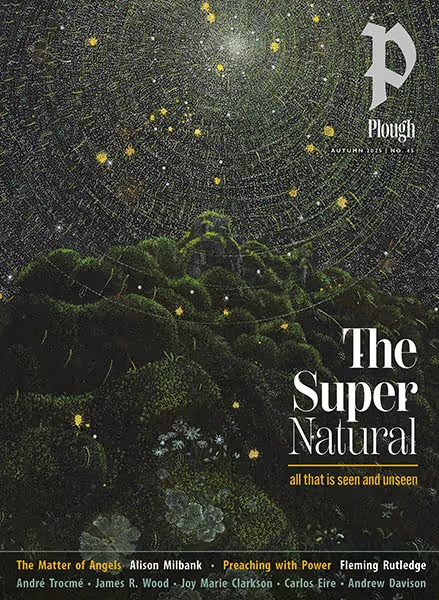
In The Supernatural issue, which was a few months ago now, you wrote about angels, and I guess this is another kind of indication of the world’s turn towards the spiritual, turn towards desire for another life. You wrote that – I can’t remember the exact numbers – but a shocking number of people in Britain and also in America believe in angels. Whether or not they believe in traditional Christianity or in God, they believe in angels. And you wrote about that, and then you discussed the role that angels play in the Christian scriptures. Could you say a little bit about what angels do and who they are in the scriptures?
Alison Milbank: Yes, it’s very clear that they are created beings, and they feature all the way through the scriptures from the Garden of Eden, the cherub guarding the gate, the burning bush. They enact God’s purposes; they’re part of the vision of God. Think of the living creatures of Daniel and Ezekiel. They rebuke people when donkeys see them and Balaam doesn’t. Then when you get to the New Testament, which was a big period of angelology in Judaism generally, they suddenly become all-important and particularly in the birth narratives. Angels speak to Joseph in Matthew, to the wise men, and obviously the angel Gabriel brings the news of the incarnation to Mary, and then they accompany Christ throughout his life. They’re with him in the wilderness; they minister to him with the wild beasts; and then in the Garden of Gethsemane, when he is at his lowest – he is sweating blood – the angels are with him. And of course, it is angels who announce the resurrection, and say that Christ is no longer in the tomb, and then point the disciples to heaven when Christ ascends.
You can’t take the angels out. They are really important, and although it might be the favorite thing for little girls to dress up nowadays at the Nativity play with their fluffy halos… Okay you can sentimentalize angels, but they are terribly important. They’re important as protectors and companions. Think of Raphael the Archangel accompanying the little boy Tobias when he goes to try and get something to heal his father. They look upon the face of God for the little ones, says Christ, so in some sense they’re our guardians. And they teach us to pray: “Holy, holy, holy,” as the seraphim sing to one another across the church in Isaiah. And certainly, there’s a big theology in the Anglican Church, particularly in the work of Richard Hooker in the sixteenth century, of angels taking our prayers to heaven and bringing us insight down from heaven, enabling us to join the heavenly worship. I could go on.
Joy Marie Clarkson: It’s wonderful. In an odd way, it draws me back to when you were talking about your pilgrimage and how you said that in your mental imagination, you hadn’t thought of trees. And it makes me realize that often in my imagination of especially the New Testament, when you said that about all the different points at which there are angels, I thought, “Well, of course, I know that. I have read the New Testament. I know in principle that the angels are there.” But somehow, they slip out of my imagination unless I bring them back in. Maybe that’s just a silly habit of mine. It’s almost like I’m demythologizing the narrative or secularizing it. But they are there, as you said, all throughout, acting as these messengers and these protectors. And I was going to ask you... I think something I will be doing after this conversation – we’re getting into Advent – is I want to meditate on the different angels in the story leading up to the Nativity. But I was wondering what difference do you think it makes for us to leave room for angels in our understanding of the world and in our daily lives, living and praying?
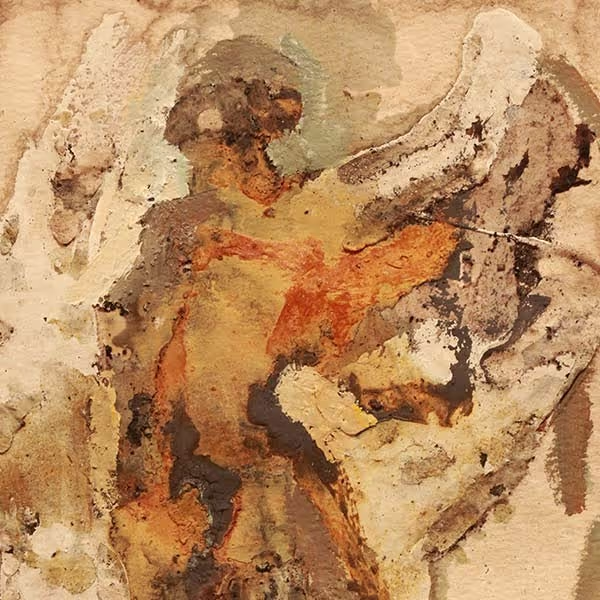
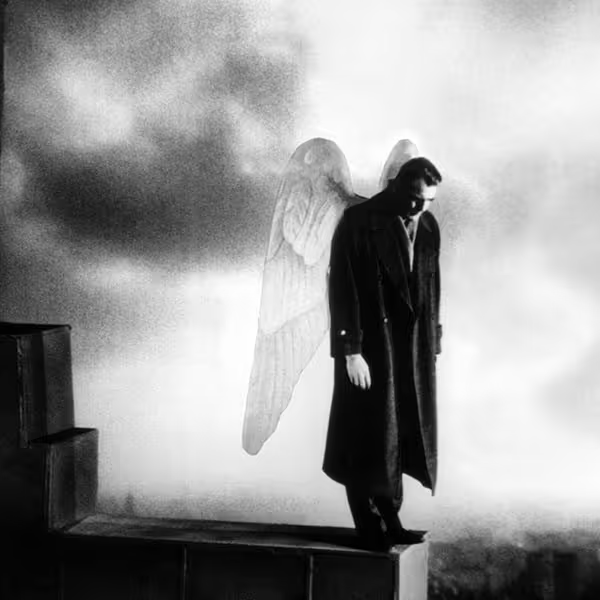
Alison Milbank: I think it makes us aware that the world isn’t empty, that the skies are not empty, that okay, angels may not occupy space, but they’re certainly present. We say in the Creed, all things visible and invisible, or seen and unseen. God creates more than just humans as conscious intelligences. We’re not alone. The heavens, the skies, the universe, the earth are full of angels. And I think that’s very important. And I also think it’s important because it says we’re not the only pebble on the cosmic beach. We’re not the center of everything. There are these awesome beings who are beyond our comprehension in one sense. And yet, conversely, we know things they don’t, according to the book of Hebrews: that we have bodies, and that is a blessing and a gift. They do not. I think all these differences and similarities are really helpful because they help us to meditate on the value of having a body. And yet the fact that humans are not the only beings apart from the physical creatures and plants that we know. And I think it’s very, very important to live in a friendly cosmos and also a decentered cosmos, which the angels help us to see. And I love the way that the most glorious vision of the angels in the Christmas story comes to the shepherds, to the ordinary shepherds out on the hills: glory to God in the highest, peace on earth. They get the whole choir to the poor old shepherds, whereas the wise men just get the dream vision angels to give them a bit of information.
And I love the meeting of Mary and the angel; it’s terribly important. Traditionally churches in Britain had the chancel arch which separates the two parts of the church. You’d have Mary on one side: you’d have the angel on the other. And of course, Christ incarnate between them, as it were, comes down, and we pass them as we go up to take communion in the front part of the church. And that’s the most beautiful exchange, a whole series of exchanges between an angel and a human, a kind of conversation. And it looks forward to the conversation that we will all have with the angels one day. I don’t know what form it will take but it will be there, a sacred conversation in heaven.
Joy Marie Clarkson: It makes me think of one of my favorite poems, which was important to me at a specific time in my life, which I’ll tell people to go read at some point, which is “The Annunciation” by Denise Levertov.
Alison Milbank: Oh, yes, that’s beautiful.
Joy Marie Clarkson: It’s beautiful. And it mostly focuses on Mary’s response. But I’ve always just loved it, and it always helped me enter into that moment of the angel coming to Mary.
Alison Milbank: When Christmas comes, there’s so much build up; there’s so much to do; everything is so busy. And yet what we need to prepare us for Christmas is an annunciation. So I would really recommend as a spiritual practice, reading that scene and imagining yourself as Mary.
Joy Marie Clarkson: Absolutely. I want to read this little bit from the end of the poem because it has always moved me so much. This is at the end of going back and forth between Mary and the angel. And then it says, she, being Mary, “She did not cry. ‘I cannot, I am not worthy,’ / Nor ‘I have not the strength.’ She did not submit with gritted teeth, / raging, coerced. / Bravest of all humans, / consent illumined her. / The room filled with its light, / the lily glowed in it, / and the iridescent wings. / Consent, / courage unparalleled, / opened her utterly.” So, if people need a way into imagining themselves as Mary, that is a poem I love very much.
Now, Alison, you’ve given us much to ponder, especially as we move into the Advent season. But I want to ask you, as we conclude, a question I ask all of our guests, which is: Is there something that helps you remember that another life is possible?
Alison Milbank: I have to take you into my kitchen, which has a ledge at the back of the oven. And on this ledge, I have my icon collection. I think if I was in an Orthodox home, you would have an icon corner, but in my house, they’re all lined up at the back of the stove, and I think of them as my... I once went to an Orthodox baptism, and after the baby had been baptized, the priest carried him up to the iconostasis – the big screen with all the icons. And she said: “There’s Mary, there’s Joseph, there’s James, there’s Mary Magdalene,” introducing him to his new Christian family. And if I’m ever forgetting that I live in a world of a cloud of witnesses, I just – I’m there at the stove an awful lot – I just look above the stove, and there they all are looking at me and offering me windows through which to look through to heaven.
Joy Marie Clarkson: That is beautiful. Thank you for sharing that. And thank you so much for joining us. I would encourage people to go look at the “Save the Parish” website if they’re interested and also to pick up something of Alison’s writing, which I always find both enlightening and insightful, but also very easy to read, very beautiful to read. So, thank you so much for joining me, Alison. This has been such a pleasure.
Alison Milbank: It’s wonderful, Joy. Thank you very much for having me.