




Subtotal: $
Checkout

Finding Faith on YouTube
Online discourse is shaping the faith experience of Gen Z Christians.
By Nathan Dufour Oglesby
January 2, 2026
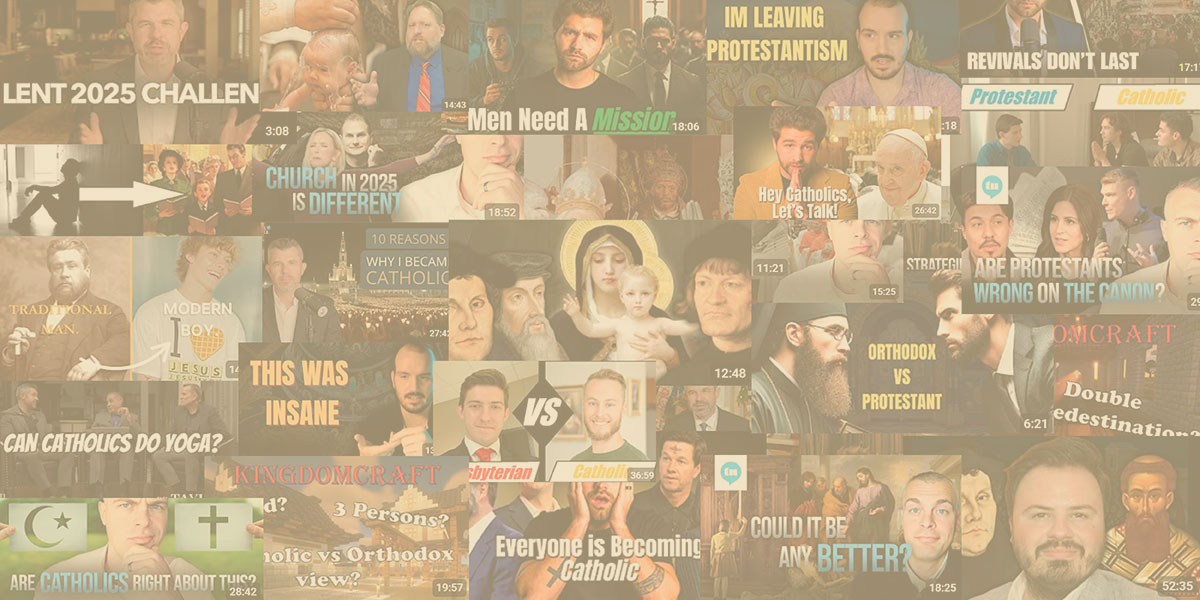
In idle moments, when I pick up my phone and open YouTube before even realizing I’m doing it, the first video recommended to me is usually something to do with Christian denominational apologetics. At the precise intersection of my sociological interests, spiritual commitments, and social media addiction, the YouTube algorithm has realized that nothing absorbs me more readily than listening to Catholic, Orthodox, and Protestant apologists debating points of dogma.
There is a whole flourishing genre here – videos in which Christians document their processes of denominational discernment, articulating their theological commitments and defending their traditions in digital space, with titles such as “10 Reasons Why I Became Catholic” or “7 Reasons Why I’m Still Protestant” or “The Real Reason I’m Leaving Non-Denominationalism.” It’s like watching the unfolding of many spiritual autobiographies at once in real time, but unlike Augustine’s Confessions or John Henry Newman’s Apologia Pro Vita Sua, social media is an ever-unfinished book.
Even as I’m writing, this online community is astir because the digital content creator @CleavetoAntiquity has just converted from Protestantism to Orthodoxy. As another creator, Gavin Ortlund, observes, surprise conversions like this elicit the same kind of avid commentary and emotional investment as a major trade in professional sports. It combines the thrill of having a team to root for, and in which to root one’s identity, with the existential gravitas of eternal salvation and ultimate concerns.
But one might ask (particularly if one is not a Christian or a theology nerd): Does any of this really matter? What difference does denominational identity even make today, when, as the usual narrative goes, religion is on the decline and the world hurtles forward into technological acceleration and political upheaval?
Clearly the stakes of denominational identity are not as high as they were during the Protestant Reformation, when a change from Protestant to Catholic, or Lutheran to Anabaptist, often carried life-or-death consequences in this world, and were thought to be a matter of salvation or damnation in the next. How shall we compare these conversions to the ones we see happening online? What claims do these denominational identities actually make on people’s lives? Are they not often a kind of performance in digital space, the kind that social media platforms are designed to produce and commodify? Are these conversions “real” or merely “virtual,” in both senses of that word?
These considerations are relevant, because digital discourse does in fact shape our world, both culturally and politically, and Christian identity is often at the center of it, especially in the United States. After Charlie Kirk’s assassination, many prominent Christian influencers eulogized and even sanctified him, and Kirk’s own social media rhetoric had deeply infused right-wing politics with Christian language. Meanwhile, the left wing in online apologetics sought to portray Kirk and his supporters as distorters of the faith. The very identity of “Christian” has become a sociopolitical battlefield, the front lines of which are ranged in digital space.
But while Christianity is often identified as one of the principal agents or tools of the culture war, there are aspects of the current renaissance in digital evangelization – and particularly this renewed interest in doctrinal debate and denominational identity – that may have the capacity to reorient Christians around matters of faith rather than politics. What if digital evangelization and the recovery of traditional forms of faith can actually ease the culture war instead of fomenting it?
At the outset, that may sound implausible. It’s hard not to be cynical about the current state of digital discourse, and suspicious of anything that comes out of it. The very phrase social media is oxymoronic, since these platforms appear to corrode social life more than they enhance it. For a Christian, one might say that this is precisely “the world” that one is supposed to “be not of.” Even Jonathan Haidt, in his secular book The Anxious Generation, speaks in a prophetic key of the “spiritual degradation” social media has wrought on Gen Z by relentlessly circumscribing the energy and attention requisite for genuine spiritual experience.
The recent phenomenon of digital evangelization has its own critics, with some calling into question the authenticity of its conversions. I’ve written critically about how online Catholicism can lapse into aestheticized and politicized caricatures of the faith. This is hardly new – Christianity didn’t wait for the internet to become ideological or to harden into self-aggrandizing and antagonistic identity structures; this has been a problem at least since Constantine. But in some ways this tendency is exacerbated by the structure of digital spaces that encourage users to curate and present themselves as brands.
Tara Isabella Burton’s Self-Made traces the evolution of modern culture’s impulse toward narcissistic self-making, the curation of self-as-product that effaces and replaces the worship of God. But in the world of digital denominationalism, religious identity itself becomes the content of self-commodification. This is legible even in usernames and handles, where the faithful present themselves as avatars of dogmatic positions and identities, like @GenZCatholic98, @AtheistTurnedOrthodox, or @BradTheTrad. (These are very slight edits of actual handles.) The very idea of a “handle” incites us not to simply be ourselves, but to be @ourselves, latched to a public display of our belief or form of belonging.
I can’t help wondering how Saint Paul would have handled this. I mean, literally, what would his handle have been? Would he have been @PaulTheApostle? Would he have run multiple accounts, appearing as @SaulThePharisee to the Jews, and @ApostleToTheGreeks to the Greeks (Rom. 1:16)?
Paul’s letters often emphasize the modular nature of identity in his evangelistic method: “I have become all things to all people, that I might by all means save some” (1 Cor. 9:22). His apostolic identity is explicitly not in the service of reifying a self, or constructing a brand with fixed content – rather, he is emphatically in the business of emptying himself (Phil. 2:7) and putting on Christ (Rom. 13:14). It’s not about creating an identity, but losing it.
In digital spaces, the dynamics of identity performance become inseparable from those of marketing and the economics of attention, incentivizing forms of “community” that aren’t about unity at all, but competition over market share: the more one can define a particular, curated Christian identity, the more one can secure and maintain a niche audience. Hence creators of various denominations tend to spend a great deal of time attacking not only those who are very far from them politically or theologically, but even those who are just one notch over to the left or right, or those who have a marginally different understanding of particular doctrines. Thus digital denominationalism, for all its communicative power in drawing converts, can have the effect of reducing popular theology to the narcissism of small differences.
But it would be rash to dismiss this informal online school of theology as inherently illegitimate; rather, it has to be understood in terms of the digital medium itself. After all, it is not just the primary instrument whereby young people are being converted; it is also a primary space in which their faith experience actually occurs. As Christopher B. Barnett observes in the recent Theological Discourses on Social Media, this is not just another medium, but a new place.
Jordan B. Cooper, a Lutheran minister and prominent YouTuber, asserts that the most powerful force in faith formation right now is not the clerical hierarchy of the churches themselves, nor the academic theologians writing papers in journals, but the legions of Christian content creators, whose message is inseparable from the medium in which they’re expressing it. Just as the printing press was not only a tool that the Reformation put to good use, but marked a moment that dramatically reshaped religious experience, so might our era of digital acceleration be remembered as a momentous period in the history of the church, one in which a new medium reshaped practice.
Through this lens, digital religiosity is more than mere performance: by refiguring traditional identities in a new context, it generates new and authentic religious meanings, operating within what some have called the “metamodern” – the nascent cultural phase in which we are moving beyond the postmodern tendencies of relativism, nihilism, and irony toward a reintegration of traditional forms of meaning, without losing the critical self-awareness that has characterized the postmodern age. And yet this reintegration is mediated by technologies that control it, in an environment engineered to shape cognition and behavior to a far greater degree than the printing press could in a previous era of religious upheaval.
Thus, Gen Z’s turn toward traditionalist and orthodox Christian identities can be read as a kind of counter-revolution against the chaos of the digital age, even while expressed in its defining medium and idiom. Growing up with access to virtually limitless information, and the overwhelming pluralism of values that comes with it, they begin naturally to yearn for some kind of limitation, to establish meaning, coherence, and authority. Thus, tradition becomes “cool” again, originating in online aesthetics and then exhibiting itself as a cultural phenomenon in real life. Much has been written, for instance, about the Neo-Trad Catholicism of New York’s Dimes Square, with its aesthetic fascination not only with traditionalist ritual but with political authoritarianism as well.
But the hunger for tradition, for forms of order and a definite identity, is not limited to identitarian performativity. In You Must Change Your Life, the German philosopher Peter Sloterdijk describes how a re-engagement with religion offers a coherent set of habits and practices as boundary conditions in an age of informational excess and consequent ethical incoherence. Similarly, in After Virtue, Alasdair MacIntyre emphasizes that ethical frameworks are not abstract systems derived from formal principles, but embedded cultural practices in a particular time and place – ethics and religion are always a function of a particular community.
All this points to an inherent difficulty in forming religious community online: the nature of the digital is that it bifurcates time and place – it offers an asynchronous form of community, where no one is experiencing quite the same thing at the same time or in the same context. In doing so, it breaks up the materially communal conditions, the soil, as it were, in which meaningful religious identity and practice have traditionally grown.
So the question is: Are young people who are looking for religious experiences finding that soil? Are they successfully transplanting from virtual to physical space? In other words, are they actually going to church?
Interestingly, the data do indicate that they are, with digital evangelization drawing new members into traditional forms of worship. A 2024 survey of Orthodox parishes in America shows a 78 percent increase in attendance since the pandemic, and some Catholic and nondenominational churches have also seen increases.
Mainline Protestant churches, meanwhile, remain in significant decline. And mainline Protestants tend to be less expressive of that identity online. But there are exceptions to this. Richard Ackerman, also known as Redeemed Zoomer, is a Jewish-born Presbyterian convert who has made the theology of denominational discernment the cornerstone of his content, amassing over 600,000 followers on YouTube and spawning numerous copycat channels that mimic his meme-inflected presentational style.
Unlike his Catholic and Orthodox counterparts, Ackerman is less concerned with converting people to his own denomination than with offering clear, if simplified, introductions to the major Christian traditions. His aim is not to create more Presbyterians, but to foster a broad theological orthodoxy as a way of resisting the political splintering of the church. He frames this as an effort to ground the faith of his contemporaries in theology rather than partisan identity politics. It is more important for Christians to affirm the Nicene Creed than for them to affirm a niche set of theological distinctives, let alone political ones.
As part of this project, Ackerman launched what he calls the “Protestant Reconquista,” an online movement dedicated to reinvigorating mainline Protestant churches along theological lines rather than political ones. The name is problematic – evoking the European Christian reconquering of Muslim Andalusia, with all its fraught cultural resonances – but in this it is much in keeping with the aesthetics of the online moment: self-consciously provocative, ironic yet sincere. Theologically conservative (his Instagram tagline reads “From Leftist to Christian”), he embraces various socially conservative positions while being avowedly economically progressive. What matters here is less the positions themselves than the fact that he arrives at them by virtue of theology, rather than arriving at his theology by virtue of his politics – and that his channel is bringing whole swaths of young people to that perspective.
While his theological framework rejects right-wing political appropriations of the faith, it also rejects liberal theologies that drift into universalism, syncretism, or pluralism. He is interested in restoring the Protestant mainline without insisting that its members vote a certain way or relitigating the theological schisms of the last several centuries. Ackerman holds that restoring coherent identity and community requires a definiteness that liberal theology and the “spiritual but not religious” struggle to provide. The scandal of Christ’s particularity, in all its historical concreteness, is what many young people seem to crave.
Despite its theological conservatism, the most striking aspect of Redeemed Zoomer’s rhetoric is its emphasis on unity, even amidst disagreement. This is exemplified by Ackerman’s response to the recent appointment of Sarah Mullaly as the first female Archbishop of Canterbury, which sent shockwaves through the Anglican Communion not only because of Mullaly’s gender but because of her perceived departures from theological orthodoxy. While many Anglican leaders have already hinted at the possibility of schism, Ackerman has vociferously exhorted the Anglicans in his audience not to break with Canterbury over this. Such a stance challenges the divisive norms of digital discourse – the idea that it matters more to be with than to agree with, and that consensus is less essential than communion.
“Conservatives have a big retreatism problem,” Ackerman told me recently, referring to their tendency to leave denominations that lurch left. “ It doesn’t help them, because they lose the institutional heritage. And it doesn’t help the liberals either, because their institutions just become museums.” If every disagreement becomes a cause for exodus, the church becomes an atomized array of ideological brands. As Ackerman describes it, it would be like if the prophet Isaiah, instead of protesting the injustices of the Kingdom of Judah from within it, “just split off and started Isaiah’s Free Bible Temple in the Desert.”
Such a double-sided critique is countercultural in the current conditions of discourse, both online and off. Christians often portray themselves as countercultural; for conservatives this means resisting the trends of liberal secularism, while for leftists it often means resisting capitalism and the authoritarian right. But what is truly countercultural in a culture of division is reconciliation, and the recognition that the transcendent aspects of our shared creed are more essential than the ways we differ in applying it to the political and moral questions of our media-saturated world.
On social media space or in a group chat, you can find people who agree with you about this or that theologian or the necessity of supporting, or denouncing, whatever the president has just said. But in your church – if you don’t go church shopping for an experience that echoes those group chats – you must worship alongside, and take communion with, people who may not agree with you about those things but do agree with you about the creed that you both gather there to profess. If you sit in the pews beside someone who voted differently yet shares that same creed, the ground is laid for common action in the here and now, in your parish, with the people beside you in the pews.
What kind of action will this be? A de-politicized Christianity cannot be completely apolitical, if it is transforming how people live their lives. If it’s real faith, there will be a real “cost of discipleship.” But the cost of discipleship shifts from age to age. In our age it is often paid socially. Perhaps the most immediate “cost” right now is losing the comfort of feeling “safe” in one’s ideological bubble as one steps out of the virtual and into physical, local, communal space: in the church right down your street, and in the everyday material conditions where sacramental life takes root.
In a sense, then, the most essential direction for Christian action is ecological: the local plane of soil, bodies, food, and waste – the material world from which our technologies estrange us. Just as we can imagine a less politicized religion, we can imagine a reorientation toward localism and embodiment, grounded in what Colin Pugh and I have called the “molecular postsecular,” a shift toward small communities, traditional faith, and a contemplative re-engagement with matter itself. Despite its hazards, digital dogmatics can supply an invitation to, and a liturgical framework for, this renewed encounter. Even if online identities begin as performative masks, they can also be the medium through which we can pass into a reintegrated form of religious belonging – from self-presentation into communal participation, and from simulated identity into sacramental life.

You have ${x} free ${w} remaining.
This is your last free article this month.
We hope you've enjoyed your free articles.
This article is reserved for subscribers.
Already a subscriber? Sign in
Try 3 months of unlimited access. Start your FREE TRIAL today. Cancel anytime.
Michael Nacrelli
Mullaly's departures from orthodoxy aren't merely "perceived." Nor are they minor. They're significant and undeniable. I can't agree with the notion that remaining in a denomination led by heretics is a spiritually prudent response.