The Weight of a Tender Conscience
Scrupulosity can be a gift, but there is a point where constant self-checking becomes a burden. Thankfully, our faith shows us a way out.
April 17, 2026
Try 3 months of unlimited access. Start your FREE TRIAL today. Cancel anytime.
START FREE TRIAL NOWThe Weight of a Tender Conscience
Scrupulosity can be a gift, but there is a point where constant self-checking becomes a burden. Thankfully, our faith shows us a way out.
[.article__paragraph--cap][.small-caps]There is an old rabbinic image[.small-caps] of a fence built around the Torah. The fence was meant to protect what mattered most. Over time, it grew more elaborate, more carefully maintained. Eventually, the fence prevented people from reaching the teaching it was meant to guard. The rabbis noted that what had begun as care had become an obstacle. They were warning against being too intent on doing the right thing. They knew devotion without discernment could wound rather than heal.[.article__paragraph--cap]
I recognize this danger because I have lived inside its logic for most of my life. I have known seasons when devotion narrowed into paralysis. Discernment tightened my chest and narrowed my vision. Every decision felt freighted with cosmic consequence, as if God’s will were a thin wire I might step off without knowing it. At other times, it showed up as the certainty that I had already failed, that I had missed something God wanted from me, and that I would never quite recover my footing.
One such season unfolded in college. I no longer remember the precise issue. I do remember the feeling. A question of obedience to biblical teaching would grab hold of me and refuse to let go. I would go back over the same ground, revisiting decisions, replaying motives, wondering whether I had missed something important before God.
At first, it felt like faithfulness. I was trying to be careful, to respond well, to not miss what was being asked of me. There was something good in that. But it was also constricting. After a while, I could not tell what counted as enough. The question continued to nag at me. Even a sense of peace began to feel suspect. I wasn’t trying to avoid obedience; I was trying so hard to be faithful that I no longer knew how to stop.
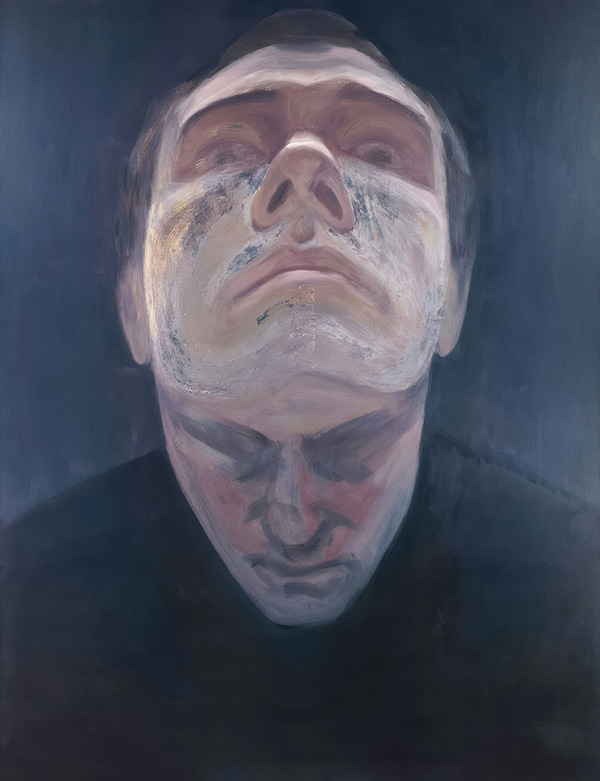
[.imgcaption]Jaan Toomik, Self-Portrait, oil on canvas, 2001. [.smalltext]Dual Usage: Unsplash License & Public Domain.[.smalltext][.imgcaption]
I took it to a professor I trusted, someone who listened patiently as I tried to explain my unease. When I finished, he sat quietly for a moment and then gently said, “Jason, I think you have a guilt complex. And I think you need to go with grace.” He named something I could not yet see clearly for myself. Years later, in seminary, I was meeting with the spiritual director who oversaw the formation program. Part of her role was to assess whether we were practicing the disciplines we were learning. I spoke openly with her about personal prayer, reading scripture, observing silence. The conversation felt good, even affirming. Then, almost casually, she leaned forward and said, “Jason, most of the time I encourage students to practice these things more. But not you. These are practices you have pressed yourself with for years. And I’m not sure that’s always been good for you.” She paused, then added, “So my word for you today is this: go with grace. Stop doing all the things. Go with grace. I believe God wants you to go with grace.”
Those two moments have stayed with me because they named a pattern that has echoed through much of my life: a tender conscience slowly overburdened, seriousness drifting into self-surveillance, devotion tightening until it could no longer breathe.
[.article__paragraph--cap][.small-caps]Our culture often praises scrupulosity.[.small-caps] We admire people who care deeply about right and wrong, who refuse to be careless with others. Scruples, in that sense, are a gift. But there is a point where fastidiousness turns on itself: conscience loses proportion, moral attentiveness turns inward and becomes relentless, the burden of responsibility swells until it crowds out trust.[.article__paragraph--cap]
Long before anyone had clinical language for this, monks were already warning about it. In the fourth century, Evagrius wrote that some thoughts sound holy but leave a person anxious and tight inside, and John Cassian noticed that practices meant to free the soul could become compulsions when they were driven by fear. He suggested a simple test: Does a practice widen the heart, or does it constrict it? Athanasius, a patriarch from the same era, went further, insisting that God has answered this dilemma by coming close enough to heal those wounded by the fear of doing wrong. The Incarnation, in his telling, is an act of restoration, not surveillance. God moves toward humanity to heal what has been fractured.
Ignatius of Loyola knew the danger of scruples firsthand. After his conversion in 1521, he found himself trapped in cycles of confession and self-examination, unable to rest in forgiveness. What eventually freed him was learning to discern the fruit of a thought rather than its tone. Thoughts that led toward courage, generosity, and trust were to be received. Thoughts that led toward paralysis and dread were not. Ignatius learned the hard way that fear can borrow the language of devotion.
Great literature traces the same fault line. Hawthorne’s Arthur Dimmesdale is undone not by indifference, but by a conscience that cannot receive mercy. Dostoyevsky’s characters circle themselves endlessly until confession and relationship interrupt the closed system of self-judgment. Again and again, writers have shown us the cost of a conscience cut loose from grace.
[.article__paragraph--cap][.small-caps]I now know what my body[.small-caps] has been trying to tell me all along. A person can live in an unhealthy state of constant self-checking while calling it faithfulness. Over time, joy thins and enthusiasm fades.[.article__paragraph--cap]
I am not suggesting that one’s conscience is the enemy. But if one is going to live with integrity and find wholeness, the conscience needs a larger home. A life can hold seriousness and mercy together. One can know when attention is needed and when rest is faithful. One can act with care without endlessly auditing oneself.
I have met too many people who only discovered this after years of exhaustion or quiet despair. Many do not lose faith because they cared too little, but because they cared so much that they ended up carrying more than a human can bear. What they needed was permission to stop trying so hard, and someone to help them discern the difference between fruitful obedience and anxious scrupulosity.
The Jewish and Christian traditions offer that wisdom. It appears in rabbinic warnings about fences, in the words of monks who learned to test piety by its fruit, in novels that trace the cost of an unchecked conscience, in spiritual directors who, at just the right moment, say, “Go with grace.”
After years of incessant self-checking, I have found a steadier truth waiting to be trusted: God’s order is not fragile, love does not require perpetual proof, and true faithfulness leaves one room to breathe. And I have found that when the soul is no longer under surveillance, it becomes more attentive, responsive, and alive.