The Flaming Heart of Danko
In this Russian legend, a young man sacrifices his life to save his people.
February 19, 2026
Try 3 months of unlimited access. Start your FREE TRIAL today. Cancel anytime.
START FREE TRIAL NOW
[.smalltext] This short story, translated by A. S. Rappoport, is from Easter Stories: Classic Tales for the Holy Season , this week’s featured book [.smalltext] [.smalltext] . [.smalltext]
[.article__paragraph--cap] [.small-caps] It was beside the sea, [.small-caps] near Akkerman in Bessarabia, that I heard the following tale from the old woman Izergil. She was drowsing off, nodding her head and whispering something, softly, very softly … perhaps a prayer.[.article__paragraph--cap]
Dark, heavy, gloomy-looking clouds were rising over the sea, looking like a chain of mountains. They were travelling slowly towards the steppe. Fragments broke away from the summit and, flying forward, hid the stars in succession. The sea was murmuring. Close to us among the green vines there was kissing, and whispering, and sighing. A dog howled in the distance, far away across the steppe. The air became stifling, and some curious odor assailed one’s nostrils and irritated the nerves. Flights of shadows thrown by the clouds passed slowly over the earth, disappearing only to make room for others. The moon was almost hidden; nothing but a patch of dull opal filled its place, over which from time to time swept a ragged blue-black cloud. Far off on the horizon, where the steppe had grown dark and terrible, as if hiding some fearful mystery, little blue flames kept shooting up. They shone for a moment, first here, then there, and then disappeared, as if there were men wandering far apart from one another about the steppe looking for something with matches, which they had no sooner lighted than the wind blew them out. They were curious, these blue flames, with their fantastic little gleaming lights.

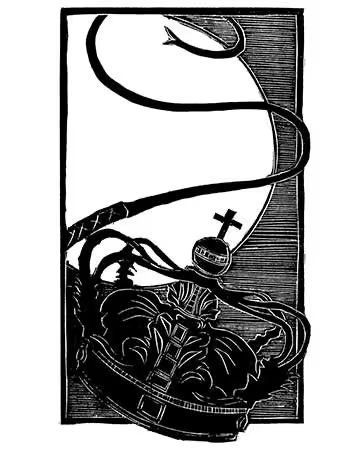
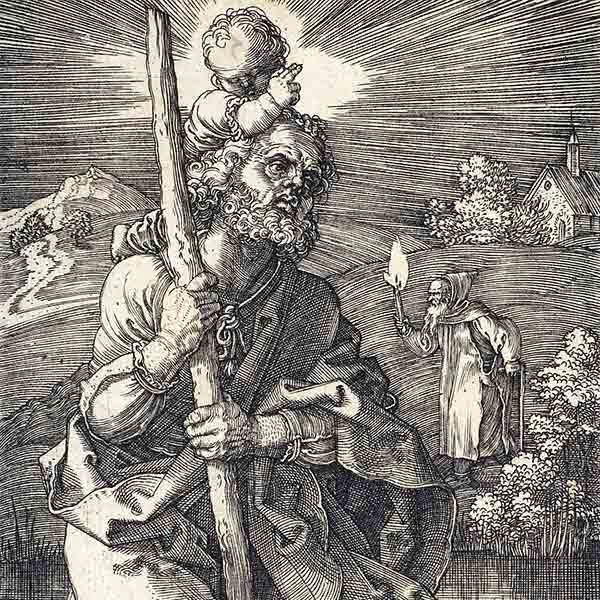
[.imgcaption] Lisa Toth, Woodcut [.imgcaption]
“Do you see those sparks?” asked Izergil.
“The blue sparks over there?” I said, pointing towards the steppe.
“Yes, those blue sparks, those are the ones. So they are still flying about … but I can no longer see them. There are many things now which I cannot see.”
“Where do they come from, those little flames?” I asked her.
I had been told something once about the origin of these sparks, but I wanted to hear what Izergil had to say upon the subject.
She looked at me, then replied:
[.blockquote] Those sparks come from Danko’s burning heart. There was once a heart that caught fire … and those sparks flew from it. I will tell you all about it … It is another old tale. Everything is old – everything. You see how many things happened in the past … Now there is nothing, neither deeds, nor men, nor tales such as we had in the old days. And why? Tell me that … But you are not able. What do you know? What do any of you young ones know? Well, well!… Keep your eye fixed on the times that are past; it is there only that you will find the answer to the riddle, the meaning of everything. [.blockquote]
[.blockquote] But you do not care to learn about old times, and that is why you do not understand life… But I, do not I know it? Yes, I understand it, and I see everything, although my eyes are old and weak. I can see that men now do not really live, that they do nothing more than just accommodate themselves to existence, exhausting all their strength merely on this, and then, having robbed themselves and spent their time in this useless fashion, they begin to rail at destiny. Everyone is master of his own fate! I see plenty of men nowadays, but I see no strong men. Where are they gone to? Handsome men are becoming rarer and rarer. [.blockquote]
The old woman went on asking herself why there were now so few strong and handsome men, and as she meditated on the matter, she looked out over the dark steppe as if seeking a reply.
I was waiting for her tale, and I said nothing, fearing to make any remark that might turn her from the subject we were now upon. I was aware that when she embarked on the stormy sea of her own memories she grew philosophical, and it often happened that some legend or other became lost in the labyrinth of this philosophy. It was a very simple and liberal philosophy; but when old Izergil was expounding it, one could only think of a strange ball of many-colored threads which had become cunningly entangled by the hand of time.
She began again:
[.blockquote] In the good old days there were men living in the world, I cannot say exactly where, I only know that their dwelling place was surrounded by huge, impenetrable forests, and that one side opened onto the steppe. They were free, lighthearted, powerful men, who wanted nothing. But at last a great trouble fell upon them. Other races of people arrived and drove the first settlers away into the depths of the forest. There all was darkness and swamp, for the trees were so old that their thick branches had grown interlaced, hiding the sky above them, so that the sun’s rays could hardly penetrate through the solid screen of foliage. When by chance they touched the stagnant water of the marsh, the exhalation was so poisonous that the people died one after another. The women and children began to lament, and became sad and thoughtful. It was evident that they must leave the forest. [.blockquote]
[.blockquote] There were two ways of exit to choose from: one led back to where their strong and cruel enemies were stationed; the other, which led forward, was overgrown by the enormous forest trees barring the road with their solid network of boughs and their knotted roots, which struck deep into the sticky mud of the swamp. A kind of twilight reigned throughout the forest during the day; the trees reared their mighty forms, silent and motionless, like giants of stone. At night, when the men lit their fires, the encircling trees seemed to draw even more closely around them, threatening, it appeared, to fall and crush these free creatures, accustomed to the splendid immensity of the steppe. [.blockquote]
[.blockquote] It was more terrible still when the tops of these colossal figures were shaken by the storm, and the forest resounded with menacing voices that rang like the funeral dirge of the men who had taken refuge there – and yet they were strong men who might well have fought to the death with those who had vanquished them; they had, however, been forbidden to die in battle, for they were the guardians of certain sacred precepts which would be lost forever when they died – and so it was that they lingered on there, in a dreamy state of existence, through the long nights, amid the smothered murmurs of the forest and the empoisoned air of the swamp. There they remained, the shadows thrown by their fires leaping around them in silent fantastic dance; and at times it seemed to the men that they were not merely shadows, but rather the evil spirits of the forest and swamp celebrating their triumph. And so the men spoke little, and sat on, thinking. [.blockquote]
[.blockquote] There is nothing, not even work, or women, which so exhausts body and soul as unquiet thoughts that suck the heart’s blood like a vampire. This perpetual state of meditation robbed them of their vitality. They became prey to a terror which made their strong hands helpless; and the terror took possession of the women as they wept over the bodies of the men who had been killed by the infectious air, and over the living ones enslaved by fear. [.blockquote]
[.blockquote] Words of dread and apprehension began to be whispered about the forest, at first timid and hardly audible, but then louder. The men were proposing to go straight to the enemy and offer themselves and their own wills in homage, for the thought of slavery no longer appalled them. [.blockquote]
[.blockquote] Then Danko appeared, and single-handedly saved the whole tribe. [.blockquote]
The old woman spoke much of Danko’s flaming heart; her sentences followed one another with a rhythm that suggested long, self-coloured ribbons, unwinding themselves like a drawn-out melody, while in her dull, harsh voice I seemed to hear the shuddering of the forest, in the midst of which the unhappy exiles had succumbed to the poisonous atmosphere. She went on:
[.blockquote] Danko – one of the men – was young and handsome. Handsome men are always courageous, and addressing his companions he said: [.blockquote]
[.blockquote] “Thinking alone will not even move a stone out of the path. Nothing ever comes to him who does nothing. Why do we waste our energy in weeping? Rise – let us be going!” [.blockquote]
[.blockquote] “Rise – let us go straight away into the forest and force our way through! It is not without limits! Everything in this world has an end! See now! Let us be going!” [.blockquote]
[.blockquote] The men looked at him. They recognized his authority, for his eyes were alight with a fire of strength and determination. [.blockquote]
[.blockquote] “Lead us,” they said. [.blockquote]
[.blockquote] And he led them on. [.blockquote]
The old woman paused, gazing in the direction of the steppe where the shadows were deepening. The sparks from Danko’s flaming heart could be seen in the distance, like blue aerial flowers blooming for the space of a moment. Then she resumed her story:
[.blockquote] Danko put himself at their head. They followed him in a body; they had perfect confidence in him. But the way was indeed difficult! There, amid the darkness, the swamp opened its hungry, fetid jaws to swallow them, and every step of the way was won with sweat and blood. So they went on for a long, long time. [.blockquote]
[.blockquote] The forest grew thicker as the men’s strength became less! They began to murmur against Danko, saying that he was young, inexperienced, and that he had done wrong to drag them along like this. And he, quiet and courageous, still marched ahead and led them on. [.blockquote]
[.blockquote] One day a fearful storm broke over the forest; a low and terrible sound crept up among the trees. The forest grew dark, as if all the nights that had been since the world began were reassembled within it. The men marched on under the gigantic trees like pygmies amid the hideous roar of the tempest, while the trees tore the air with their evil voices and the cold blue glare of the lightning lit up the forest at intervals, filling the hearts of the cowering men with dread. The trees seemed to start into life as the cold fire fell on them; they stretched forth their long, gaunt hands as if to keep back these men who were trying to escape from the bondage of darkness. The men, worn out with their efforts, began to lose courage. They were ashamed, however, to confess their weakness. [.blockquote]
[.blockquote] And now, all at once, they fell upon Danko – on the man who was guiding them! They began to reproach him with his incapacity. [.blockquote]
[.blockquote] “You! You are a good-for-nothing and harmful man! You have dragged us here, and we are dead with fatigue; you shall die for it!” [.blockquote]
[.blockquote] And the thunder and lightning added emphasis to their words. [.blockquote]
[.blockquote] Danko looked at the people for whom he had sacrificed himself and saw that they were as the brute beasts. He looked at the men who were crowding round him; there was no nobility on their faces, no hope, as he saw, that he would meet with mercy at their hands. His indignation rose, but out of pity for his brothers he held it in check. He would meet with no mercy at their hands. Yet he loved these men, and without his help he feared that they would perish. [.blockquote]
[.blockquote] Then his heart grew aflame with the desire to save them, and the vivid light of that flame leaped into his eyes. And they, seeing this, thought that he was furious with anger. They rose like wolves, believing that he was going to fight them, and drew round him in a circle, that they might get better hold of him to kill him. But he had already read their souls, and his heart burnt with a fiercer fire, for their suspicious thoughts filled him with sorrow. [.blockquote]
[.blockquote] And still the forest chanted its mournful dirge, and still the thunder roared and the rain rattled. [.blockquote]
[.blockquote] “What shall I do for these men?” Danko cried in a voice that rang louder than the thunder. And he rent open his chest with his two hands, tore out his heart, and held it up high over his head. [.blockquote]
[.blockquote] And the flaming heart blazed with a light more dazzling than that of the sun. [.blockquote]
[.blockquote] Then the forest depths, illumined by this torch of supreme love for man, grew silent. The shadows fled trembling from before this aurora, driven into the far corners of the forest, into the jaws of the poisonous swamp. The men stood dumb with astonishment, as if turned to stone. [.blockquote]
[.blockquote] “Forward!” cried Danko, rushing onward as he held aloft his flaming heart to light the road. [.blockquote]
[.blockquote] They threw themselves after him, full of ecstasy and wonder. The trees shook their leafy summits with astonishment, and again the forest became full of sound, but now it was covered by that of the tramping of the men’s feet. They marched along, inspired with courage, lead on by the marvelous spectacle of the flaming heart. [.blockquote]
[.blockquote] And suddenly the forest in front opened. Mute and impenetrable, it now lay at last behind him. Danko and his companions found themselves plunging into a vast sea of light and pure air, washed by the rain. The storm still hung over the forest, but here around them was the warm light of the sun, the grass sprinkled with bright diamonds of rain, while the river sparkled gold as it glided along. It was evening, and as the rays of the setting sun fell on the water, it ran crimson like the blood that flowed from Danko’s torn chest. [.blockquote]
[.blockquote] The dying Danko, proud and fearless, cast a look of joy before him over the immensity of the steppe – over that land of liberty that rolled away on either side; then with one last smile, he fell and breathed his last. [.blockquote]
[.blockquote] The wondering trees looking on from behind whispered softly among themselves, and the grass, wet with Danko’s blood, made answer to them. [.blockquote]
[.blockquote] And the people, full of joy and hope, did not even notice that their leader was dead; they did not see that his heart was still burning brightly beside his body. One man alone, perceiving this, and seized with some feeling of fear, put his foot on the proud heart. The flame broke into a shower of sparks and went out. [.blockquote]
And these are the blue sparks which you see over the steppe before a storm breaks!
As the old woman finished her beautiful tale, a terrifying silence fell upon the steppe, as if it too had been struck dumb by this deed of the courageous Danko, who had allowed his heart to burn away for the love of his fellow men and had died asking for no return. The old woman, slumbering and shivering at intervals, was leaning back against the baskets which were piled with grapes. I looked at her and thought of all the tales and of all the recollections with which her memory must be filled. I thought of Danko's flaming heart, and of the curious, imaginative power in man that had created so many fine and charming legends of the old times with their heroes and wonderful deeds, of the sad times in which we were living, so poor in men of power and in great events, so rich in the cynical contempt that mocks at everything – unhappy times, with their swarms of miserable men, whose hearts were only half alive …
The wind blew, lifting the rags that covered the shrunken bosom of the old woman, whose sleep grew more and more profound. I drew the garments over her aged form, and lay down myself beside her on the ground. The steppe was wrapped in gloom and silence. The clouds slowly and mournfully dragged themselves across the sky, while the sea murmured low and plaintively. And still old Izergil slept on …
It was possible she might never wake again.