Seventy-Five Years of Narnia
When he bares his teeth, winter meets its death, And when he shakes his mane, we shall have spring again.
December 30, 2025
Try 3 months of unlimited access. Start your FREE TRIAL today. Cancel anytime.
START FREE TRIAL NOW
[.article__paragraph--cap] [.small-caps] The year 2025 marks [.small-caps] the 75 th anniversary of the publication of one of the most successful children’s books of all time: The Lion, the Witch and the Wardrobe by C. S. Lewis, the first volume in his seven-book series, the Chronicles of Narnia. It has been translated into over forty languages, has been adapted numerous times for cinema, stage, television, and radio, and every year still ranks as a global bestselling title in the fantasy genre.[.article__paragraph--cap]
“It all began with a picture.” That is how Lewis describes the origin of this classic tale. The whole imaginative process “began with a picture of a faun carrying an umbrella and parcels in a snowy wood.” This picture had been in his mind’s eye since he was about sixteen years old. One day, when he was about fifty, he said to himself, “Let’s try to make a story about it” (“It all began with a picture,” Radio Times , 1960).
At first, he wasn’t sure how the story would go and, at that early stage, “there wasn’t even anything Christian” about the picture in his head. Other pictures gradually presented themselves to his mind. Lewis said the process was a bit like birdwatching; every now and again a new one would fly into view.
These other pictures included “a queen on a sledge” and “a magnificent lion.” Slowly they sorted themselves into a sequence of events, a story. However, things were still rather formless, like fruit bubbling in a saucepan as you make jam, Lewis said. And then, all of a sudden, “Aslan came bounding into it” and once Aslan arrived, he “pulled the whole story together.”
It was obviously important to Lewis that the different parts of the story come together in a coherent and satisfying manner. But how does Aslan, the leonine ruler of Narnia, pull the different parts together and why was Lewis so interested in this picture of a faun in a snowy wood carrying an umbrella and parcels?
[.article__paragraph--cap] [.small-caps] I believe we will find answers [.small-caps] to these questions if we consider the symbolism of the planet Jupiter. Jupiter, or Jove, was a spiritual symbol that Lewis admired throughout his life. He did not literally believe in the seven heavens of the medieval cosmos and their astrological influences, but he certainly admired the poetical use to which such symbolism could be put. “The characters of the planets, as conceived by medieval astrology, seem to me to have a permanent value as spiritual symbols,” he wrote in 1935, fifteen years before the publication of The Lion, the Witch and the Wardrobe . He then asked, “Who does not need to be reminded of Jove?” (“A Metrical Suggestion,” Lysistrata , 1935). When we read this first Narnia Chronicle through a Jovial lens, it suddenly springs into focus.[.article__paragraph--cap]
Jupiter, according to Lewis’s poem “The Planets,” makes people “lion-hearted” and brings about “winter passed and guilt forgiven.” Sound familiar?
The White Witch has made it “always winter.” Her kingdom of ice and snow is a curse, a tyranny. This is not a winter wonderland but the perpetual freeze of death. And almost always in Lewis’s works when winter comes, Jupiter can’t be far behind. It is not just in “The Planets” poem that Lewis shows Jupiter destroying winter. In his academic book The Allegory of Love , Jupiter brings about “winter overgone” and in his novel That Hideous Strength , Jupiter’s influence descends upon Earth and does away with “freezing wastes,” “numbing weight,” and “unendurable cold.”
So, when Lewis says that he had in his mind a picture of a snowy wood, we ought to be ready for Jupiter to show up and make this wintry landscape summery. Lewis’s imagination almost never treats winter as a good thing. It is nearly always a symbol of evils such as fear, moral decay, and guilty sorrow.
And the interesting thing is that the picture in his mind’s eye actually suggests the evil nature of winter even before Lewis began turning it into a story. The faun is carrying an umbrella. He is trying to protect himself from the snow. He is not larking about, throwing snowballs, building snowmen and letting snowflakes fall on his eyelashes. This wintry wood is ominous and threatening. There is hardly anything beautiful about it.
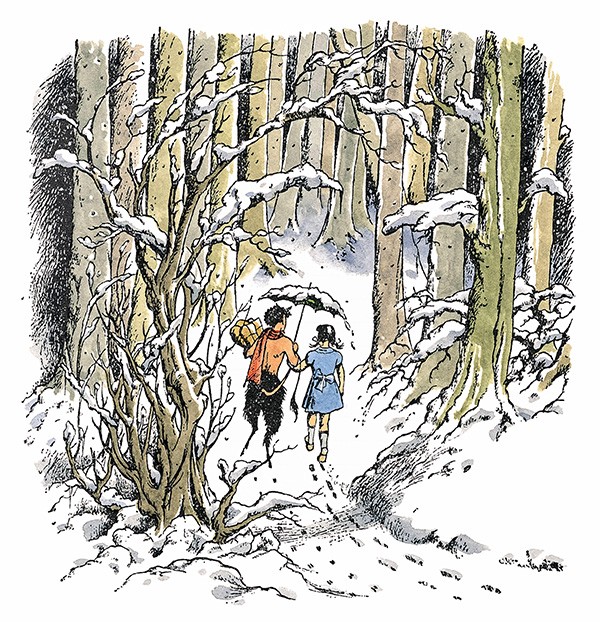
[.imgcaption] Pauline Baynes, Illustration of Mr. Tumnus the Faun with Lucy Pevensie from the 1950 edition of The Lion, the Witch and the Wardrobe by C.S. Lewis. [.smalltext] Pauline Baynes / HarperCollins Publishers / AF Fotografie / Alamy Stock. [.smalltext] [.imgcaption]
When Lewis began to turn this picture into a story he drew out these meanings of doom and fear. The unnamed faun in the mental picture became, of course, Mr. Tumnus, who is worried about catching cold; the winter makes him gloomy; he has “a melancholy voice.” He is anxious to hold the umbrella over Lucy to protect her from the winter too. He is sad because it is “always winter and never Christmas.” The parcels that he carries are presumably Christmas parcels – but he won’t be able to open them because Christmas has been banned by the White Witch. If he complains to the Witch about this he will be turned to stone.
Still, he hasn’t given up hope. He longs for the old days of jollification. “Jollification” is a very important word in this context because jollity and joviality are associated with Jupiter. In Gustav Holst’s musical masterpiece, The Planets Suite , there is a movement entitled “Jupiter, the Bringer of Jollity.” Lewis knew and loved Holst’s Planets . He described it as a rich and marvelous work that moved him greatly.
In The Lion, the Witch and the Wardrobe , Jupiter’s influence produces jollity as winter finally passes and summer comes in. January turns to May. Festivity and revelry replace fear and freezing. Aslan, who sums up the Jovial spirit in his own person, is the means by which this influence makes its presence felt:
[.blockquote] When he bares his teeth, winter meets its death,
And when he shakes his mane, we shall have spring again. [.blockquote]
Aslan is responsible not only for the passing of winter and the coming of jollity; he is also “the king.” Why? Because Jupiter was “the king of the planets,” the sovereign power of the seven heavens. Kingship, in fact, was Jupiter’s main quality, and doubt over who is to be the sovereign of Narnia is therefore the main question driving the plot of this story. Is the land going to be ruled by Aslan, the king of the wood, or by the Witch, the self-styled “Empress of Narnia.”
Here it will be helpful to take a look at the first mention of Aslan. Introductory descriptions are always especially important in setting the keynote of a story. At the first mention of Aslan, the children don’t know who he is, but Mr. Beaver tells them, “He’s the King.” And a few moments later, in case they haven’t understood, he tells them again that Aslan “is the King of the wood and the son of the great Emperor-Beyond-the-Sea. Don’t you know who is the King of Beasts?”
Aslan is “the true king” who has a “crown” and a “standard.” He is “royal, solemn,” “royal and strong,” with a “great, royal head.” Interestingly, he is never again, in any of the other Narnia Chronicles, described as “royal,” because in those stories different planetary symbols are at work. Here, Lewis is keen to emphasize the fact that Aslan is a royal personage because he is wanting to immerse us in Jupiter’s symbolism, which he had explored so thoroughly in his academic works as a medieval literary historian. For instance, in The Discarded Image , Lewis writes that the influence of Jupiter “is Kingly, but we must think of a King at peace, enthroned, taking his leisure, serene.”
And not only is Aslan’s kingship emphasized; so is that of the two boys, Peter and Edmund. The story is really a clash of kingship between these brothers. Who is going to become High King of Narnia? Will it be Peter, under Aslan, or will it be Edmund under the White Witch?
The Witch has ensnared Edmund with her declaration that she wants a boy “who would be King of Narnia after I am gone,” and soon after that she promises him, “You are to be the Prince and – later on – the King.” Edmund is convinced this is his destiny; he “wanted to be Prince (and later a King)”; he thinks “about Turkish Delight and about being a King” and resolves to “make some decent roads” when “I’m King of Narnia”; this “set him off thinking about being a King.” Eventually he realizes that “it didn’t look now as if the Witch intended to make him King” (she is holding a knife to his throat at this point), and out of nowhere, so it seems, Father Christmas appears, shouting, “Long live the true King!”
The true King is Aslan and he has his own plans for the four children. Aslan shows Peter “the castle where you are to be King” and the four thrones “in one of which you must sit as King … you will be High King over all the rest.” Of course, it turns out that all four children, including Edmund, are crowned at the end of the story, but only after Aslan has demonstrated true kingship in his self-sacrifice for Edmund’s sake.
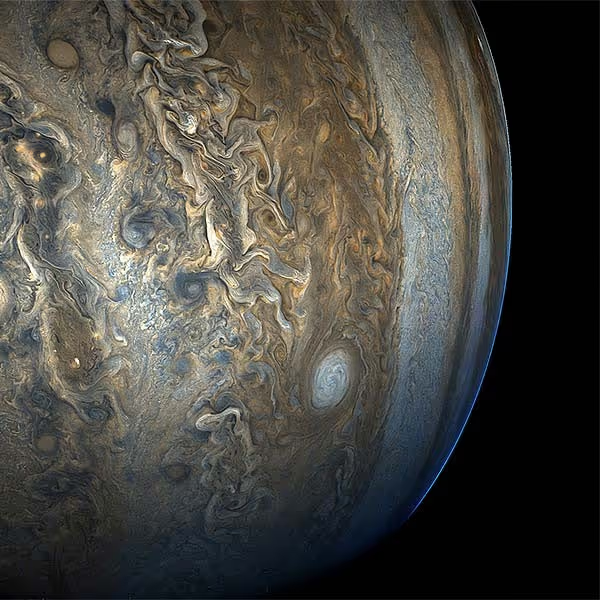
And this sacrifice is also, intriguingly, yet another feature of Jupiter’s character. Lewis’s great friend, Charles Williams, once wrote a poem that mentioned “Jupiter’s red-pierced planet.” He was referring to the Great Red Spot which astronomers observe on the surface of Jupiter. It’s a huge storm, wider than the diameter of Earth, which Williams imagined as a bleeding wound. Lewis, commenting on this poem, remarks that “Jupiter, the planet of Kingship, thus wounded” becomes a reflection of “the Divine King wounded on Calvary” ( Arthurian Torso , 1948).
Thanks to Williams, Lewis had a specific reason to link Jupiter with the sacrifice of Christ on the cross at Calvary. And of course, it’s this sacrifice that reappears in Narnia when Aslan dies on the Stone Table, thus saving Edmund’s life so that all four thrones in the castle of Cair Paravel can be occupied by the Pevensie children.
Their grand coronation is the climax of the story and the high point of the kingly theme. Aslan has suffered and died. Like Jesus, who wore a crown of thorns and was hailed as “king of the Jews,” Aslan shows his true kingly nature in bleeding and dying for Edmund’s sake. As a result, he gains authority even over death and so becomes able to crown the children and restore true sovereignty to Narnia. He declares to them, “Once a king in Narnia, always a king in Narnia. Once a queen in Narnia, always a queen in Narnia.” This glorious scene is what the whole tale has been leading to:
[.blockquote] In the Great Hall of Cair Paravel – that wonderful hall with the ivory roof and the west wall hung with peacock’s feathers and the eastern door which looks towards the sea, in the presence of all their friends and to the sound of trumpets, Aslan solemnly crowned them and led them to the four thrones amid deafening shouts of “Long Live King Peter! Long Live Queen Susan! Long Live King Edmund! Long Live Queen Lucy!” … So the children sat on their thrones and scepters were put into their hands. … And that night there was a great feast …and revelry and dancing, and gold flashed and wine flowed. [.blockquote]
We can see, from Lewis’s other works, that feasting, kingship, jollity, the passing of winter, and the sacrifice of Christ on the cross are all linked in his mind via the symbolism of Jupiter. Can we really think it’s just a coincidence that all these things should also appear together, and so prominently, in this first Narnia tale?
If any doubt remains, it should be dispelled by considering the character of Father Christmas. Many critics have complained about Father Christmas appearing in this story. How can the people of Narnia know of “Christmas” when they show no knowledge of a character called “Christ”? It looks like a mistake.
However, if Lewis was indeed writing his first Narnia Chronicle in order to express Jove’s spirit, the Jovial personality, we can see why he was so keen to keep Father Christmas in the story, even though, on the face of it, he doesn’t belong there. As Lewis wrote elsewhere:
[.blockquote] A supreme workman will never break by one note or one syllable or one stroke of the brush the living and inward law of the work he is producing. But he will break without scruple any number of those superficial regularities and orthodoxies which little, unimaginative critics mistake for its laws. ( Miracles, A Preliminary Study , 1947) [.blockquote]
Sometimes a storyteller will do what seems illogical on the surface because he knows of a deeper logic going on underneath. If readers haven’t grasped the real and inward significance of the work as a whole” then this illogical thing will look like “a mere botch or failure of unity.”
Once we see that Jupiter’s imagery provides the “inward significance” of this story, we will see that Father Christmas is not a botch, but something quite the contrary. He helps crystallize the atmosphere that Lewis is attempting to conjure. Father Christmas, red-faced, loud-voiced, and jolly, is the nearest thing we have to the jovial personality in popular modern culture. His gladdeningly red cheeks and his bright red robe (“bright as holly-berries”) are entirely within the spirit of the work.
In his university lectures at Oxford, Lewis used to describe the jovial character as “cheerful and festive; those born under Jupiter are apt to be loud-voiced and red-faced.” He would then pause and add: “It is obvious under which planet I was born!” – which always produced a laugh because that description fitted him to a tee ( C. S. Lewis: A Biography , Roger Lancelyn Green and Walter Hooper, 1974). With his rubicund features, deep voice, and hearty laugh, Lewis resembled a prosperous farmer more than a professor. Lots of people who knew him described his personality as jovial, not always knowing the significance the term had for him. Peter Milward, who attended Lewis’s lectures at Oxford, emphasizes his “sturdily jovial manner,” and goes on to make an important connection: “he was indeed a . . . jovial man; and these qualities of his I later recognized . . . in his character of the kingly animal, Aslan” ( A Challenge to C. S. Lewis , Peter Milward, 1995).
Aslan, Narnia’s redeemer, brings us back to Christmas and the birth of the infant Jesus. In early January 1953, Lewis wrote to a friend remarking on what he had seen in the night sky during the recent festivities: “It was beautiful, on two or three successive nights about the Holy Time, to see Venus and Jove blazing at one another, once with the Moon right between them: Majesty and Love linked by Virginity – what could be more appropriate?” (Letter to Ruth Pitter, January 2, 1953). Venus signifies love and the Moon signifies virginity. Jupiter signifies majesty and kingliness and, as such, was in Lewis’s view a highly suitable symbol for Christ the “king of kings” (Rev. 19:16). In attempting to read the significance of the Christmas stars, Lewis was modeling himself on the magi, the wise men who follow the star from the east and come to Herod asking, “Where is he that has been born King of the Jews?” (Matt. 2:2). It is to be expected that the stars speak of Christ, for “the heavens are telling the glory of God” (Ps. 19:1; cf. Rom. 10:18). Lewis describes the nineteenth psalm as “the greatest poem in the psalter and one of the greatest lyrics in the world” ( Reflections on the Psalms , 1961).
In this light, we can better understand what he was up to in The Lion, the Witch and the Wardrobe . He was portraying a world in which there is a harmony between Christ and the cosmos, because the same spiritual symbol informs both. The children in the story can look at Aslan, the kingly lion with his great royal head, who bleeds to bring about Edmund’s rescue. But they need to see that his Jovial spirit is responsible for the whole of the rest of the story too. His Jovial spirit provides “royal robes” for them in the Wardrobe, does away with the miserable winter, allows them to meet Father Christmas, and enables them to become kings and queens.
Everywhere they look – if only they have eyes to see – they will perceive Aslan’s Joviality. All sorts of apparently incidental details – oak trees, thrones, crashing waves, peacock feathers – are present because they are particular manifestations of Jove’s personality in a generally Jovial world. Aslan’s Jovial spirit runs through it all – the big things, the medium-sized things, and even the tiniest things, such as the red breast on the robin (“you couldn’t have found a robin with a redder chest”). As Lewis wrote in one of his academic works, a good storyteller will pay attention even to seemingly unimportant details, for it is “on such apparent minutiae that the total effect … depends” (“A Note on Comus ,” The Review of English Studies , 1932).
Lewis turns Jupiter imagery to Christian effect in this his most famous book. He cleverly uses the planetary symbolism which he had studied so closely in his academic work and which he had written about so much in his poetry. He turns the planet into a plot. He turns this spiritual symbol into a story.
Why? Because he believed that Jesus Christ is the “king of kings” (1 Tim. 6:15) and that God will give a “crown of life to those who love him” (Jam. 1:12). Like the children in the story who are told “once a king or queen in Narnia, always a king or queen in Narnia,” Christians too may hope to inherit a royal destiny. For, as Saint Paul writes to the faithful in Rome “We are God’s heirs and fellow heirs with Christ, provided that we suffer with him in order that we may also be glorified with him” (Rom. 8:17).