




Subtotal: $
Checkout

The Temptation of Palm Sunday
On Palm Sunday, Christ was offered the worldly power of a political leader.
By William Stringfellow
March 29, 2026
In the whole ministry of Christ, particularly among the events precedent to Holy Week, there is no more lucid instance of temptation than the fond interpretations given to Palm Sunday by the contemporary teachers and preachers of the churches. Palm Sunday is not a day of triumph, as it is so often depicted. Easter is the day of triumph.
Palm Sunday is a day of dramatic temptation for Christ. It is a day of profound frustration for the disciples and one on which the apprehensions about Christ on the part of the ruling authorities of Israel and Rome are exposed.
The substance of consternation is the desire for the gospel to end in the political triumph of Palm Sunday. If the work of Christ would only end in that way, Christians would be spared the betrayal of Judas, the apathy and cowardice of the other disciples, the mystery of the Last Supper, and Gethsemane’s sweat and agony. They would also avoid the accusations of the authorities and the ridicule of the crowd; the cross and the descent into hell; the embarrassment for man in God’s power in the Resurrection; and the awful gift of Pentecost.
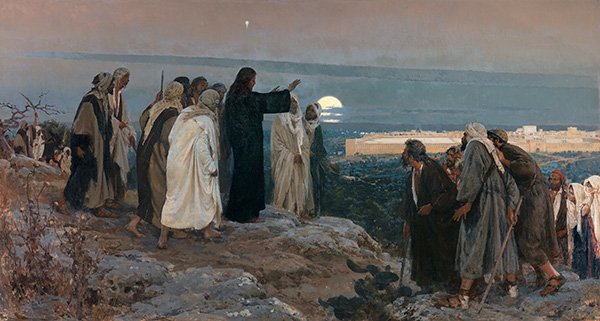
Enrique Simonet, He wept over it, 1882, oil on canvas. Wikimedia Commons (public domain).
Palm Sunday, I suggest, represents in the ministry of Christ the same temptations with which he was confronted by the power of death during his forty days in the wilderness. The time of Christ in the wilderness was not at all a time of spiritual exercise or contemplation. To be in the wilderness is to be alone with the reality of one’s own death, to be confronted with the reign of death in all the world. In the wilderness the power of death tempts Christ with the offer of worldly dominion, but Christ is victorious over all the claims and temptations of death. And death departs from him, as the account puts it, until an opportune time.
Palm Sunday is that opportune time for death to again tempt Christ with the offer of worldly power, though now death uses those who are Christ’s own disciples to press the temptations upon him. After all their sacrifice and service to him, now the day was at hand when his kingdom would be established. Had he not said so himself? The expectation of the disciples was that Christ would now become the king of an earthly realm; so they gather on that day to celebrate their new king.
But Christ is again victorious over the temptations of death. And so the gospel story does not end in the Palm Sunday parade. In the events which followed, the multitude of the disciples quickly forsook Christ. For those who remained with him a few days longer, there must have been great bewilderment as they continued to protest and oppose his vocation. But before the week had passed Judas betrayed him, Peter denied him, and all the rest fled and hid.
The rulers of Israel and Rome also saw Christ on Palm Sunday as what the disciples wanted and expected and besought him to be – a political leader. They were startled and apprehensive; therefore, they tried to stop the celebration lest Christ threaten or undermine their own power.
His family and friends and followers, on the one hand, and his enemies, on the other, failed on Palm Sunday to comprehend who Christ really is. All of them were captivated in the temptation with which the power of death confronts Christ. Palm Sunday is no day of triumph; for Christians it is a day of profound humiliation.
The counsel of Palm Sunday is that Christians are free to enter into the depths of the world’s existence with nothing to offer the world but their own lives. And this is to be taken literally. What the Christians have to give to the world is their very lives. The daily witness of the Christians in the world is essentially sacramental, rather than moralistic. The public witness of the Christians is a symbol and communication of their death in Christ every day in each situation in which they find themselves. They thereby demonstrate their faith in God’s triumph over death in Christ.
William Stringfellow, “The Temptation of Palm Sunday,” in Free in Obedience (Wipf & Stock Publishers, 2006). Used by permission of Wipf and Stock Publishers,

You have ${x} free ${w} remaining.
This is your last free article this month.
We hope you've enjoyed your free articles.
This article is reserved for subscribers.
Already a subscriber? Sign in
Try 3 months of unlimited access. Start your FREE TRIAL today. Cancel anytime.
Elizabeth Ball
I have not heard this perspective before, but it makes sense. It might also explain (at least somewhat) why this is for me the least relatable event of holy week, and possibly the entire gospel. It does however demonstrate the hope of the people, even if they received something other than what they expected.
Michael Nacrelli
What has always moved me about the Palm Sunday gospel accounts is that Jesus finally gets the acclaim he's due, even if it's very short-lived. It's a foretaste of every knee bowing to him at his return.
John Hull
Loved this essay, and want to share a thought. In the last paragraph it states we have nothing to offer but our lives. I believe this to be true. Later it states, "The daily witness of the Christians in the world is essentially sacramental, rather than moralistic." What I saw at first read was, "sacrificial", rather than, "sacremental". I am no theologian, and perhaps am not fully understanding what it means to be sacramental, but given the precept that we offer the only gift we have to give, our very lives, "sacrificial" seems to fit. "Sacifice" comes from the Latin, "sacer" (sacred) + "facere" (to make). Perhaps we are the sacrament. How better to be sacramental than to be selfless?