A Light to Lighten the Gentiles
Candlemas is a Christian festival rich in history and lore.
February 2, 2026
Try 3 months of unlimited access. Start your FREE TRIAL today. Cancel anytime.
START FREE TRIAL NOW
Lord, now lettest thou thy servant depart in peace according to thy word.
For mine eyes have seen thy salvation,
Which thou hast prepared before the face of all people;
A light to lighten the Gentiles and to be the glory of thy people Israel.
—The Prophecy of Simeon
(Luke 2:29–32)
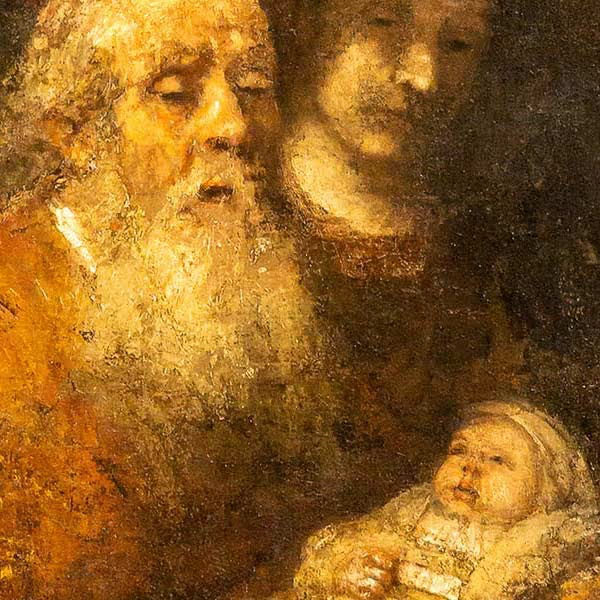
It’s one of the most affecting moments in the Nativity narrative. Mary and Joseph have taken the infant Jesus, at forty days old, to the temple in Jerusalem for the ritual of maternal purification commanded in the Law of Moses. There they meet an elderly man named Simeon, who has been told by God that before his death he will see the Messiah, the hope of Israel.
One can imagine the surprise that the young parents felt as this man, a stranger, took the babe in his arms. “Behold, this child is set for the fall and rising again of many in Israel” is not a statement one typically makes of a newborn. (“Congratulations on the baby” normally suffices.) Nor is it likely that Mary was entirely reassured to hear the man add, “Yea, a sword shall pierce through thy own soul also.”
Even more enigmatic and disquieting, however, might have been Simeon’s words preceded that prophecy: “a light to lighten the Gentiles.” Twenty centuries on, it’s easy to overlook the significance of this statement; we’re so accustomed to the notion that all the nations of the earth – not only the Jewish people, not only the believers – have received divine favor. We live today in a world wholly shaped by the example and ethics of Jesus and the God he proclaimed. But when Simeon encountered him in the temple, it was not so.
And this idea – that we, the Gentiles, now walk in God’s light – is at the root of the celebration of these events on Candlemas.
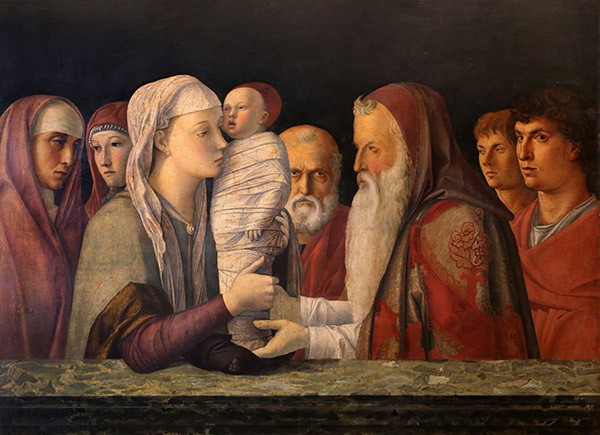
Giovanni Bellini, Presentation at the Temple , tempera on panel, c. 1469.
Like many church customs, the Feast of the Presentation of Jesus (to give it its formal name) has roots in the pagan world. According to historian Ronald Hutton, the month of February had been a time of purification in pre-Christian Roman festival traditions ( Februa is Latin for “cleansing”), but it was Christianity, drawing on the words of Simeon recorded in Luke’s Gospel, that made it the season for a festival of light. In England the festival came to be known as Candlemas by the early eleventh century, but already in the time of Bede (d. 735) the day was observed with candlelit processions. In his homily “On the Purification of Saint Mary,” Ælfric of Eynsham, the tenth-century writer and abbot, provides the clearest look at how the festival was understood in England before the Norman Conquest:
Be it known also to everyone that it is appointed in the ecclesiastical observances, that we on this day bear our lights to church, and let them there be blessed: and that we should go afterward with the light among God’s houses, and sing the hymn that is thereto appointed. Though some men cannot sing, they can, nevertheless, bear the light in their hands; for on this day was Christ, the true Light, borne to the temple, who redeemed us from darkness and bringeth us to the Eternal Light, who liveth and ruleth ever without end. Amen.
Christ, “the true light, which lighteth everyone that cometh into the world” (John 1:9), had come to the temple on this date, as the prophet Malachi had foretold (Mal. 3:1). From the perspective of Ælfric and Bede, England had dwelt in darkness, idolatry, and barbarism until the arrival of Christian missionaries preaching the gospel. The message of Jesus had rescued these isles from the superstitions in which they had been shrouded for countless ages.
There are echoes of this notion in the story of the nativity of Saint Dunstan, printed in the Legenda Aurea , a medieval anthology of saints’ lives, which relates how shortly before his birth, Dunstan’s parents attended a Candlemas service, during which all the tapers in the church were suddenly extinguished, save for the one in his mother’s hands: “Howbeit her taper was out, but by the power of our Lord it lighted again by itself, and burned full bright so that all the others came and lighted their tapers at the taper of Saint Dunstan’s mother.” The story concludes with the words of a holy man who happened to be present at the miracle, who said, “The child that she bare should give light to all England by his holy living.” Saint Dunstan, the legend suggests, brought the light of God to England. In the words of an Anglo-Saxon translation of the Gospel of Matthew, “…and sittendum on earde deaþes scade, ys leoht up-asprungen.” And to those who sat in the shadow of death is light sprung up .
Ælfric’s homily emphasizes that at the core of the day’s observances are the priestly blessing of candles – a custom that over the centuries acquired its own pageantry and superstitions. According to medieval tradition, on this day the English monarch processed into the royal chapel flanked by a candle-bearing lord chamberlain. For those who could afford it, this was an occasion for buying expensive candles in rare colors: in December 1289, Eleanor of Castile ordered ten pounds of verdigris for the making of green candles. Historian Ian Mortimer notes that during the 1415 Candlemas celebrations at the Council of Constance in Germany, the antipope John XXIII, in a gesture of remarkable generosity, handed out “huge candles, each weighing sixty pounds.… Then his chaplains threw down smaller candles, and ‘among the people there was a great scramble, one falling over another, and loud laughter.’” It was an occasion for general merriment, as the record of elaborate feasts and street music in Coventry, Cambridge, and other towns across Europe attests.
In the country, meanwhile, the day took on a range of different associations. As Eleanor Parker writes in her radiant book Winters in the World: A Journey through the Anglo-Saxon Year , Candlemas occupied a transitional place in the medieval calendar, “the last feast of Christmas and the first feast of spring ... a festival which has at its heart a meeting between childhood and old age, birth and death, and winter and spring.” For rural folk, this was the moment when winter reached its midpoint; when snowdrops would appear, presaging spring; when newborn lambs began to emerge; when geese would begin to lay. (“The spring is near, when green geese are a-breeding,” says Berowne in Love’s Labour’s Lost ; an old farmer’s rhyme echoes, “Candlemas Day / Every good goose should lay.”)
The weather on Candlemas presaged conditions for the rest of winter: storms on the day promised mild weather to follow, while fair skies warned of more storms to come, hence the Scottish rhyme, “If Candlemas is fair and clear / There’ll be two winters in the year.” (In parts of Germany a hibernating badger emerging from its den was said to predict the weather for the next several weeks, which has led some folklorists to insist that America’s Groundhog Day is a secular variation on Candlemas.) Because the festival landed midway through winter, several English counties adopted versions of the saying common in Rutland, “Candlemas Day / You should have half your hay,” meaning that on this date there should be at least half the winter’s stock of hay left to feed one’s livestock through the rest of the season. In the west of England, Ralph Whitlock tells us, Candlemas was deemed the best day in the year for planting peas and beans. A contributor to Notes & Queries , writing in 1855, claimed to have met “an old shepherd named Balderstone” on a “foggy Candlemas” who told him, “On Candlemas Day, if the thorns hang a-drop / Then you are sure of a good pea crop”—“and certainly,” adds the writer, “the pea crop that year was remarkably good.”
Over time, a certain tension developed between the day’s liturgical observances and folk customs. A prayer from the Roman Missal asks that the candles blessed on this date cause the devil to flee “in fear and trembling with all his ministers,” a petition that may have encouraged the widely held belief that candles possessed a mystical power to banish evil spirits and thunderstorms.
There were other superstitions. With the Christmas season formally ending, neglecting to remove decorations by Candlemas risked inviting family misfortune or even the devil, who would obligingly take down any greenery that had been left up. In “Ceremony upon Candlemas Eve,” the seventeenth-century English poet Robert Herrick urged:
Down with the rosemary, and so
Down with the bays and mistletoe;
Down with the holly, ivy, all,
Wherein ye dressed the Christmas hall—
The poem ends with a warning: maids who are slothful in their cleaning duties will be troubled by goblins, proportionate to their neglect.
With the Reformation in England, Candlemas folk traditions drew increasing scrutiny. In a proclamation “Prescribing Rites and Ceremonies, Pardoning Anabaptists” penned in 1539, King Henry VIII took pains to stress the symbolic (non-efficacious) nature of the ceremony: “The bearing of candles is done in the memory of Christ, the spiritual light, of whom Simeon did prophecy, as it is read in the church that day.” The blessing of candles, like the bestowal of ashes on Ash Wednesday and the receiving of the “Sacrament of the Altar,” was now a purely spiritual act, with no powers that could be misconstrued as magical.
Given the nature of certain regional customs, it’s no surprise that the Crown, now vigilant against any perceived papist or pagan tendencies, was becoming wary. Folklorist Marie Trevelyan writes of an old tradition known in Wales in which two candles would be placed on the table or bench in a home; each member of the family would sit between the candles and drink from a drinking horn, which would then be thrown backward: “If it fell in an upright position, the person who threw it would live to reach a very old age; if it fell bottom upward, the person would die early in life.” Perhaps more alarming to the civic and religious authorities were attempts to conflate Candlemas with St. Brigid’s Day (February 1), a festival in honor of the fifth- and sixth-century Irish saint Brigid, whose esteem in Ireland was rivaled only by St. Patrick’s. St. Brigid’s Day replaced an earlier, pre-Christian festival whose precise nature remains unknown, but which likely celebrated what Ronald Hutton has called “the most pleasant Irish female deity,” a goddess of poetry, prophecy, and battle. Traveling through the Western Isles of Scotland in the final decade of the seventeenth century, Scottish writer Martin Martin observed that on Candlemas Day, the inhabitants of Colonsay dressed a sheaf of oats “in women’s apparel” and lay it in a basket known as “Briid’s Bed.” Before retiring, each member of the family cried, “Briid is come, Briid is welcome!” in the hopes that St. Brigid would appear to them in the night.
Though Candlemas observances had been formally banned by the Duke of Somerset following Henry VIII’s death, as the above examples demonstrate, they persisted in the outer regions of the British Isles during the following centuries. According to folklore scholars Jacqueline Simpson and Steve Roud, “There are occasional nineteenth-century references to people lighting candles in their own homes on this day, or exchanging them as gifts,” though these have been steadily increasing during the last century. Thus, a once-public celebration had to become a private one, and only with the gradual waning of prohibitions has it begun to creep back into public life. The village of Blidworth in Nottinghamshire, for example, continues to observe a ceremony known as “the cradle rocking,” in which a baby boy is placed in a cradle and rocked by the vicar of the local parish on the morning of Candlemas.
Candlemas remains one of the lesser-known feast days, however, having never quite recovered the glory and pageantry with which it was celebrated from the Early Middle Ages to the Reformation. Perhaps the festival is due for a revival. In an age when we seem to spend much of our lives online, there’s a growing hunger for the material, the tangible, the sacramental, and people are beginning to take a greater interest in the reassuring rhythms of the ritual year. (I maintain that the Harry Potter books owe much of their success to the comforting repetition of the academic year at Hogwarts and the emphasis placed on festive days.) A friend recently posted on X that they had just finished reading Winters in the World , writing how transformative Parker’s book had been for their mindset on festivals and holidays, concluding, “There is so much darkness and our lives are so short, we should be celebrating.”
“And the light shineth in darkness; and the darkness comprehended it not” (John 1:5).