Raising Jewish Children in Northern England
An Orthodox rabbi sent his children to a Church of England school. Find out how it went.
February 13, 2026
Try 3 months of unlimited access. Start your FREE TRIAL today. Cancel anytime.
START FREE TRIAL NOW
[.article__paragraph--cap] [.small-caps] When my wife and I moved [.small-caps] from Jerusalem to Manchester with infants aged two years and six months, we lived in a hotel for two months, then rented an apartment on a thoroughfare in Prestwich. I took my daughter to a local kindergarten and tried to make conversation with the lady running it, telling her I used to buy my daughter a roll on the way to the kindergarten at the YMCA in Jerusalem. “Everything brought in here would have to be kosher,” she said, which I suppose is more of a concern in Manchester than in Jerusalem. I concluded that if the woman could not be kind to my daughter while I was present it seemed far-fetched to expect her to be so when I was not. My wife kept wanting to move out to Hebden Bridge, a small town halfway between Leeds and Manchester, and we went out there for the day. My daughter walked off the train and saw a large signboard taller than she was outside the train station. It had a picture of Pooh bear and was advertising a nursery. She walked in the door behind the signboard and up a flight of stairs and into a room full of soft toys. Thereafter that nursery was referred to as “Dollygarten” as far as she was concerned, and my wife turned to me and said, “We need this.” So we moved to Hebden Bridge.[.article__paragraph--cap]
Having led a fairly busy social life in Jerusalem, we had been shocked by the different social norms of ultra-Orthodox North Manchester. In the six months we lived in the middle of Prestwich the only home to which we were invited was that of the rabbi whose tiny synagogue I chose to go to. We told ourselves that if we had nobody whose house we could go to for lunch on Sabbath, we might as well be somewhere where we couldn’t go to anybody’s house.
The question arises of how you raise Jewish children in Hebden Bridge, having moved them from the Jewish capital Jerusalem to the biggest ultra-Orthodox enclave in Europe in Manchester and then just another hop, skip, and jump to a town that has no visible Jews at all. It turns out there are Jews, a lot of Jews, all over Yorkshire, but they were not readily visible, you had to find them, and they had not moved to the middle of Yorkshire in order to attend synagogue daily. We were in many ways on our own as far as education went, and this essay is about three pivotal educators to whom I credit our success in raising religious children in the Calder Valley, a place once known for religious nonconformity but now more known for militant atheism.
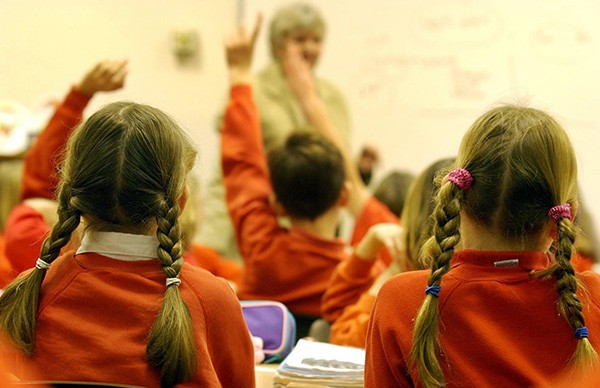
Aside from Anne, who ran “Dollygarten” and cared for both my daughters until they reached school age, the first major educator outside the house that we encountered was Gretl Young, headmistress of the small Church of England school on the edge of town. You might think we would have avoided a church school, but we did visit the larger primary school in the center of town, which seemed to believe largely in offering a vegetarian option at lunch, and another school halfway down the hill from our house, which seemed to require you to shout to be heard anywhere on the premises, and finally found our way to Hebden Royd school, where the preschool class was run by a lady who spoke very softly to every child and our daughter could hear herself think. Gretl Young was significant not only for being quite jolly and knowing every child by name, but also because she was a theology graduate. She took her Christianity seriously. So much so that when I said I did not want my children to attend assemblies and be inculcated with Christianity she said, “Fair enough, they can sit in the library.” They were not excluded from communal assemblies, which focused on popular songs by people like David Bowie and uplifting stories about inspirational figures from history, but anything that included a hymn, a passage from the Gospels, or any other religious content saw them quietly reading novels in the library.
[.imgcaption] [.smalltext] Photo: Barry Batchelor/Alamy Stock. [.smalltext] [.imgcaption]
I only came to appreciate Young fully when there was no room for two of my older children (we eventually had four) in two of the higher classes and we had to look for places for them elsewhere. My wife went to speak with the head teacher of another local school, not a theology graduate. He objected to the children being excluded from assemblies. He said the vicar usually made his way to the assemblies and sometimes used Gospel verses his lesson, but on the whole, it was more important the children should feel part of the community than what they should hear in assembly. This man did not take his own religion seriously, let alone mine. I went back to Gretl Young and she said, “Leave it with me.” In the course of an afternoon she had spoken with the various form tutors and squeezed my children into nominally full classes. At Hebdon Royd, my children were the only Jews, and they were respected as such. One teacher once turned to my eldest on the day she was meant to teach the Holocaust and said, “Louisa, I can’t possibly teach this with you here. What do you have to say about it?”
I appreciated Gretl Young again when my youngest, a second son, went into preschool with the very talented teacher who would come to replace Young as head teacher. He asked me about my son needing to wear a yarmulke at all time, “Is it not his decision?”
I replied, “No. It’ll be his decision when he’s eighteen. Right now he has to wear it.” That teacher also was not a theology graduate, nor anything but a nominal Christian, and I dare say the school’s ethos changed when Young retired, after all my children had moved on. I will remain grateful to Gretl Young and her consideration until my dying day.
The second educator I credit was a teacher at Hebdon Royd, Mrs. Spooner, who was an amateur actress in the nearby local theater. In her drama class, she allowed my daughter and two of her friends to rehearse their own staging of the opening scene of Macbeth , in which my daughter had the three witches crawling around on the floor like demented snakes as they spoke their lines. It remains one of the creepiest interpretations I’ve ever seen, and Mrs. Spooner not only did not feel any need to stamp her own interpretation on this, she arranged for their staging to be given a public presentation at an assembly where parents were invited. My daughter went on to explore acting as a possible career, and while attributing this to Mrs. Spooner is far-fetched, saying Mrs. Spooner treated acting as a serious activity is not.
A couple of years later, Mrs. Spooner directed a play that combined dramatized local stories with songs from the First World War. The stories were affecting, but I no longer remember them. The songs stayed with me, though. Not a week went by after that production when I did not hum to myself the following verses:
[.blockquote] And when they ask us
And they’re certainly going to ask us
The reason why we never won the Croix de Guerre
And we’ll never tell them
No we’ll never tell them
There was a front but damned if we knew where. [.blockquote]
The English poet Ted Hughes came from Mytholmroyd, the next town over from Hebden Bridge, and his work is haunted by the violence his father and uncles witnessed – but did not talk about – in the First World War. The valley as a whole is shadowed by a stark monument called Stoodley Pike, a black steel obelisk not unlike a huge black pawn that stands on a cliffside and overlooks the valley. Through those songs in Mrs. Spooner’s production, more perhaps than through the acting, my children and I came to understand the deep melancholy and loss that underlay the valley’s culture.
A few years later, Mrs. Spooner played the leading role in a production of a play called The Kitchen Sink , which ran at the nearby Hippodrome in Todmorden. The play is a comedy about a woman trying to hold her family together as her husband loses his business, her daughter fails to recover from being sexually assaulted, her daughter’s boyfriend loses his own parents, and her son struggles with going to London to become a painter. Sometime late in the second act, Mrs. Spooner delivered a speech which was considered so central to the play, a line from it appeared in advertisements for the play: “Rochdale is a great place to come from. It’s just not such a great place to end up.”
The original town name was Withernsea, a faded resort in Yorkshire, but every town that staged the play changed the location to another nearby Northern town. The play is a melancholy comedy, of the sort most prolifically practiced in the twentieth century by Alan Ayckbourn. I once watched a lecture where he described a certain speech in a play coming across the audience “like a cold breeze” in the middle of their previous blithe enjoyment. That’s exactly how this speech landed in Mrs. Spooner’s rendition on the night we all watched it in Todmorden, about three months before lockdown put an end to any illusion that the way of life in the North of England was anything like that in the South. Even then you could feel every soul in the theater realize the speech’s deep and painful truth. It landed not like a cold breeze but like lead in the pit of your stomach.
I credit Mrs. Spooner with having taught my children an awful lot about life and English culture, much more than any English teacher they subsequently encountered. The fact that she delivered that speech in an amateur production, not the professional theater, adds rather than detracts from the lesson. She was personifying the message of the play, which is that the North will kill you if you stay. It is more genuine, and it should stay with you, but you have to leave if you want to have a chance. My eldest daughter left the North at sixteen, after lockdown, and though she keeps coming back to visit, she has never again lived in the North.
The third educator we encountered outside the house was Mrs. Refson, nominally the wife of the head teacher of a tiny Jewish school in Leeds but actually its moving force. Her husband was the Jewish judge of Leeds and we went to meet him when my first son was born to arrange a circumcision for him. Mrs. Refson was present when my wife and I and our two daughters came to see her husband. She took in my daughters and how they were dressed, how they spoke, and how they behaved. Her husband was very cordial and a learned man but I have no illusions. It was Mrs. Refson who decided to call us up and invite us to stay with them for Rosh Hashannah, and go to his synagogue on the Jewish new year.
She subsequently invited us again to stay with them, eat with them before the fast of Yom Kippur, and spend that day at his synagogue. She invited us again to other festivals. This resulted in our sending our children to her school, one by one, as the need arose. My younger daughter started at Hebden Royd nursery but withdrew on the grounds, as she put it, that “they don’t respeck me.” She went to Mrs. Refson’s school and liked it better. When she got a little older, she went back to Hebden Royd for primary school, but her point of reference for Jewish identity, dress code, and the role of a woman in the Jewish community remained Mrs. Refson.
When my older son won a scholarship to go to the local grammar school we considered if we wanted him to go to that school and executed a volte-face, sending him instead to Mrs. Refson’s school. This created a tiny upper year of boys, three boys strong, where he was introduced to Talmud by her husband. My son, now eighteen, says that he remembers every word he was taught in the section of Talmud taught by Dayan Refson. When he was taught it again in Jewish high school a couple of years later, they asked him where he had learned it before.
There are many decisions in my life I would take differently, but sending my children to Mrs. Refson’s school is not one of them. My daughters are now grown and making their way in the world, but I would say the decisions they make are an attempt to balance the demands of those two role models – Mrs. Spooner as the voice of art and culture, and Mrs. Refson as the voice of the Jewish community and how a woman dresses and carries herself within it. I remain grateful to Gretl Young for having allowed all my children the space to bounce between those two very different cultures as their individual needs and educational stages required.
A teacher at Mrs. Refson’s school remarked to me that the school was different when my children were in it, that they brought “something different” to the school. Most of the students at that school are the children of Lubavitch Hassidic emissaries, a very insular and particular culture that is not by any means uniform in how it is lived in different places, but nevertheless quite particular about what it excludes. When that teacher remarked to me that my children brought something special to the school, I would say what he spotted was the Calder Valley and an older English culture they had connected with and brought with them without relinquishing their Jewishness. In that way, they expanded what was acceptable in the school. Because they were confident about their Judaism, they could not be dismissed as not knowing what they were talking about, and because they brought in something different they changed what was there before. They brought a trace of Mrs. Spooner to Mrs. Refson and it was Gretl Young who allowed them to go back and forth until they had mixed the two enough to make their own way in the world.