Forerunner
A Gadfly of God
Justin Martyr, like Socrates before him, was convicted of being an atheist under the emperor Marcus Aurelius.
April 10, 2026
Try 3 months of unlimited access. Start your FREE TRIAL today. Cancel anytime.
START FREE TRIAL NOW
[.article__paragraph--cap][.small-caps]Justin himself tells the story [.small-caps]this way. It was the thirteenth year of the reign of Emperor Hadrian, 883 ab urbe condita. We would call it AD 130. Justin was in his early twenties, going for a walk near the sea – the Aegean, as he was in Ephesus, in Asia Minor. This was not just a saunter: he was a serious young man doing what serious young men love to do, which is to have a Big Philosophical Think.[.article__paragraph--cap]
Justin had a lot of material to work with. He’d been born in Flavia Neapolis, in Palestinian Syria, a pagan citizen of the Roman Empire. Beginning in his teens, he had felt himself to be on a philosophical quest: What is the nature of reality, of justice? What leads to happiness? And what about God? Or is it “the gods”?
He’d burned through quite a few teachers in the time he’d been on this project. He’d started with a Stoic, who was no help: “He did not himself know anything about God, and said such instruction was unnecessary.” Then he went to a Peripatetic, who entertained him for a couple of days but then tried to charge him a fee, which Justin felt to be a red flag. After that, he’d tried a Pythagorean, but the Pythagorean said he couldn’t possibly begin teaching Justin philosophy until he had learned music, astronomy, and geometry, and kicked him out when he admitted that he didn’t want to wait to start studying philosophy until he’d gotten through math.
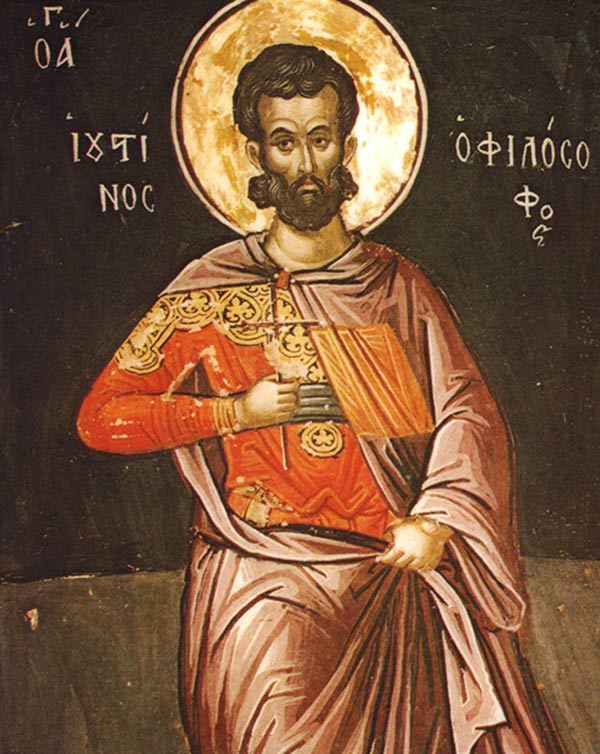
[.imgcaption]Theophanes the Cretan, Saint Justin Martyr, ca. 1545. [.smalltext]Artwork from The Picture Art Collection/Alamy. Used by permission.[.smalltext][.imgcaption]
Justin seemed to fare better with the Platonists. “The perception of immaterial things quite overpowered me, and the contemplation of ideas furnished my mind with wings, so that in a little while I supposed that I had become wise, and such was my stupidity, I expected immediately to look upon God, for this is the end of Plato’s philosophy.” It was in this state that he came to the seaside.
And as he walked, he realized he was being watched; his watcher was an old man, with the air of one who also is seeking. The dialogue that follows indeed betrays a writer who had been reading a lot of Plato.
[.blockquote]Old Man: Do you know me?[.blockquote]
[.blockquote]Justin: No.[.blockquote]
[.blockquote]Old Man: Why, then, do you so look at me?[.blockquote]
[.blockquote]Justin: I am astonished, because you have chanced to be in my company in the same place; for I had not expected to see any man here.[.blockquote]
[.blockquote]Old Man: I am concerned about some of my household. These have gone away from me; and therefore I have come to make personal search for them, if, perhaps, they shall make their appearance somewhere. But why are you here?[.blockquote]
Justin explains that he is a philosopher:
[.blockquote]Justin: What greater work could one accomplish than this, to show the reason which governs all, and having laid hold of it, and being mounted upon it, to look down on the errors of others, and their pursuits? But without philosophy and right reason, prudence would not be present to any man. Wherefore it is necessary for every man to philosophize, and to esteem this the greatest and most honorable work …[.blockquote]
[.blockquote]Old Man (interrupting): Does philosophy, then, make happiness?[.blockquote]
[.blockquote]Justin: Assuredly, and it alone.[.blockquote]
[.blockquote]Old Man: What, then, is philosophy? And what is happiness? Pray tell me, unless something hinders you from saying.[.blockquote]
[.blockquote]Justin: Philosophy, then, is the knowledge of that which really exists, and a clear perception of the truth; and happiness is the reward of such knowledge and wisdom.[.blockquote]
[.blockquote]Old Man: But what do you call God?[.blockquote]
[.blockquote]Justin: That which always maintains the same nature, and in the same manner, and is the cause of all other things – that, indeed, is God.[.blockquote]
The old man, he tells us, listened to him “with pleasure,” though even now we get the sense that this young man is perhaps a bit full of himself. But this is how Socrates worked: to draw these confident young men into making statements, and then to examine these statements from every side, to pass from apparent knowledge into ignorance and then, perhaps, gradually, to something else that is more solid.
Indeed, after this initial exchange, Justin naturally falls into the role of one of Socrates’ interlocutors, giving himself all the “It is as you say” lines. The Old Man prods at Justin’s certainties, without entirely disagreeing with the natural theology he has come to espouse, and winds up thus:
[.blockquote]There existed, long before this time, certain men more ancient than all those who are esteemed philosophers, both righteous and beloved by God, who spoke by the Divine Spirit.… They are called prophets. These alone both saw and announced the truth to men … speaking those things alone which they saw and which they heard.… Their writings are still extant, and he who has read them is very much helped in his knowledge of … those matters which the philosopher ought to know.…[.blockquote]
[.blockquote]They were witnesses to the truth above all demonstration, and worthy of belief; and those events which have happened … compel you to assent to the utterances made by them, although, indeed, they were entitled to credit on account of the miracles which they performed, since they both glorified the Creator, the God and Father of all things, and proclaimed his Son, the Christ [sent] by him.… But pray that, above all things, the gates of light may be opened to you; for these things cannot be perceived or understood by all, but only by the one to whom God and his Christ have imparted wisdom.[.blockquote]
They talk on and on through the day, and then the old man goes away, leaving Justin to reflect on the encounter: “I have not seen him since. But straightway a flame was kindled in my soul; and a love of the prophets, and of those men who are friends of Christ, possessed me; and while revolving his words in my mind, I found this philosophy alone to be safe and profitable. Thus, and for this reason, I am a philosopher.”
He is telling this story many years later, at his first meeting with a man who would become a friend. He is still in Ephesus: they meet under the shaded promenade around the city’s gymnasium. Trypho, a Hellenized Jew, also a Roman citizen, had started out the conversation by calling out to him, “Hail, O philosopher!” – as Justin was dressed in the pallium, the cloak sported by philosophers.
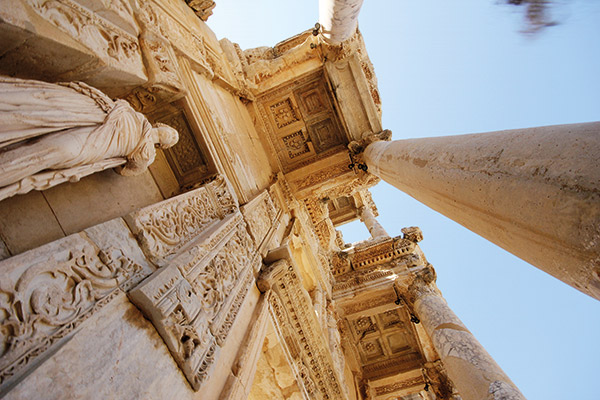
[.imgcaption]Ruins at the ancient city of Ephesus. [.smalltext]Photograph by Kybele via AdobeStock. Used by permission.[.smalltext][.imgcaption]
Throughout their dialogue, Justin speaks as a philosopher to another lover of wisdom. He speaks as a Gentile follower of the God of Israel. And he speaks as a Christian. Elsewhere (in the two Apologies, which, along with the Dialogue with Trypho, are the only works of his that remain to us) he speaks as a former pagan, to others who were raised as he was on the stories of Perseus and Aesclepius, Zeus and Hera – or Jupiter and Juno – and all their crowd. He is all things to all people. His approach is profoundly helpful in our own age, full of contradictory takes on the apprehension of reality, the conduct of one’s life, the pursuit of happiness, and the knowledge of God.
Justin is bold in what he claims, bolder than most Christians today would be:
[.blockquote]We have been taught that Christ is the first-born of God, and we have declared above that he is the Word of whom every race of men were partakers; and those who lived reasonably are Christians, even though they have been thought atheists; as, among the Greeks, Socrates and Heraclitus, and men like them.…[.blockquote]
[.blockquote]When Socrates endeavored, by true reason and examination, to bring these things to light, and deliver men from the demons, then the demons themselves, by means of men who rejoiced in iniquity, compassed his death, as an atheist and a profane person, on the charge that he was introducing new divinities; and in our case they display a similar activity.[.blockquote]
[.blockquote]For not only among the Greeks did reason [Logos] prevail to condemn these things through Socrates, but also among the Barbarians were they condemned by Reason Himself, who took shape, and became man, and was called Jesus Christ; and in obedience to him, we not only deny that they who did such things as these are gods, but assert that they are wicked and impious demons.…[.blockquote]
[.blockquote]Hence are we called atheists. And we confess that we are atheists, so far as gods of this sort are concerned, but not with respect to the most true God, the Father of righteousness and temperance and the other virtues, who is free from all impurity. Him, and the Son … and the prophetic Spirit, we worship and adore, knowing them in reason and truth, and declaring without grudging to everyone who wishes to learn, as we have been taught.[.blockquote]
He was killed. It’s there in the name: Justin Martyr. He was martyred in Rome under the emperor Marcus Aurelius, philosopher-king if ever there was one, author of elegant books of Stoic epigrams. His judge was the prefect Quintus Junius Rusticus, himself a philosopher and Marcus Aurelius’s teacher.
These men did not themselves believe in the gods. But it was for refusing to worship those gods that Justin was tried and convicted. He was accused of being an atheist, impious, not paying respect to the gods whom the state respects, of being an introducer of new and strange gods. We have a reliable eyewitness account of the trial:
[.blockquote]The saints were seized and brought before the prefect of Rome, whose name was Rusticus. As they stood before the judgement seat, Rusticus said to Justin: “Above all, have faith in the gods and obey the emperors.”[.blockquote]
[.blockquote]Justin: We cannot be accused or condemned for obeying the commands of our Savior, Jesus Christ.[.blockquote]
[.blockquote]Rusticus: What system of teaching do you profess?[.blockquote]
[.blockquote]Justin: I have tried to learn about every system, but I have accepted the true doctrines of the Christians.[.blockquote]
[.blockquote]Rusticus: What sort of teaching is that?[.blockquote]
[.blockquote]Justin: Worship the God of the Christians. We hold him to be from the beginning the one creator and maker of the whole creation, of things seen and things unseen. We worship also the Lord Jesus Christ, the Son of God. He was foretold by the prophets as the future herald of salvation for the human race and the teacher of distinguished disciples. For myself, since I am a human being, I consider that what I say is insignificant in comparison with his infinite godhead. I acknowledge the existence of a prophetic power, for the one I have just spoken of as the Son of God was the subject of prophecy. I know that the prophets were inspired from above when they spoke of his coming among men.[.blockquote]
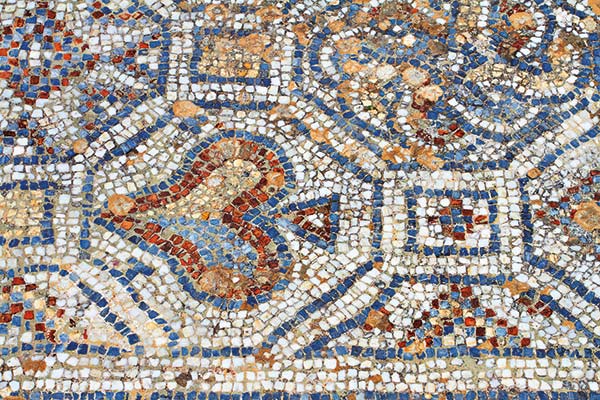
[.imgcaption]Mosaic floor in the ancient city of Ephesus. [.smalltext]Photograph by Lynel via AdobeStock. Used by permission.[.smalltext][.imgcaption]
Rusticus would not have imagined himself to be Pilate here. Nor would he have seen himself as Antiochus IV Epiphanes, demanding that the seven Maccabean sons break the Torah. But he certainly could have recalled Meletus throwing the accusation of atheism and impiety at Socrates. One can imagine Socrates’ own words at the back of Rusticus’s mind:
[.blockquote]If now when the god orders me to fulfill the philosopher’s mission … I were to desert my post … I might justly be arraigned in court for denying the existence of the gods, if I disobeyed the oracle because I was afraid of death: then I should be fancying that I was wise when I was not wise.…[.blockquote]
[.blockquote]If you kill such a one as I am, you will injure yourselves more than you will injure me.… And now, Athenians, I am not going to argue for my own sake, as you may think, but for yours, that you may not sin against the god, or lightly reject his boon by condemning me.…[.blockquote]
[.blockquote]So, now, we all go our ways – I to die, and you to live. And the question is, which one of us on either side is going toward something that is better? It is not clear, except to the god.[.blockquote]
Socrates worshiped what he did not know. Justin lived in the world of the Proclamation, of what Saint Peter called “the things that have now been announced to you through those who preached the good news to you by the Holy Spirit sent from heaven.” These are things “into which angels long to look,” things, as Jesus said, quoting the psalmist, “hidden since the foundations of the world.”
[.blockquote]The prefect said to Justin: “You are called a learned man.… Listen: if you were scourged and beheaded … do you have an idea that you will go up to heaven to receive some suitable rewards?”[.blockquote]
[.blockquote]Justin: It is not an idea that I have; it is something I know well.…[.blockquote]
[.blockquote]Rusticus: Now let us come to the point at issue.… Gather round then and with one accord offer sacrifice to the gods.[.blockquote]
[.blockquote]Justin: No one who is right thinking stoops from true worship to false worship.[.blockquote]
[.blockquote]…Rusticus pronounced sentence, saying: “Let those who have refused to sacrifice to the gods and to obey the command of the emperor be scourged and led away to suffer capital punishment according to the ruling of the laws.” Glorifying God, the holy martyrs went out to the accustomed place. They were beheaded, and so fulfilled their witness of martyrdom in confessing their faith in their Savior.[.blockquote]
“I dare say,” said Socrates, “that you may feel irritated at being suddenly awakened when you are caught napping; and you may think that if you were to strike me dead … then you would sleep on for the remainder of your lives, unless the god in his care of you gives you another gadfly.”
Here, 563 years later, facing that philosophical jurist, the representative of that most philosophical emperor, was another gadfly.